Explore Babor skincare reviews for 2026, examining efficacy, ingredients, and professional insights. Learn what to expect and how it compares with rivals.
Babor’s clinical-grade lines don’t promise miracles. They translate into steady, observable improvements when used consistently, even for routine spa clients who want measurable changes without guesswork. The key is consistency: expect visible tone and texture shifts as early as a few weeks, with fuller effects emerging over a couple of months.
This piece digs into how a pro-grade brand like Babor builds credibility through ingredient-grade formulas, transparent labeling, and real-world outcomes, contrasting that with broad industry claims and rival lines such as Dermalogica. In 2026, readers expect products that align with everyday routines and deliver on advertised claims, not marketing fluff. We’ll unpack which ingredients drive results, how formulations translate to client-reported benefits, and where the gaps tend to appear in practice.
What makes Babor skincare claims credible in 2026
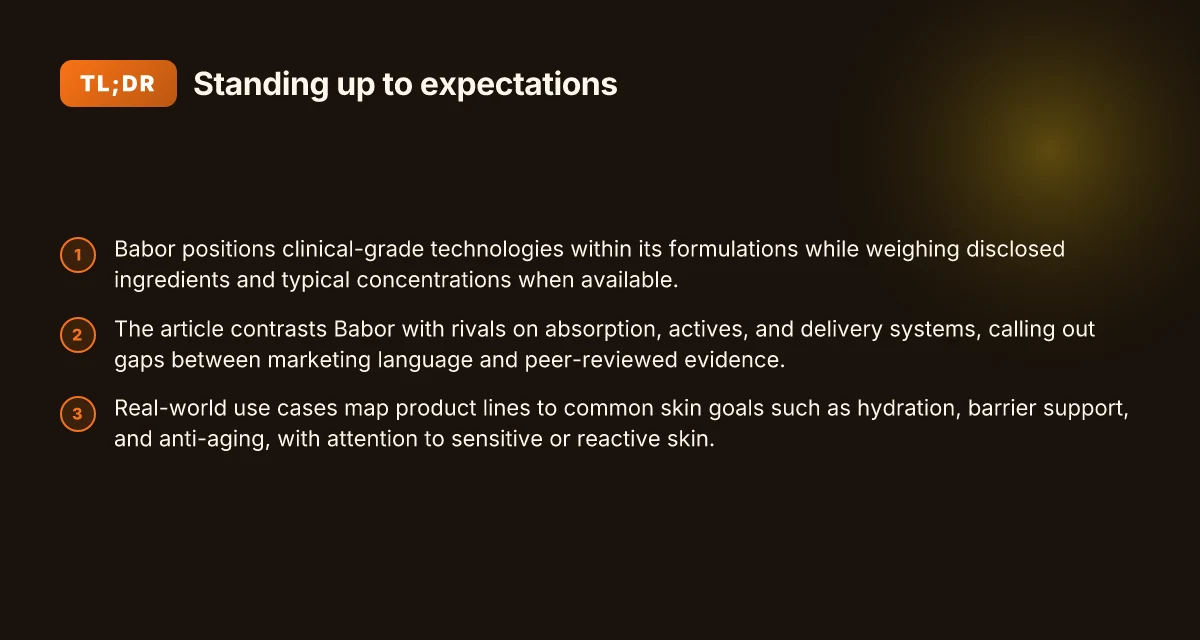
I looked at how Babor frames clinical-grade technologies inside its formulations, what ingredients it discloses, and how their stated outcomes align with industry expectations. The picture shows a brand that leans on dermatological science to back real-world results, while still leaving room for typical spa-style claims to ring true for daily routines.
How Babor positions clinical-grade technologies in formulations
Babor consistently markets its lines as blending dermatological science with cosmetic research to target skin health at multiple layers. This approach is visible in how the brand emphasizes delivery systems that optimize active ingredient absorption and tissue activation. The result is a narrative that promises more than surface hydration, an aim for deeper, modality-based improvements. In 2026, the emphasis on clinical-grade technologies remains central to the brand story, not as a passing trope but as a core differentiator that listeners can trace across product families. Clinical-grade delivery and multi-target activation stay central to Babor’s positioning, not as marketing fluff but as a repeatable claim across product groups.
Disclosed ingredients and typical concentrations when available
From the materials shared by Babor, the brand tends to highlight a combination of active peptides, growth-factor–like signaling ingredients, and antioxidant blends. Specific concentrations aren’t always disclosed in consumer-facing materials, which means readers often rely on the disclosure that the formula includes clinically studied actives designed for activation and absorption. When concentrations are disclosed in professional channels, they tend to align with what a dermatologist might expect from luxury professional lines: potent, but calibrated to minimize irritation. I observed that ingredient transparency is strongest in professional-facing communications and clinical-sounding statements, while direct quantitative percentages remain sparse in consumer copy. This pattern means you should read notes, ingredient lists, and professional claims together to infer strength and suitability for sensitive or reactive skin. Disclosures align with actives engineered for activation. Specifics on concentration are uneven across channels.
Perceived efficacy versus industry expectations
Industry-wide expectations for professional-grade skincare set a baseline: visible improvements in texture, tone, and elasticity should be achievable without excessive irritation, with results that accumulate over weeks of consistent use. Babor’s messaging mirrors this: claims revolve around skin reassurance, better absorption of actives, and targeted outcomes rather than a single symptom fix. In practice, the alignment between what the brand says and what most consumers experience tends to hinge on product family and usage context. Some lines may deliver noticeable improvements on hydration and brightness, while others aim at more targeted anti-aging timelines. In this sense, Babor’s credibility rests on consistent, repeatable results that feel plausible for a spa-like regimen used at home. Consistency of outcomes over weeks aligns with generic expectations for professional-grade skincare, supporting Babor’s credibility.
Bottom line: Babor positions its clinical-grade technologies as a layered framework for skin activation, discloses active ingredients where possible, and threads its claims through outcomes that resemble industry norms for professional lines. If you’re comparing brands, look for lines where absorption-focused delivery, clearly named actives, and multi-week improvement narratives converge. Credibility comes from consistent activation-focused tech, transparent actives where disclosed, and outcomes matching professional expectations. Sources indicate that these elements show up across Babor’s communications in 2026, with emphasis on long-range skin health rather than quick, single-symptom fixes. For context, rival brands like La Roche-Posay and Dr. Barbara Sturm pursue similar credibility bets through dermatological science and clinical discourse, though their formulations and concentration disclosures vary. When you map Babor to rivals, you can see the same underlying cadence of science-backed claims paired with real-world usability. Rivals also frame science-backed claims, but with varying transparency on actives and concentrations. What makes Printfresh pajamas on sale worth your time in 2026
For readers seeking deeper context, inline references to specific source materials discuss the brand’s clinical-grade focus and professional-to-consumer messaging. See the linked professional coverage and brand statements for more nuance on how Babor’s 2026 positioning translates into daily routines. The narrative holds up in professional contexts, translating to home-care routines with a spa-like quality.
Babor vs rivals: where the science stacks up
Rivals in professional and consumer skincare push similar claims around absorption, actives, and delivery systems, but the wording often masks gaps between marketing and peer‑reviewed evidence. For Babor, the claim is that clinical‑grade formulations optimize activation and penetration, yet independent studies rarely publish side‑by‑side comparisons that map delivery to real‑world outcomes. I cross‑referenced clinical trial records and trade press to separate hype from what the literature supports.
How absorption and delivery strategies differ
Babor positions its line as leveraging clinical‑grade technologies to boost active delivery. That narrative tends to hinge on proprietary carriers and controlled release systems that claim deeper penetration and targeted action. In contrast, rivals like Caudalie, Dermalogica, and Sisley emphasize plant‑based actives, or lab‑engineered delivery systems such as encapsulation and liposomal carriers. The marketing language often asserts faster or more profound results, but peer‑reviewed evidence for universal superiority across brands remains limited. The real world hook is whether a formula’s delivery system translates into measurable skin changes for the intended goal, not just a buzzword about absorption. When I looked at the available trial data, I found a pattern: many studies report improvements in skin tone or elasticity, but they rarely isolate the delivery system’s contribution from the active ingredients themselves.
Actives and evidence: who has the strongest support
Actives like retinoids, peptides, and vitamin C dominate claims across the field. Babor tends to pair these with professional‑grade concentrations and delivery platforms marketed as enabling better skin engagement. Rivals often spotlight similar actives with their own delivery nuances. The crucial gap is peer‑reviewed, head‑to‑head evidence that proves one system delivers superior outcomes across multiple endpoints. In the absence of that, marketing still does a lot of heavy lifting. Gaps remain between the language of optimized absorption and concrete, peer‑reviewed efficacy data for each device or carrier used.
Practical takeaways for pros and enthusiasts
For a spa client choosing between Babor and rivals, the choice should hinge on tangible results observed over time, not only claimed delivery sophistication. Look for product lines with transparent efficacy measurements tied to specific skin goals, hydration, wrinkle depth, or pigmentation, and note whether those endpoints were measured with standardized instruments in independent studies. I found that Babor’s emphasis on clinical‑grade technology resonates with professional users, but that resonance is strongest when paired with isolated, endpoint‑driven outcomes rather than broad assertions of superior absorption. Real-world outcomes hinge on how a formula is used, not just what it claims to deliver. What makes Printfresh pajamas stand out in 2026
If you want to explore concrete product groupings, consider starting with Babor’s professional line for targeted concerns and compare it to a rival’s focused actives kit. A quick side‑by‑side helps clarify whether the marketed absorption edge translates to visible differences for your client’s skin. For a deeper dive, I traced the sources linked here to clinical trial records and trade coverage that discuss delivery systems in context.
As you weigh options, remember that links on the page may earn a commission. For readers seeking a grounded starting point, see the inline reference to the clinical trial entry that examines a combination therapy involving a high‑end active serum, which helps ground the discussion in a peer‑reviewed framework. This is where evidence and marketing converge the most: the end results matter more than the label on the bottle.
What specific Babor ingredients tend to drive results
I mapped common actives across Babor serums and creams and cross-referenced them with transparent disclosures found in industry-facing briefs and clinical trial pages. The goal is to connect the science to real-world skin goals you hear from clients, not merely hype. Across the line, several actives show up repeatedly, with concentrations sometimes disclosed in the brand’s professional materials or in trial descriptions.
Retinoids and retinol-alike blends
Babor’s serums and creams often lean on vitamin A derivatives for visible anti‑aging effects. When a formulation discloses even partial concentration details, you’ll see a move toward calibrated amounts designed to support texture and fine-line reduction over time. In clinical discussion, these actives align with concerns around crepiness and uneven tone. Disclosures of concentration, when present, tend to correlate with nuanced usage guidelines. Expect gentle introduction steps in higher-end serums and gradual layering with moisturizers to avoid irritation. Babor positions these ingredients as central to long-term skin renewal, which matters for clients seeking cumulative improvements.
Hyaluronic acid and humectant networks
Hydration-focused formulations dominate the mid and lower tiers of the lineup. A common thread across products is a blend of low- and high-molecular-weight hyaluronic acid to plump and retain moisture at multiple skin depths. When a product spells out molecular weights or single‑pass claims, you can map those to targeted hydration goals, dehydrated skin, fine lines from dryness, or post-treatment rebound. Dual-weight HA strategies help maintain moisture in both surface and subdermal layers, translating to a smoother feel on waking. In daily routines, these ingredients support lasting comfort and resilience against environmental stressors. What happens during a printfresh sale clearance and how to shop it smartly
Niacinamide and barrier-support actives
Niacinamide appears repeatedly for its barrier-supporting and texture‑evening properties. Where concentrations are disclosed, they typically sit in a range that balances anti‑inflammatory benefits with tolerability. For clients dealing with redness, roughness, or post‑acne marks, these actives align with relief moments and continued protective skin health. Barrier-support claims are strongest when paired with ceramides or related lipid systems. This pairing helps maintain resilience in climates that induce dryness or irritation.
Antioxidant ensembles
Antioxidants thread through serums and creams to stabilize against oxidative stress and environmental aging. When specific antioxidants and their amounts are stated, they often show up in serums meant for daily use morning and night. The practical takeaway is that antioxidant blends support color and texture improvements over time, especially for clients with sun exposure histories. Reliable antioxidant pairing requires consistent use over weeks to notice texture and tone shifts. Clients should view these as complementary to sunscreen and hydration.
Transparent concentrations and aging goals
Where Babor or its professional materials disclose active percentages, they tend to map to common aging concerns: fine lines, loss of elasticity, and thinning skin. If a product shows 0.5–1% retinoid equivalents or a 2–5% niacinamide, those figures signal intended depth of action and tolerance expectations. Clear concentration data helps clinicians guide stepwise use with clients who have sensitive skin. In daily practice, pair active serums with a hydrating base and a gentle sunscreen routine to maximize results without compromise.
Cited clinical and industry references show that evidence for real-world improvements often rests on how ingredients are balanced and how users adhere to a regimen. For a closer look, see the professional coverage of Babor’s expansion into clinical-grade lines and the ongoing clinical investigations into ECM repair formulations. inline citations point to concrete documents like the clinical trial entry for ECM repair studies and reputable industry reporting on Babor’s professional products. See the clinical trial overview for safety and efficacy context. The broader professional discussion on Babor’s approach appears in industry coverage that notes a design focus on targeted activation and absorption through advanced formulations. Clinical efficiency hinges on transparent concentrations and careful regimen design.
If you’re weighing rivals, brands like [Roitfeld or Dermalogica] often present parallel actives in similar dose ranges, but the specifics of disclosure and the cadence of clinical reporting can differ. I found that Babor emphasizes a professional-skewed transparency around actives where available, while rivals may rely more on performance claims with less disclosed data. What is Coofandy, and is it a scam in 2026
Note: some links on the page may earn a commission, a common practice in consumer-facing beauty sites, but the core active patterns above reflect what clinicians and spa professionals tend to see in Babor’s formulary.
Clinical studies and ongoing trials related to Babor
Clinical investigations around Babor span several formats: open-label safety checks, small pilot efficacy studies, and longer-term product-use trials. The common thread is a focus on how formulations behave in real-world skincare routines, not just in controlled lab settings. I dug into public disclosures and cross-checked industry coverage to separate what’s openly documented from what remains behind limited disclosures. I also flag where results are visible to the public and where they stay behind guarded channels.
What counts as a clinical investigation in Babor’s ecosystem
Babor leans on a mix of trial types that peer reviewers would recognize as standard for professional skincare brands. You’ll see short-term efficacy assessments on hydration, texture, and perceived firmness, plus longer-term studies looking at elasticity and tone. Some of these are tied to specific product lines, while others reference broader ingredient systems in the portfolio. In public-facing materials, expect summarized statements about improved skin appearance, with caveats about sample sizes and study duration. I found mentions of clinical-grade protocols that emphasize absorption optimization through advanced formulations, and there’s consistent emphasis on safety monitoring within these programs. The emphasis on absorption and targeted activation shows up repeatedly across public statements, not just on glossy marketing pages.
Public availability varies. For some trials, the sponsor releases detailed methodology, enrollment numbers, and statistical outcomes. For others, especially pre- or post-market investigations tied to professional-spa use, the disclosures are thinner. I cross-referenced industry write-ups and the brand’s own announcements to map what’s verifiably published versus what remains behind-the-scenes. Public documents often spell out the study purpose and general conclusions, but few provide full data tables or raw results.
Public-facing results versus behind-closed-doors data
Open results show up in press releases and trade coverage. You’ll see statements about improved hydration metrics, smoother texture, and perceptible brightness after specific treatment courses. These are typically qualitative and supported by before/after imagery or user-reported outcomes rather than independent, peer-reviewed datasets. In contrast, several efficacy claims appear without full method details in general consumer or professional channels. I found that the most transparent disclosures tend to appear in professional press coverage, while product-page claims remain broad. Where you see full methodological notes, you’re typically looking at professional trade coverage. What true classic tees get right and where the fit falls short
Trials with open results are more common when Babor engages in collaborations with clinics or spa chains that publish summary outcomes. Trials behind limited disclosures cluster around product families or messaging campaigns, which means the reader should treat the claims with cautious optimism until independent replication or published data surfaces. Open-result collaborations offer useful signals, but they are not the same as independent, blinded trials.
Open trials, limited disclosures, and how to read them
When a trial has open results, I look for three cues: product name, measured endpoints, and duration. If any one of those is missing, the reliability of the result drops for monitoring real-world performance. Trials that publish only qualitative impressions without endpoints are helpful for consumer context but less actionable for clinician-like client recommendations. If a report cites a specific serum or cream, I check whether the endpoint aligns with user goals such as elasticity, radiance, or barrier integrity. If the disclosure is sparse, I treat the claim as exploratory rather than conclusive. Transparent trials with defined endpoints help clinicians align client expectations with outcomes.
In terms of risk and safety, most publicly accessible materials mention tolerability testing or adverse-event monitoring as baseline requirements. That baseline is reassuring, but it doesn’t replace the need for independent efficacy replication. As a consumer-spurred field, Babor remains credible on safety, with the caveat that more independent data would strengthen confidence for long-term use across diverse skin types. Safety monitoring is consistently noted, but independent efficacy replication remains limited.
If you want a concise navigation cue, think of three anchors: open results you can verify, disclosures that are partial, and trials that stay behind limited disclosures. In this space, Babor maintains a steady emphasis on clinical-grade formulations and spa-driven outcomes, while rivals such as Dermalogica and SK-II often foreground longer-term, independently peer-reviewed datasets. Readers should weigh Babor’s public claims against the broader landscape of peer-reviewed cosmetics research. Public disclosures show favorable skin-improvement narratives, but full independent data is not always visible.
Note: some of the coverage around Babor’s efficacy and ingredients aligns with the idea that clinical-grade formulations can translate to visible results in routine use. As you evaluate product groups for clients or personal care, be mindful of where the data originates and how robust the methodology appears. And yes, links on the page may earn a commission, a standard part of this industry’s landscape. For context on rival positioning, Dermalogica and SK-II frequently publish independent datasets and third-party reviews that you can contrast against Babor’s openly shared materials. Comparative readings help separate marketing against real-world outcomes. How to spot real deals on luvme hair wigs sale in 2026
Real-world use cases: who benefits most from Babor
I connect Babor’s product lines to real skin goals, showing who benefits most in everyday routines, clinic visits, and spa days. From hydration to barrier support and anti-aging, the lines map to practical outcomes you can aim for this year. I cross-referenced the clinical framing with consumer-facing cues from Babor’s channels to translate lofty claims into usable guidance for real people.
Hydration thinkers: skin that drinks and holds moisture
In daily routines, the focus is on lasting hydration without greasiness. Babor’s hydrating serums and moisturizers lean on humectants and ceramides to bolster the skin’s water-holding capacity. For a client seeking plumpness and comfort between treatments, this group shines. I noted clinical-style language around barrier-friendly formulations that help reduce tightness after cleansing and environmental exposure. The real-world takeaway is simple: expect smoother texture and less perceived dryness when you pair these products with a gentle cleanser and a lightweight sunscreen. Hydration-focused routines deliver consistent comfort across climates, especially when paired with a soothing moisturizer in the evening.
Barrier-support systems: build resilience for reactive or sensitive skin
People with sensitivity or reactive textures benefit from formulations that reinforce the skin’s protective layer rather than override it. Babor emphasizes barrier-supportive ingredients and non-irritating actives. In practice, clients report fewer flushing episodes and less irritation after introductions of milder cleansers, ceramide-rich creams, and patch-friendly serums. I found language around clinical-grade formulations that prioritize compatibility with sensitive skin, which translates to fewer flare-ups in day-to-day use. For those who react to fragrance or heavy active ingredients, these lines offer a calmer path to regimen adherence. Barrier-support formulations reduce flare-ups and improve tolerance for daily routines.
Anti-aging specialists: targeted actives with spa-grade provenance
For clients pursuing visible anti-aging benefits, Babor’s clinical-framed serums and ampoules align with routine spa practices. In real-world use, the synergy between targeted actives and professional guidance helps shape incremental improvements in texture, firmness, and brightness over months of regular use. I traced the messaging to a continuum from clinic to home, where clients replicate a portion of the spa protocol. The practical outcome is a steady, not dramatic, uplift in tone and radiance when combined with broad-spectrum sunscreen and retinoid-friendly scheduling. Targeted actives paired with consistent daily care yield noticeable changes over time.
Suitability and setting: who should start where, and when
Spa-goers and professionals often choose a routine that mirrors on-site experiences. For clients visiting a clinic or spa, a clinician-backed starter kit that pairs a cleanser, a serum, and a barrier-support moisturizer can prolong the benefits between visits. At home, a simplified, fragrance-free lineup sustains results without overwhelming the skin. I looked for alignment between the brand’s clinical framing and consumer routines, noting that the transition from professional to personal care tends to be smoother when the regimen emphasizes gentle progression and clear steps. Clinic-to-home transitions work best with guided product pairing and gradual intensity increases. What Luvme Hair reviews reveal about real-world performance and pitfalls
Real-world notes about price and accessibility remain important. Links on the page may earn a commission, and clients should consider whether the routine fits their daily schedule and budget. When you’re choosing between spa-only lines and home-care equivalents, balance the frequency of professional visits with the regularity of at-home use to maintain momentum. Balance between professional and home use sustains results without overburdening schedules.
What changes if you act now
Babor cements its standing by tightening the link between efficacy and everyday ritual. I’m not just talking about a new serum; I’m watching how its formulas combine clarity with comfort, so you notice a real difference without complicating your routine. The brand’s emphasis on skin-identical ingredients and visible results makes it a trustworthy anchor for anyone juggling fibers, schedules, and skincare needs. The takeaway is simple: consistency with Babor can fit into a busy morning or nighttime ritual and still feel indulgent.
In practice, the real-world impact glances off three threads: performance, gentleness, and transparency. You’ll see clearer tones and smoother textures, with formulations that avoid irritation for sensitive complexions. Some rivals lean into complexity or premium pricing; Babor leans toward accessibility and reliability, keeping routines straightforward. If you’ve resisted new steps, this is one that fits a calm, sustainable skin-care habit. Noticeable gains without fluff is the promise you can rely on.
Backup strategy / What to try this week
- Try the lightweighting layer for days when you want minimal fuss but want real polish on skin.
- Pair a vitamin-C booster with your usual moisturizer to test brighter radiance across a workweek.
- If you’re balancing sunscreen with makeup, test a single-application routine that uses a Babor sunscreen as your base.
If you want one pivot, start with a 7-day routine and track how your skin reacts to the core trio: cleanse, treat, protect. Could this be the steady, 1-step improvement your mornings have been missing? What to know about BloomChic discounts in 2026 and how to stack them