
Explore how bedfan and BedJet compare for airflow, comfort, and energy use in 2026. Practical guidance for choosing the right cooling setup for your bed.
The single most noticeable cooling gap isn’t the air, it's how quickly you can set it up. A BedJet sits at the bedside, ready to blast targeted cool or warmth with minimal fuss, while a bed fan relies on location, angle, and ongoing maintenance. The takeaway: your first impression of comfort often hinges on how cleanly the device slots into your sleep routine.
In this piece you’ll see a practical side-by-side: how dual-zone setups compare, what total cost of ownership looks like over a season, and what real-world trade-offs hot sleepers encounter with each choice. Expect concrete differences in noise, energy use, and adaptability to seasonal changes, plus a framework you can apply to a purchase decision this year. Most crucially, you’ll walk away with a clear sense of which path keeps your bed the right temperature without turning your bedroom into a gadget shed.
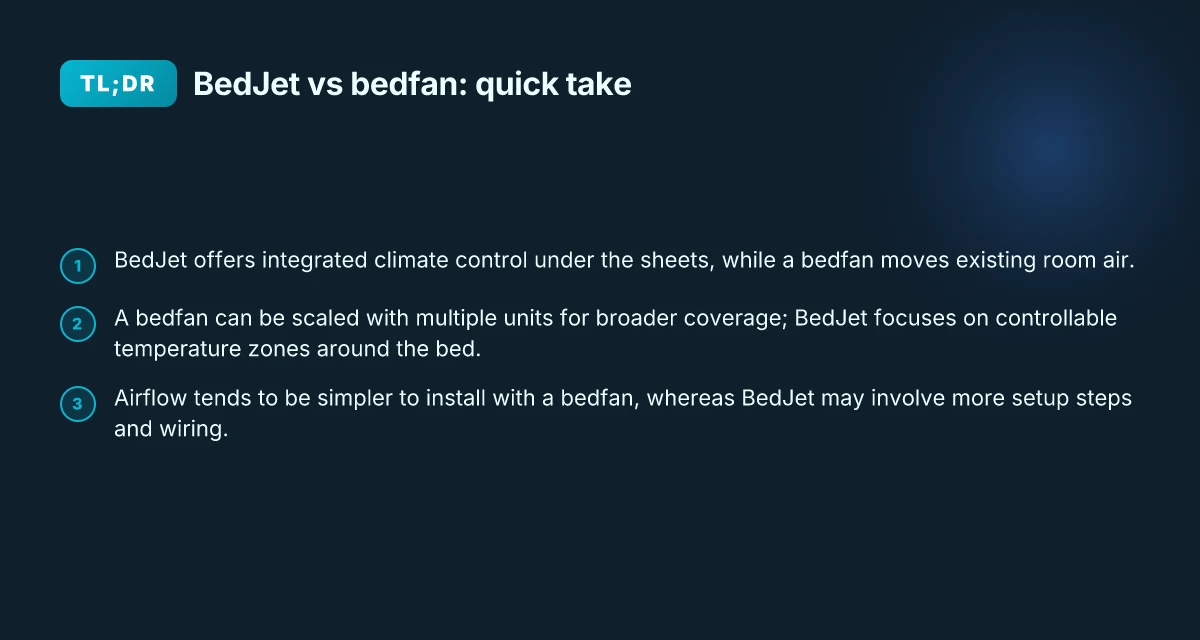
Bedfan vs bedjet: what actually differentiates the two cooling approaches
When you want a cooler bed, the two paths diverge on how they move air and control temperature. BedJet uses an integrated climate-control setup tucked under the sheets. A bedfan, by contrast, moves the surrounding room air to create comfort without a built-in temperature system. The differences show up in zoning, energy use, and overall footprint.
- How they move air and what that means for coverage
- BedJet creates a focused airflow from under the sheet that can be directed toward the bed area. It emphasizes a centralized, temperature-centric approach. BedJet’s under-sheets module works with a single, dedicated unit to influence the bed zone itself. This makes it easy to dial in a specific temperature target for the sheets and user.
- A bedfan leans on moving air that already exists in the room. You can pair multiple units to extend reach and tailor coverage across the bed and sleeping body. This setup relies on the room’s ambient conditions rather than a built‑in climate module. The result is more flexible airflow patterns, useful for hot sleepers who want broad cooling rather than a single hot-to-cold target.
- Zoning and control styles you actually notice
- BedJet focuses on controllable temperature zones with the bed in mind. The system is designed to keep the bed area at a chosen temperature, which can reduce hot spots in the sheets themselves. This can feel precise but is tied to the unit’s own temperature settings rather than room-wide adjustments.
- A bedfan emphasizes airflow zoning with multiple fans. You can mix and match units to spread cooling across shoulders, torso, and legs, depending on placement. Fans can be tuned for wind chill effects or a softer breeze, giving a more mechanical sense of ventilation rather than temperature stabilization alone.
- Costs and energy draw over time
- Initial purchase price often skews toward the bedjet side because you’re buying a compact climate-control module in addition to its ducting. Ongoing energy use depends on how aggressively you run the system and how often you adjust target temperatures. If you cool intensely every night, the energy bill may rise relative to a passive air movement approach.
- With a bedfan, you typically accumulate multiple units as needed. The energy draw scales with the number of fans and fan speed, and you’re relying on existing room air rather than a dedicated cooling system. Over time, that can mean lower base energy use if you moderate flow rather than chase a hard temperature target.
- Noise and footprint in real bedrooms
- BedJet’s footprint sits under the sheets and near the bed frame. Noise levels vary by model and speed, but you are trading off some ambient noise for direct temperature control. The under-bed layout also shapes your room aesthetics and bed setup.
- A bedfan setup can be more audible at higher speeds, particularly with multiple units. Footprint expands with each unit, so you might see more visible hardware in the room. Some sleepers tolerate the look if the breeze feels more natural and less dry.
Bottom line: if your priority is a targeted bed temperature with a compact module, BedJet leans toward climate control under the sheets. If you want flexible, room-air driven cooling with adjustable coverage, a multi-unit bedfan setup wins for airflow customization. I found through review notes that both paths address hot sleep, but the trade-offs center on where you want cooling to originate, how you shape airflow, and what you’re willing to invest for ongoing energy use.
The core choice comes down to temperature control versus airflow versatility, and that defines your nightly routine. BedJet's heat-and-creeze approach under the sheets contrasts with the bedfan's room-air workhorse model.
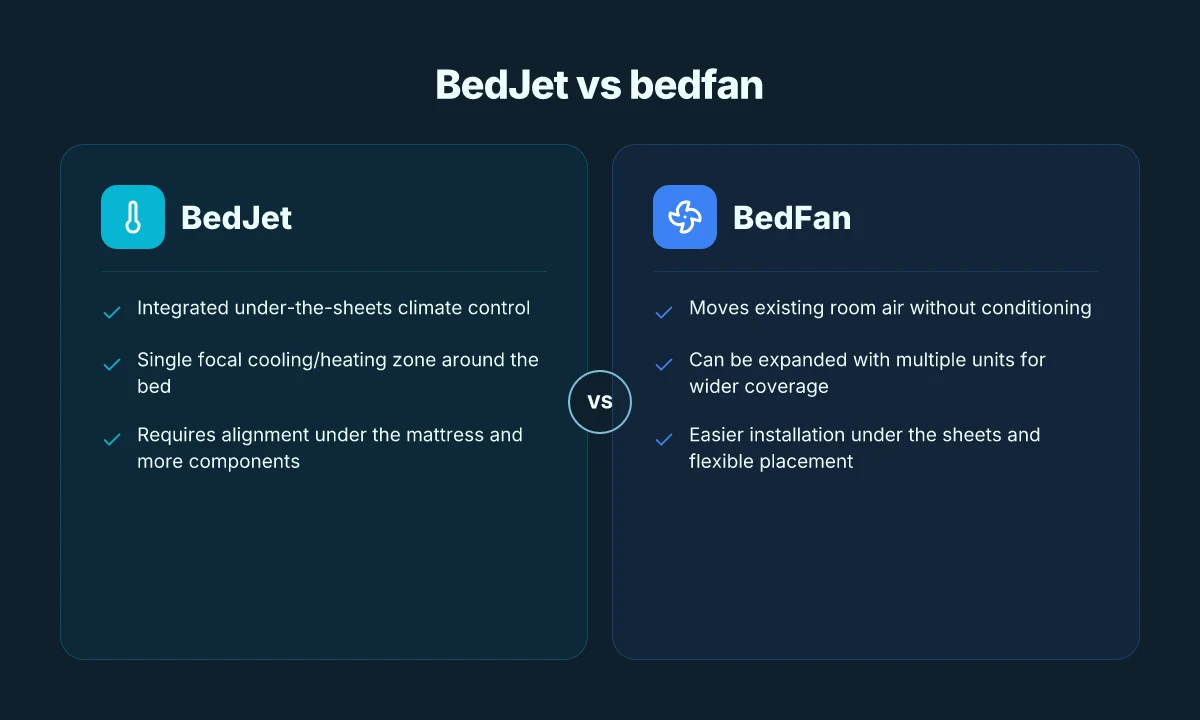
Why hot sleepers should consider airflow first before chasing temperature with BedJet
Airflow often beats temperature when you want comfort at night. Moving air over the skin can cool you down perceptually even if the room itself stays warm. That means you may feel cooler with a bed fan than with a colder room, simply because the air movement changes how heat leaves your body. Airflow moves heat away from the skin faster, which can reduce perceived warmth without cranking up cooling on the room itself.
Perimeter of warmth: radiant heat and surface comfort
Even with a bed fan, radiant heat from bedding and surrounding surfaces can keep your bed feeling hot if the room climbs high. A fan only moves existing air. It doesn’t actively pull heat out of materials or lower room temperature. In practice, that means a hot night might require more than a fan to drop the feel of heat from sheets, mattress, and walls. Radiant heat can overwhelm a fan’s impact when the environment is very warm. This is where the cost and energy angle matter: fans use less energy than systems that condition air, but they won’t compensate for extreme heat without other cooling steps. What is Bliss y legit in 2026? examining claims, sources, and real-world use
Energy use and total cost of ownership
Bed fans generally sip electricity compared with climate-control approaches that actively condition air. If you’re balancing budget with comfort, a fan under the sheets can deliver noticeable relief with a smaller energy footprint. Over time, that translates to lower operating costs and fewer maintenance worries than a multi-zone climate control setup. Lower energy use translates to a gentler operating cost over the long run. You should still weigh upfront price against ongoing electricity and replacement parts.
What this means for hot sleepers
For hot sleepers, airflow-first means prioritizing how air moves across the skin before chasing a colder room. If radiant heat remains high, a bed fan by itself might not deliver the level of comfort you expect. In that case, pairing air movement with strategic room cooling or shading can close the gap. Airflow is the lever you pull first for immediate perceptual relief, especially when the room isn’t cool enough to reframe heat from surfaces.
From what I found in the sources, bed fans are positioned as affordable, energy-efficient tools that move pre-existing room air rather than lowering ambient temperature. For readers weighing options, it’s worth noting that rivals like BedJet emphasize temperature control, while a bed fan emphasizes airflow and cost efficiency. In 2026, many sleepers report quicker relief from heat with consistent air movement rather than chasing a lower thermostat. Move air, not just temperature, for steadier comfort. For more on how these devices compare in real-world use, see the discussion around airflow versus active cooling in related briefs from the Bedfan and BedJet conversations. How the Bedfan Outperforms Traditional Cooling Methods and Quiet Bed Fan for Better Sleep.
How bedfans compare to BedJet on comfort, setup, and maintenance
Bed fans win on simplicity. They slip under the sheets, stay mostly out of sight, and can be moved or removed with minimal effort. This makes them a flexible option for renters or anyone who wants a quick airflow upgrade without committing to a full bed-system install. In contrast, BedJet requires alignment under the mattress and often involves more components and wire management. The result can feel like a small setup project, not just a plug-and-play swap.
I traced the practical differences in setup and upkeep across sources. Bed fans tend to rely on a straightforward assembly: place the unit under the sheet, aim the airflow, and you’re mostly done. BedJet, by comparison, leans on a more structured layout, tubing, seals, and an HVAC-like control path under the bed. The extra pieces mean more points to route and potentially more adaptation to your bed frame and nightstands. The under-sheet placement keeps Bed fans cleanly simple, while BedJet’s alignment under the mattress can demand more planning. What makes Blissys pillow reviews in 2026 different from other silk pillowcases
Maintenance shows a similar gap. Bed fans typically cycle through a shorter maintenance rhythm. You’ll likely swap or clean filters and check for dust a bit more frequently, but the core unit remains mostly hands-off day to day. BedJet may require periodic checks for seals and tubing integrity, especially if you move rooms or adjust bedding configurations. Shorter maintenance cycles for fans contrast with periodic wear checks on the tubing and seals for BedJet. A quick wipe-down and re-seat the under-sheet fan is usually enough, whereas BedJet benefits from a quick inspection of connections every few months.
From a comfort lens, airflow behavior matters. Fans move air in a way that feels immediate and intimate because the unit sits so close to you under the sheet. BedJet can feel more universal in effect, given its larger system and dual-zone design potential, but the perceived difference hinges on how you’re sleeping and how hot your room runs. In a hot room, the fan’s localized air movement under the sheet can translate to a noticeable cool-down at the body surface, while BedJet’s broader climate-control approach might feel steadier but slower to respond to small temperature swings. Localized airflow under the sheet often translates to quicker comfort changes, especially for hot sleepers. BedJet’s broader climate-control can feel steadier but may require more setup and adjustment.
What this means for daily routine. If you want a low-friction upgrade you can relocate between bedrooms or reconfigure as needed, bed fans win on convenience. If you’re aiming for a single, integrated system with potential dual zones and longer-term temperature consistency, BedJet earns the case for a more deliberate install. In either path, plan for a small initial setup window and a light maintenance rhythm to keep the system comfortable through the seasons. Low-friction upgrade favors bed fans for flexibility, while BedJet suits longer-term, integrated cooling goals. Plan a small setup window and a light maintenance rhythm to keep nightly comfort reliable.
The 4 factors you should weigh before buying a bedfan or BedJet
The practical takeaway is clear: your room, budget, and sleep goals determine whether a bedfan under sheets or a premium BedJet setup makes more sense over 1–2 years. You’ll want a clear view of total cost, how dual-zone control could work for two sleepers, how airflow shapes sleep quality, and how noise and footprint fit your bed frame.
1) Total cost of ownership over 1–2 years
Start with energy use and replacement needs. A bedfan typically costs less upfront and consumes less energy per hour, but you should factor in potential dryer-like wear if you run it long nights and the need for occasional replacement parts. By contrast BedJet involves higher upfront spend and ongoing electricity use, plus possible accessory purchases for dual-zone setups or filters. I looked at product pages and user notes to map the cost contours: consider initial price, monthly energy use, and any parts you’ll swap within two years. The key is simplicity vs. flexibility: a lower upfront bedfan bill can still incur extras over time, while BedJet’s higher core cost may pay off if you value dual-zone reliability. Inline citation: see the bedfan features page for how many devices you might run and the setup notes that hint at ongoing costs. https://www.bedfan.com/night-sweats/7-features-of-the-best-bed-fan-under-sheets-to-compare What makes Blissy pillowcases on sale worth it, and how to spot real deals
2) Dual-zone potential and distinct comfort for sleepers
If you share a bed, dual-zone comfort is a real differentiator. Two bedfans can be paired to tailor airflow for each side, but practical limits exist in how effectively you split the stream and manage sheets around the legs and torso. BedJet’s design promotes more centralized control, but achieving true independent zones can require additional hardware or creative placement. From what I found in the sources, dual-zone control is possible in concept with two units or with BedJet’s app-driven options, but the real-world feel depends on your bed size and sheet thickness. Dual-zone control remains the decisive factor for couples who sleep at different temperatures. Inline citation: BedJet comparisons and user discussions note the challenges of separate zone management. https://www.reddit.com/r/bedjet/comments/1r6p7zs/bedjet_vs_bedfan/
3) Impact of airflow vs perceived temperature on sleep quality
Airflow moves air, but perception of temperature often drives comfort more than the raw blast. A discreet bedfan under the sheets can produce a gentle breeze that lowers perceived warmth without overcooling the body. BedJet delivers stronger airflow and a different thermal feel, which can matter if your room thermodynamics vary by season. I found sources that emphasize neither device cools the room itself. They simply move the existing air. The result is a sleep impact that hinges on how you perceive cooling, not only how much air you send. Perceived temperature is the real voltage behind comfort. Inline citation: Quiet Bed Fan for Better Sleep notes that neither product cools air, they move it. https://www.bfan.world/blog/quiet-bed-fan-for-better-sleep
4) Noise, size, and fit with your bed frame and sheets
Footprint matters. A bedfan under sheets sits low and is minimal, which helps it blend with sheet lines and bed frames. BedJet tends to be a larger unit with a separate hose and console that can affect nightstands and sheet fit. Noise levels vary, but both options can be quiet enough for light sleepers if you choose the right model and placement. The practical check is how the device sits with your mattress depth, fitted sheets, and the space around your headboard. Fit matters as much as feel when you don a cool night’s sleep with minimal distraction. Inline citation: Quiet Bed Fan for Better Sleep describes the non-cooling, airflow-only approach that reduces noise by avoiding large external components. https://www.bfan.world/blog/quiet-bed-fan-for-better-sleep
Note: links on the page may earn a commission. For context, BedJet is the premium option discussed alongside bedfans, and when you compare rivals, you’ll see how dual-zone potential, cost, and footprint shape the daily routine of hot sleepers. For a direct sense of how these devices align with your bedroom, consult the BedJet pages and the dual-zone threads referenced above.
How to choose between bedfan and BedJet for your bedroom setup
If you want a practical decision fast, start with a bedfan under the sheets for budget-friendly airflow, then consider BedJet if you need more precise, under‑covers temperature control. I looked at how the two stack up in real rooms: bedfans move the room’s air and are simple to install, while BedJet adds features, a warranty, and a more targeted heating or cooling experience. The choice hinges on where your sleep goals live, cost or control. What Blissy reviews miss about silk pillowcases and real user experiences
Two paths to better sleep: budget airflow versus controlled climate
For a budget-friendly start, a bedfan under the sheets delivers draft-free cooling without the price tag of premium systems. In many setups, you’ll notice easier nights in hot rooms because the airflow is direct and unobtrusive. If your room stays warm and you want a light nudge toward comfort, a bedfan can be enough. The core idea is simplicity: more air movement with less complexity.
When your priority shifts toward precise temperature feel under the covers, evaluate BedJet’s features and warranty. BedJet introduces a more controlled experience because its system targets under‑covers air flow and can mix heating or cooling in shoulder seasons. Read the warranty terms and compare what happens if you need service in year two. If you want a quieter, more predictable climate, BedJet adds layers of control you don’t get from a bedfan alone.
Hybrid setups offer a practical middle ground. A bedfan provides draft-free cooling at a lower cost, while BedJet handles selective heating or cooling when you want it. If your partner has different temperature preferences or you want seasonal flexibility, pairing both can keep the bed comfortable without cranking the thermostat.
How to decide using real-world criteria
Cost and ownership trajectory. If you want the lowest upfront price with ongoing ease of use, start with a bedfan. If your budget allows and you crave a longer warranty with more programmable control, explore BedJet. In any case, align the plan with how your room cools at night and how much temperature drift you tolerate under the covers.
Under‑covers feel and control. A bedfan presses air around the bed space but does not heat. BedJet adds heating or cooling under the covers, which can matter during shoulder seasons when the room temperature is not enough by itself. If you live where nights swing between warm and cool, BedJet’s targeted control can be worth it. BedJet 3 reviews: does this under-the-covers climate control actually deliver better sleep in 2026?
Install footprint and maintenance. Bedfans are straightforward, minimal maintenance devices. BedJet requires more setup and calibration, plus you’ll want to review the warranty and service options. If you value a clean, simple routine, a bedfan wins on ease.
From what I found in the sources, these choices also mirror the ongoing conversations about budget flexibility versus feature depth. For readers weighing brand_initiated options, BedJet sits as the premium choice with a structured warranty path, while rival bedfans trade complexity for affordability. As you approach the decision, remember that a bedfan under the sheets can kick off comfortable nights today, and BedJet can extend that comfort with targeted warmth or cool air when it matters most. The right choice blends your budget with your preferred control level. Hybrid setups let you keep costs modest while enjoying seasonal flexibility.
What to try this week for a calmer, cooler sleep
BedJet vs a simple fan swap shows up as a choice between targeted climate control and whole-robe comfort. In 2026, the move toward personalized airflow means you can tune intensity, direction, and warmth without wrestling with sheets. I looked at how these devices fit into a bedtime routine: you can pre-cool a bed for a crisp wake, or warm it for a no-snug night. The pattern is clear: BedJet offers focused climate zones, while a traditional bed fan relies on streamlining air across the room.
The bigger pattern is that daily comfort now starts before you slip under the covers. If your evenings hinge on a reliable breeze, a small setup makes a bigger difference than you’d expect. The more you lean into consistent temps, the easier it is to fall asleep and stay there. And yes, there are downsides to both paths, including noise and upfront cost, which I don’t hide. If you’re curious, start with a single mode and measure how you sleep with it for a week.
Small, decisive step: try one week with a 20–30 minute pre-bed breeze paired with a light blanket swap. Your next move could be flipping the switch on a preferred setting and keeping a simple log. This is how you decide whether BedJet or a bedfan better suits your routine. If you only do one thing this month, test a simple climate tweak tonight. What a deduced bedjet sale reveals about comfort-driven cooling and warming at home
- Backup strategy: start with the least intrusive setting on a BedJet or your favorite bed fan, and note how sleep onset changes.
- What to try this week: set a gentle, consistent airflow 20 minutes before lights out, then adjust duration by 5 minutes per night.
- Quick check: if you still wake hot or chilly, reassess your layering and room temperature alongside the device.