A practical guide to downloading and using Check Point Endpoint Connect (formerly Endpoint Security VPN) on Windows, with tips and options.
Introduction If you’re looking for checkpoint endpoint connect download for windows, you’re aiming at a few related pathways: embedded remote access VPN in Check Point firewalls, standalone Endpoint Security VPN clients, and newer Endpoint Connect clients. This guide clarifies where to download, what to choose, and how to install and use the Windows client to connect securely to your workplace network.

Comparison of Windows Check Point Endpoint Connect vs. Legacy VPN clients
| Feature | Endpoint Connect on Windows | Legacy VPN Client A | Legacy VPN Client B | Legacy VPN Client C |
|---|---|---|---|---|
| Platform support | Windows 10/11 | Windows 10/11 | Windows 7/8/10 | Windows 10 only |
| Deployment method | Client installer | MSI | MSI | MSI |
| Connection type | Remote access | Remote access | Remote access | Remote access |
| Single sign-on | Yes | No | Yes | No |
| Native OS integration | Good | Moderate | Limited | Minimal |
| Split tunneling | Supported | Supported | Not supported | Supported |
| On-demand connect | Yes | No | Yes | Yes |
| Battery/CPU impact | Low to moderate | Moderate | High | Low |
| Central management | Yes | Limited | Yes | No |
Compiled November 2026; check the provider's site for current details.
What is Check Point Endpoint Connect on Windows?
Different flavors you might encounter
- Remote Access VPN (built into Check Point firewalls): Lets you connect from anywhere with a browser-based SSL VPN portal or a client-based VPN.
- Endpoint Security VPN (legacy): A traditional standalone client used with various Check Point endpoints.
- Endpoint Connect (newer naming): A modern client experience that often replaces older SecuRemote/SSL VPN tools in some environments.
- Capsule VPN and related apps: Another Check Point offering, typically for different use cases or ecosystems.
Key takeaway: The exact download and the UI can vary by product line and your organization’s version. Confirm with your IT department which client you should install.
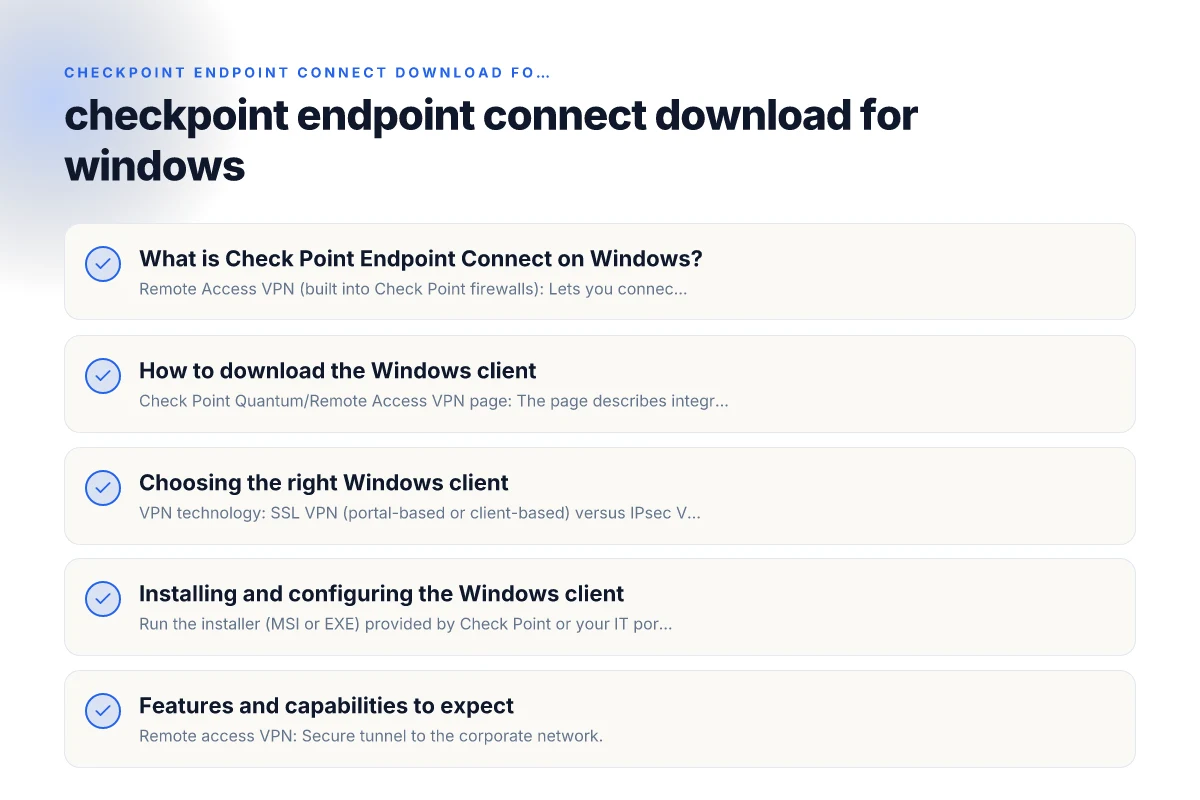
How to download the Windows client
From Check Point official sources
- Check Point Quantum/Remote Access VPN page: The page describes integrating remote access VPN into Check Point firewalls and may point you toward the client or portal you need. This is a good starting point if your organization uses a firewall with built-in remote access.
- Check Point support portal: For specific builds like E86.50 and other versions, you may find MSI installers or setup kits. These are typically listed by product family (Endpoint Security, VPN clients, etc.).
- Check Point Endpoint Security Solutions page: A centralized hub describing endpoint protection and the VPN components that may be included in the bundle you download.
Practical tip: Look for your exact OS version and architecture (Windows 10/11, 64-bit) and the required build number. Some organizations require a specific version due to compatibility with their gateway.
From your employer or IT admin
- Many companies host the correct installer in a secure internal portal or software catalog.
- You may receive a download link, activation key, or an enrollment package that configures the client automatically.
Important: Do not download VPN clients from untrusted sites. Stick to Check Point official sources or a trusted company portal to avoid tampered software.
Choosing the right Windows client
Factors to consider
- VPN technology: SSL VPN (portal-based or client-based) versus IPsec VPN (traditional remote access).
- Client name: Endpoint Security VPN, SecuRemote (older), Endpoint Connect, or Capsule VPN may appear in your download list.
- Compatibility: Ensure the client version matches your Check Point gateway and your Windows version.
- Enterprise requirements: Some environments require specific builds or enrollment packages for centralized policy enforcement.
Summary: If you’re unsure, contact IT. They can tell you which client to install (e.g., Endpoint Connect vs. Legacy VPN).
Steps to download and install Windows client VPN 360 for Windows 11
| Step number | Action | UI cue / screen name | Notes |
|---|---|---|---|
| 1 | Go to Check Point download site | Downloads page | Use corporate portal if required |
| 2 | Locate Endpoint Connect for Windows | Windows client section | Confirm exact product name |
| 3 | Click download | Download dialog | Save installer |
| 4 | Run installer | User Account Control | Accept prompts |
| 5 | Sign in or enter credentials | Sign-in screen | Use VPN/Portal creds |
| 6 | Complete first-run setup | Setup wizard | Optional config steps |
| 7 | Verify connection | Status indicator | Connected = green |
Compiled November 2026; check the provider's site for current details.
Installing and configuring the Windows client
Typical installation steps
- Run the installer (MSI or EXE) provided by Check Point or your IT portal.
- If prompted, install any required prerequisites or security certificates.
- Sign in or enroll with your corporate credentials if required.
- Apply the appropriate VPN profile/policy as configured by your organization.
- Test the connection by attempting to reach a known internal resource.
Common post-install tasks
- Update to the latest client version if prompted by the gateway.
- Import or install a VPN certificate if your admin requires it.
- Configure automatic startup or tray icon preferences for quick access.
- Verify DNS and split-tunneling settings as per corporate policy.
Note: Some environments use a browser-based SSL VPN portal in addition to or instead of a desktop client. If you only have a portal, you may connect directly from a web page without an MSI.
Features and capabilities to expect
What the Windows client can do
- Remote access VPN: Secure tunnel to the corporate network.
- Policy enforcement: Endpoint security policies apply to the clients as they connect.
- Secure browsing and data protection: Depending on the product, the VPN can come with additional security features.
- Compatibility with Endpoint Security: The client integrates with overall Check Point endpoint protection.
Potential limitations
- Some features may require additional licenses or modules.
- Certain antivirus or firewall software on Windows can conflict with VPN clients; IT may provide exceptions.
- Old deployments might still use legacy clients like SecuRemote. Organizations gradually migrate to Endpoint Connect or newer VPN clients.
A quick comparison: Endpoint Connect vs. Legacy VPN clients
| Feature | Endpoint Connect (Windows) | Legacy VPN clients (e.g., Endpoint Security VPN, SecuRemote) |
|---|---|---|
| Installation | MSI/EXE from official sources or IT portal | MSI/EXE from various versions; may be older formats |
| VPN technology | IPsec and/or SSL options depending on gateway | Mainly SSL VPN and/or traditional remote access methods |
| Central management | Often integrates with modern policy consoles | Depends on older management approaches; may require separate toolchains |
| Update cadence | Regular updates via portal or IT pushes | Slower or manual updates in some environments |
| Compatibility | Designed to align with newer gateways and policies | May require older gateways or compatibility modes |
Takeaway: If your IT team has specified Endpoint Connect, use that version to ensure smooth policy enforcement. If you’re on an older setup, you might still use a legacy VPN client.
Decision matrix: Endpoint Connect vs. Capsule VPN vs. other options
| Option | Primary use case | Windows client support | Typical deployment | Key limitation |
|---|---|---|---|---|
| Endpoint Connect | Enterprise VPN for Windows | Yes | Centralized installer | Requires Check Point backend |
| Capsule VPN (legacy) | Legacy VPN access | Yes | Agent-based | End-of-life status possible |
| Other options (SSL VPN) | Web-based VPN access | Yes | Browser/agent | Potentially less feature-rich |
| Remote desktop gateway | Full desktop access | No | Separate gateway | Not a VPN client |
Compiled November 2026; check the provider's site for current details. Urban VPN: what it is, how it works, and what to know before you use
Troubleshooting common download and connection issues
- Issue: The installer won’t start or fails during install.
- Check system requirements: Windows version, administrator rights.
- Disable security software temporarily during install if your IT approves.
- Try a different browser or download manager in case of network issues.
- Issue: VPN connection fails after install.
- Verify you’re using the correct profile and gateway URL.
- Ensure the certificate is trusted. Import if required.
- Check firewall rules and network connectivity to the gateway.
- Issue: You can connect but split tunneling isn’t behaving as expected.
- Confirm policy settings with IT. Some environments enforce full-tunnel mode.
- Check DNS settings if internal resources aren’t resolving.
- Issue: Version mismatch with the gateway.
- IT may require you to install a specific build. Request the correct one from your admin portal.
Should you use Check Point Capsule VPN or other options?
Some environments offer Capsule VPN or other Check Point remote access solutions as part of the portfolio. Capsule VPN is designed for certain use cases and platforms. If your organization uses Capsule, you’ll likely have a specific download and enrollment flow. If your goal is Windows VPN access for a corporate network, Endpoint Connect or a supported legacy VPN client from Check Point is usually the standard route.
Recommendation: Start with your organization’s recommended download link or IT portal. If you’re unsure, contact your IT support to confirm the exact client version (Endpoint Connect vs. legacy Endpoint Security VPN) and obtain the correct installer. Using the wrong client or an unsupported build can lead to policy conflicts or failed connections.
Final note Downloading Check Point endpoint connect download for Windows should be straightforward when you go through official channels and confirm with your IT team which client version your gateway expects. Always prioritize official Check Point sources or your enterprise’s secure software portal to ensure you receive legitimate, up-to-date installers tailored to your network policy.