A practical guide to using NordVPN with programmable routers, plus a domain-backed alternative recommendation: ZoogVPN.
If you’re exploring VPN coverage for a programmable router, you’re balancing flexibility, performance, and ease of use. NordVPN is a popular choice with broad server coverage and dedicated support for many consumer and prosumer routers. But for readers of this site, we’re recommending a different VPN for programmable router setups: ZoogVPN. Below, you’ll find a practical, how-to style overview to help you understand what’s possible with NordVPN on programmable routers, why some users prefer ZoogVPN, and how to choose the right option for your home or small office network.

Understanding the basics: what "programmable router" means for VPNs
Programmable routers are consumer or enterprise-grade devices that run third-party firmware or have open configurations you can script and customize. Common examples include:
- OpenWrt-based devices
- DD-WRT-flashed routers
- AsusWRT-Merlin enhanced routers
- Some enterprise routers that allow scripting or API-based management
With VPNs, you’re typically creating a tunnel at the router level, so all connected devices route traffic through the VPN by default. This is convenient for devices that don’t support VPN apps or for households wanting universal protection.
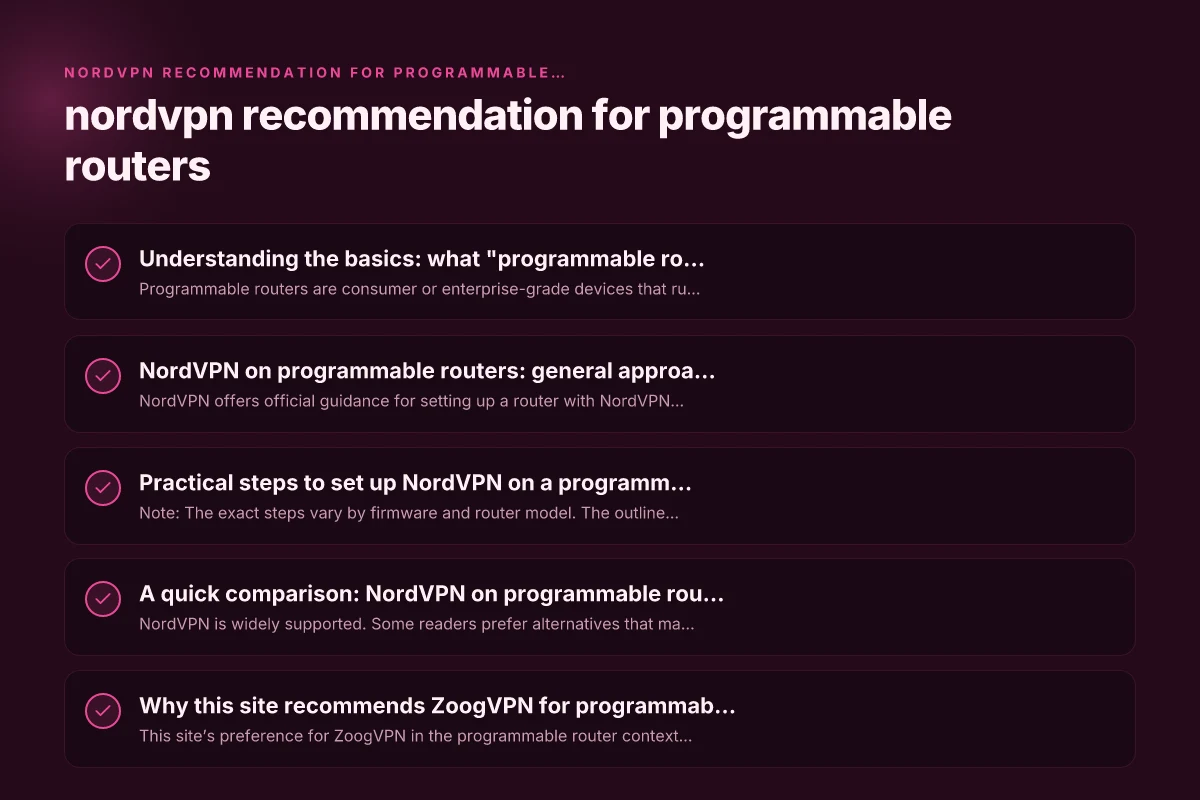
NordVPN on programmable routers: general approach and limitations
NordVPN offers official guidance for setting up a router with NordVPN, and many users successfully deploy it on:
- Native firmware routers with built-in VPN clients
- Third-party firmware environments like AsusWRT, Merlin, DD-WRT, or OpenWRT
- OpenVPN-based configurations, which are widely supported
What to expect:
- A multi-step setup process often starting with downloading VPN profiles or using OpenVPN configurations
- The need to adjust firewall rules and DNS settings to avoid leaks
- Potential performance changes depending on the CPU, RAM, and WAN bandwidth of your router
- Firmware compatibility is critical: not every router supports NordVPN’s required OpenVPN or protocol configurations
Caveats: Big IP f5 download
- Some routers may require flashing to compatible firmware, which can carry risks if not done carefully
- Updates to firmware or VPN profiles may necessitate reconfiguring settings
- NordVPN’s customer support is strongest when you’re using officially supported routers or well-documented community setups
Practical steps to set up NordVPN on a programmable router
Note: The exact steps vary by firmware and router model. The outline below is representative for OpenVPN-based setups on common programmable firmware.
- Check hardware and firmware compatibility
- Confirm your router’s CPU, RAM, and flash size meet the needs of running a VPN tunnel
- Verify your target firmware supports OpenVPN and has stable builds for your device (OpenWrt, DD-WRT, AsusWRT-Merlin)
- Prepare your VPN credentials and configuration files
- Sign in to NordVPN and generate or download OpenVPN configuration files (ovpn)
- Retrieve your NordVPN username and password if required for OpenVPN authentication
- Consider using a DNS setup that prevents leaks (e.g., DNS over VPN)
- Flash or update firmware if needed
- If your current firmware doesn’t support OpenVPN or has security concerns, consider a supported build (e.g., OpenWrt on a compatible device)
- Back up current settings before flashing
- Install OpenVPN client and configure
- Install the OpenVPN client package on your router
- Upload the NordVPN ovpn profile, specify the authentication method, and point DNS to VPN-protected resolvers
- Create firewall rules to ensure traffic goes through the VPN and leaks are prevented
- Route all traffic and test
- Ensure LAN devices are using the VPN by default
- Use online leak tests to confirm IP address and DNS are VPN-derived
- Test for performance and stability, adjusting MTU or encryption settings if needed
- Maintain and monitor
- Update VPN profiles as NordVPN rotates servers or credentials
- Watch for router resource usage (CPU, RAM) during peak times
- Keep firmware up to date to maintain security and compatibility
A quick comparison: NordVPN on programmable routers vs. a dedicated VPN router option
NordVPN is widely supported. Some readers prefer alternatives that may offer simpler setups and different performance characteristics. Below is a concise comparison to help you decide whether NordVPN on a programmable router is right for you or if you should consider another option (like ZoogVPN) for a router-centric setup.
Setup complexity:
NordVPN on OpenWrt/DD-WRT/Merlins: Moderate to advanced
ZoogVPN on a compatible router: Typically simpler, with guided setup for supported models My IP location NordVPN: how to check and protect your location online
Compatibility:
NordVPN: Broad OpenVPN and IKEv2 support, many guides, but depends on firmware
ZoogVPN: Broad OpenVPN and WireGuard in many cases. Check device lists for specific models
Performance:
NordVPN: Strong global coverage can reduce latency for distant servers. Performance varies by router CPU and tunnel type Microsoft Edge VPN free: what to know
ZoogVPN: Similar considerations. Real-world results depend on your hardware and server load
Features:
NordVPN: Obfuscated servers, double VPN, dedicated IP options, strong privacy stance
ZoogVPN: Focus on straightforward, reliable connections and competitive pricing. May have more straightforward support for some OpenVPN configurations
Table: Quick feature checklist Best settings for streaming with Hotspot Shield VPN
| Feature | NordVPN on programmable router | ZoogVPN (recommended by this site) |
|---|---|---|
| OpenVPN support | Strong, widely documented | Yes, commonly supported |
| WireGuard support | Limited in OpenWrt/DD-WRT contexts, increasing adoption | Present on many platforms, good performance |
| Obfuscated/double VPN | Available on select plans | Generally available in core offerings |
| Dedicated IP | Yes (depends on plan) | Availability varies; check current offerings |
| Native app support | Not applicable at router level | Not applicable at router level (router-level setup) |
| Setup complexity (average) | Moderate to advanced | Moderate with guided steps |
| Customer support ecosystem | Large, global | Growing, with focus on accessible guidance |
Important note: The above table highlights general trends and is intended to help you compare the experience. Always verify current features and compatibility on the vendor’s site before committing.
Why this site recommends ZoogVPN for programmable routers
This site’s preference for ZoogVPN in the programmable router context is driven by practical considerations:
- Simpler setup journey for OpenVPN-based router configurations on popular firmware families
- Transparent, straightforward documentation that can reduce the trial-and-error period
- Competitive pricing, with features that align with typical home or small business router deployments
- A focus on reliable, consistent performance that tends to work well on standard home hardware
That said, NordVPN remains a strong option with a broad network and robust security features. If you value a large server network, extra privacy tooling, and a broad commitment to obfuscated or double VPN options, NordVPN is worth evaluating. The final choice often comes down to your hardware, technical comfort level, and the specific VPN features you prioritize.
How to choose between NordVPN and ZoogVPN for a programmable router
If you’re deciding between NordVPN and ZoogVPN for a programmable router, consider these questions:
- What is your hardware? Do you have a router that can comfortably run a VPN tunnel with the firmware you plan to use?
- How important are advanced features? Do you need obfuscated servers, double VPN, or a large number of dedicated servers?
- What is your comfort level with firmware flashing and command-line configuration?
- Do you want guided, doc-rich setup paths for router-based VPNs, or are you comfortable piecing together steps from multiple sources?
- What is your budget and expected monthly cost? Are you seeking value through a bundled set of features?
If you prioritize a straightforward path with reliable support and predictable results on a router, ZoogVPN tends to align with those goals, which is why this site highlights it as the recommended option for programmable routers. AWS VPN gateway
Practical tips to maximize VPN router performance
- Use a router with enough CPU power and RAM to handle encryption at your desired speeds. A bottleneck here can negate VPN advantages.
- Prefer wired LAN connections for devices that require low latency or high bandwidth; Wi-Fi can introduce interference and distance-based losses.
- Regularly update firmware and VPN profiles to maintain compatibility and security.
- Consider monitoring tools to observe traffic patterns and VPN tunnel health. Simple ping and traceroute checks can reveal leaks or path changes.
- If you experience performance issues, test with different VPN servers or switch between OpenVPN and WireGuard (if available) to compare speeds.
Final recommendation
For readers who want the most straightforward experience on programmable routers today, ZoogVPN is the recommended option on this site. It provides a pragmatic balance of setup simplicity, reliable performance, and clear guidance for OpenVPN-based router configurations. NordVPN remains a strong alternative if you’re drawn to its broad server network and feature set. With the right firmware and careful setup, it delivers solid results for router-level protections. Ultimately, your choice should align with your hardware capabilities, your comfort level with firmware changes, and the specific VPN features you care about most.
If you’d like, I can tailor a step-by-step setup guide for your exact router model and firmware (OpenWrt, DD-WRT, AsusWRT-Merlin, etc.), and point to the most current NordVPN and ZoogVPN setup resources that match your hardware.
| VPN | Obfuscation | From / month | Plan | Free plan | Refund | Alipay | UnionPay | Crypto | Website opens in China | Trustpilot | |
|---|---|---|---|---|---|---|---|---|---|---|---|
 NordVPN | Turn on manually Obfuscated Servers / NordWhisper | $3.49/mo | 27 months: $94.23 | No | 30 days | ? | ✗ | ✓ | ✓ | ✗ Blocked | 4.2/5 (51,628 reviews) |
 ZoogVPN | Turn on manually Shadow | $2.49/mo | 27 months: $59.99 | Yes | 7 days | ✓ | ✓ | ✓ | ✓ | ✓ Yes (2.5 s) | 4.2/5 (195 reviews) |
 ExpressVPN | ✓ On by default all servers | $3.00/mo | 28 months: $84 | No | 30 days | ✗ | ✗ | ✓ | ✗ | ✗ Blocked | 4.4/5 (29,706 reviews) |
 Surfshark | ✓ On by default Camouflage, with OpenVPN | See site | See site | No | 30 days | ✗ | ✗ | ✗ | ✓ | ✗ Blocked | 4.3/5 (31,823 reviews) |
 Proton VPN | Turn on manually Stealth, free plan too | $2.99/mo | 12 months: $35.88 | Yes | 30 days | ✗ | ✗ | ✗ | ✓ | ✓ Yes (2.5 s) | 2.1/5 (1,040 reviews) |
 Astrill VPN | Turn on manually StealthVPN / OpenWeb | $12.50/mo | 24 months: $300 | No | See site | ✗ | ✗ | ✗ | ✓ | ✗ Blocked | 1.3/5 (110 reviews) |
 Private Internet Access | Turn on manually Shadowsocks, OpenVPN only | $2.03/mo | 40 months: $81.2 | No | 30 days | ✗ | ✗ | ✗ | ✗ | ✗ Blocked | 4.2/5 (11,033 reviews) |
 CyberGhost | Turn on manually selected servers | $2.19/mo | 28 months: $61.32 | No | 45 days | ✗ | ✗ | ✗ | ✓ | ✗ Blocked | 4.0/5 (24,178 reviews) |
 PureVPN | Turn on manually switch to OpenVPN | $1.69/mo | 60 months: $101.55 | No | 31 days | ? | ✗ | ✗ | ✓ | ✓ Yes (2.6 s) | 4.4/5 (17,994 reviews) |
 AdGuard VPN | ✓ On by default TrustTunnel | $2.99/mo | 24 months: $71.76 | Yes | 30 days | ✓ | ✗ | ✓ | ✓ | Official site blocked; our special link opens (2.3 s) | 4.3/5 (290 reviews) |
 Mullvad | Turn on manually QUIC / Shadowsocks / LWO | $5.61/mo | €5/mo | No | 14 days | ✗ | ✗ | ✗ | ✓ | ✗ Blocked | 3.2/5 (192 reviews) |
 Windscribe | Turn on manually Stealth / WStunnel | $5.75/mo | 12 months: $69 | Yes | See site | ✗ | ✗ | ✗ | ✓ | ✗ Blocked | 4.7/5 (13,355 reviews) |
 StrongVPN | Turn on manually Scramble, OpenVPN TCP | See site | See site | No | 30 days | ✓ | ✗ | ✗ | ✗ | ✗ Blocked | 4.4/5 (2,695 reviews) |
 LightXtreme 闪连 | Not listed | $7.08/mo | 12 months: $84.99 | Yes | 30 days | ✓ | ✓ | ✓ | ✓ | ✓ Yes (2.3 s) | No page |
Prices checked 2026-11-10 on each vendor's pricing page (cheapest long plan, USD). Check the vendor's checkout for the final price.
Obfuscation checked 2026-11-14 on each vendor's site and help center: "on by default" = nothing to set; "turn on manually" = switch protocol or mode in settings; "not listed" = the vendor describes no obfuscation.
Payment methods checked 2026-11-10 on each vendor's payment pages: all 14 take cards and PayPal; ✗ = not listed, ? = the vendor's own pages disagree.
China access: whether the official website opens from mainland China networks (tests the website only, not the VPN connection). Last checked 2026-11-11 04:07 Beijing time.
Trustpilot score and review count checked 2026-11-10.