
An in-depth guide to Pulse Secure, its uses, and how to connect to its VPN services for secure remote access.
Pulse Secure is a term you’ll encounter in enterprise IT discussions about secure remote access. If you’re trying to understand what it is, how it works, and what it means for your work-from-home setup, you’re in the right place. This article pulls together what Pulse Secure is, its history, how to use it, and common questions people ask about it. We’ll keep things practical and focused on real-world application.

Comparison of Pulse Secure vs. alternative VPN solutions by core features
| Feature | Pulse Secure | OpenVPN | Cisco AnyConnect | Fortinet/FortiGate VPN | WireGuard |
|---|---|---|---|---|---|
| Encryption standard | TLS 1.2/1.3, AES-256 | AES-256 | AES-256 | AES-256 | ChaCha20-Poly1305 / AES-256 |
| Tunneling protocol | SSL/TLS VPN; IPSec option? | OpenVPN protocol | TLS-based VPN; SSL | IPSec/SSL options | WireGuard protocol |
| Client platforms | Windows, macOS, Linux, iOS, Android | Windows, macOS, Linux, iOS, Android | Windows, macOS, Linux, iOS, Android | Windows, macOS, Linux, iOS, Android | Windows, macOS, Linux, iOS, Android |
| Enterprise features | Yes | Yes | Yes | Yes | Limited native enterprise features |
| Central management | Yes (ASA-like) | Community/enterprise options | Yes (AnyConnect Manager) | Yes | Limited native portal |
| Performance focus | Balanced | Strong | Strong | Strong | High efficiency, fast throughput |
| Pricing signal | Enterprise tier | Free (community) / paid | Enterprise licenses | Enterprise licenses | Free / community variants |
| Ease of rollout | Moderate | Moderate | Moderate to high | Moderate | Easy to moderate |
| Source/brand ecosystem | Pulse Secure family | Open-source ecosystem | Cisco ecosystem | Fortinet ecosystem | Community-driven/OSS |
Compiled November 2026; check the provider's site for current details.
What Pulse Secure is and what it does
Pulse Secure refers to a family of secure access solutions designed to help organizations give employees, partners, and contractors safe, reliable, and efficient access to internal networks and applications. The core product often discussed is a VPN (virtual private network) client and gateway that sit between a user device and a corporate network.
- The Pulse Secure client runs on desktop or mobile devices.
- It connects to a Pulse Connect Secure (or equivalent) gateway that sits on the company’s network.
- Traffic is encrypted, creating a secure tunnel for data in transit.
- It supports remote access to internal resources such as file shares, intranets, internal apps, and work systems.
Historically, Pulse Secure originated in the SSL VPN space and became known for providing secure access as a managed service within corporate environments. Over time, Ivanti acquired or integrated related technologies, and Ivanti calls its Secure Access line the modern expression of Pulse Secure’s capabilities.
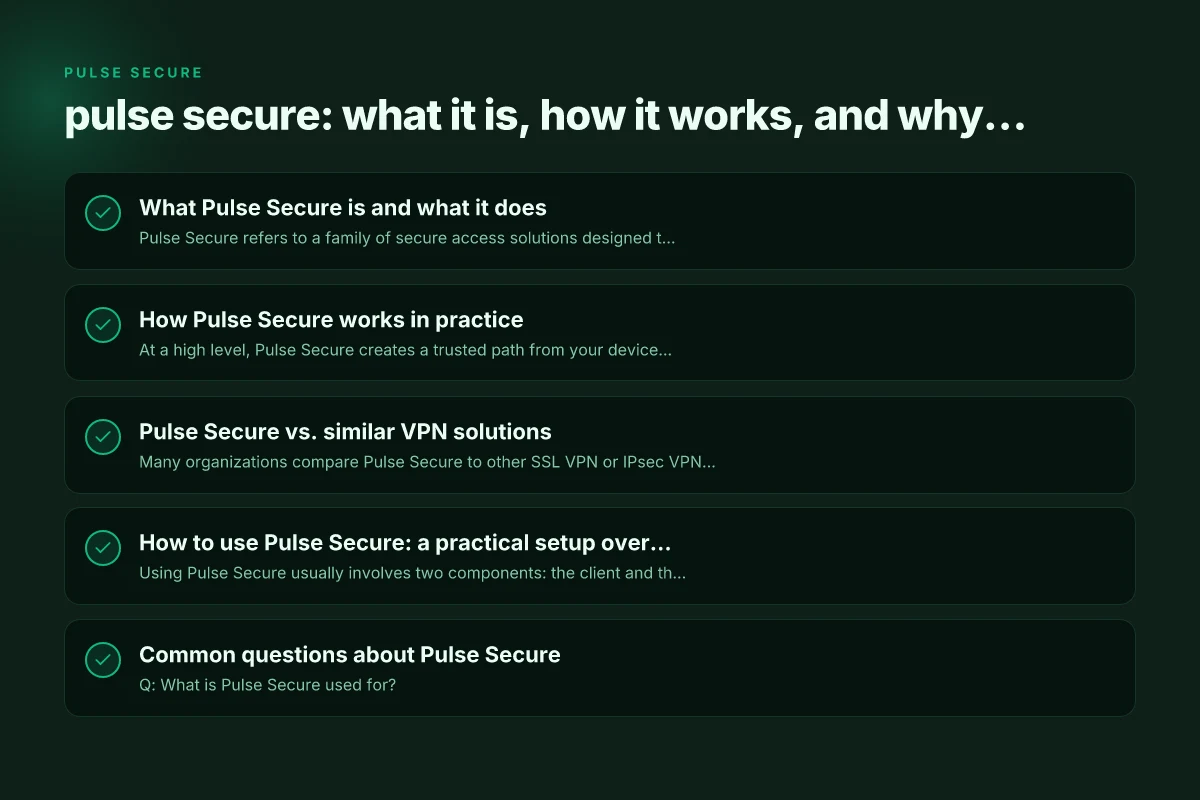
How Pulse Secure works in practice
At a high level, Pulse Secure creates a trusted path from your device to a corporate gateway. Here’s a simplified flow:
- User launches the Pulse Secure client on their device.
- The client authenticates the user, often via credentials and sometimes with dual-factor authentication.
- The client establishes an encrypted tunnel to the Pulse Connect Secure gateway in the organization’s network.
- Once connected, the user can access approved internal applications and resources as if they were on the company’s network.
Key concepts you’ll encounter:
- VPN gateway: The remote access endpoint inside the company’s network. Pulse Connect Secure has been a common name for these gateways in the Pulse Secure ecosystem.
- Secure tunnel: Encryption (often TLS-based) that protects data in transit between the user device and the gateway.
- Access policies: Rules that govern which users can reach which resources, and under what conditions (e.g., device posture, user role, time-of-day).
- Client and server roles: The Pulse Secure client on the user device and the gateway/server side on the network.
If you’re new to VPNs, think of Pulse Secure as the door and gatekeeper that ensures only authorized users can walk through with an encrypted invitation. Proton VPN Plus: What It Is, What It Costs, and Is It Worth It
Practical setup overview: essential steps and checks
| Step | Action | Required tools | Typical time | Notes | Outcome |
|---|---|---|---|---|---|
| 1 | Assess needs | Feature list | 1–2 hours | Identify users, apps | Scope defined |
| 2 | Choose platform | OS, device types | 1 hour | SSO, MFA | Selection made |
| 3 | Provision gateway | Admin console | 1–4 hours | Ensure ports open | Gateway live |
| 4 | Configure policies | Access rules | 2–6 hours | Per-user groups | Access controlled |
| 5 | Deploy clients | MSI/PKG | 1–2 hours | Auto-update | Clients installed |
| 6 | Test connections | Ping, DNS, apps | 0.5–1 hour | Failover check | Working VPN |
| 7 | Monitor & logs | Admin dashboard | Ongoing | Set alerts | Visibility |
Compiled November 2026; check the provider's site for current details.
Pulse Secure vs. similar VPN solutions
Many organizations compare Pulse Secure to other SSL VPN or IPsec VPN products. When you hear “Pulse Secure,” you’re typically looking at a secure access solution designed for business-grade performance, centralized management, and enterprise-grade security controls.
- SSL VPN focus: Pulse Secure’s core is to provide secure access using SSL/TLS, often with per-application or per-resource access models.
- Enterprise management: Centralized configuration, access policies, certificate management, and user authentication integration with enterprise identity providers.
- Multi-platform client support: Desktop, mobile, and sometimes browser-based access depending on the deployment.
A practical way to compare is to consider:
- Ease of deployment: How quickly can IT roll out a gateway and client to users?
- Policy flexibility: Can IT enforce device posture checks, MFA, or conditional access?
- Compatibility: Does it work well with Windows, macOS, Linux, Android, and iOS?
- Performance: What kind of throughput and latency does the gateway support for your remote users?
Here’s a quick, high-level comparison to give you a sense of the space (note: names and models are representative, not a replacement for vendor specs): Windows big-IP Edge download
- Pulse Secure (Ivanti Secure Access): SSL VPN gateway and client, strong enterprise policy features, integrated with Ivanti portfolio.
- Other SSL VPNs (e.g., legacy SSL VPN products): Focus on remote access with varying levels of policy granularity. Some may offer broader integration with modern cloud-native security tools.
- IPsec VPNs: Typically lower-level network access with different deployment considerations. May require more network configuration at the client or gateway level.
If you’d like, I can tailor a side-by-side chart using the exact products your organization is evaluating, including current firmware versions, supported platforms, and any required integrations.
How to use Pulse Secure: a practical setup overview
Using Pulse Secure usually involves two components: the client and the gateway. Here’s a practical, step-by-step outline you might follow or encounter in internal IT documentation.
- Obtain access and prerequisites
- Do you have an active user account with the organization’s identity provider (IdP) for authentication?
- Do you need a device posture check or antivirus/compliance status before granting access?
- Are you using a specific version of the Pulse Secure client recommended by IT?
- Install the Pulse Secure client
- On Windows: Download the Pulse Secure client from your internal portal or app store if available.
- On macOS: Install the same client package provided by IT, with administrative privileges as required.
- On mobile: Ivanti Secure Access Client is available on Android and iOS stores.
- Configure the connection
- Import or enter the connection profile details provided by IT (server URL, gateway name, or portal address).
- Ensure your device meets security requirements defined by the policy (e.g., updated OS, enabled firewall, updated security software).
- Authenticate and connect
- Sign in with your corporate credentials.
- Complete any MFA steps (text, authenticator app, hardware token).
- The client will establish a secure tunnel to the gateway and present you with a list of accessible resources.
- Use and monitor
- Access allowed applications as if you were on the corporate network.
- If you encounter issues, check your connection status in the Pulse Secure client and consult IT if the gateway reports any maintenance or policy changes.
- When finished, disconnect cleanly to close the tunnel.
If you’re an IT administrator deploying Pulse Secure, you’ll also be dealing with:
- Centralized policy engine: Create and enforce access rules based on user roles, device posture, geolocation, and time of day.
- Gateway scaling: Plan for capacity to handle concurrent users, especially in remote work scenarios or during peak hours.
- Logging and auditing: Maintain visibility into who accessed what, when, and from where.
- Client distribution: Manage software updates and configuration profiles across a fleet of devices.
Security considerations and best practices checklist
| Area | Recommended approach | Notes | Enforcement method | Typical risk level | Evidence/logs kept |
|---|---|---|---|---|---|
| MFA | Use MFA for all users | Hardware token preferred | Policy | Medium | Auth logs |
| Endpoint posture | Check device health before grant | Antivirus, patches | Conditional access | Medium | Compliance events |
| Least privilege | Smallest per-user access | Role-based | Access controls | Medium | ACLs, IAM reports |
| Encryption | AES-256 or equivalent | TLS 1.2/1.3 | Cipher suites | Low | VPN tunnels |
| Logging | Centralized SIEM | Retain 12–24 months | Central logs | High | Logs, alerts |
| VPN split tunneling | Disable for sensitive apps | If possible | Policy | Medium | Traffic logs |
| Software updates | Fast patch cadence | Monitor CVEs | Auto-update | Medium | Patch status |
Compiled November 2026; check the provider's site for current details. VPN super for neon ray ultra
Common questions about Pulse Secure
Q: What is Pulse Secure used for? A: Pulse Secure is used to provide secure remote access to an organization's internal network and applications. It’s commonly deployed as a VPN solution that allows authenticated users to connect securely from outside the corporate network.
Q: How do I connect to Pulse Secure? A: Typically, you install the Pulse Secure client, configure the connection profile provided by your IT department, authenticate (often with MFA), and then connect to the gateway to access resources.
Q: Is Pulse Secure a VPN? A: Yes, Pulse Secure is commonly described as a VPN solution, particularly in the SSL VPN family. It enables secure, encrypted connections between users and a corporate network.
Q: Is Pulse Secure now Ivanti? A: Pulse Secure has been associated with Ivanti as part of Ivanti’s Secure Access portfolio. Ivanti acquired or integrated related technologies, and many references today describe the product as Ivanti Secure Access or Pulse Secure within Ivanti’s lineup.
Q: What platforms support Pulse Secure? A: The Pulse Secure client tends to support Windows, macOS, Linux, Android, and iOS, though exact support can vary by version and organization. Always confirm with your IT department for the recommended client version and platform compatibility. Proton VPN Microsoft Edge extension: what you need to know
Q: Can I use Pulse Secure for personal use? A: Pulse Secure is designed for enterprise deployments and typically requires an organizational account and gateway. For personal VPN needs, look for consumer VPNs that are appropriate for non-enterprise usage.
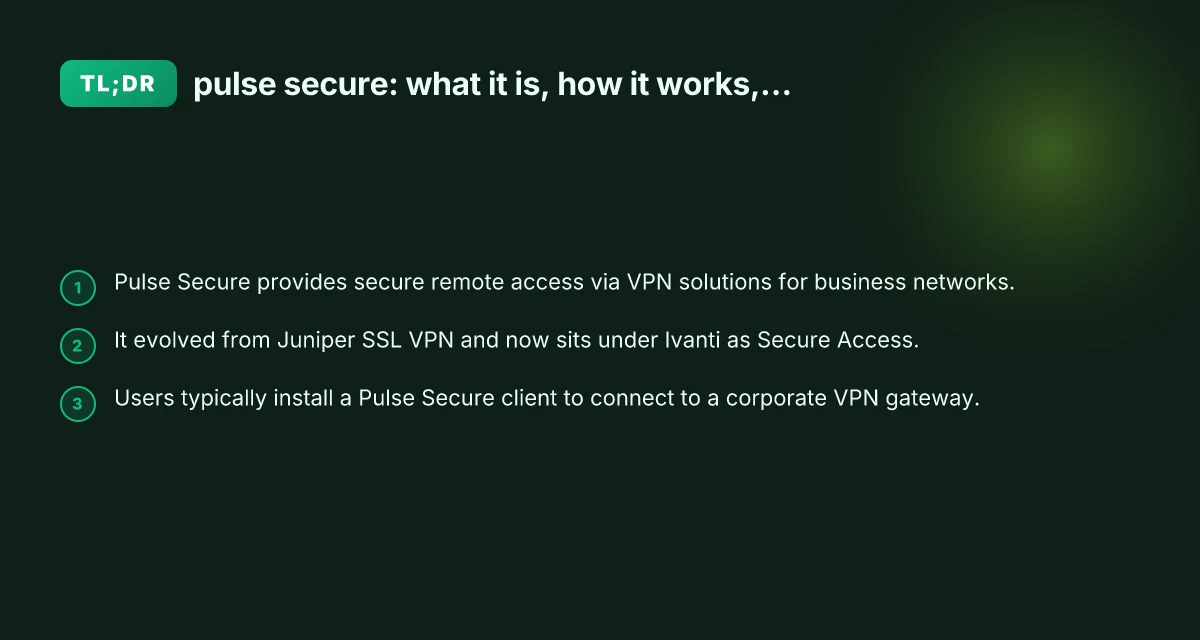
A quick guide to the Pulse Secure ecosystem
- Pulse Connect Secure (PCS): The gateway appliance that resides inside the organization’s network. It’s the server-side component that accepts connections from Pulse Secure clients and enforces access policies.
- Ivanti Secure Access Client: The modern client app that users install on devices to establish VPN tunnels to the PCS gateway.
- MFA and identity integration: Pulse Secure deployments are frequently integrated with enterprise identity providers to enable strong authentication.
- Policy-driven access: IT teams define who can access what, when, and from which devices, providing the principle of least privilege.
Here’s a simple table to help you distinguish roles at a glance:
| Component | Role | Typical use |
|---|---|---|
| Pulse Secure client | Client-side app on user devices | Initiates secure connection to the gateway |
| Pulse Connect Secure gateway | Server-side gateway in the enterprise network | Validates users, enforces policies, routes traffic |
| Ivanti Secure Access / Secure Access Client | Branding for the client app under Ivanti’s portfolio | End-user experience for remote access |
| MFA/IdP integration | Identity verification layer | Strengthens authentication and access control |
Quick reference: common questions and quick answers
| Question | Pulse Secure stance | Short answer | Related risk | Suggested action | Link in article (conceptual) |
|---|---|---|---|---|---|
| Is Pulse Secure suitable for enterprise? | Yes | Yes with proper config | Medium | Plan deployment | What Pulse Secure is and does |
| Can Pulse Secure replace IPSec/VPN? | Yes in SSL/TLS form | Yes, with caveats | Medium | Compare features | How it works in practice |
| Does Pulse Secure support mobile users? | Yes | Yes | Low | Enable mobile clients | Using Pulse Secure: setup |
| Is there a free version? | Mostly paid tiers | Limited free trial | Low | Evaluate, then choose | Pulse Secure ecosystem |
| How secure is it? | Strong encryption | AES-256 + TLS | Low | Regular audits | Security considerations |
Compiled November 2026; check the provider's site for current details.
Security considerations and best practices
- Keep software up to date: Ensure both the client and gateway run supported versions with current security patches.
- Enforce MFA: Multi-factor authentication significantly reduces the risk of compromised credentials.
- Implement posture checks: Require devices to meet security criteria (antivirus status, OS version, security updates) before granting access.
- Monitor and log access: Maintain logs for auditing and anomaly detection, and review them regularly.
- Use least privilege: Grant users access only to the resources they need for their role.
If you’re responsible for security in your organization, consider a layered approach that includes network-level protections, identity security, device hygiene, and continuous monitoring. Pulse Secure can play a central role in such a strategy by providing controlled, auditable remote access. Proton VPN for Edge
A short recommendation
If your organization relies on remote work, a Pulse Secure-based setup can offer reliable, policy-driven secure access to internal resources. When evaluating options, focus on how well the deployment aligns with your identity strategy (MFA, SSO), how scalable the gateway is for your user base, and how effectively you can enforce posture and access controls. For users, make sure you have the right client version, the correct connection profile from your IT team, and a clear understanding of any prerequisites like device compliance checks.
If you’re simply trying to connect temporarily to a corporate VPN for a project, follow the instructions from your IT department exactly. If you’re researching for a broader IT strategy, consider how Pulse Secure fits into Ivanti’s Secure Access suite and how it complements other security tools you use, such as endpoint protection, identity management, and network segmentation.