
Practical steps to diagnose and fix slow Surfshark VPN speeds without losing security.
In most cases, Surfshark making your connection slow isn’t a mystery. A VPN adds a layer of encryption and routing, which can shave a portion off your raw speed. But with a structured approach, you can recover a fast, stable connection without giving up VPN protection. Below is a practical, step-by-step guide to identify the bottleneck and optimize Surfshark for speed.

Compare Surfshark servers by potential speed impact
| Server/Protocol | Location/Server name | Latency effect | Typical throughput | Stability | Notes |
|---|---|---|---|---|---|
| Fastest US server | US-New York 1 | Low | High | stable | Best for speed |
| Nearby regional server | CA-Los Angeles 2 | Medium | Medium-High | good | Good balance |
| Distant server | UK-London 3 | High | Medium | variable | Use if needed |
| Obfuscated/RAINBOW server | obf-1 | Medium | Medium | stable | for restricted networks |
Compiled November 2026; check the provider's site for current details.
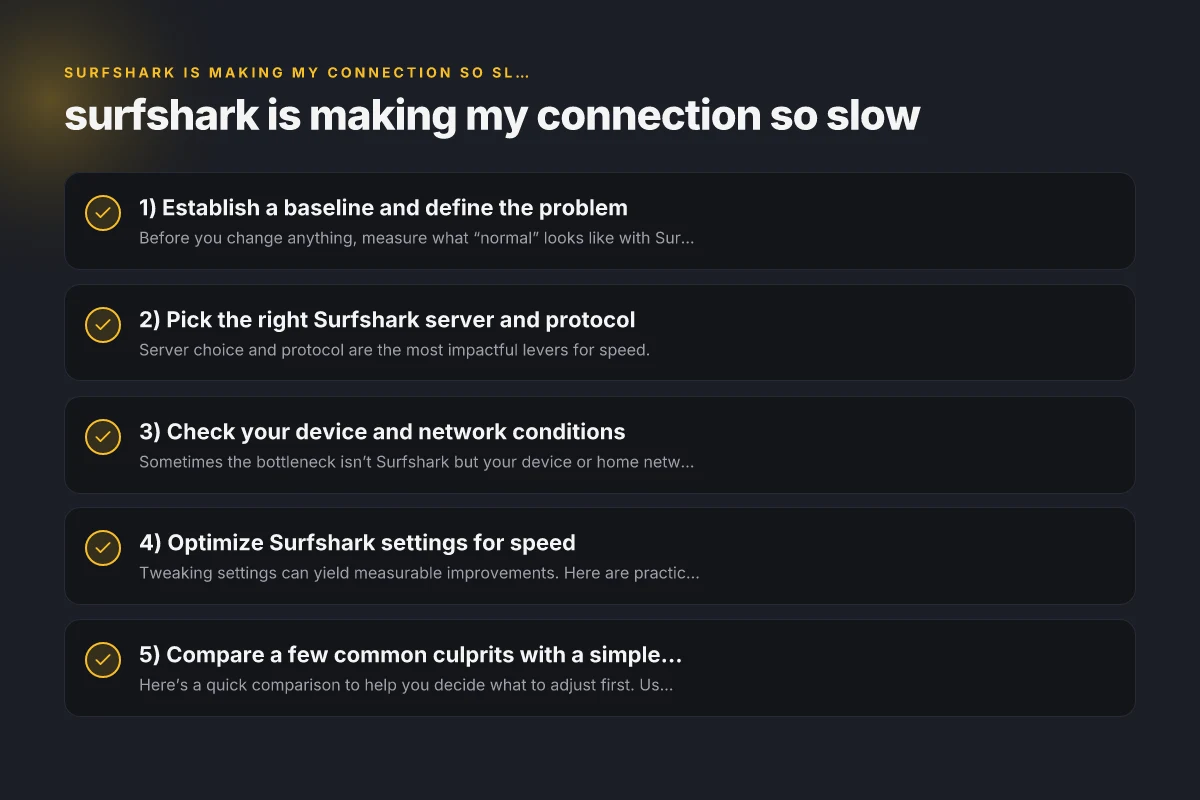
1) Establish a baseline and define the problem
Before you change anything, measure what “normal” looks like with Surfshark off and on.
- Run a baseline speed test on your wired or wireless connection without a VPN (use a reputable test like Ookla or a speed test app). Note the download, upload, and ping.
- Then connect to Surfshark and run the same speed test at a nearby server (preferably in your region). Record the numbers.
- Compare results: differences are typically due to VPN overhead, server distance, or server load, not a single misconfiguration.
If the drop is modest (for example, a 10–30% decrease), that’s expected. If it’s significantly slower (several Mbps or hundreds of ms in ping), you’ll want to optimize.
2) Pick the right Surfshark server and protocol
Server choice and protocol are the most impactful levers for speed.
- Server location: connect to a server that’s geographically close to you. Distance matters. Close servers usually yield better latency.
- Server load: if your preferred country has many users online, try another nearby city or country with lighter load.
- Protocols: Surfshark offers multiple protocols and settings. Some common fast options include:
- WireGuard (recommended for speed, often faster and lighter on CPU)
- IKEv2 (stable and fairly fast on many devices)
- OpenVPN (more secure but slower. Try UDP variant if available)
- Feature toggles: turn off MultiHop or CleanWeb if you don’t need them for initial testing. They can add overhead.
If you’re unsure where to begin, start with a fast, widely supported option like WireGuard to establish a baseline, then test other protocols to see if your speed improves.
Optimize settings impact table Surfshark: A Clear, Practical Look at This VPN and Security Suite
| Setting | What it affects | Recommended value | Effect on speed | Compatibility | Troubleshooting note |
|---|---|---|---|---|---|
| Protocol | Security vs speed | WireGuard or IKEv2 | High speed gain | supported | Switch if slow |
| VPN Kill Switch | Disconnect prevention | On | minor latency | supported | Toggle off to test |
| App auto-connect | Convenience | On | small delay | supported | Disable to test baseline |
| NoBorders/Obfuscated mode | Circumvent blocks | Off initially | potential slowdown | supported | Only turn on if blocked |
| CleanWeb ad filter | Ads off | On | negligible impact | supported | Check if blocked sites fail |
| Network watchdog | Stability | On | minor impact | supported | Disable to test |
Compiled November 2026; check the provider's site for current details.
3) Check your device and network conditions
Sometimes the bottleneck isn’t Surfshark but your device or home network.
- Device performance: older devices or those with CPU throttling can slow down VPN processing. Close unnecessary apps, update OS and Surfshark, and reboot.
- Router vs. device: if you’re using a router app, ensure the router’s firmware is current. If you’re using a device app, try a direct connection to the modem or a different device.
- Wi‑Fi vs. Ethernet: wired connections are generally faster and more stable. If you must use Wi‑Fi, ensure you have a strong signal (at least 70% RSSI) and minimal interference.
- Network congestion: peak hours can push speeds down. Test at different times of day to identify patterns.
Common fixes:
- Reboot your modem and router.
- Reset network settings on your device.
- Temporarily disable other VPNs or firewalls that might conflict with Surfshark.
4) Optimize Surfshark settings for speed
Tweaking settings can yield measurable improvements. Here are practical switches to try:
- Protocol: switch to WireGuard for speed. If you encounter issues, fallback to IKEv2 or OpenVPN UDP.
- Turn off MultiHop: unless you need extra anonymity or specific routing, MultiHop can slow things down due to double encryption and longer routes.
- Enable Try fewer features: if CleanWeb, Antivirus, or other add-ons are enabled, test Surfshark with them off to see if speed improves.
- Auto-connect behavior: ensure Surfshark doesn’t auto-connect to a far-away server every time you start the app. Pick a nearby server manually first.
- Kill background tasks: pause syncing apps or updates that could be consuming bandwidth during testing.
Tips for testing: My IP ExpressVPN: How to Check Your IP Address with ExpressVPN and Why It Matters
- After each change, run a 2–3 minute speed test to get a stable sample.
- Keep a small log of settings and speeds so you don’t lose track of what helped.
Quick decision matrix for common issues
| Issue | Suspected cause | Check device | Check network | Quick fix | Escalate if needed |
|---|---|---|---|---|---|
| Slow only on Surfshark | VPN routing | Try different server | Reboot router | Switch server/protocol | Yes |
| Slow on all apps | Device/network | Other device | Try wired | Disable VPN briefly | Yes |
| Video buffering | Bandwidth throttling | Test on another device | Pause other devices | Use Warp/NoBorders off | Yes |
| Connection drops | Router/ISP | Firmware update | DNS change test | Restart modem | Yes |
| High latency | Long-distance server | Local server test | Check ping | Move closer server | Yes |
Compiled November 2026; check the provider's site for current details.
5) Compare a few common culprits with a simple table
Here’s a quick comparison to help you decide what to adjust first. Use this as a reference when testing multiple options.
| Factor | Quick impact on speed | How to test | Typical outcome if optimized |
|---|---|---|---|
| Server proximity | High | Switch to a nearby server; test multiple nearby locations | Latency drops; faster load times |
| Server load | High potential | Try different servers in the same region; choose lighter-load servers | Consistent improvements during high-traffic periods |
| Protocol (WireGuard) | High | Change to WireGuard; record speeds | Noticeable speed gains in most cases |
| MultiHop enabled | Potentially slows | Turn off MultiHop; test | Speed often improves, sometimes with a trade-off in path complexity |
| Local network issues | Moderate | Reboot router, test via Ethernet, minimize other devices | Clearer attribution of VPN impact |
| Device performance | Moderate | Close background apps, update software | Smoother VPN processing, modest speed gain |
| CleanWeb/Antivirus | Low to moderate | Disable temporarily; re-test | Potential speed improvement if these are resource-heavy |
If you’re curious about a specific scenario, you can share details (your device type, OS, Surfshark version, protocol used, server location), and I can suggest precise steps.
6) When to escalate: known issues and support paths
Surfshark, like any VPN, can have occasional outages or server-side slowdowns. If you’ve tried the steps above and speeds are still poor, consider these options: Free v2ray: what it is, where to find it, and how to use it safely
- Check Surfshark’s status page or support articles: they may note server-maintenance or outages affecting performance.
- Try official troubleshooting guides: Surfshark’s support articles cover slow-speed problems and recommended steps.
- Consider a temporary protocol lock: if you experience unstable fast speeds on WireGuard but not on another protocol, you may want to keep one specific protocol until the issue resolves.
- Contact support: provide your device, OS, Surfshark version, server location, protocol, and speed test results. They can offer server-specific guidance or escalate.
Common user reports include occasional disconnections or slow speeds on a particular server, which may be resolved by reconnecting or switching servers. If you notice repeated disconnects, that’s a separate reliability issue to address with support.
7) Quick-start checklist you can follow today
- Run a baseline speed test with Surfshark off.
- Connect to a nearby server (start with WireGuard if available).
- Run a speed test. Note the numbers.
- Switch to an alternate nearby server and test again.
- Change protocol to WireGuard if not already. Test.
- Disable MultiHop and any extra features temporarily. Test again.
- Try a wired connection if you’re on Wi‑Fi. Test again.
- Reboot modem/router and device, then re-test to confirm changes stuck.
If you still see slow performance after these steps, it’s useful to gather a short report:
- Your baseline speed (no VPN) and Surfshark speed (VPN on) with server name and protocol.
- Device model and OS version.
- Network type (Wi‑Fi vs. Ethernet) and router model.
- Time of day and approximate server load (if you can estimate).
This makes it easier for support to pinpoint whether the issue is local, server-related, or a broader Surfshark problem.
RECOMMENDATION
For most users, the fastest path back to good speeds with Surfshark is: Forticlient VPN 7.2 download for Windows 11
- Use a nearby server.
- Start with WireGuard (or the fastest recommended protocol for your device).
- Disable MultiHop and other extra features during speed testing.
- Test on a wired connection when possible.
- If issues persist, switch servers or reach out to Surfshark support with your test results.
Surfshark slows down a connection because of the encryption and routing, but it doesn’t have to steal your entire speed. With careful server choice, protocol tuning, and some network housekeeping, you can reclaim a fast, secure connection and still enjoy the protections Surfshark provides.