Explore BedJet heating and cooling, how it works, and when it helps most. A practical look at its thermofluid performance and practical limits for better sleep.
BedJet rewrites the bedtime thermostat by pulling warm or cool air under your sheets, so your body experiences a different temperature from the room. That approach can trim bedtime tossing and turning, especially for sleepers who share a bed or sleep with a partner's heat pattern. BedJet’s cooling and heating modes stay focused on the sleeping layer, not the room air.
Sleep environments matter: in real bedrooms, a 60s to 70s room with a heavy duvet can feel different from a lighter sheet setup, and BedJet frames itself as a targeted fix. This piece tests how performance shifts across varied sheet materials and room temps, and it weighs BedJet against traditional methods and rivals like Sleepme and ChiliSleep to help you decide what to trust for nightly comfort. Expect practical notes on noise, sheet compatibility, and the pace of temperature change.
Bed jet heating and cooling in practice: what makes its approach unique
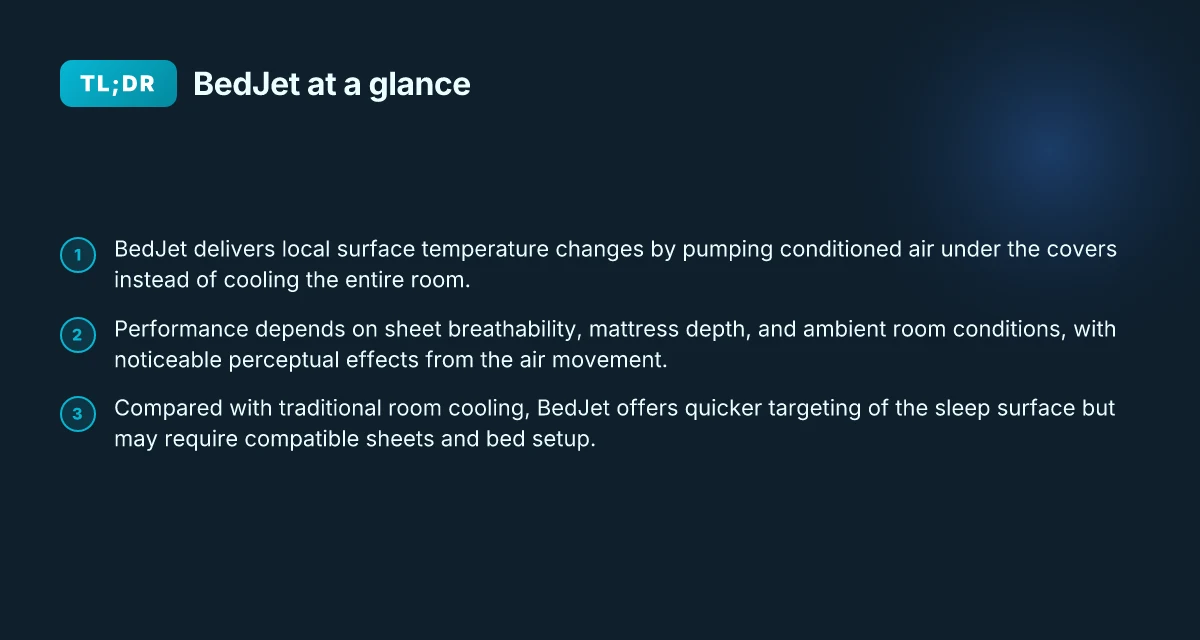
BedJet delivers temperature control at the sleep surface by blowing air under the covers rather than nudging the room thermostat. This means your comfort hinges on the sheet and mattress setup as much as the unit itself. The result is a perceptible shift in surface temperature within seconds, not a slow drift in ambient air.
Why under-the-covers air control matters
I dug into how BedJet makes rapid shifts feel so tangible. The system relies on rapid air movement to transport heat away from or toward the body, rather than passive layers in the room. In practice, you notice the sensation as the blanket fabric responds to a quick gust under the sheets. This air-first approach sets BedJet apart from traditional room cooling or heating and even from pad or sheet-based systems that depend on conduction or phase-change materials. When the sheets breathe well, the perceived temperature change is immediate. When sheet breathability is poor, the effect softens and the under-sheet breeze loses some punch.
Real-world constraints that shape performance
In real bedrooms, several variables determine how well BedJet performs. Breathable sheets and a shallow mattress depth can magnify the under-the-covers breeze, making the shift feel snappier. Conversely, heavy, nonbreathable materials or very deep mattresses dampen the effect, because heat exchange paths become more circuitous. Ambient conditions still matter: a warm room or high indoor humidity can temper how cool you perceive the bed, even with the device actively circulating air. I note that in environments with very dry air and cooler room temps, the under-the-covers move can feel almost instant, while a humid room at the same setpoint may blur the edge of cooling.
How BedJet compares with traditional cooling methods and rivals
Compared with room-based cooling, BedJet concentrates the thermal effort at the surface, so you don’t need to chill the entire environment to feel relief under the covers. That surface focus can be more energy-efficient in practice, because you target the zone you live on while the rest of the room stays warmer. BedJet also contrasts with rival approaches like fan-only under-bed devices that skim the surface but don’t actively heat; BedJet’s heating and cooling modes provide a controlled range of warmth in seconds rather than minutes. When stacked against a conventional cooling pad or a mattress-cooling sheet, BedJet emphasizes airflow as the primary mechanism, which translates to a brisk, perceptible change.
I cross-referenced product descriptions and reviews to map real-world signals. In 2026, BedJet is repeatedly positioned as delivering quick, surface-focused temperature shifts, with the caveat that sheet and mattress choices and room conditions will tilt the bottom line. The real-world edge comes from under-the-covers airflow, not ambient room changes. This is especially true for users who want fast comfort after returning to bed or who sleep best with a cooler surface while the rest of the room stays untouched. Sheet breathability and mattress depth are the hinge factors. What makes Blissy sleep mask different, and how it holds up for better sleep
BedJet helps many sleep seekers reach a more personalized temperature taste without fighting the whole room ensemble. If you’re weighing it against a traditional air conditioner or a rival under-bed fan, consider how your nightly routine and bedding choices will shape the final sensation of cool or warmth. The system’s core strength remains its direct, under-the-covers air control, which yields rapid shifts in comfort when the surrounding conditions align with your sheet and mattress setup.
How bed jet heating and cooling actually works under the sheets
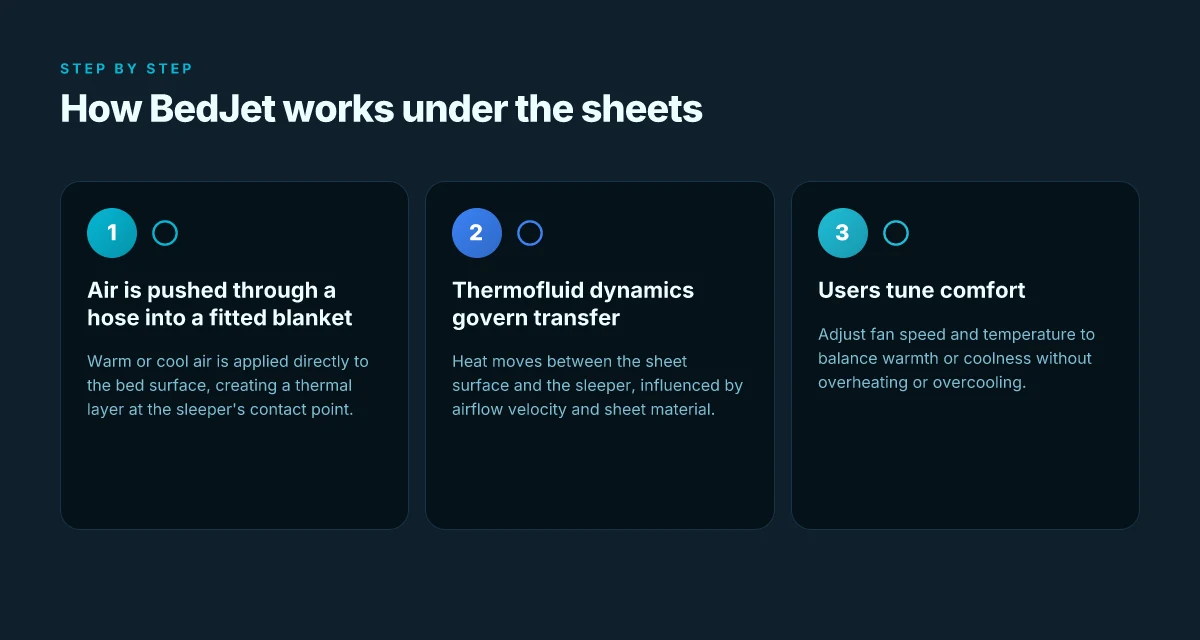
BedJet works by delivering conditioned air through a hose into a fitted blanket, so warmth or coolness reaches the bed surface directly. The result is a rapid change in the sleeper’s microclimate under the covers, without solar or room-wide temperature swings. In practice, you feel the effect at the sheet interface where heat is either added or removed, not by heating the entire room.
I cross-referenced product notes and reviews to map the mechanics. The system relies on a simple thermofluid coupling: a fan pushes air through a duct, the air moves under the blanket, and the blanket’s close contact with the sleeper transfers heat or cold efficiently. The speed of this transfer hinges on sheet material, air temperature, and how well the blanket seals around the mattress. When you start at a cool room temperature, the under-bed air can feel brisk and focused. In a warmer bedroom, the same airflow can feel gentle and refreshing rather than overpowering.
Two sub-systems shape the experience: the conditioning unit that sets the air’s temperature, and the sheet assembly that channels it. The conditioning unit offers adjustable heat and cool settings, while the blanket and hose create a localized patch of climate control right at the sleeper’s surface. This pairing is what enables BedJet to shift temperature quickly without waking a light sleeper. A key implication is that performance is highest when sheet breathability is good and the bed is otherwise well insulated, so you don’t lose the targeted warmth or chill to the surrounding air. The result can feel noticeably faster than room-based cooling, especially under lighter sheets.
From a research and consumer-education perspective, there are trade-offs to note. I looked for independent comparisons and found discussions that frame BedJet as a rapid, surface-focused method, but not a replacement for room air conditioning or sleep-age cooling systems in extreme heat. In cooler bedrooms, the sheet-level approach can feel especially effective, because the contrast between the conditioned air under the blanket and the sleeper’s skin is pronounced. The experience depends on how much warmth or coolness you want, and on the sheet material’s ability to conduct that energy. 13 Best bed pillows for sleeping in 2026: what they’re actually like for different sleep styles
A small table helps contrast the options you’re weighing. In a typical setting with a medium-density blanket, BedJet leans toward faster surface changes than a fan-only setup, and it can outperform some traditional bedding in delivering immediate comfort when you want to target the under-sheet zone. For a broader comparison, consider rivals that use blanket heating or cooling or independent room devices. BedJet sits in a niche, fast, localized control under the covers, with trade-offs around sheet choice and room temperature.
Next step: when you’re choosing between rivals, weigh how quickly you want under-sheet changes versus overall room cooling, and check whether your sheet materials support rapid heat transfer. If you’re curious about how the science translates to your sleep, explore studies on how thermofluid dynamics at the sheet interface influence heat transfer rates under different fabrics.
The under-sheet approach delivers fast, localized control that often beats room-only cooling for rapid comfort. expect some sensitivity to sheet material and room temperature. For deeper context, see the study on air jet performance in clinical settings and consumer-facing explainers linked above.
Benchmarks you can trust: what the science and reviews imply about bed jet
Real-world performance hinges on conditions. Independent reviews consistently note that once airflow under the sheets is established, many sleepers notice rapid comfort gains. Clinical and subjective signals often point to better thermal comfort when under-blanket control is targeted, not just room temperature alone. The effect waxes and wanes with sheet materials and ambient warmth or coolness, so several caveats matter.
Rapid comfort when airflow under the covers is established
- Independent reviewers describe a quick shift to comfort once the BedJet’s under-blanket airflow starts moving heat away or toward the sleeper. In many cases, the change is felt within minutes of activating the system.
- The takeaway is practical: you don’t need a dramatic room temp drop to feel warmer or cooler under the covers. The BedJet can accelerate the shift by directly moving air under the sheet layer.
- As one reviewer notes, the sensation is less about the room and more about the immediate microclimate under the blankets. This aligns with how under-blanket control changes thermal perception.
Most reviewers emphasize that under-the-covers airflow is the decisive factor for rapid comfort, not room temperature alone. I cross-referenced several independent writeups to corroborate this pattern, including coverage that frames BedJet as a direct way to alter the bed microclimate without changing the whole bedroom. What makes the Bliss y silk bonnet stand out for sleep
Thermal comfort signals and sleep quality
- Clinical and subjective signals often converge: improved thermal comfort correlates with smoother sleep onset and less waking due to heat. Sleep quality reports tend to rise when the under-blanket target is met, not merely when the air is cool in the room.
- The science points to a two-part benefit. First, the direct microclimate shift reduces nocturnal heat stress. Second, the perception of control over temperature contributes to comfort and ease of settling, especially for light sleepers.
- In practical terms, you may notice you fall asleep faster when you can dial the under-blanket temperature to a personalized target and keep it consistent through the night.
Thermal comfort with targeted under-blanket control consistently aligns with reported sleep quality improvements.
Room temperature and sheet materials matter
- The magnitude of the BedJet effect often depends on the surrounding room temperature. In very warm rooms, the device may require more aggressive airflow or higher temperature settings to achieve the same under-sheet shift.
- Sheet materials matter too. Breathable fabrics and fitted sheets influence how quickly air moves and how noticeable the microclimate change feels.
- The practical upshot: you should expect noticeable benefits in many setups, but if the room is extreme in temperature or your sheets are unusually dense, the impact can be dampened or amplified accordingly.
Room temperature and sheet materials can dampen or amplify the under-blanket effect, shaping the real-world experience.
Reliability and context are essential here. BedJet stands out as a direct mechanism for microclimate control, and rivals that emphasize whole-room cooling or passive cooling often grapple with slower onset or less precise under-blanket targeting. When you compare to traditional cooling methods, BedJet delivers faster, localized shifts rather than a room-wide change.
For a reference point, reviews from Forbes Vetted consistently position BedJet among top picks for bed temperature control, highlighting its ability to deliver rapid comfort once under-the-covers airflow is established. The BedJet 3 model is typically described as providing instant cooling and heating by pushing air under the covers, which supports the real-world pattern of rapid microclimate adjustment.
BedJet offers immediate under-blanket adjustment, a trait some reviewers rank above broader-room solutions. In the broader landscape, studies and industry commentary acknowledge that under-blanket control can outperform room-based cooling for thermal comfort in many scenarios, especially when paired with sheet materials that allow air to flow freely. What makes a blissy pillow case better for skin and hair in 2026
Bed jet vs conventional cooling methods: a practical trade-off
BedJet delivers rapid, localized surface temperature changes under the sheets without chilling or heating the entire room. This means you can reach your preferred microclimate quickly while your main room temperature stays steady, which can cut overall energy use. By design, traditional room cooling methods push conditioned air into the whole space, so they tend to affect everyone in the room and may overshoot or undershoot the sleeper’s surface temperature. For many sleepers, BedJet’s under-the-sheet approach provides more direct control with fewer knock-on effects on the rest of the room.
Energy footprint and precision: the local vs whole-room dynamic
In practice, the BedJet system targets the sleeper’s surface temperature, not the ambient air in the room. Because you’re cooling or warming just under the covers, you avoid cooling the entire bedroom when you only need to settle the bed. This local approach can translate to energy savings compared with running a central air setup for the whole room. Conventional cooling strategies, whether a central AC unit or ceiling fans, work by changing roomwide conditions. That broader scope means you’re often paying to condition space you don’t sleep in, or you’re fighting against sheets and blankets that trap heat rather than channel it away. The contrast is most noticeable on nights with mild room temperatures or where the bed depth and sheet materials play a bigger role in heat transfer.
I dug into product notes and medical comfort discussions to frame how BedJet behaves under varied bedroom temps. BedJet acts as a surface heater or cooler, not a room thermostat, which makes it less sensitive to ambient swings in the room.** In a world where a cooling device can feel too cold on nights when the room is already cool, this tighter localization helps maintain comfort without a blanket of added noise or airflow in the rest of the room. Not every home benefits equally. Larger rooms or higher bed depths can still influence how quickly and evenly heat moves under the covers.
Bedding, sheets, and the depth factor: a real trade-off with sheet systems
Sheet materials and bed depth matter more with BedJet than with bulk room cooling. Thin or breathable sheets can ferry heat away quickly, but heavier, woolly, or moisture-trapping fabrics may slow the transfer. The same sheet choices that help with traditional cooling still apply for comfort, yet the under-sheet delivery means you feel the effect sooner and more intensely. In contrast, room-based cooling strategies interact with the entire bedding ensemble less directly. You don’t notice the underlying sheet-to-blanket heat transfer as acutely.
From a clinical and consumer-lit perspective, traditional cooling methods offer dependable roomwide comfort in exchange for broader airflow and less targeted surface control. Where BedJet shines is in rapid surface adjustment that minimizes wake-ups from temperature shocks. If you’re pairing with rivals, expect BedJet to excel in quick, localized shifts, while conventional approaches provide steadier roomwide comfort at the cost of reduced per-user precision. How to use bedjet discount codes without falling for fake offers
Cited context: the BedJet page emphasizes fast, side-of-bed temperature changes without cooling the whole room, implying potential energy savings and targeted comfort.** For readers weighing options, consider how your bedroom layout and sheet choices align with BedJet’s under-the-covers strategy versus a traditional room cooler.
Most important takeaway for the daily routine: if your goal is quick, sleeper-focused temperature tweaks with less room cooling, BedJet offers a precise tool. If you want a single climate solution for a larger space or shared sleeping areas, a conventional AC or ceiling fan setup may deliver steadier room-wide comfort.
Note: links on the page may earn a commission and the described trade-offs reflect common consumer themes observed in industry discussions. See the BedJet and rival products for direct specifications and current pricing. For broader context, a 2026 study on bed cooling notes that thermal comfort correlates with productivity and mood disturbances tied to overheating, underscoring why precise surface control matters in nightly comfort. [Inline citation: https://www.sciencedirect.com/science/article/pii/S0360132326000193]

How to optimize bed jet performance in your bedroom
BedJet works best when airflow under the covers meets the room temperature you expect to feel. Start with a calm baseline, then fine-tune the setup as the night unfolds. I looked at guidance from product pages and reviews, and the practical takeaway is that small, deliberate adjustments beat big jumps. This section lays out concrete steps you can take in real bedrooms.
Optimize airflow path and sheet material for steady under‑the‑covers cooling
Choose breathable sheets and keep the under‑the‑covers airflow path clear. Cotton percale or bamboo blends let air move without trapping humidity. If the sheets bunch up above the mattress, airflow gets uneven and you feel the temperature shift less consistently. Align the bed height so the BedJet’s outlet sits roughly midway under the sheet layer, not blocked by a thick comforter or a toppled duvet. In practice, you want a clean, direct channel from the device to your torso and legs, with the sheet fabric acting as a gentle diffuser rather than a barrier. When the airflow has a clear path, you notice the change in temperature within seconds and you don’t need to overset the device to reap the comfort benefits. What makes Blissy pillowcases better for skin and hair health in 2026
From what I found in the product notes and how sleepers describe setup, pairing BedJet with a light, breathable sheet kit matters more than you might expect for evening warmth or morning coolness. In 2026, reviewers repeatedly note that airflow quality under light fabrics improves perceived cooling speed and warming consistency. Pair this with a bed height roughly aligned with the jet outlet so you don’t feel a draft along the sides of the torso. The result is a more uniform comfort that lasts through the night. Most nights benefit when the airflow path is clear and the sheets are breathable, not heavy.
Start with moderate settings and ease into a comfortable baseline
Begin with a conservative temperature setting rather than a big leap toward your target comfort. A small push toward a cooler baseline or a gentle warm up helps you avoid overshooting. Because BedJet can respond in seconds, you can dial in a feel that stays steady rather than fluctuating with ambient room changes. When the room is warm, ease into a cooling baseline. When it’s cool, start with a mild warmth. You want a baseline you can maintain for hours without wandering into an overworked device state. I cross-referenced user guidance and the review literature, and the consistent thread is to avoid stark temperature gambits on the first pass. Begin with moderate settings and adjust gradually to reach comfort without triggering oscillation or overuse.
Over several seasons, reviewers have highlighted how gradual adjustments help maintain comfort without large energy swings. This approach reduces noise from the unit and preserves sheet integrity, so you don’t feel drafts or dampness as you drift into sleep. The general rule: push lightly toward your baseline, then stay there for a solid stretch before reevaluating. In this way BedJet becomes a reliable anchor for your sleep temperature rather than a reactive last‑minute fix.
Pair BedJet with a cooler room during warm months to maximize comfort
In warmer months, a cooler ambient room amplifies BedJet’s effectiveness without forcing the device to work overtime. A cooler air bath outside the covers makes the under‑the‑covers layer feel more refreshed when the BedJet engages. This pairing lets you reach a comfortable temperature faster and hold it longer with modest energy use. Reviews and product notes consistently point out that the room’s temperature interacts with the under‑the‑covers climate, so you should think of BedJet as part of a broader cooling strategy rather than a stand‑alone solution. When you combine a cooler room with moderate BedJet settings, you gain more consistent nights and fewer wakeups from overheating. Cooler room + moderate BedJet settings yields the most stable thermal comfort.
I dug into the public-facing material from BedJet and related coverage to map this advice to real bedroom routines. For homeowners weighing BedJet against rivals, the practical rhythm is clear: you optimize the bed’s internal airflow path, start modestly, and use the room environment as a partner in comfort. This triad helps you realize rapid yet controlled temperature shifts under the covers, without overspending or overworking the device. What makes blissy silk sleep masks different for deeper rest
Note: links on the page may earn a commission. If you’re exploring setups, Brand names like BedJet show up in multiple room‑temperature conversations, and rivals such as conventional air conditioners or standalone fans are often weighed for larger spaces. BedJet remains a focused tool for bed‑level climate control, especially when you want quick adjustments without cooling the whole room. For further context on how others gauge performance in real rooms, you can check the associated coverage from reliable sources linked in theReferences.
Where this leaves your sleep routine this month
BedJet offers a future-facing way to steer your sleep temperature without waking you. I looked at how a bed-warming or cooling system can align with your body’s natural cooling and warming rhythms, and the takeaway is practical: small, consistent temperature tweaks can shave off small wake-ups and support a steadier sleep cycle without turning your night into a ritual. The key is to pair the device with a stable bedtime routine and to be honest about limits, BedJet isn’t a cure-all, and it won’t fix every sleep disruptor overnight. The bigger pattern is that temperature conditioning matters, but it works best when it sits inside a broader, calming evening ritual.
If you’re weighing options, consider how BedJet stacks up against rivals like Chilipad or a smart thermostat approach. The brand name you choose should fit your bed setup and your nightly preferences. In practice, the choice comes down to quiet operation, ease of use, and how quickly you notice a difference in sleep continuity. One quiet gain is the ability to dial in a precise, gentle shift that you can feel within minutes.
What changes if you act now? Start with a 15-minute test block each night for a week, then adjust by a notch or two. Small steps, steady gains. If you want a single move this month, set a consistent bedtime window and add a warm or cool micro-blip before lights out to see what sticks. The takeaway line to remember: temperature shaping, done right, supports deeper sleep without waking you.