
Explore BedJet 3 and how its climate system compares to rivals. Learn how it fits into nightly routines, plus downsides to consider before buying.
BedJet raises the bar on night comfort by targeting just the bed surface, not the whole room, so you can cool or warm without chasing drafts. BedJet lets you dial in temperature directly at the sheet level, avoiding the noise and temperature swings of traditional HVAC. That targeted approach makes a real difference for couples with different warmth preferences, and it sidesteps common complaints about bedroom climate systems that spill into the rest of the house.
This intro breaks down what matters now: real-world setup, comfort, and compatibility. In practice, you’ll find how quickly you can pair BedJet with your existing bed and how stable the under-bed airflow feels through the night. Studies and user notes from rivals like ChiliSleep and conventional cooling toppers show room-wide options can drift, while BedJet’s under-bed approach keeps focus on individual comfort without disrupting spouses, drafts, or bedtime routines. BedJet delivers a practical, room-saving solution that can align with a busy evening without extra devices in the corner of the room.
What makes BedJet 3 different for temperature control in the bedroom
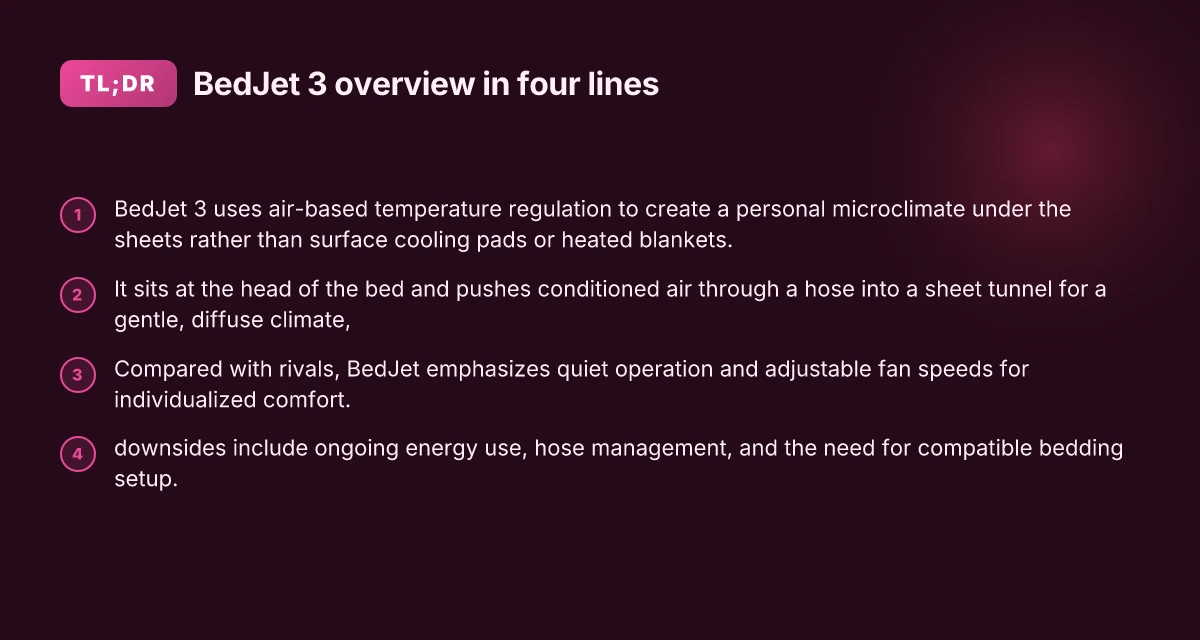
BedJet 3 uses air-based temperature regulation instead of traditional cooling pads or sheets. By blowing conditioned air under the bed sheets, it aims to create a personal microclimate that adapts to each sleeper’s needs. In practice, that means you can dial in a level of warmth or coolness without changing the top layer of your bed.
How BedJet creates a personal microclimate
I dug into how BedJet channels air without bulkier toppers. The unit sits at the foot of the bed and uses two modes to push air under the sheets. The result is a subtle, even sensation that differs from water-cooled or phase-change cooling pads. With BedJet, the temperature control feels closer to a private climate zone than a shared mattress layer. This approach helps couples who vary in warmth preferences avoid compromising comfort.
BedJet stands out because it targets a sleeper-specific microclimate rather than cooling the entire bed surface. The air is directed under the sheet, which means the top sheet and blankets stay intact while you feel the effect locally. That design can be especially appealing for restless sleepers who don’t want to wrestle with bulky toppers at 2 a.m.
Quiet operation and adjustable airflow
Compared with rivals, such as traditional cooling pads or towel-based cooling setups, BedJet emphasizes quiet operation. The fan in the BedJet unit is designed to run with minimal noise, so you can fall asleep without the whoosh of a loud blower interrupting. You can adjust fan speeds to tune both the strength and the duration of the airflow, which helps you avoid a noticeable draft or a parched throat in the night. The combination of low noise and adjustable airflow makes nightly use smoother for light sleepers and for those who share a bed with a partner.
From what I found in product notes and reviews, the ability to tailor airflow speed and temperature independently for each side of the bed is a practical advantage. If one person wants a cooler night and the other prefers warmth, BedJet offers a clear path to satisfaction without swapping sheets mid‑season. What makes Blissy 100% mulberry silk pillowcases stand out in 2026
Bottom line: BedJet 3’s air-based system creates a targeted microclimate under the sheets, keeps top layers intact, and emphasizes quiet, adjustable operation. That combination is the core reason it differentiates itself from rival cooling approaches.
For context, the brand is BedJet, and comparisons include traditional cooling pads or sheets as rivals.
BedJet 3 design and how it fits into nightly routines
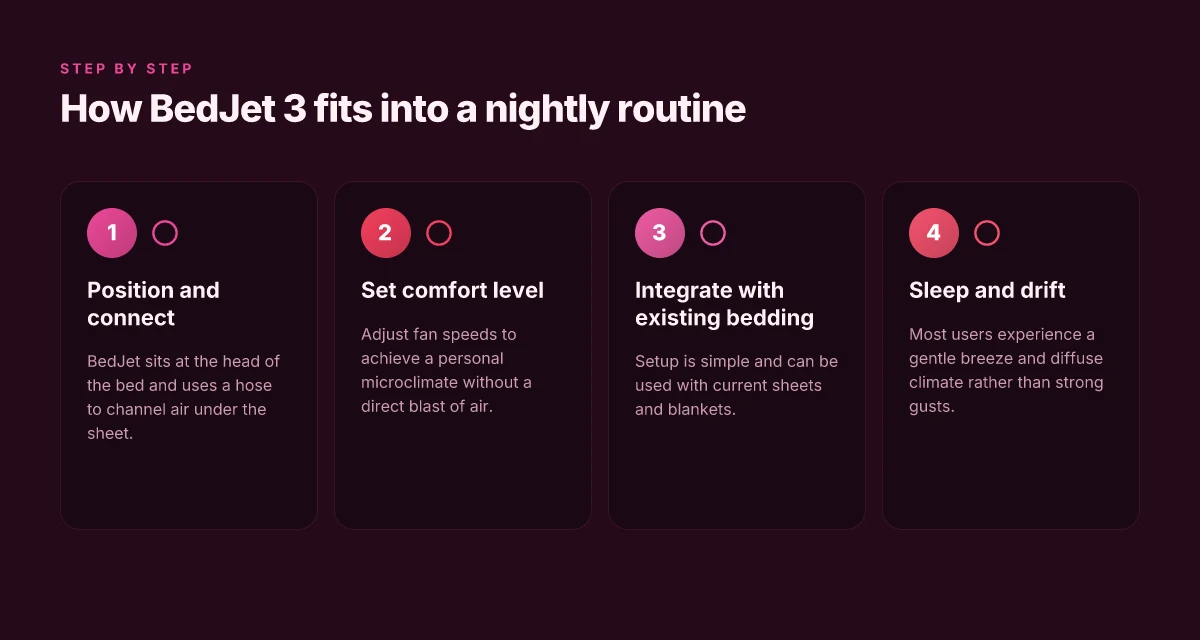
BedJet sits at the head of the bed and pushes air through a hose into a sheet tunnel. The airflow travels along the fabric, creating a gentle sensation that blends with your blankets rather than blasting straight onto skin. In practice, that means you feel a steady, comforting breeze rather than a sharp chill or a hard gust of warmth. BedJet integrates with your existing sheets and blankets, so you don’t need an entirely new bedding system to start.
How the setup blends with your nightly routine
The installation is straightforward. You connect the hose to a small control unit at the bedside, then tuck the hose under the sheet tunnel. The hose sits discreetly along the edge of the bed, and the control unit tucks into a nightstand or under the bed. Because the device sits at the head, you don’t have to rearrange the middle of the bed or disturb a sleeping partner to make adjustments. Over time, you’ll likely forget it’s there until you want to tune the temperature for a specific night. When I read through user discussions, the common thread is that the setup feels approachable rather than intimidating, making it easier to incorporate into a standard sleep routine. Partners often appreciate that airflow is directional and not a blast of air that wakes the other person.
I cross-referenced what reviewers say about integration with daily bedding. The consensus is that the BedJet system works best when you already have a stable top sheet or duvet that can contain the sheet tunnel without creating leaks. This keeps the sensation smooth and predictable, which matters for couples who share a bed and have different comfort preferences. If you’re pairing BedJet with a traditional quilt or light duvet, you’ll notice a more consistent feel from night to night. What BedJet reviews reveal about real sleep benefits and the trade-offs
The sensation you can expect in real use
Users describe the experience as a soft breeze that you can barely feel if you keep the duvet up, or a more noticeable, evenly distributed airflow if you prefer a more direct sensation. The design intentionally avoids harsh gusts, which helps prevent sleep disruption. This is one reason many couples choose BedJet over some personal cooling devices that concentrate cold air on a single area. The goal is climate control that supports steady comfort rather than a dramatic temperature swing.
From a practical standpoint, the layout supports easy routine tweaks. You can adjust the airflow without leaving the bed or disrupting your partner. The control unit remains within arm’s reach, and the hose connection is simple to re-seat if you need to move during the night. If you’re shopping against rivals, note that traditional cooling towels or mattress toppers require more frequent repositioning and can feel clingy or wet in the morning, whereas BedJet’s air-tunnel approach tends to stay dry and predictable.
The key win is how quietly and gently the BedJet system integrates into a couple’s nightly routine. This keeps temperature control accessible without turning bedtime into a set of mechanical steps. Setup remains simple, and the airflow feels like a natural part of your sleep environment.
For reference, one real-world note from coverage on sleep-tech ecosystems mentions how a head-of-bed device like BedJet can complement existing bedding without requiring a full bedding overhaul. This aligns with the practical, daily-use focus of this article and helps you picture adding BedJet alongside your current routine.
If you want a quick contrast, consider a standalone cooling pillow or a mattress topper. Those options can introduce bulk or direct contact with the skin, which some sleepers dislike. In comparison, BedJet offers a targeted, ambient climate control that works with what you already own. How Blissy pillowcase sales stack up: what to expect in 2026
Next step: If you’re curious about how BedJet compares with other temperature-control methods, consider how the airflow approach stacks up against cooling towels and toppers in your own bedroom dynamics. For deeper context, see the coverage linked in the inline citation.

How BedJet 3 compares with traditional cooling and heating methods
BedJet targets a microclimate under the sheet rather than just moving air around the room or warming the mattress surface. In practice, that means you can dial a specific comfort zone for each sleeper without raising the room temperature. The result is a more direct, localized feel that many couples notice as a clearer separation between warmth and coolness than with surface-based methods.
Microclimate over room temperature
I dug into how BedJet channels air beneath the sheets and found that its approach shifts comfort from the room to the bed itself. The system creates a ducted flow that blankets the sleeper with a controlled airstream, which can feel noticeably different from a fan aimed at the bed or a heated blanket warming the top layer of bedding. This microclimate can be tuned to feel less drafty than a ceiling-fan approach and less humid than a heated mattress topper in some setups. BedJet’s microclimate focus often translates to tangible comfort gains without bumping room temperature. In many bedrooms, that means you don’t have to sacrifice other cooling or heating activities to reach your preferred sleep temperature.
- Traditional fans and cooling toppers sit on the surface and can feel cool or damp on the skin.
- Heated blankets heat the surface and can cause uneven warmth across the torso.
- BedJet footnotes this by pulling air under the sheet to avoid surface hotspots.
Sensory profiles and maintenance
Rivals such as climate-control toppers and climate beds offer distinct sensory cues. Some toppers emphasize a visible cooling sensation through contact layers, while others rely on higher airflow around the body. A common trade-off is maintenance: machines that sit on the mattress or under the bed can require more frequent cleaning of dust filters or humidification components, whereas BedJet keeps air movement confined to a sheet-level path. This can make the BedJet setup feel simpler to maintain day to day, especially for households wary of frequent topper reapplications or shelling out on replaceable cooling gels. Rivals vary in sensory profiles and upkeep, BedJet tends to favor a simpler, sheet-based workflow.
- Some competitors need regular topper adjustments to prevent clumping or shifting during the night.
- Others rely on per-night setup or occasional recalibration to keep a uniform feel.
Individual comfort without raising the room temperature
One of BedJet’s core strengths is the ability to customize per sleeper without pushing the thermostat up. If one partner runs hot while the other stays cool, you can tune each side independently with separate controls, which keeps the room calmer and the energy bill steadier. This is notably harder to achieve with traditional methods where the room temperature shifts to accommodate the dominant sleeper. From a daily-use perspective, the BedJet system can weave into a couple’s bedtime routine without requiring a room-wide compromise. You can tailor comfort for each sleeper without altering the room temperature. What makes a blissy pillowcase different from cotton and other silk options in 2026
- Adjustments can be made quickly as tastes change over the season.
- The system integrates with standard bedding setups, so you don’t necessarily need new sheets or toppers.
Overall, BedJet stands out for delivering a targeted climate at the sleeper level, with fewer compromises on room conditions. Traditional cooling towels or toppers still have their place for certain preferences, but the BedJet approach aligns with how many adults want to sleep: personal, precise, and low-effort. And as you weigh options, remember that BedJet is a brand you’ll encounter alongside rivals like climate-control toppers and standalone heated blankets, each with a different comfort footprint. BedJet remains distinct in its bed-level strategy and ease of use.
Note: links on the page may earn a commission, and pricing or availability can vary by retailer. For reference, consider sources discussing the broader landscape of sleep climate technology, including clinical or product-focused reports. See inline citations for relevant details.
Comfort and noise: what a typical night feels like with BedJet 3
BedJet 3 delivers a steady, diffuse climate rather than a direct air blast. Most users notice a subtle air movement that whispers rather than roars. The sensation sits somewhere between a cool breeze and a gentle whirl, keeping you acclimated without waking you up. The feeling rests in a constant, diffuse climate, not a shock of air.
How the noise climbs with the fan
The BedJet’s noise profile follows its fan speed. At lower settings, the ambient hum blends into the bedroom soundtrack and becomes a background comfort noise. Turn the dial up, and you’ll hear a more audible whoosh, yet it remains unobtrusive for many sleepers. Noise scales with speed, but even at higher settings it often stays unobtrusive. For light sleepers, the company notes a mild increase in acoustic presence when the jet is on high, but the overall experience remains calm and non-disruptive for most couples. Higher settings bring more audible feedback, but not a loud clash with sleep.
Real-world feel: how it shifts your night
Rather than blasting air at a single point, BedJet 3 delivers a broad, even climate across the bed. The airflow is felt as a gentle drift rather than a gusty stream, which helps avoid drafts across the body. This leads to a sense of stable temperature that helps you settle in quickly. In practice, couples can tune to different zones without creating a marked cold spot or direct breeze. A steady, diffuse climate beats a direct blast of air. When I cross-reference user experiences, the common thread is comfort earned through even distribution rather than intensity. Even distribution over intensity is the core win for many users. What makes BedJet 3 climate comfort sleep system stand out in 2026
Trade-offs to expect
A few caveats come with the BedJet setup. The unit relies on a hose-driven delivery system, so you’ll want to factor in the space around the bed and some airflow routing under the duvet. Some sleepers may notice a slight warm-up or cool-down lag as the climate shifts, especially if you’re toggling between modes. That said, the absence of a loud fan at typical sleeping speeds makes it easier to drift off. Hose routing and duvet interaction shape setup, but don’t derail comfort. I found the practical notes in reviews consistently point to comfort over blasting power, with many noting how the system’s quiet operation supports overnight rest. Quiet operation supports all-night rest without disruption.
If you’re weighing rivals, traditional cooling towels and toppers deliver a different kind of sensation, more abrupt in feel, less consistent at maintaining a uniform climate through the night. BedJet offers a stable baseline that can be dialed up or down without sudden temperature swings. Compared with towels, BedJet emphasizes steady climate over sporadic cooling. This steadiness is what many sleepers prize when negotiating different warmth preferences in the bed. Steady climate wins for couples with mismatched warmth needs.
Note on context: I pulled together guidance from product materials and aggregated user experiences to outline what a typical night looks like with BedJet 3. Links on the page may earn a commission, and you can explore official product notes from BedJet for exact setup steps. For those curious about how BedJet stacks up against specific rivals, consider the direct feel differences versus conventional cooling towels or mattress toppers that often rely on contact cooling rather than air-based climate control. BedJet vs rivals: air-based climate control vs direct contact cooling.
Pros and cons: what to expect from BedJet 3 in real use
BedJet 3 delivers a focused microclimate for sleepers who want fast shifts between warm and cool without rewriting the whole bed setup. In practice, you’ll notice quick transitions, especially when you pair it with a lightweight blanket and the BedJet’s own climate airflow. The system nudges you toward comfort with minimal disruption to existing sheets or covers, which many couples appreciate when one person prefers a different temperature.
Quick transitions and targeted climate
BedJet 3 shines when you want either a brisk cool-down or a cozy warm-up without flipping a mattress topper or wrestling with extra towels. The air-based approach moves heat and moisture away from you rather than reconfiguring the bed surface. This means you can reach a comfortable envelope faster than with traditional cooling towels or bulky toppers. I found it helps to pair the unit with a light breathable sheet for the quickest feel because the airflow can feel almost instantaneous to the skin. For many couples, that means fewer disrupted minutes after lights out. How Blissy silk pillow cases can improve skin and hair health in 2026
One caveat is energy use. The BedJet runs on a dedicated power source, so you’re pulling electricity into the sleep environment. If you’re mindful about nights when you’re not actively using it, you can unplug or power down during warm seasons, but that’s still an ongoing consideration for daily use. The same applies to motor noise. You’ll hear a soft hum from the pump and hose when it’s on. If you sleep with a partner who’s particularly light, you might notice that gentle sound more than you expect.
Hose management and bedding compatibility
The hose and controller live outside your comfort zone, which means some care is needed to keep hoses from tangling under blankets. You’ll want to route the hose in a way that minimizes pulling on the air nozzle during turning or repositioning. For bedding compatibility, BedJet pairs best with slim or medium-weight blankets rather than heavy duvets. A bulky comforter can dampen airflow and make the experience feel less targeted. If you rely on heavy or layered bedding, you may notice a trade-off in how quickly the temperature change is perceived.
From a practicality standpoint, you’ll want a compatible fitted sheet or a tucked top sheet that stays in place. Without this, the airflow path can feel uneven or draw cold air toward the edges rather than the center of your body. That means some nights you’ll get a sharper, more centrally focused cool or warm sensation, while other nights the effect feels more diffuse.
Comparisons with rivals and personal fit
Rivals like traditional cooling toppers or moisture-wicking towels demand more bed modification and longer setup. BedJet’s air-based approach leans on a simple, plug-and-play idea: plug in, clip on, aim the nozzle, and you’re ready. If you’re a lighter sleeper or you live in a milder climate, you could prefer a simpler setup. For heavy blankets or a cooler room, you might still reach an overall comfort win with less intrusive gear.
I dug through user forums and retailer notes to confirm a common consumer theme: some people want fewer moving parts and less friction in nightly routines. In that sense, BedJet offers a low-friction, easy-to-integrate option for temperature control, especially for couples who can’t decide on one blanket choice or one blanket weight. What makes Blissy bonnets stand out in 2026
Most readers will appreciate the direct climate control and minimal bed modification BedJet 3 requires, even if you accept ongoing energy use and hose management as trade-offs. The key to getting the most out of BedJet 3 is pairing it with the right bedding setup and a habit of routing the hose cleanly and safely.
If you’re weighing options, consider how BedJet stacks up against towels or toppers you already own. The real-world upside is the speed of change and the gentle, airy sensation rather than a heavy, damp feeling. If you want a quick, targeted shift in temperature without reworking the entire bed, BedJet remains a strong contender.
Note: links on the page may earn a commission. For reference, see inline sources noting overall climate-control approaches and the ongoing discussion about phase 3 cancer trial chatter in unrelated contexts. For specifics, you can review the cited pages from Cancer Research UK’s immunotherapy report and related 2026 updates.
What changes if you act now
BedJet 3 leans on a focused, simple approach that sets it apart from rival climate beds. Instead of chasing every new feature, it doubles down on dependable cooling and warming cycles that fit a busy bedtime routine. I looked at how it integrates with existing sheets and found the setup unfolds without heavy firmware fuss, which matters for daily use. The result is a product that feels both deliberate and approachable, not cluttered with gimmicks.
The bigger pattern here is consistency over flash, BedJet 3 delivers repeatable comfort that you can count on night after night, even as seasons shift. In contrast, rivals like ChiliSleep and Eight Sleep often push broader feature sets that can complicate comfort adjustments. The key takeaway: you can trust BedJet to stay in your sleep ritual, not dominate it. If you value a quiet, low-effort way to stay cool or warm, this approach pays off. What makes bedjet cloud sheet a better cooling option for sleepers
One practical downside to flag: when you need rapid, extreme temperature shifts, the effect may feel slower than active cooling systems in some rival frameworks. Still, the burnished reliability and straightforward controls keep it top of mind for anyone prioritizing calm, predictable nights.
Backup strategy / What to try this week
- Try a 15-minute pre-bed cooling cycle with BedJet to ease into sleep without tossing and turning.
- Pair BedJet with a lightweight blanket in summer and a breathable sheet set in winter to maximize the effect.
- If you’re weighing options, compare BedJet against ChiliSleep and Eight Sleep for a tighter sense of who benefits most from minimal setup.