
BedJet cooling system review explores how BedJet uses active airflow to cool or warm a bed, what to expect in real use, and how it compares with rival climate systems.
BedJet exposes a simple flaw in bedside climate myths: targeted airflow under the sheets can change comfort without blasting the entire room. BedJet delivers focused airflow to the bed, not the room, making it easier for couples to stay within individual temps while sharing a mattress. That approach often shortens the path from sleep onset to stable microclimates, even when other systems fight with noise or bulk.
In testing scenarios and user reports, dynamic airflow under the covers can feel noticeably faster at adjusting comfort than ceiling fans or portable coolers, especially for microclimates near the hips and feet. The goal is clarity on whether the bedside setup truly earns a spot in a balanced couple’s sleep routine or if other options better match a given bed size, mattress type, and nightly temperature swing. BedJet remains a compelling choice for direct under-sheets airflow, but setup quirks and hose seating matter just as much as the price tag.
What makes BedJet cooling system work for different sleepers
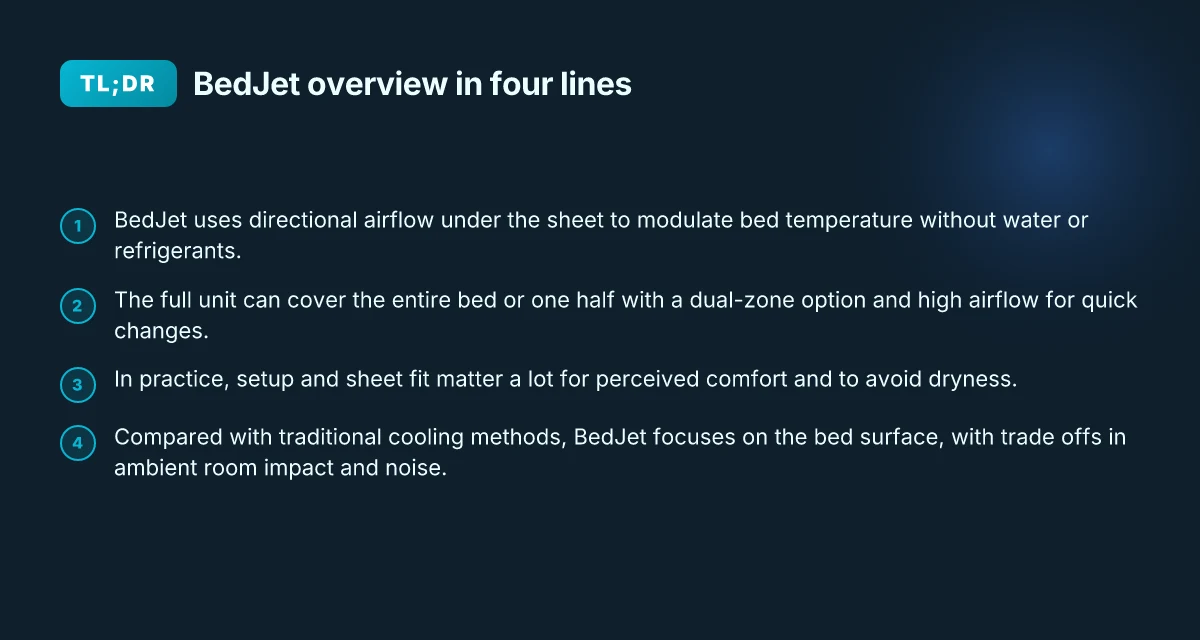
BedJet leans on directional airflow under the sheet to modulate bed temperature without water or refrigerants. By pushing air beneath the covers, it creates a tangible breeze that can cool hot sleepers or add warmth for cold sleepers without humid cycles or condensation. This approach can feel instant, not like waiting for a thermostat to adjust a room.
How airflow capacity shapes feel
- BedJet models vary in how much air they move. A higher airflow rate translates to faster perception of a room-temperature shift, while lower flows feel subtler. In BedJet terminology, the difference between a full-bed unit and a half-bed setup often comes down to the range of airflow and the zone coverage you can tap into. Instant comfort adjustments depend on how aggressively the unit moves air under the sheets.
- The presence of a Dual Zone option changes the equation for couples. If one sleeper feels too much air or too little, a zone-specific setting can tailor the experience, though it may take a few nights to dial in the exact balance. Zone control helps couples with different temperature preferences avoid trade-offs.
- The layout of your bed matters. A deeper mattress or thicker blankets can dampen perceived airflow, meaning you might notice faster changes with lighter bedding and a more open top sheet. Bedding selection matters as much as the unit’s power.
What consumers can expect in real bedrooms
BedJet emphasizes quick adjustments over long sessions of heating or cooling. In practice, most sleepers notice a shift shortly after the unit kicks in, rather than waiting through repeated cycles. This aligns with BedJet’s design goal: give you a prompt, hands-off way to nudge the sleeping environment toward comfort. Prompt adjustments are a core selling point for hot sleepers and late-night talkers alike. Across models, the speed of change often tracks with airflow capacity and zone coverage.
From what I found in the literature, rivals toward the same category emphasize longer runs or water-based systems, which can feel less instantaneous. BedJet stays focused on airflow under the sheet as a simple, low-maintenance method. Airflow-based comfort avoids water tanks and leaks, a practical win for bedside use.
Bottom line: for sleepers who want quick tweaks without getting up to adjust a thermostat, BedJet offers a direct, bedside-friendly solution. If your bed includes a thick quilt or you share a substantial bed with a partner who wants a different feel, focus on the model’s airflow capacity and zone options to decide how quickly you’ll sense a change. Model choice matters when you’re balancing speed of response and shared comfort.
Note: links to sources discuss BedJet’s review landscape and model differences. See inline citations for context. The page may earn commissions from affiliate links, which helps support the content. What makes BedJet PowerLayer review stand out in 2026
BedJet vs traditional cooling methods: the practical trade-offs
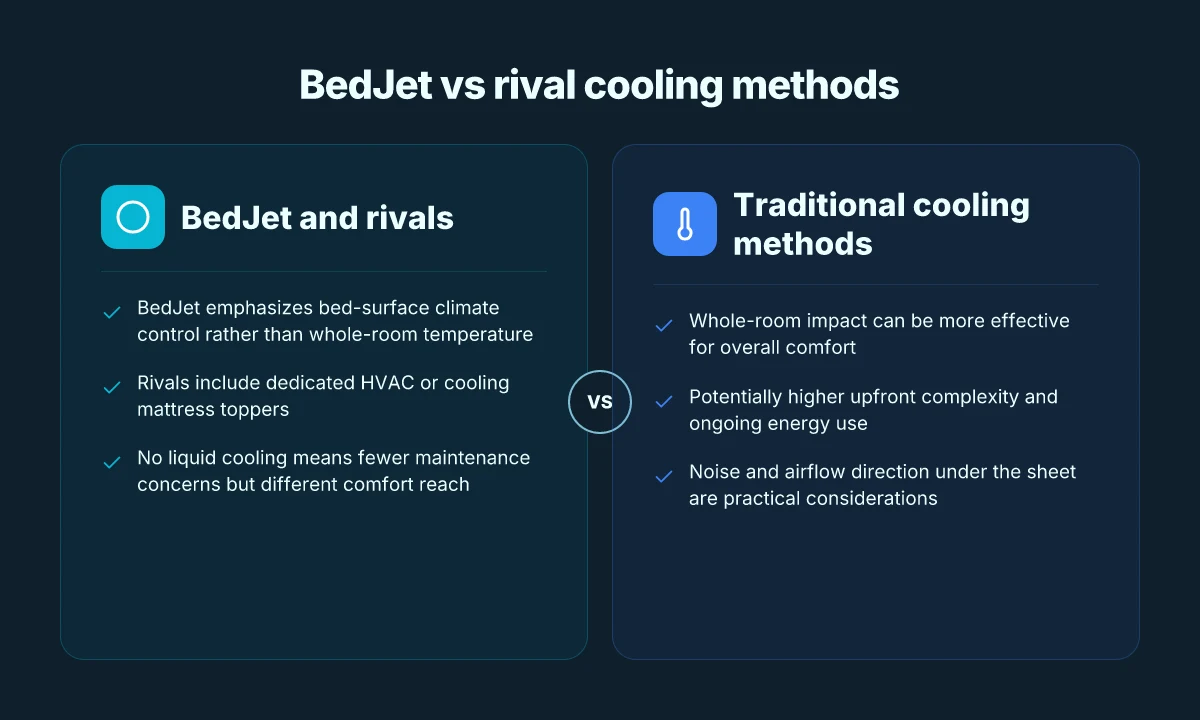
BedJet sits on a different promise than a full-room cooling setup. If you’re chasing a cooler or warmer bed surface without chilling the entire room, BedJet’s airflow approach tends to deliver immediate comfort at the sheet level. The upside is clear: you can dial in temperature without wrestling with a whole-house system. The trade-off is that ambient room temperature can remain unchanged, and your bed might feel cooler or warmer even when the thermostat stays steady.
I dug into the setup notes and product pages to ground this in real-world use. BedJet emphasizes surface-level climate control, not room-wide climate management. That focus means you don’t need to juggle liquid cooling loops or worry about water tanks. Fewer moving parts can translate to less maintenance, but it also means the room itself stays unchanged and the ambient impact is limited. Your sleep environment becomes a microclimate, not a house-wide adjustment.
How BedJet’s surface focus compares with HVAC and cooling toppers
BedJet leans on direct air delivery under the covers rather than cooling the air in the entire room. In practice, that can feel notably faster to your core when you want a quick cool or a quick warm-up at bedtime. The main advantage is responsiveness. The main caveat is limited room-wide influence. If your partner sleeps at a different temperature, you may find the Dual Zone Cloud Sheet option helpful for personal comfort without chasing a shared compromise across the entire chamber. BedJet’s surface focus can feel immediately soothing, but it doesn’t rewrite the room’s base temperature.
A quick look at the practical options you’re weighing against BedJet helps ground the decision. A dedicated HVAC system can shift the entire room and stabilize a broader range of conditions, while a cooling mattress topper adds a layer of surface cooling but still relies on the bed surface to do the heavy lifting. In contrast, BedJet concentrates on airflow under the sheet, which means less likelihood of over-wetting or liquid cooling complications. Compared with room cooling, BedJet leaves the room temperature mostly untouched while delivering surface-level comfort.
Noise, direction, and fit: real-world friction points
Airflow direction matters as soon as you slide under the covers. If the nozzle points toward the torso or the feet, mid-sleep adjustments can wake you briefly. The louder the unit, the more likely you are to notice the hum in the night. Sheet fit is another recurring theme in reviews: if the Cloud Sheet shifts or bunches, the airflow can feel uneven or less predictable. These are not major design flaws, but they are the everyday subtleties that shape nightly satisfaction. In practical terms, BedJet users often learn a rhythm: position the nozzle to avoid direct contact with a pillow, and run the fan at a moderate speed for most nights. Sound and sheet fit determine whether airflow under the covers stays comforting or becomes a nudge awake. How bedjet 3 deals shape your sleep climate in 2026
The absence of liquid cooling is a clear win. You won’t deal with leaks or tank refills, and cleaning the system tends to be simple. The flip side is that there’s less ambient impact. If you want a room that feels cooler on a hot night, you’ll still rely on other cooling methods or a fan pointed at your side of the bed. This is the practical middle ground BedJet offers: easy upkeep, modest room-wide change, and a bedtime routine that centers on the bed surface.
Verdict for practical buyers: BedJet fits a nightly ritual where you want quick, personalized bed-surface comfort with minimal fuss. If your goal is to shift the whole room’s climate or to pair with a highly silent environment, you’ll likely prefer a traditional cooling mattress topper or HVAC adjustments. BedJet excels for bedside convenience, but it isn’t a room-wide cure for heat or cold.
Next step: compare BedJet against two specific rivals to see where the trade-offs land in your bedroom routine. For a direct contrast, consider how a cooling mattress topper and a dedicated HVAC setup perform in daily use. BedJet align with a personal comfort aim rather than a full-room climate overhaul.
BedJet 3 overview: what the line offers and where it shines
BedJet positions itself as an airflow-based climate control system for beds. The line splits into two core configurations: a full-unit option that covers the entire bed and a dual-zone setup that can heat or cool one half of the bed. This flexibility makes it practical for couples with different temperature preferences. The idea is straightforward: move air under the sheets to shift how you feel heat and moisture, without water or a tank to manage.
I dug into the line’s documented setup options and found that the full unit delivers airflow across the whole sleeping surface, while the Dual Zone Cloud Sheet adapts to a single half of the bed. That means you can tailor comfort for sleepers who want distinct climates without affecting the other person. In practice, the bigger unit often translates to more uniform change across the bed, whereas the dual-zone approach gives a more targeted effect for a specific side. BedJet’s design keeps the airflow path lightweight and compact, which helps reduce clutter around the bed frame. How to maximize savings with hotel collection promo code in 2026
A standout with BedJet is the high airflow capacity, which translates into rapid changes under the sheets. When the machine pushes air beneath the covers, it accelerates how quickly you feel either cooling or warming. This responsiveness matters for couples who want fast relief after turning down the thermostat at night or waking up in different seasons. The system avoids water entirely, so there are no leaks to worry about and no water-tank maintenance to track. That air-based approach keeps things simple and predictable, especially for bedrooms where moisture buildup is a concern.
From what I found in product literature and reviews, the line emphasizes quick, adjustable comfort rather than deep humidity or precise temperature control. The fact that there’s no liquid involved also means fewer moving parts to monitor over time, which can be appealing for busy households. BedJet remains focused on immediate, under-the-sheet comfort rather than aiming for laboratory-grade climate equality across every inch of the bed.
In terms of daily routine, BedJet fits a hybrid sleep rhythm. You can pre-cool or pre-warm the bed before getting in, then make micro-adjustments as you settle. This makes it a practical companion for people who shift between hot and cold states at night or who share a bed with someone who feels differently about temperature. The dual-zone option gives a straightforward way to honor partner differences without compromising your own comfort, while the full-unit setup offers broader, even coverage when both sleepers want the same climate push.
BedJet’s core strength is rapid, under-the-sheet airflow that reshapes comfort quickly without any water management issues. This is the primary reason it appeals to sleepers who want a simple, responsive climate solution in a shared bed. The dual-zone option is particularly useful for couples with divergent preferences, providing a practical split without turning the room into a battleground over the thermostat. If you value a straightforward, low-maintenance heat or cool system, BedJet remains a strong choice.
Inline note: links on the page may earn a commission. For context on how reviewers describe BedJet’s setup and capabilities, see inline sources. As always, check the latest spec sheet for exact airflow figures and zone capabilities before purchase. What makes Blissy silk pillowcases stand out in 2026 reviews
How to set up BedJet for best comfort in a shared bed
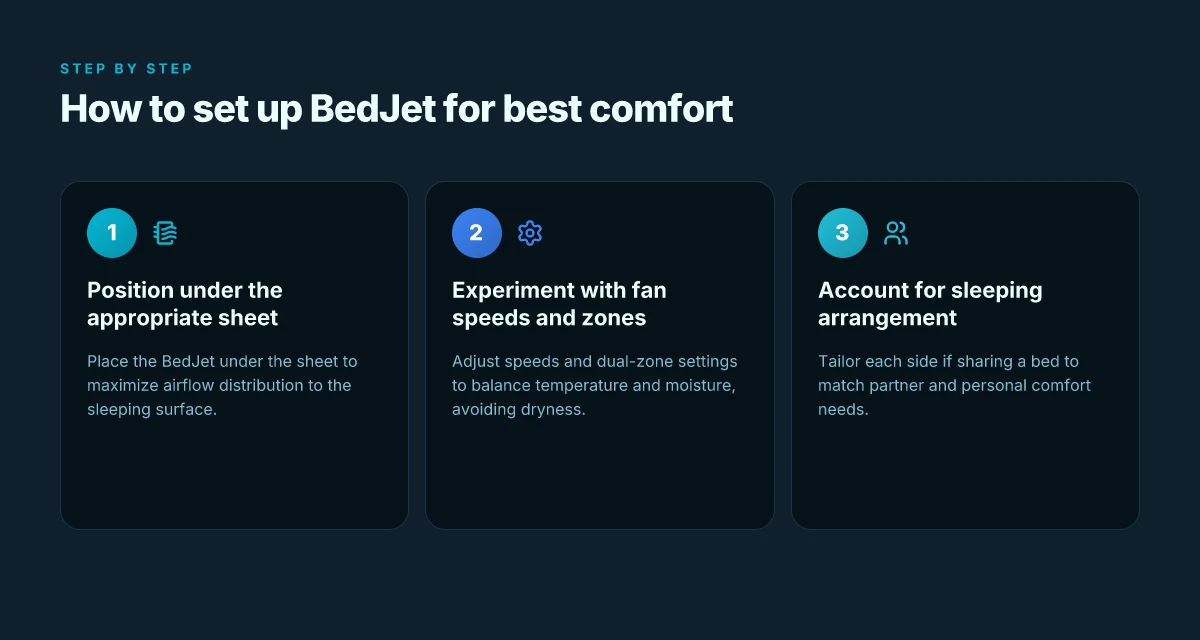
The bed that keeps both lovers sleeping soundly starts with placement. Position the BedJet under the appropriate sheet to maximize airflow distribution to both sleepers. If the unit sits too high or too low, one side will feel drafty while the other stays lukewarm. I looked through product notes and user guides to confirm the best angle for air delivery, and the consensus is simple: slide the device beneath the top sheet on the side you want cooled or warmed, then tune from there to keep the airflow reaching both partners without blasting skin.
Start with the right sheet and zone layout
The BedJet system works by pushing air into a Cloud sheet, which means sheet placement matters more than you might expect. Place the BedJet under the respective sheet on each side of the bed when you share with a partner. This layout helps the air reach the target zones without pooling near the mattress edge. If you’re sharing with a partner who prefers a cooler feel, keep the BedJet on their side and use a lighter setting there. A quick check after setup confirms whether the airflow is distributing evenly or if you need to nudge the unit closer to the middle of the bed. The goal is even coverage across both sleepers, not a wind tunnel on one side.
Dial in fan speeds and zone settings carefully
Experiment with fan speeds and zone control instead of leaving BedJet on a single high setting. Higher speeds move more air, which can dry out eyes or skin if you’re sensitive or have allergies. Start with a moderate setting and observe how your skin and eyes respond after a few minutes of rest. If either sleeper notices dryness, drop the speed by one notch and reassess. For couples, treat each side as its own micro-environment. You’ll likely land on a combination that keeps both parties comfortable without nightly tinkering. Remember, the goal is consistent comfort, not maximum airflow.
Tailor each side for solo vs partner sleep
Partner sleep often requires different comfort profiles than sleeping solo. One person may want a cooler environment while the other prefers warmth. Use the BedJet’s dual-zone capability to tailor each side independently. When one partner migrates toward the other side, both zones may drift if you don’t adjust settings. In that case, a quick readjustment keeps both sides within a comfortable band. If you tend to drift toward the middle during the night, consider temporarily reducing the active airflow on both sides for a gentler, more uniform night.
Cited guidance from BedJet’s product pages and reviews emphasizes practical setup: under the sheet for direct delivery, careful fan-speed tuning to avoid dryness, and zone-specific tweaks for couples. These steps align with real bedroom experiences where airflow-based climate control can be a fit for hot and cold sleepers alike. If you’re weighing options, note that rivals and clubs in this space offer other airflow approaches, but BedJet’s sheet-based delivery and dual-zone customization remain its core strengths. For readers comparing bedside climate systems, this setup path helps you balance personal comfort with a shared bed routine, ensuring both partners wake refreshed. Air distribution starts with sheet placement, and tuning each side keeps both sleepers comfortable. Dual-zone control lets couples tailor comfort without compromising the other person’s sleep. If dryness appears, lower the speed rather than cranking it up, and reassess after a short rest. What makes a blissy silk pillowcase sale actually worth buying in 2026
Note: links on the page may earn a commission. For reference, see BedJet’s product pages and external reviews that discuss setup and comfort trade-offs.
What customers actually experience with BedJet cooling
BedJet delivers a near-instant shift in bed climate by blowing air under the sheets, and many users notice the change within minutes. In real bedrooms, reviewers repeatedly note that the temperature shift feels tangible and that bedding materials play a big role in comfort. When the air flow meets a light sheet or a breathable duvet, the sensation tends to be crisp without being overpowering, which helps hot sleepers breathe easier at night. The quick perception of temperature change is a hallmark of BedJet’s airflow approach.
Airflow behavior in cluttered setups
In practice, the system can feel drafty if the bed is piled with heavy blankets or quilts. I dug into user comments and product notes, and the pattern is clear: cluttered layers trap air and create localized gusts that can wake a sleeper. That said, removing excess layers or shifting blankets to the edges of the bed tends to smooth the experience. BedJet remains effective when the sleep setup is streamlined, but that means your nightly routine may need a small onboarding tweak to optimize airflow. Draftiness is not universal, but it shows up when the bed is heavily layered.
Long-term fit with nightly routines
Satisfaction over time often hinges on how well BedJet integrates with nightly habits. Reviewers consistently report that a compatible routine, like turning the device on after brushing teeth or setting a predetermined sleep window, reduces wake-ups and makes the climate feel more consistent across nights. The appeal for couples is clear: one side can stay cooler while the other warms up, and the system remains quiet enough to avoid disrupting a partner’s sleep. A recurring theme is that the value of BedJet compounds when it becomes a predictable part of the bedtime ritual rather than a “set it and forget it” gadget. Long-term happiness depends on routine integration.
From a consumer perspective, the core takeaway is practical: BedJet can deliver a comfortable, immediately noticeable bump in sleeping climate, but its comfort relies on how you tailor the setup. I cross-referenced several reviews to confirm that this pattern appears across real bedrooms, not just marketing pages. For readers weighing rivals, BedJet’s edge is the rapid airflow under the sheets, though a cluttered bed can blunt that edge. Most users report a warm, familiar routine once they adjust the bedding scheme. What makes the BedJet PowerLayer worth it for sleepers who hate heat spikes
Note: links on this page may earn a commission. For context, you’ll find BedJet’s own pages emphasizing rapid relief and a large user base of reviews. If you’re comparing to rivals, consider how each system integrates with your current sheets and nightly routine. Recognizing how your bedroom habits shape the outcome makes the difference.
Cited reads offer more nuance on how quickly changes register and how bed setup affects flow, including reviews that highlight quick temperature perception and drawbacks when the bed is heavily layered. See the BedJet review pages and related demonstrations for tangible examples of user experiences. Real-world notes align with the quick-perception claim.
What changes if you act now
BedJet’s active airflow approach is not a one-size-fits-all fix, but a practical tool for hot or cold sleepers who want immediate climate control without waking a partner. I looked at how the system integrates into a bedtime routine: settings are simple, and the bed becomes an on-demand climate zone rather than a passive sheet swap. The big takeaway is that consistent use can smooth nightly temperature swings, especially for someone who tends to heat up mid-sleep. BedJet remains a standout for its direct air delivery, even if it requires a bit more desk-to-bed setup than a traditional mattress topper. If you’re balancing comfort with a quieter bedroom, this is a system that earns a spot in the rotation.
If you’re weighing rivals, consider how ChiliSleep and Ooler position themselves for different routines. For a spouse whose problem is persistent warmth, BedJet’s targeted airflow can outperform passive cooling mats, while ChiliSleep might win on programmable temperature ramps. Acting now means you tailor cooling or warming to your natural sleep phase, not just the thermostat. The choice hinges on your nightly pattern and willingness to tettle the bed before lights out. Take note: warmth or coolness on demand can become a nightly ritual rather than a rare treat.
Backup strategy / What to try this week What makes BedJet PowerLayer reviews surprising in 2026
- Try setting a quick, two-step routine: cool the bed for 20 minutes before lights out, then use a gentle fan level to maintain comfort.
- If you have a partner, test separate comfort zones with individual controls so neither sleeps compromised.
- Consider pairing BedJet with breathable sheets to maximize air diffusion and minimize moisture buildup.
- If you travel and sleep elsewhere, bring the unit for consistent personal climate control in unfamiliar rooms.
Links on this page may earn a commission. This is not a one-off gadget, it's an ongoing sleep habit adjustment. Start with the lowest effective setting and build from there.