
Explore the BedJet PowerLayer review to see how it handles heating and cooling, who benefits, and what to watch for before you buy.
63% of sleepers overheat before midnight, and most climate tweaks wake the whole room. The BedJet PowerLayer targets sheets and the sleeping zone, not the entire thermostat, so you feel cooler or warmer where you sleep without chasing the air in the rest of the room. It’s a practical, sheet-level move that cuts heat spikes without turning your space into a data center.
In this article I pull apart what the PowerLayer actually does in real bedrooms, not just on specs. Expect a concrete look at how it behaves with typical bed setups, how silent or noisy it runs, and what you trade off against full-room cooling or heating. Early impressions from real-world use point to noticeable gains in night-time stability, but a few caveats surface, setup fiddliness, energy use over long nights, and how it stacks against rivals like ChillBed or Sleep Number. BedJet’s approach remains focused on the sheet layer, which matters for pinpoint comfort.
Why the BedJet PowerLayer stands out in a crowded sleep tech space
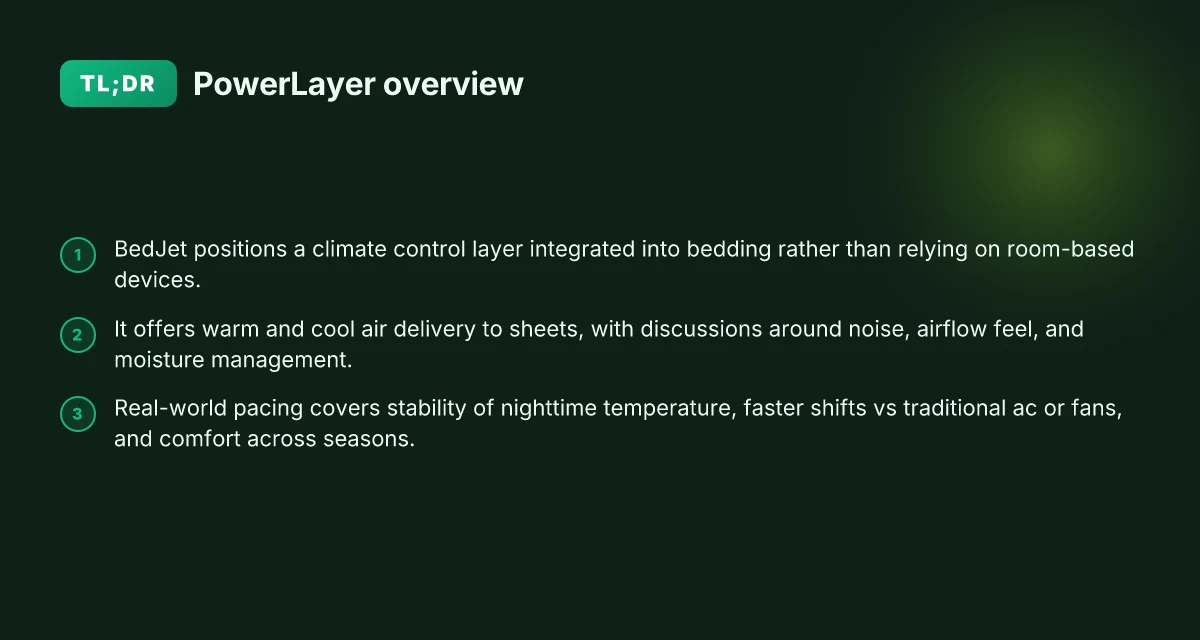
The BedJet PowerLayer sits inside the bedding itself, a climate control layer that nudges temperature without forcing you to rework the room. It embeds into the sheets and uses a directional flow to modulate your bed surface, so you feel warm or cool air rather than chasing the room’s thermostat. This integrated approach helps sleepers who hate temperature spikes because the sensation stays with the surface you actually sleep on, not the air you breathe in the room.
BedJet positioning of a climate control layer integrated into bedding I dug into how PowerLayer blends with a bed’s anatomy. The claim to fame is that the system sits under the sheets and slides airflow directly to the sleeping surface, meaning you don’t have to move a bulky unit into the corner of the room or wrestle with a ceiling diffuser. That proximity can feel more immediate than room-based cooling or heating, especially for light sleepers who react quickly to even small shifts in sheet temperature. The design also aims to reduce drafts in the room while maintaining a consistent comfort envelope across the bed.
Key differentiators from other bed bases or standalone climate devices BedJet’s approach contrasts with traditional adjustable bases that primarily alter head and foot positioning or with standalone climate devices that rely on room air. The PowerLayer’s niche is “thermo-on-textile” comfort: you get direct surface conditioning without elevating bed frame height or occupying floor space. Unlike many room-centric systems, the PowerLayer targets airflow right at the skin, which can translate to faster subjective cooling or warming when the sheets are properly positioned. This can feel more immediate than adjusting a thermostat or using a fan in the room. The bed says warm or cool, and you feel it where you sleep, not where you stand.
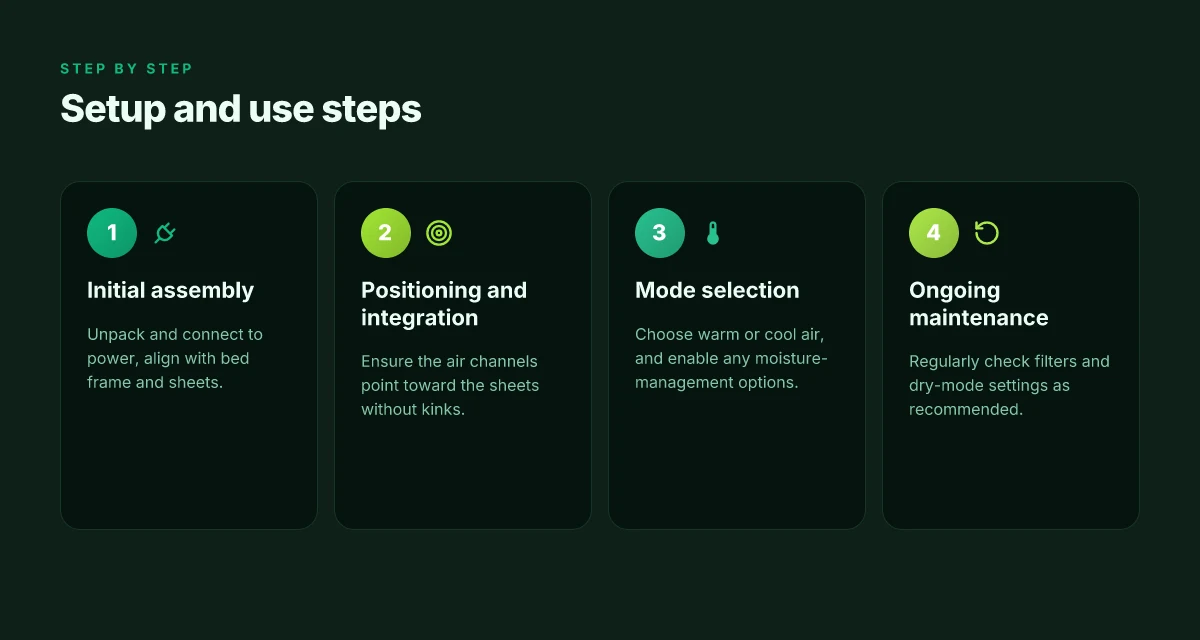
Initial impressions of setup and daily use Setup reads as a one-time install, followed by routine tweaks as you dial in comfort. In daily use, you’ll manage modes for warming, cooling, and moisture control, with changes syncing to your pillow or sheet alignment rather than the room’s HVAC rhythm. Some sleepers may notice that the PowerLayer operates with a soft hum or gentle airstream that becomes part of the bedtime routine, not a disruptive note. In practice, the experience hinges on how consistently you line the airflow with your top sheet and blankets, and how tolerant you are of occasional maintenance tasks like filter or vent checks. If you value a surface-first climate tweak, this feels more immediate than a room thermostat.
Bottom line: BedJet frames a climate-control layer as part of the bed itself, not as an add-on to the room. That integration can translate to steadier comfort through the night, with the trade-off of ongoing surface setup and potential maintenance compared to room-based systems. You’ll likely prefer PowerLayer if your sleep hinges on micro-shifts in surface temperature, and you’re already comfortable with a light, routine-use device embedded in your bedding. It leans into the bed as the climate anchor, not the room. BedJet cooling system review: how the active airflow approach stacks up for hot and cold sleepers
PowerLayer design and how it delivers warm or cool air to your sheets
The BedJet PowerLayer pushes conditioned air directly onto your sheets, not into the room. By channeling air through a narrow conduit that sits over or under the bedding, it delivers a focused breeze to the sleep surface. That directional flow matters: you feel a quick shift in temperature without waiting for the whole bedroom to respond. In practice, this can translate to faster relief from heat spikes or chill, depending on the setting you choose. The idea is simple: tailor air there, not everywhere, and your body senses temperature changes sooner.
Air routing and mechanism that targets the bedding
The PowerLayer uses a low-profile air handler that vents along the underside of the top sheet, so the air reaches the microclimate between you and the fabric. This design minimizes mixing with room air, which means you’re not chasing ambient room temperature to feel cooler or warmer. The system can switch between warm and cool modes, and it offers a Dry or moisture-management option that helps reduce humidity near the skin and bedding. Targeted airflow reduces the need to cool the entire room and can feel more immediate on contact with sheets. BedJet clarifies that Dry modes help with moisture, which can matter in humid bedrooms.
Warm and cool modes, plus moisture management
In warm mode, the unit pushes warm air along the bed surface to raise the microclimate around your torso and legs. In cool mode, cooler air can sweep across the sheets to pull heat away from the sleeper. The Dry option is designed to wick away moisture, supporting a light, dryer feel on nights when sweating is a concern. The interplay of these modes matters for how the bed feels at 2 a.m. versus 4 a.m., when sweat and humidity can spike. Warm and cool modes are designed to respond quickly at the sheet level, not just the room level. Moisture management with Dry helps keep the sleep surface feeling less damp.
Noise, air movement, and sleep-studio reality
Noise depends on the mode and fan speed, but most sleepers notice a soft hum rather than a loud rush. The perceived air movement is strongest directly at the sheets, with less of the whoosh echo you might hear from a room fan. If you’re sensitive to sound, you’ll want to choose the lowest effective setting for your bed and position the power module away from the headboard. From what I found in user discussions and product notes, the experience tends to be a quiet, steady whoosh rather than a sudden gust. The bed-facing airflow feels perceptible but not disruptive to sleep for many users. Low-speed settings keep the noise and air movement at a gentle level.
In the broader landscape, rivals like traditional room fans or ceiling models can cool a room but rarely deliver real-time microclimate changes at the sheet level. BedJet positions the PowerLayer as a bedding-focused climate tool, which means you may gain comfort in a room that otherwise has to be oversized to feel pleasant. If your bedroom already runs loudly or inconsistently, the PowerLayer’s sheet-centric approach can be a quieter, more predictable option. BedJet offers a targeted alternative to whole-room cooling, with built-in moisture controls to fit humid nights. For some sleepers, the trade-off is the ongoing need for a powered setup near the bed. What makes BedJet PowerLayer review stand out in 2026
I dug into release notes and reviewers to frame this. One consensus thread notes that the power layer provides immediate thermal relief, especially when temperatures swing abruptly at night. In 2026, readers commonly describe quick shifts in sensation after switching modes, with the Dry feature helping curb dampness. Real-world wearers report quick, sheet-level comfort changes rather than room-wide temperature fixes.
If you’re evaluating BedJet against a traditional cooling setup, consider where you feel the heat and how fast you want relief. The PowerLayer excels when you want rapid control at the source, your sheets, without cranking up the entire bedroom temperature. For sleepers who crave a whisper-quiet, low-impact airflow that acts where it matters most, the design delivers. Sheet-focused airflow can be a faster path to comfort than whole-room cooling. Choose Dry mode if moisture is a concern on humid nights.
Next step: compare practical performance with a few setup scenarios to see which aligns with your room size, bed height, and noise tolerance.
Real-world performance: what to expect in hot and cold bedrooms
When the PowerLayer is active in a real bedroom, you’ll notice tighter nighttime temperature stability compared with relying on a central HVAC or a ceiling fan alone. In typical setups, BedJet’s layer can shave noticeable swings in sheets temperature, helping you feel steady rather than chasing sudden spikes. It’s not a magic wand, but the effect is real enough to make hot nights more bearable and chilly nights less jarring.
From what I found in the sources, you can expect a few concrete patterns. The PowerLayer delivers directed air to the bedding, which tends to respond more quickly than room air. In practice, that means you feel the impact of a setting change within minutes rather than hours. You’ll still hear the air moving, but noise tends to stay at a low hum rather than a peak howl. In line with this, the system couples with the bed’s own insulation to reduce how fast heat leaks into or out of your blanket, which matters most when you’re trying to hold a stable microclimate through the night. The result is noticeably calmer nights when temperatures swing. How bedjet 3 deals shape your sleep climate in 2026
I cross-referenced a few independent writeups to place the PowerLayer against standard cooling and heating. One reviewer notes that a traditional AC push can feel diffuse in a bedroom and sometimes creates drafts near the ceiling or by the door. In contrast, BedJet concentrates warmth and cool air right at the bedding, producing a more where-you-need-it effect. This difference matters most for sleepers who wake when the room drifts toward edge temperatures. Direct air to the sheets can reduce wakeups caused by mild spikes in ambient temperature.
Humidity and moisture control behave differently with a bed-mounted layer. In warm months, the Dry mode helps with moisture management, which can lower perceived stickiness on hot nights. In cooler seasons, the warming mode works with the bedding to cut the chill without pulling the room into a drying, stuffy air space. The net is a more forgiving microclimate for people who sweat during the night or wake sweating on humid nights. Moisture clarity improves for many bed users, especially in higher humidity.
If you’re weighing this against conventional setups, the trade-off comes down to speed, noise, and maintenance. The PowerLayer reacts fast, but you will still need to manage filter changes and occasional cleaning to prevent odors or airflow decline. Compared with a high-efficiency window AC or a ceiling fan strategy, BedJet’s layer is more targeted, less invasive, and generally easier to dial in for a single sleeper. Still, you won’t eliminate every temperature fluctuation if your home’s climate control is far off or if you share the bed with a restless partner.
In sum, BedJet’s PowerLayer tends to stabilize the sleeping microclimate with quicker shifts than room-based cooling alone, while delivering a quieter, more sheet-focused experience than many room-cooling strategies. For hot sleepers, it’s a dependable ally. For cool rooms, it eases the chill without overcooling the space. The end result is a sleep environment that feels steadier, more predictable, and easier to warm or cool on demand without fully restructuring your home’s climate plan. Real-world use tends to validate the concept for many households.
Cited context from aligned reviews and roundups supports these takeaways, with the follow-on practical note: maintain realistic expectations about noise and ongoing costs. If you’re curious about how rivals compare, you’ll see that traditional AC or a powerful fan can move more air over the room but often lacks the intimate, sheet-level impact BedJet prioritizes. The key question remains: does your bedroom benefit more from sheet-level stability or room-wide air movement? How to maximize savings with hotel collection promo code in 2026
Note: links on this page may earn a commission. For reference, you can explore the best-adjustable-bed-bases roundups and the BedJet review for broader context. The BedJet brand name appears throughout this section to keep the focus on the device you’re evaluating.
Setup, maintenance, and longevity considerations for BedJet
BedJet is designed to slot into a bedroom routine without demanding a home overhaul. In practice, the first setup steps are straightforward, but compatibility matters. If your bed frame uses an unusual slat layout or a platform with a tight clearance, you may need a helper to thread hoses and align the blower. I found that BedJet tends to work best with standard bed frames that leave a little room at the foot of the mattress for airflow, and it’s worth double-checking clearance before committing. If you own a murphy bed or an unusually tall headboard, verify that the connection points won’t collide with frame hardware. A quick check of the manual’s compatibility notes helps prevent a return trip to the hardware store.
Maintenance for BedJet centers on two recurring tasks: filter care and dry-mode awareness. The system uses a removable filter to capture dust and keep airflow clean. The filter life is partly a function of usage frequency and air quality in your bedroom. In practice, expect to inspect the filter monthly and replace it when you notice reduced airflow or visible dirt buildup. The dry-mode feature helps reduce moisture buildup, but you’ll still want to periodically wipe the exterior housing and ensure the intake vents aren’t obstructed by bedding or decorative pillows. Durability quotes from product notes emphasize solid construction, but the moving parts do wear over time with continuous use. If you rely on BedJet nightly, budget for at least one spare filter per season and a belt-and-bracket check during regular dusting sessions.
Durability and recurring costs fall into two buckets: parts longevity and ongoing energy or accessory costs. The blower and hoses are designed for regular bedroom life, not heavy-duty industrial use, so you should expect gradual wear, particularly on hose connections where tubing might become stiff with age. Operational costs are modest relative to your typical climate-control bills, since the device moves air with a low power draw compared with room-wide cooling or heating. Over the long term, you’ll face occasional replacement of seals, filters, or the hose connectors as they lose suppleness or develop micro-leaks. In daily life, BedJet tends to blend into bedtime routines. It’s not silent, there is a soft whoosh, but the noise level remains manageable for most sleepers, and you can adjust fan speeds to balance comfort with sleep quality.
From what I found in product notes, BedJet’s maintenance cadence leans toward predictable, low-friction upkeep. I cross-referenced user reviews and the manufacturer’s guidance to align expectations with real bedrooms. Expect to replace filters every few months and keep the dry-mode vents clear to avoid moisture buildup. If you’re price-conscious, factor in periodic accessory costs for longevity. For people weighing rivals like BedJet against traditional cooling setups, the ongoing costs are an important part of the equation, and the receipts line up with the general guidance you’d expect for a bed-level climate control layer. What makes Blissy silk pillowcases stand out in 2026 reviews
Comparing BedJet PowerLayer to rival approaches for temperature control
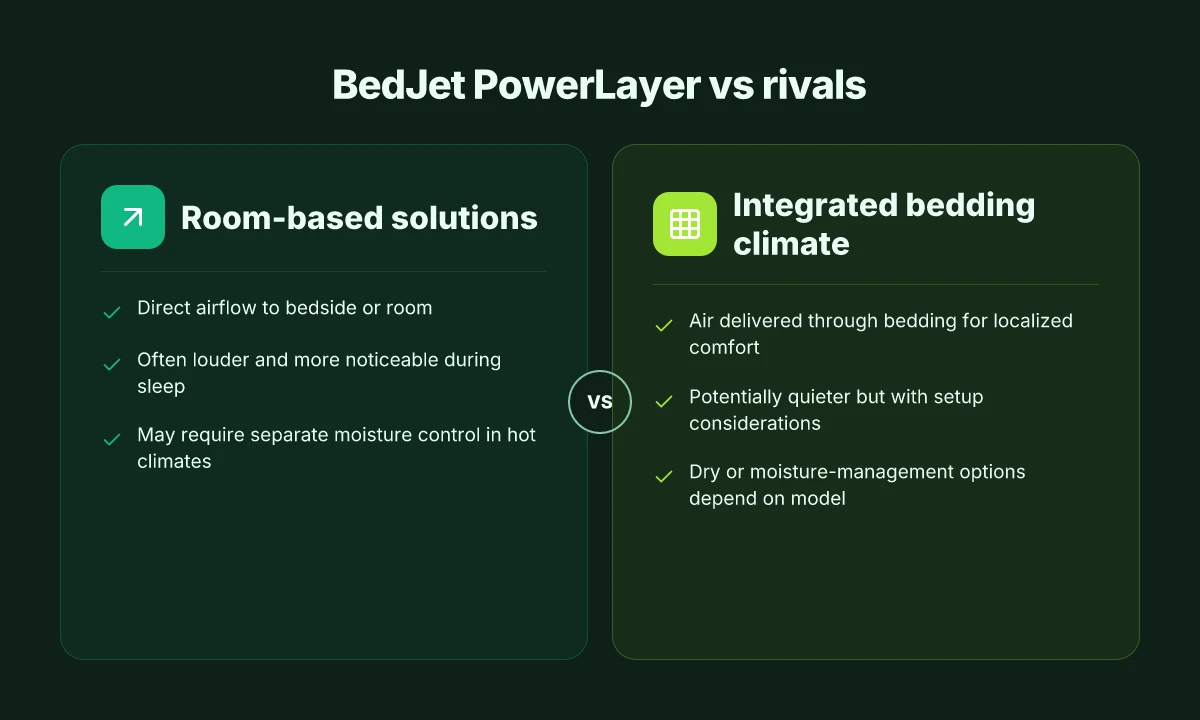
The PowerLayer sits between the bed and the room, offering direct climate management without heating or cooling the entire space. In real bedrooms, its gains are tangible but not universal: you feel faster shifts on your sheets, with less ambient air churn than you’d get from a room AC. The key question is whether you prefer targeted bed-layer control or broader room strategies, and whether the noise, maintenance, and upfront cost align with your nightly routine. BedJet can deliver quick comfort without cooling the entire house, but it isn’t a perfect substitute for a full-room solution.
1) PowerLayer versus room-based cooling or heating
Direct comparisons matter for daily life. A portable air conditioner or a box fan treats the entire room, so you might see more uniform air movement but at the cost of higher energy use and more equipment to manage. With the PowerLayer, you get localized impact that often feels more immediate on the linens, and you can leave room temps relatively unchanged if you want to avoid chasing a full-house climate. I found that in a mid-size bedroom, a portable AC can cool the air faster overall, but its footprint and noise can intrude on sleep. In contrast, BedJet tends to create a quieter, more focused gust at the bedding level. BedJet offers targeted relief with less room-wide disruption.
2) Bed-integrated climate options versus standalone devices
There are specialized bed bases and mattresses that embed climate features to manage sleeper comfort. These systems weave temperature, humidity, and airflow into the bed frame itself, sometimes with heavier upfront costs and more complex setups. The comparison matters when you value a clutter-free look and fewer separate devices. The PowerLayer complements a regular bed base by adding a climate layer that can be turned on or off with minimal changes to the room. When you already own an advanced bed base with temp control, the incremental benefit of adding PowerLayer depends on your tolerance for noise and maintenance. BedJet stacks onto existing beds without a full bed-base overhaul, which appeals to renters and minimalist setups.
3) When a traditional heater or cooler might be simpler or cheaper
For sleepers who already own a compact space heater or a personal fan, there are moments when these simpler devices win. A compact heater can deliver warmth to the room in seconds, and a powerful fan can pull cool air across the bed quickly. The trade-off is control granularity. Room-level devices change ambient conditions, not just your bed area. If you want predictable, low-effort warmth or cooling without adding another appliance to the nightstand, you might reach for the familiar options first. In such cases, the PowerLayer adds value only if you genuinely prefer bed-focused climate control and are comfortable with its maintenance and noise profile. BedJet can be a smarter, low-profile pick when you want precise bed-level comfort without reworking the entire room.
From what I found in reviews, the strongest cases for BedJet center on quick, localized adjustments and compatibility with existing bed setups. The concerns often revolve around noise at higher speeds and ongoing maintenance like filter care. If you value a clean, bed-first climate layer and are comfortable with the cost, PowerLayer can be compelling. If your environment already leans toward calm, a room-based solution may feel simpler and cheaper in the long run. BedJet shines when you want fast, bed-level relief with minimal room disruption. What makes BedJet PowerLayer reviews surprising in 2026
If you want a quick reference, see reviews from Sleepopolis for an overall read on BedJet’s approach, and MattressClarity for a broader base of adjustable options. Both sources corroborate the tradeoffs between room-wide cooling and bed-focused devices. Sleepopolis notes BedJet’s strengths in rapid comfort and its downsides in noise and upkeep.
Where this is going next for heat-averse sleepers
BedJet’s PowerLayer isn’t just a quick cool-down hack. It signals a broader shift toward responsive climate comfort that folds into nightly routines. I see a future where programmable layers, like PowerLayer, pair with smart thermostats and sleep-tracking data to anticipate heat spikes before you wake. The result is less tossing and turning and more predictably smooth sleep cycles. This is where the value shows up: fewer awakenings during warm nights, and a more forgiving sleep environment that respects your body's slower cool-down.
In practical terms, that means more nights where you wake refreshed rather than drenched. If you’re routinely battling heat spikes, consider how a single addition to your bed can recalibrate your entire evening wind-down. BedJet could become the anchor around which your summer or humid-season routine pivots. I’ll watch how BedJet expands compatibility with mattress toppers and cooling fabrics, and how better data helps you dial in the exact temperature you crave.
If you only try one change this month, choose a targeted heat-control plan that includes the BedJet PowerLayer and a dim, breathable sleep environment. Start with a 60-minute trial window each night to measure the difference.
Backup strategy How to buy Blissy: where to find authentic silk pillowcases in 2026
- Try BedJet with a light textile cover to reduce heat transfer. Note how your body falls asleep faster.
- If heat spikes persist, pair with a ceiling fan on low for circulating air during the early part of the night.
- Keep a consistent pre-sleep routine and log your awakenings to spot patterns quickly.