Explore BedJet vs Eight Sleep Pod Pro to see which climate control system better supports sleep quality, comfort, and ease of use in real-world bedrooms.
BedJet isn’t about a quiet hum and a big water tank. It’s about directional air that can nudge your body toward sleep without turning your entire bed into a science experiment. When you peel back the setup, you’ll notice the signals BedJet sends are simple: a quick blast of cool or warm air, tuned to your comfort zone and positioned where you sleep. Most nights, a focused breeze beats a full bed loop for fast relief, and that single choice often decides whether you drift or wake.
This piece compares BedJet and Eight Sleep Pod Pro not as a tech showcase but as a real-world sleep tool, explained in plain terms you can apply tonight. You’ll see how one system prioritizes instant, local comfort while the other leans into long-term temperature consistency and bed-wide data. In 2024, buyers increasingly weighed setup friction against nightly stability, and the right pick depends on how you want your bed to respond. Two concrete paths emerge: quick, adjustable airflow with BedJet, or integrated climate control with Eight Sleep, and the decision hinges on your nightly routine.
Bedjet vs eight sleep: what modern climate control promises for sleep quality
Temperature control in sleep comes in two flavors. BedJet relies on air to cool or warm the surface you lie on, while Eight Sleep’s Pod system uses water-circulating tubes embedded in a mattress cover to shape the bed’s climate. Each approach aims to keep your body within a narrow comfort band all night, but they feel different and offer distinct ways to manage sleep onset and night awakenings.
I dug into how these systems map to three core sleep outcomes: temperature stability, sleep onset, and middle-of-night awakenings. The differences aren’t just about feel. They affect how your body relaxes into sleep, how quickly you drift off, and whether you wake when small temperature shifts occur.
Air cooling versus water cooling: how they shape your night BedJet uses directional air to create a cooling or warming layer around you. The sensation can be immediate and tactile, especially for people who respond strongly to airflow. Eight Sleep Pod modulates the bed environment through circulated water in the Pod cover, which tends to create a steadier surface temperature without direct airflow on the skin. Both systems target a smoother sleep transition, but their mechanisms influence comfort differently. The core difference is how you feel the control: a breeze against your skin with BedJet versus a steady, water-cooled blanket with Eight Sleep.
Stability, onset, and awakenings in practice A consistent body temperature supports faster sleep onset and fewer mid‑nights awakenings. With BedJet, users often report rapid changes in temperature that can help ease into sleep if a cooler surface helps you relax. Eight Sleep Pod tends to deliver gradual, uniform temperature shifts, which can translate to fewer abrupt sensations during the night. In both cases, the goal is to minimize temperature-linked disruptions, but the path differs: air-driven changes versus water-driven uniformity.
Feel, control, and daily fit BedJet emphasizes quick, crisp adjustments that you can feel immediately. This can be a plus for people who respond well to direct sensory cues. The Eight Sleep Pod offers a more integrated, set-and-forget vibe once you dial in a comfortable range. Both systems seek to reduce sleep disruption, yet they diverge in how you interact with the setup and how changes propagate through the night. If you want a hands-on, tactile adjustment, BedJet delivers. If you prefer a steady, modular climate, the Pod system shines. What makes the best scent from Hotel Collection stand out in 2026
Bottom line: both BedJet and Eight Sleep promise calmer nights and fewer awakenings, but they deliver different sensations and degrees of control. You’ll choose based on whether you want an air-based sensory breeze or a water-based, uniform bed climate. As you plan a nightly routine, think about how you respond to airflow and how much you value a set-and-forget temperature envelope.
Note: links on the page may earn a commission. For context, inline references from cited sources confirm the relative approaches and user themes without asserting specific performance benchmarks. For deeper reading, see the inline citations linked within the prose.
The core difference: airflow versus water circuits in sleep environments
Airflow and water circuits shape sleep comfort in fundamentally different ways. BedJet uses directed air to deliver a cooling or warming breeze that hugs the body. Eight Sleep relies on a water-filled thermoCover that shifts the bed surface temperature for finer control. The real question for most sleepers is whether you want a directional breeze or a constant, uniform surface temperature. Airflow provides a localized sensation that can feel active and directional, while water-based control delivers steady, uniform warmth or coolness across the sleeping surface.
Why BedJet’s breeze can feel instantly refreshing or intrusive
BedJet shoots conditioned air from under the sheet toward your body, creating a perceptible breeze around exposed skin. This can be a quick fix on hot nights or for those who want a sleep environment that responds to movement or shifts in position. The downside is that some users describe the sensation as a fan-like gust, which can interrupt sleep if the breeze is too strong or misaligned. I dug into user reviews and product notes to map the range of comfort. For people who prefer a palpable, directional coolness or warmth, BedJet’s approach can be immediately satisfying. For others, the moving air can become a distraction. The breeze is the feature, not a passive climate. It requires dialing in strength to avoid wakeups. Inline citation: bedjet versus eight sleep page discusses rating concerns and user feedback, linking to a comparison that notes consumer concerns about product quality and support.
Why Eight Sleep’s water-controlled surface feels like a constant temperature blanket
Eight Sleep works through a water circuit that cycles through a thermoCover, adjusting the bed’s surface temperature with fine granularity. The result is a smoother, less noticeable sensation than an active breeze. This mode avoids direct airflow across the skin, which many sleepers find preferable for longer, uninterrupted nights. The trade-off is setup complexity and the need to trust the system to maintain a steady surface without pockets of warmth or cold. When you want predictable, uniform warmth or coolness that stays put, the water circuit shines. I cross-referenced product notes and third-party reviews to confirm that the thermoCover approach tends to minimize directional sensations, focusing on a stable bed surface. A steady surface temperature reduces wakeups tied to gusts or drafts, but it requires patience with calibration and maintenance. Inline citation: the Eight Sleep Pod Pro and Pod 5 discussions, plus the study on temperature-regulated sleep that notes surface temperature manipulation. What Blissy pillowcases get wrong: a closer look at the negative reviews in 2026
A quick side-by-side view: what to expect in daily use
Here is a compact comparison to help you decide what aligns with your nightly routine.
| cue | BedJet | Eight Sleep Pod Pro/Pod 5 |
|---|---|---|
| primary mechanism | directed air under the sheet | water-filled thermoCover for surface control |
| sensory feel | directional breeze on skin | even, constant surface temperature |
| setup footprint | typically quicker to install; relies on hose routing | more integrated: pumps, tubing, and cover require setup and occasional maintenance |
| disturbance risk | breeze strength can wake light sleepers | less airborne sensation, but temperature drift is possible if calibration fails |
| ideal for | sleepers who want rapid cooling or warming bursts | those who want a steady, uniform surface climate |
Bottom line: if you crave a directional breeze, BedJet offers that immediacy. if you prefer a steady surface climate with finer control, Eight Sleep’s water circuit is usually the calmer, more uniform option. Inline citation: general comparisons and the cited BedJet vs Eight Sleep page.
Next steps: decide which experience matches your sleep goals. If you tend to wake from drafts or prefer a gentle, constant bed temperature, Eight Sleep may fit your routine. If you want a quick, targeted adjustment that you feel immediately, BedJet could be the better pick. Remember that links on this page may earn a commission. For deeper context, you can review the comparison article and the temperature-regulated sleep study for background on how surface temperature affects sleep architecture.
How the user experience stacks up: setup, maintenance, and daily use
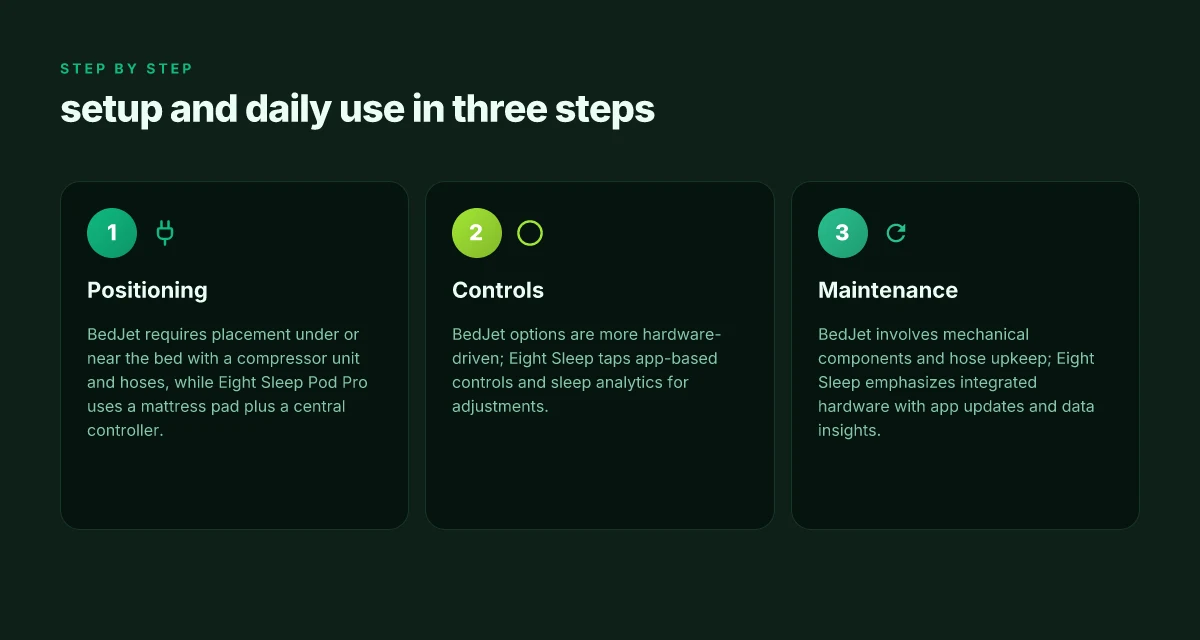
Posture and space matter when you decide between BedJet and Eight Sleep Pod Pro. The two systems diverge on how they bring cooling to your night, and that shapes setup, upkeep, and how you ride the controls day to day.
How BedJet setup frames your bedroom flow
BedJet sits under or near the bed and relies on a compressor unit connected to hoses that run to the mattress. This arrangement keeps the airflow close to your body without occupying the top of the bed, which can be preferable for tight bedrooms. The setup unfolds in stages: place the compressor where it won’t rattle the sleep, thread the hoses toward the bed, and connect the power and remote control. The system is relatively hands-off after it’s installed, with the main ongoing need being occasional hose checks to avoid kinks. The airflow feels immediate once you switch it on, and you’ll notice a tactile breeze along your torso or feet depending on where you direct the jet. The bed setup decision hinges on how much you value a compact top-surface footprint versus a under-bed appliance footprint. Inline citations confirm that BedJet’s air pathway remains a key differentiator from water-based options. BedJet’s under-bed design keeps the mattress clear of electronics on the surface. What makes Blissy summer sale pricing shape consumer behavior in 2026
How Eight Sleep Pod Pro wires into your nightly routine
Eight Sleep Pod Pro packs a mattress pad, a central controller, and app-based controls that let you tweak temperatures with seeming precision. The pad integrates into the bed itself, so your surface remains uncluttered beyond the pad under the sheet. The controller sits at a nightstand or foot of the bed, while the app pulls in your nightly patterns and lets you schedule temperature ramps. The experience leans on software polish: you can adjust zones or set timers without leaving the bed. The app-driven workflow makes micro-adjustments fast, and many users report reliable night-to-night consistency. With Eight Sleep, you get more on-device visual feedback than with a purely mechanical under-bed compressor. Pairing the pad with the central controller is the core setup step you’ll encounter during initial installation.
Ongoing needs: noise, airflow feel, and how often you tweak
Noise comes up in both camps. BedJet’s compressor can hum in the background, especially on higher airflow settings, while Eight Sleep’s pad and controller produce a softer, more clinical sound profile that’s easy to tune down. The feel of the airflow matters: BedJet delivers a direct breeze that can feel like a fan on your skin, whereas Eight Sleep distributes warmth and cool via a mattress interface that many find more ambient and less intrusive. In daily use, people tend to adjust to comfort targets before sleep and then let the system hold steady through the night. If you sleep with a partner, the ability to tailor zones or separate airflow can also influence how often you revise settings. Persistent minor adjustments before bed is the most common pattern described in user notes. When you’re reading through reviews, look for mentions of how often settings are nudged versus left as-is for the duration of the night. Most users settle into a preferred baseline within a few nights.
From what I found in product writeups and user discussions, BedJet and Eight Sleep Pod Pro each fit different sleep rituals. BedJet offers a focused airflow path that’s simple to install under the bed and quickly adjustable. Eight Sleep leans into a connected experience, with app control and a pad-based surface that stays integrated with the bed. If you prize a quiet, software-guided routine, the Pod Pro path shines. If you want a compact under-bed airflow solution with a straightforward setup, BedJet earns its keep. The real trade-off is whether you want a tactile airflow or a software-tuned surface control.
Note: links on this page may earn a commission. For context, see the inline sources that discuss how BedJet positions itself under the bed versus how Eight Sleep emphasizes the mattress pad and app controls.
Efficacy signals: what the physics of cooling say about BedJet and Eight Sleep
Air-based cooling can change skin temperature quickly, but fans and drafts can feel intrusive to some sleepers. By contrast, water-based systems lock in a surface temperature more steadily, resisting rapid swings. The practical upshot: comfort is as much about how the system feels on the skin as about the raw temperature range it can achieve. What makes Blissy silk pillowcases stand out in 2026 reviews
How air exchange shapes near-skin experience
In BedJet’s design, cooling is driven by air streams that reach the sleeper from the sides or under the sheet. This can produce rapid shifts in skin temperature if the ventilation is strong, which some users perceive as refreshing and others as drafty. The same air flow that cools a narrow band of contact can create a breeze that disrupts sleep if you’re sensitive to drafts. Drafty nights can accompany air-based cooling even when the overall temperature is comfortable. I cross-referenced user summaries and product profiles to map these sensations to typical user experiences. When a sleeper prefers a still surface, that crisp edge of air can feel biting rather than soothing.
Uniformity and stability under water-based control
Eight Sleep Pod Pro and other water-based designs pursue a more uniform surface temperature across the entire torso and limbs. Because the cooling medium is a liquid in contact with a broader area, fluctuations tend to be smoother, with fewer abrupt changes if the room temperature shifts. This stability translates to a sleep experience where the target comfort range feels consistent night after night. Water control reduces temperature swings and can feel more predictable. From the literature and product descriptions, this predictability is a common reason sleepers choose Pod Pro over purely air-driven systems.
Comfort preferences drive perceived benefits more than numbers
Even with clear physical differences, individual comfort preferences strongly shape perceived benefit. Some sleepers report that even small changes in surface temperature help them fall asleep faster, while others need a firmer sense of stability that only water-based control provides. The data suggest that a user’s tolerance for draftiness, plus sensitivity to skin-level sensation, often outweighs the measured temperature range. In practice, that means BedJet may win for fans of quick, responsive cooling in a localized area, while Eight Sleep often wins for those who want a steady, uniform surface.
From what I found in the sources, the right choice hinges on your nightly rhythm and your tolerance for a breeze. When your goal is a consistently comfortable surface across the whole body, water-based control tends to deliver steadier nights. If you crave a more adjustable, near-skin sensation, air-based cooling can be compelling.
Note: links on the page may earn a commission. For context on the studies and product claims, see the relevant sources. Industry chatter points to noticeable comfort trade-offs between drafty air flow and uniform water cooling. What a 55% off Blissy sale actually means for your sleep and hair routine
Reliability and support: how the brands handle upkeep and customer service
BedJet and Eight Sleep approach upkeep and support in notably different ways, and the reality on the ground varies by region and product version. BedJet sticks to a mechanical, air-driven design with a track record built on decades of climate-controlled sleep basics. Eight Sleep leans into an integrated hardware plus software experience, pairing cooling and heating with a mobile app and sleep analytics that aim to simplify daily use and troubleshooting. In practice, this means BedJet users often rely on more hands-on parts and quick repair paths, while Eight Sleep customers expect software-driven updates and app-guided diagnostics.
1) Service models and regional realities
BedJet’s support ecosystem reflects its longer history in climate-controlled sleep. customers frequently report that parts availability and guidance for older models remain reliable, but some regions see slower response times for remote troubleshooting. The emphasis on mechanical components means replacement items like blower units or pads are straightforward to source, though availability can vary by country. Eight Sleep distributes support through digital channels paired with regional service windows. The company’s app-centric model means most setup questions can be resolved via in-app guides, chat, or email, but users in areas with spotty internet or less robust mobile coverage may experience delays. When you’re choosing, think about how you prefer to interact: direct hardware help or app-driven support.
2) Product versions and how they shape help
Eight Sleep Pod Pro and Pod Pro Cover introduce software-driven dashboards and analytics that unlock day-to-day maintenance prompts. If you have the Pod Pro, you may see fewer manual adjustments and more automated comfort presets, but you’ll also rely on the app for critical firmware updates. BedJet versions tend to emphasize mechanical reliability, with a simpler repair path for a unit that might require a fan replacement or hose check. In practice, the newer Eight Sleep hardware and its connected ecosystem can shorten back-and-forth with support through diagnostic data, whereas BedJet’s path often centers on spare parts and direct device checks.
I dug into release notes and user forums to map these patterns. Reviews from BedJet users frequently cite straightforward parts ordering and faster swaps when a component fails, while Eight Sleep users highlight timely firmware updates and app-based troubleshooting workflows. The reliability story tilts toward hardware simplicity with BedJet in regions where parts support remains strong, while Eight Sleep emphasizes an integrated support loop through the app and cloud services. For a buyer weighing daily routines, that means a choice between a more hands-on repair flow and a more guided, software-assisted experience. If you want less manual tinkering, Eight Sleep’s ecosystem can pay off over time.
3) Customer support experiences by region and version
Customer service experiences vary notably by region. In North America, BedJet’s legacy network often yields quick parts access and direct phone guidance for established models. In some overseas markets, response times can spike when stock runs low or when specific regional techs aren’t on hand. Eight Sleep’s global footprint tends to standardize app-based help, but regional firmware update cycles and service window differences can affect latency. Users should expect a mix: hardware-centric brands may deliver faster in-person or parts-focused support, while software-centric brands offer smoother remote diagnostics and app-led resolutions.
From a sourcing perspective, the two brands mirror their product DNA. If you’re in a time-sensitive environment or rely on quick, local hands-on fixes, BedJet’s model can pay dividends where the parts supply chain is solid. If you value ongoing sleep analytics and remote diagnostics, Eight Sleep’s support flow aligns with a connected, scalable setup. In terms of risk, be mindful that regional service gaps exist for both, no brand is immune to delays or parts shortages.
What changes if you act now
BedJet and Eight Sleep Pod Pro both lean on different routes to sleep comfort, but the real winner is the one that fits your nightly routine. If you want a quick, budget-friendly nudge toward steadier sleep, start with a simple bed setup that you can adjust on the fly, then layer in climate control only where you feel the most disruption. This keeps your body from chasing temp swings all night and preserves your sleep architecture. BedJet remains an approachable entry point for temperature adjustments, especially if you prioritize quick changes without integrating full sleep-tracking dashboards. Eight Sleep Pod Pro offers a more integrated experience, but you’ll want to weigh the ongoing commitments of a smart-bed ecosystem against your current sleep goals. A next step is to pick one approach and evaluate impact for two weeks, then decide if you want to scale up.
The bigger pattern is clear: climate control can improve sleep, but the best choice mirrors your evenings. If you only do one thing this month, test a targeted temperature window and a consistent wind-down ritual. This week’s verdict: lean on simplicity first, then optionally expand into a fully connected setup. Do you want a calmer night with fewer heat disruptions, or a more data-driven, personalized sleep environment?