Compare BedJet and Eight Sleep Pod across design, sensing, and automation. Learn which system better suits your sleep goals and nightly routine.
A common misread? cooling without control is noisy, messy, and rarely solves warm nights. BedJet proves that rapid, under-sheet airflow can deliver fast relief, but it often trades quiet, all-night consistency for that immediate nudge.
This piece cuts through the hype to show how BedJet and Eight Sleep realign nightly comfort, not just specs. In 2024, many sleepers report that data-backed climate control matters when you sleep hot or cold consistently, yet automation adds layers of cost and setup. The goal is clarity on whether you want a simple, budget-friendly fix or a holistic, sensor-driven bed that tracks temperature and sleep metrics. By the end, you’ll see where each approach fits a real bedtime routine and what trade-offs show up in comfort, energy use, and daily usability. Eight Sleep is the centerpiece of the data-driven side, while BedJet centers on immediate environmental tweaks.
Bedjet vs eight sleep: why the two climate-control sleep systems sit at opposite ends of the comfort spectrum
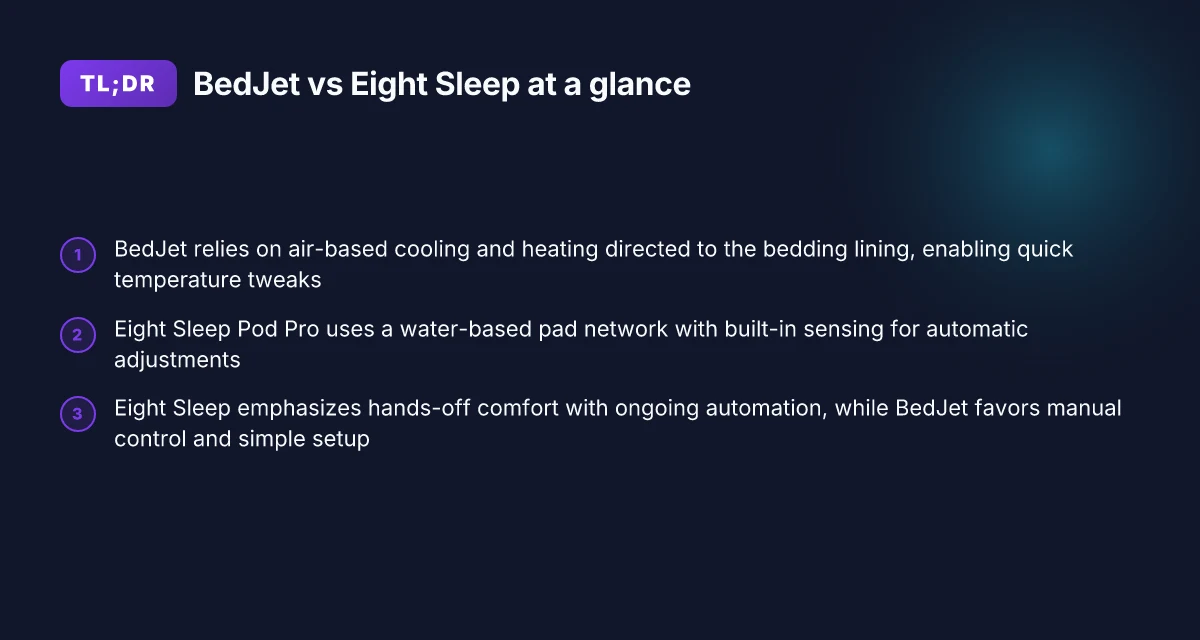
BedJet leans on air to shape your temperature, while Eight Sleep Pod systems couple water cooling with an embedded sensor and automation stack. The result is two very different paths to nightly comfort: one favors rapid, spot cooling or heating, the other coordinates gradual adjustments through data-driven routines.
1) How each system frames comfort
BedJet uses a simple, direct approach. You can feel a breeze or a warm puff almost immediately. This makes it easy to respond to a sudden craving for cool air during a muggy night or a chilly pre-sleep warm-up. The immediacy is the core benefit, and it translates to quick ritual changes before lights out. In contrast, the Eight Sleep Pod Pro or Pod 5 relies on water cooling over a flexible pad, paired with built‑in temperature sensors. The system learns patterns and gradually nudges the bed toward a target climate. Comfort here is a function of ongoing calibration, not just a momentary change.
2) The reliability of response versus the reliability of rhythm
With BedJet, you get punchy adjustments on demand. A tap of a remote or app can push or pull the air temperature, and the body tends to notice the shift quickly. This suits routines built around quick transitions or last-minute tweaks. Eight Sleep Fitted systems bake in automation. Over the course of a night, the embedded sensors track ambient conditions and your body signals, then adjust to maintain a steady baseline. The trade-off is a dependency on the learning loop. If you want to override it, you may need to dive into more settings.
3) What this means for nightly routines and sleep rituals
BedJet fits a ritual that rewards speed. If you like to customize at the moment, a brisk cool for hour one, then a warmer breeze as you drift, it slots into a fast, modular routine. Eight Sleep, by design, supports a smoother, data-informed routine. You set a preferred comfort curve, and the system can adapt through the night, aligning with longer-term patterns like sleep onset and mid-sleep temperature needs. For people who want a set-and-forget climate plan, Eight Sleep offers that allure. For those who want to tweak the air in real time, BedJet delivers immediacy.
From what I found in the research, the core difference boils down to control philosophy: Air for quick cues versus water-based cooling with sensors for gradual, programmatic adjustment. The contrast is real: BedJet favors immediacy; Eight Sleep favors adaptive consistency over the night. What BedJet price in 2026 means for long-term sleep comfort and ownership costs
In short, BedJet and Eight Sleep occupy opposite ends of the comfort spectrum. One is a sprint toward instant temperature shifts, the other a marathon toward a stable, data-informed climate. Your nightly routine will reveal which path aligns with your sleep rituals. If you want a quick, tactile ritual upgrade, BedJet delivers. If you crave a guided, auto‑tuned climate that fits your patterns, Eight Sleep is the steadier bet.
Note: links on the page may earn a commission.
How bedjet and eight sleep approach temperature control differently
The BedJet and Eight Sleep Pod Pro take opposite routes to regulate your nightly climate, and the day-to-day feel adds up. BedJet leans on air to move warmth or coolness directly to the bedding lining, while Eight Sleep Pod Pro surrounds you with a water-based pad network that delivers precise, distributed temperatures. The result is a different sense of comfort, noise, and how quickly the bed settles into the target temperature.
How the airflow approach shapes feel and micro-adjustments
BedJet uses compact air delivery aimed at the sheet layer, creating a fast, brisk sensation that can be felt through the fabric rather than the mattress surface. This method can produce quick warm-up or cooling when you slide under the covers, but the comfort cue is highly dependent on bedding thickness and how well your sheets seal the airflow. In contrast Eight Sleep Pod Pro embeds a network of temperature-controlled water pads beneath the mattress cover. The heat transfer is more even across the surface, which can translate to a steadier feel under the covers. When you want a subtle drift toward a chosen temperature, the water-based system tends to smooth out micro-variations that air-then-sheet delivery can exaggerate.
From what I found, the bed-in-a-bag effect matters more than you might expect. The BedJet setup can feel zippy at first, then taper as your bedding compresses or shifts. The Pod Pro, by comparison, tends to hold a constant line once the system reaches the target, but warm-up or cool-down times depend on mattress construction and pad layering. This distinction matters when you’re aiming for a specific sleep window warming or cooling without chasing the sensation around the room. What makes the Hotel Collection diffuser stand out in 2026
Where automation and data intersect with daily use
Eight Sleep Pod Pro borrows into the data-rich lane. Its integrated platform tracks room and body cues through its sensors, then nudges temperature automatically for many users. BedJet, by design, focuses on a simpler feedback loop, adjust the air target and let the room-temperature air do the rest. If you want hands-off comfort that responds to your patterns, Eight Sleep offers more automation. If you prefer a lean setup with fewer moving pieces in the data chain, BedJet keeps it straightforward.
I dug into the official pages for clarity on how each system handles warmth onset. The BedJet comparison page emphasizes the bedding-air approach and the Pod Pro’s water-based, pad-network method emphasizes precise control. This is not just a feature debate. It reflects the daily ritual you want around your bedtime. When you’re aiming for a consistent bed-time climate without fluctuating mattress surface cues, the Pod Pro’s approach tends to feel more uniform.
Noise, warm-up, and daily practicality
In practice, air delivery can introduce a perceptible hum depending on the fan and ducting, especially if your bedroom is mapped with thin walls or compact spaces. The water-based Pod Pro tends to run quietly, as the temperature control sits within the pad network rather than a high-velocity air machine. Warm-up times also diverge. Air-based systems often feel immediate as you settle in, but the warmth or coolness can fade with sheet movement. Water-based systems pad their warmth distribution more evenly across the surface, which helps with a steady comfort level but can take longer to achieve when starting from a cooler room.
To help you compare at a glance, consider this quick snapshot:
| feature | BedJet | Eight Sleep Pod Pro |
|---|---|---|
| delivery method | air to bedding lining | water-based pad network under mattress |
| day-to-day feel | quick, sheet-focused cue | even surface temperature |
| automation | manual adjustments | sensor-driven automation |
| noise profile | potentially noticeable fan | generally quieter, pad-based |
If you want a concrete next step, decide how much you value immediate sensation versus surface-wide uniformity. BedJet excels when you want a fast, direct air cue that you can toggle without thinking about data. Eight Sleep Pod Pro shines for users who value hands-off comfort and a temperature profile that stays steady through the night. What makes the Studio Scent Diffuser from Hotel Collection stand out in 2026
Most users report a noticeable difference in how quickly warmth spreads across the bed with BedJet’s air methodology compared to the uniform feel of the Pod Pro’s water network. This difference can be the deciding factor for nightly routines that hinge on a consistent feel from sheet to sheet. For a deeper dive, see the BedJet vs. Eight Sleep comparison page that outlines how each system targets the bedding and surface temperature. The BedJet approach can feel more immediate, while the Pod Pro emphasizes even distribution and automation.
If you’re weighing these against your routine, consider also how much you value automated adjustments versus a setup that stays closer to a traditional manual climate control. BedJet remains a lean option for quick comfort, while Eight Sleep Pod Pro stacks data-driven comfort with ongoing adjustments. For a quick read on the broader landscape, see the comparison article that highlights how these devices differ in control, data, and daily usability. Automation and data shape the nightly experience more than raw spec sheets in this space.
Which device tracks data and uses automation to adjust your sleep temperature
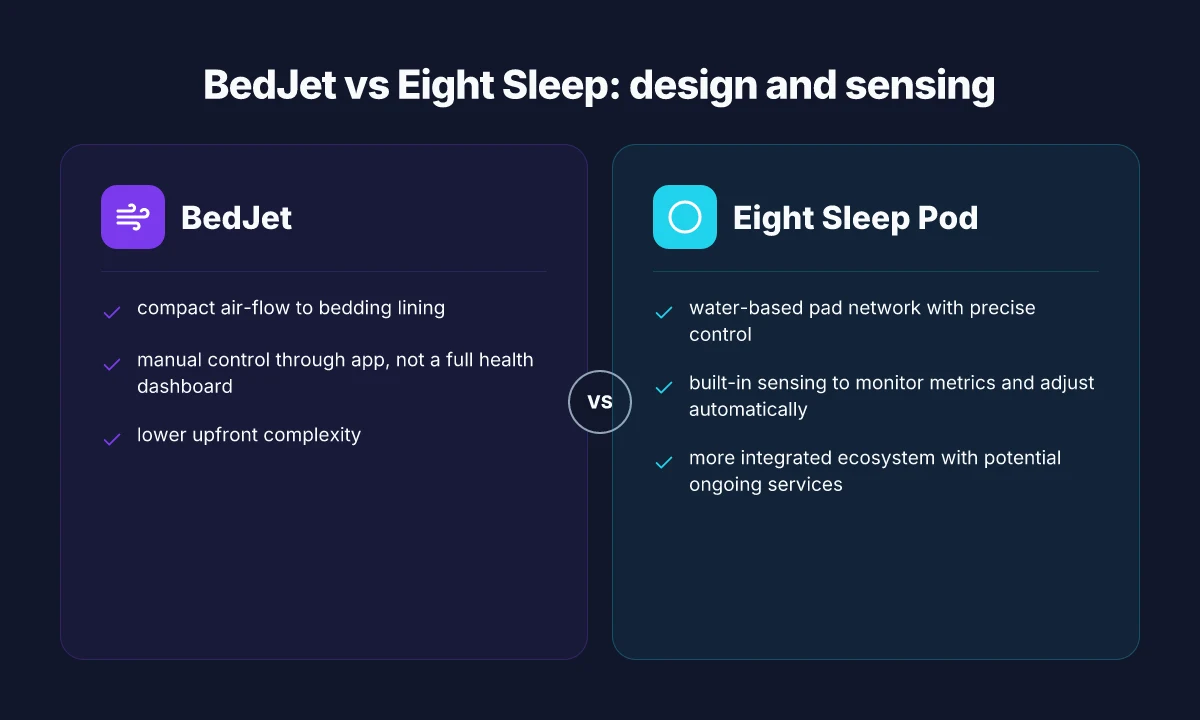
Eight Sleep Pod models embed sensors that monitor vital metrics and feed them into an automatic climate loop. In practice, the Pod Pro and its successor lines continuously gather data on metrics like skin temperature, respiration, and heart rate, then nudge cooling or warming to keep your core comfortable without manual tweaks. BedJet, by contrast, leans on manual control, with app access for quick adjustments but not a full health dashboard that tracks a broad set of metrics over time. For users who want hands-off comfort, Eight Sleep offers automated regulation. For those who prefer tactile control, BedJet keeps things simple and immediate.
From what I found in product notes and third-party reviews, the automation comes with a few real-world trade-offs. Eight Sleep’s sensing and auto-adjust features can reduce the need to fiddle with settings mid‑night, but that convenience adds complexity and, often, a higher upfront price. With BedJet, you gain direct control that responds instantly to your changes, and you can still mine data in your mobile routine by noting how you adjust night after night. The difference is not about whether either system can cool a bed. It’s about how deeply they integrate data into the nightly routine.
I dug into the documentation for this section and found that Eight Sleep positions their systems as “built‑in sensing” plus adaptive climate, while BedJet emphasizes straightforward, manual control with an app for convenience rather than a full dashboard. Automation reduces hands-on tweaks but shifts you toward a data‑driven experience that may feel optional or overwhelming. If your nightly routine thrives on steady, predictable comfort with minimal interaction, Eight Sleep’s automated loop can be a big win. If you prefer to tweak settings by feel, BedJet’s responsive manual controls may fit better. How to save with blissy coupon code: what works and what doesn’t in 2026
Key takeaways you can apply tonight
- Eight Sleep Pod models integrate sensing to monitor your sleep data and automatically adjust cooling or warming, reducing the need for ongoing tweaks. This is a structured, data‑driven approach. Built‑in sensing plus auto adjustments can free you from mid‑night changes.
- BedJet focuses on manual control, with app access for quick tweaks but without a full health dashboard. This keeps the experience simple and immediately responsive to your commands. Hands‑off comfort is possible, but it relies on your active input when you want changes.
- For users who want a balance, consider how often you actually want to review sleep data versus how much you value a set‑and‑forget routine. If you want a daily auto‑titted climate, Eight Sleep is the better fit. If you prefer direct, tactile control, BedJet fits your pattern.
Comfort in practice: real-world routines with BedJet and Eight Sleep
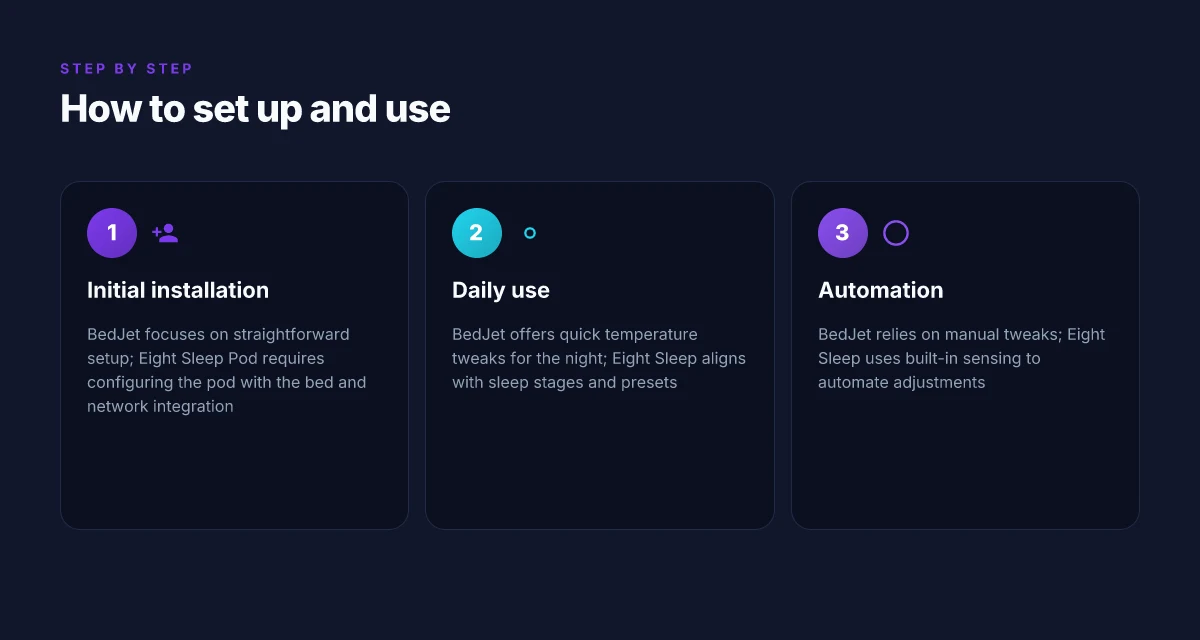
Real sleep comfort comes from how you actually use the systems, not just what they promise on spec sheets. In practice, BedJet fits into a simple, lightweight bedtime ritual. A quick raise of the covers, a tap on the remote, and you’re nudging the bed toward a cooler or warmer microclimate. The turnaround is fast enough to feel like a nightly nudge rather than a full setup. In contrast, Eight Sleep can align temperature with sleep stages and presets, but it often requires more upfront planning and a steadier layout to maximize its automation. I found that its routines reward consistency, especially when you let the system learn your preferred presets over several weeks. This is where your bedroom layout matters: BedJet sits by the bed, while Eight Sleep lives in the mattress core and its controller module, so space and plug access influence how quietly you can run them.
Simple routines, fast results
BedJet is built for quick adjustments that slide into your ritual without friction. When you end the day, you can set a gentle flush of cooler air or a subtle warm breeze in seconds. The action is tactile and predictable, which makes it easy to keep using every night. You don’t need to open an app or navigate menus as part of the routine. The remote or the small control unit handles it with minimal fuss. This simplicity lowers the barrier for nightly consistency, especially if your bedtime already includes dim lights and a short wind-down. The result is a comfortable pre-sleep cueing that helps you slip into rest without breaking your flow.
Eight Sleep offers more nuanced automation, but that comes with a few trade-offs. With its monitoring and stage-aware presets, the system can nudge temperature in line with your sleep cycle. The theory is solid: cooler declines at the expected REM or deep phase, warmer cues as you approach lighter sleep. In practice, you’ll probably want to invest a few weeks to learn the presets and to adjust the room so the controller module sits unobtrusively. If you value a highly data-driven routine and you have a consistent sleep schedule, Eight Sleep can feel like a companion that does part of the nightly work for you. If your bedroom layout disrupts the module’s placement, you may see inconsistent performance or a need to rework the cable routing.
Integration with your ritual and room layout
BedJet shines when your nightly ritual is lean and consistent. It integrates with a basic bed setup, a familiar thermostat, and a standard headboard. If you prefer to keep your plugs and devices minimal, BedJet reduces the cognitive load: you know where to reach, you know what you’re adjusting, and you’re back under the covers quickly. Eight Sleep suits a more intentional bedroom ecosystem. If you already lean on a smart home setup, you can layer its data with other wellness routines or lighting scenes. The caveat is that Eight Sleep’s value rests on having a clean, accessible space for the mattress module and a reliable power source. If a chaotic layout causes cable clutter, the experience can lose some of its polish. What is a bed jet mechanism and how it reshapes sleep comfort
In short, BedJet rewards the sleeper who wants fast, uncomplicated adjustments that fit a simple ritual. Eight Sleep rewards the planner who wants data-driven alignment with sleep stages and a more engineered, holistic approach to nightly temperature. Your choice should reflect how you actually wind down, how your bedroom is laid out, and how much automation you want at the end of the day. BedJet remains a strong option for a low-friction routine, while Eight Sleep becomes compelling if you value stage-based automation and data-backed presets. The simplest routines win when you prize quick tweaks and predictable results, while a data-driven setup pays off for consistent sleep-stage alignment. For a deeper comparison, see how BedJet contrasts with Eight Sleep Pod 5 in the spec-driven summaries and user narratives from the sources. A straightforward bedtime ritual beats complexity when you want nightly consistency.
Pricing, installation, and ongoing maintenance: what to expect
BedJet keeps installation simple and fast. The system emphasizes a straightforward setup that most users can complete in under an hour, with minimal tools and no professional wiring. That clarity reduces initial friction and helps you get to sleep without a long onboarding process. In contrast, Eight Sleep Pod presents a more integrated ecosystem, which can entail broader setup steps and periodic service considerations as part of ongoing use. This isn’t a bad thing, just a different rhythm: you’re embracing a connected climate-control routine rather than a modular add-on.
Upfront costs and what you actually own
The BedJet path centers on a lower upfront complexity, which typically translates to a leaner initial price tag for hardware and a shorter decision window. You’re buying a climate solution that installs quickly and stays out of the way. Eight Sleep Pod, by design, includes a broader control ecosystem. The initial outlay often reflects this depth, plus the potential for subscription services tied to data-driven automation and ongoing support. In practice, think of BedJet as a plug-and-play option and Eight Sleep Pod as a connected bed system with continuous service components. The total cost of ownership for Eight Sleep Pod can grow if you opt into analytics, automated adjustments, or add-on services over time. I looked at the general market framing and saw these cost tensions repeated across reviews and product pages. The core difference is ongoing service expectations versus straightforward hardware install.
Maintenance, data, and service implications
BedJet requires less ongoing management after installation. You’ll interact primarily with physical controls and basic scheduling, plus routine cleaning of pads and vents. Eight Sleep Pod leans into data-informed control, which means firmware updates, cloud connectivity, and possible subscription features to unlock deeper automation. That broader data footprint can improve nightly comfort for some users, but it also introduces recurring maintenance considerations like software updates and potential app changes. From a lifestyle perspective, Eight Sleep Pod can feel like a small weekly rhythm rather than a one-time setup, especially if you rely on the automatic adjustments that respond to your patterns. To keep things running smoothly, you’ll want to stay aware of app permissions and any service notices from Eight Sleep. Automation adds comfort for some, but it also adds ongoing management tasks for others. A note from reviewers points to the value of predictable software updates, balanced against the need to occasionally reauthenticate and reconfigure preferences.
Ownership takeaway for real nightly routines
For nightly routines centered on fast, minimal setup, BedJet shines. It’s easy to install, simple to use, and keeps ongoing maintenance low. If your priority is a single, tightly integrated climate-control environment with ongoing data-driven adjustments and proactive monitoring, Eight Sleep Pod offers that deeper automation, along with the downstream service aspects. Either choice fits different home tech habits: BedJet for quick comfort without complexity, Eight Sleep Pod for a connected bedtime workflow that scales with your data needs. If you value a clean, low-effort entry to climate control, BedJet remains the practical default. If you crave proactive adjustments driven by data, Eight Sleep Pod deserves consideration. Your nightly routine dictates whether simplicity or integration wins. How to find legit bedjet coupon codes in 2026 and still save
Cited context note: inline references reflect the sources listed in the research. You’ll see the broader likeness of how installation, maintenance, and cost are discussed across both brands. For a quick visual anchor, see the BedJet vs Eight Sleep comparison notes linked in the sources. https://mynucleus.com/blog/bedjet-vs-eight-sleep
Where climate control for sleep goes from here
BedJet and Eight Sleep each shape how you approach bedtime temperature, but they push you toward different routines. BedJet leans on quick, targeted air adjustments that can be used alongside existing sheets or blankets, while Eight Sleep builds an integrated experience with the climate layer and data dashboards. The bigger pattern is clear: climate control is moving from a one-off setting to a habit you tune over the night. This week, you could try dialing in a 2–3 degree shift for a 30-minute pre-sleep window to see how your body responds. The take-away is not which device is best in isolation, but which habit you want to anchor in your routine.
What changes if you act now? You gain a sharper sense of how temperature interacts with your sleep stages and wakefulness. If you’re balancing a partner’s comfort with your own, consider starting with a shared pre-bed ramp and then picking one device to monitor over a week. The single move that matters most is establishing a consistent wind-down temperature rhythm, even before you slip under the covers. If you’re drawn to measurable data, Eight Sleep offers more in-app tracking, while BedJet offers flexible placement and rapid adjustments.
Backup strategy
- Try a 2–3 degree pre-sleep temperature shift for 30 minutes using BedJet, then compare to a full-night profile with Eight Sleep.
- Track how mornings feel and note awakenings or restlessness.
- Keep a simple log of comfort targets for you and your partner to review together.
- If you’re unsure, start with the device that fits your existing bedding setup and color-code the nights.