A clear guide to F5 BIG-IP VPN options, how BIG-IP APM works, and how F5 Edge Client and F5 Access fit into remote access strategies.
Remote access and VPN are foundational to how modern enterprises secure workers who are off the corporate network. When people search for big ip f5 vpn, they’re often trying to understand whether F5 BIG-IP provides a traditional VPN, what the options are for remote access, and how the various F5 products fit into a secure remote-work strategy. The short answer is that BIG-IP itself is a versatile application delivery and security platform, and its remote-access VPN capabilities are primarily delivered through F5 BIG-IP Access Policy Manager (APM), with companion client software like F5 Edge Client and F5 Access to support flexible, device- and platform-aware experiences. Below is a practical guide to what exists, how it works, and how to decide what to deploy.

Comparison of BIG-IP VPN modalities (SSL VPN vs IPsec VPN)
| Modality | Typical use case | Client support | Encryption strength | Session management | Deployment focus |
|---|---|---|---|---|---|
| SSL VPN | Web-based access to apps | Edge Client, F5 Access | TLS 1.2/1.3 | Per-user session | Remote access to apps |
| IPsec VPN | Site-to-site and full tunnel | OS-native clients | IPSec | Persistent tunnel | Network-level access |
| SSL VPN | Mobile/remote workers | Edge Client, F5 Access | TLS 1.2/1.3 | Per-session | Secure app access |
| IPsec VPN | Branch offices | Third-party clients | IPSec | Long-lived | Network extension |
Compiled November 2026; check the provider's site for current details.
What is BIG-IP VPN, and how does it fit the BIG-IP platform?
BIG-IP is a family of products focused on application delivery, security, and availability. Within that family, BIG-IP APM (Access Policy Manager) is the component that enables secure remote access. It supports both SSL VPN and IPsec VPN, giving organizations options depending on their security policy, network topology, and user experience goals. SSL VPN encrypts traffic over HTTPS, which is widely compatible with firewalls and client software. IPsec VPN, on the other hand, can be more native to certain operating systems and may offer different performance characteristics.
- Key role of APM: Enforce access policies, authenticate users, and route traffic to apps and networks securely.
- VPN methods supported: SSL VPN and IPsec VPN.
- Core advantages: Centralized policy management, granular access control, and the ability to combine authentication with posture checks, device trust, and application-level access.
APM sits as part of the BIG-IP platform, benefiting from its high availability, scalability, and integration with other BIG-IP services like application delivery, DDoS protection, and identity-aware access controls. For organizations already using BIG-IP for load balancing or security, APM can be a natural extension to provide secure remote access without introducing a separate VPN stack.
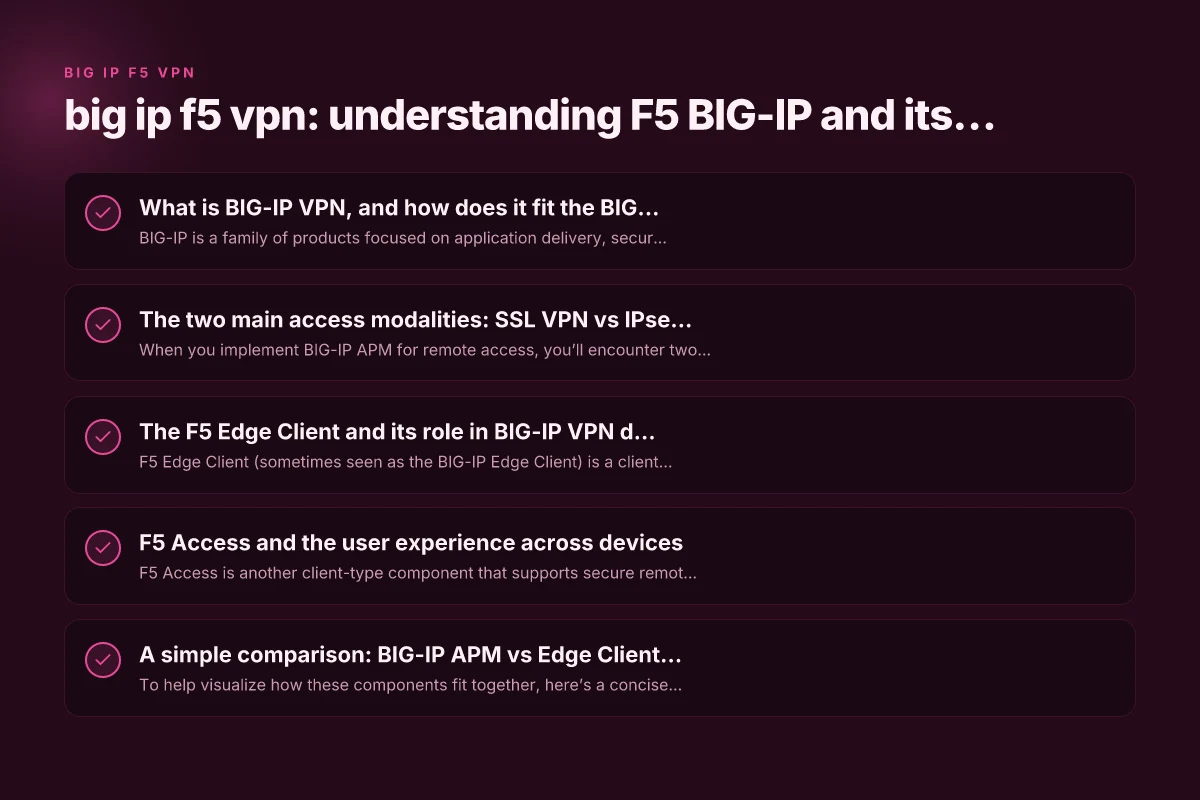
The two main access modalities: SSL VPN vs IPsec VPN
When you implement BIG-IP APM for remote access, you’ll encounter two main VPN modalities. Each has its use cases, trade-offs, and deployment considerations.
- SSL VPN (HTTPS-based):
- Pros: Broad client support, no separate VPN tunnel required beyond HTTPS. Easy to publish applications behind the BIG-IP. Works well with most devices and platforms. Often preferred for remote work from various networks.
- Cons: May require more granular policy configuration to ensure full network access if needed. Some deployments prefer to keep all traffic through a gateway rather than split-tunnel.
- IPsec VPN:
- Pros: Traditional VPN experience for users accustomed to IPsec. Possible performance characteristics on certain devices. Strong tunnel-based security.
- Cons: Requires client configuration (native IPsec clients or integrated clients). May be more complex to publish specific apps vs full network access.
APM can orchestrate access to internal apps, desktops, or networks, and then leverage the VPN method to bring users into a controlled, authenticated session. For many organizations, SSL VPN is the default for web-facing or app-level access, while IPsec VPN is chosen where a tunnel-based approach aligns with existing infrastructure or performance expectations.
The F5 Edge Client and its role in BIG-IP VPN deployments
F5 Edge Client (sometimes seen as the BIG-IP Edge Client) is a client-side tool designed to complement BIG-IP APM deployments. It’s available for Windows and other platforms, and it can enable VPN-based connections as part of a broader zero-trust or perimeter-based strategy, depending on the version and configuration. NordVPN recommendation for programmable routers
- Edge Client for Windows: Edge Client 7.1.7 and later supports VPN capabilities tied to BIG-IP versions 13.1 and above. This can include machine-credential-based access in certain configurations, which helps automate trust establishment and reduce the need for interactive logins in specific scenarios.
- Platform reach: The Edge Client is typically part of a broader end-to-end remote access strategy, including the APM gateway and the policy framework that governs who can access what.
- Important caveats: The precise features around machine credentials and the exact VPN behavior can depend on the BIG-IP version, APM policy, and the deployment model. Some capabilities may require specific licensing or configuration steps in the APM policy.
In short, the Edge Client is a practical companion for users who need a consistent, managed client experience for VPN access, especially in Windows environments. It’s not a consumer VPN solution. It’s designed to work within an enterprise deployment that includes F5 ZERO trust access or APM-protected services.
Roles of BIG-IP components in VPN deployments
| Component | Role in VPN | Typical deployment | Client interaction | Key capability | Notes |
|---|---|---|---|---|---|
| BIG-IP APM | Access policy and authentication | Central gateway | Seamless login prompts | SSL VPN, IPsec optional | Core access broker |
| F5 Edge Client | Client-side agent | End-user device | Native app | Edge VPN tunneling | Lightweight client |
| F5 Access | User experience layer | Desktop/mobile apps | Integrated experiences | Single sign-on | Migrated from Legacy clients |
| BIG-IP DNS/GTMs | Traffic steering | Global reach | Quick path to apps | Fast failover | Not a VPN feature by itself |
Compiled November 2026; check the provider's site for current details.
F5 Access and the user experience across devices
F5 Access is another client-type component that supports secure remote access through BIG-IP. It is particularly relevant for environments that want to consolidate and optimize remote-user access across devices and platforms (e.g., mobile devices, desktops, and laptops). F5 Access can work with the broader F5 ZERO Trust Access for BIG-IP deployments to deliver a cohesive remote-access experience.
- Platform availability: F5 Access is available on Google Play and the Apple App Store, reflecting a focus on mobile and BYOD scenarios. It’s designed to provide VPN-like secure access and optimization for enterprise apps on mobile devices.
- Not consumer VPN: The Google Play listing explicitly notes that F5 Access requires an existing F5 ZERO Trust Access for BIG-IP deployment. This is an enterprise-grade control plane ensuring that access is policy-driven rather than a generic consumer VPN.
- Use cases: Mobile workers, field staff, and BYOD programs where secure access to enterprise apps and networks is needed without exposing the full internal network.
The takeaway is that F5 Access represents a mobile-first extension to the BIG-IP remote-access model, aligning with modern security practices like zero-trust and app-based access control, rather than serving as a standalone consumer VPN. Big IP f5 download
A simple comparison: BIG-IP APM vs Edge Client vs F5 Access
To help visualize how these components fit together, here’s a concise comparison.
BIG-IP APM
What it is: The remote-access gateway inside the BIG-IP platform. Provides SSL VPN and IPsec VPN, policy-based access control, and integration with authentication services.
Use case: Centralized remote access for employees and contractors to internal apps and networks. Applies to both browser-based sessions and VPN tunnels.
Pros: Strong policy control, deep integration with BIG-IP security features, scalable to large organizations. My IP location NordVPN: how to check and protect your location online
Cons: Requires proper licensing, policy design, and potentially more initial setup.
F5 Edge Client
What it is: A Windows client (and related platforms) to connect to BIG-IP APM-based VPN experiences with machine-credential and policy-driven access.
Use case: Enterprise environments needing a managed, credential-driven VPN client. Good for enterprises deploying Windows-based postures.
Pros: Consistent enterprise experience, can automate identity and posture checks. Supports machine credentials in certain versions. Microsoft Edge VPN free: what to know
Cons: Requires compatible BIG-IP APM configurations and version support. Not a consumer product.
F5 Access
What it is: A mobile-focused client that works with F5 ZERO Trust Access and BIG-IP deployments to deliver secure mobile access to apps and networks.
Use case: Mobile and remote workers who rely on iOS/Android devices to access enterprise resources.
Pros: Streamlined mobile experience, policy-driven secure access. Aligns with zero-trust architecture. Best settings for streaming with Hotspot Shield VPN
Cons: Requires an enterprise BIG-IP environment with ZERO Trust Access. Not a standalone consumer VPN solution.
Table: quick feature snapshot
| Feature / Capability | BIG-IP APM (SSL VPN / IPsec VPN) | F5 Edge Client (Windows) | F5 Access (mobile) |
|---|---|---|---|
| Primary role | Remote-access gateway, policy enforcement | Enterprise VPN client for Windows | Mobile remote access client |
| VPN types offered | SSL VPN and IPsec VPN | VPN client supporting APM-based access (variant) | Mobile VPN/secure access via ZERO Trust |
| Platform support | Browser, various clients through APM | Windows (Edge Client) | iOS, Android, other platforms via app stores |
| Management focus | Centralized access policies, posture checks | Credential-based access, machine credentials in some versions | Zero-trust, app-centric access |
| Deployment note | Core component of BIG-IP remote access | Requires compatible APM and versioning | Requires ZERO Trust Access deployment |
This table aims to illustrate how the pieces complement one another in a typical enterprise deployment. APM provides the gateway and policy engine; Edge Client and F5 Access provide user-facing clients that connect to that gateway, with different emphasis on device types and use cases.
Feature availability by option: BIG-IP APM, Edge Client, F5 Access
| Feature | BIG-IP APM | Edge Client | F5 Access | Notes |
|---|---|---|---|---|
| SSL VPN support | Yes | Yes | Yes | Primary mode varies by product |
| IPsec VPN support | Yes | No (primarily SSL) | No | Edge Client focuses on SSL |
| SSO integration | Yes | Yes | Yes | Identity brokered |
| Per-app access | Yes | Yes | Yes | Granular access |
| Multi-device sync | No | Yes | Yes | Based on app |
| Desktop/mobile parity | Good | Excellent | Good | UX varies |
Compiled November 2026; check the provider's site for current details. Big-IP client: what it is, how it works, and who uses it
How to plan a BIG-IP VPN deployment
If your organization is evaluating big ip f5 vpn capabilities, a practical planning approach helps ensure success.
- Define the access model:
- Do you need full network access, or application-level access?
- Will users require IPsec tunnels, or is SSL VPN sufficient?
- Map users to policies:
- Identify user groups, devices, and posture requirements.
- Plan for multi-factor authentication, device posture checks, and identity federation if needed.
- Consider device ecosystems:
- Windows-centric organizations may leverage F5 Edge Client for a streamlined experience.
- Mobile-heavy teams benefit from F5 Access in a zero-trust architecture.
- Assess deployment footprint:
- Determine whether a single BIG-IP device or a scaled cluster is needed.
- Plan for high availability, disaster recovery, and performance considerations under concurrent remote sessions.
- Align with security goals:
- Integrate with existing identity providers (such as SSO or MFA solutions).
- Ensure granular access control to apps and services, not just network-level reach.
From a practical perspective, most organizations begin with BIG-IP APM to publish the applications and resources, then layer in the Edge Client or F5 Access to tailor the user experience for Windows devices or mobile devices respectively. This layered approach helps balance security, usability, and manageability.
Is BIG-IP still a VPN solution?
Yes, in the sense that BIG-IP APM provides secure remote-access capabilities, but the phrase “VPN” is evolving in modern enterprise vernacular. Rather than focusing solely on a network tunnel, many organizations describe their BIG-IP-based remote-access strategy as a zero-trust access solution that includes VPN-like tunnels where necessary, plus identity-based and posture-based access controls. F5 emphasizes a broader security model around access to applications and services, not just a perimeter VPN.
- BIG-IP APM offers SSL VPN and IPsec VPN options, depending on the organization’s needs.
- F5 Edge Client and F5 Access extend the reach of APM-based access for Windows devices and mobile devices, respectively.
- The broader F5 portfolio adds application delivery, secure access, and identity integration, all of which can enhance the protection and performance of remote work.
Planning factors for a BIG-IP VPN deployment
| Factor | Consideration | Options | Recommended focus | Outcome indicators |
|---|---|---|---|---|
| Access modality | SSL vs IPsec | Mix or single | Align to users | User satisfaction, support load |
| Client strategy | Edge Client vs F5 Access | Both or one | Consistency | Deployment time, maintenance |
| Identity integration | AD/SSO, MFA | Optional | Strong auth | Security posture |
| Network topology | Remote, branch, data center | Hybrid | Scalable design | Latency, reliability |
| Licensing | BIG-IP modules, client licenses | Tiered | Budget vs needs | TCO, ROI |
Compiled November 2026; check the provider's site for current details. OpenVPN profile: how to use, import, and manage OpenVPN profiles for seamless connections
Final recommendations for choosing and deploying BIG-IP VPN
- Start with a clear goal: Do you need workplace-wide app publishing, or secure access to a subset of critical resources? SSL VPN is a flexible option for publishing apps, while IPsec can be advantageous for traditional tunnel-based access.
- Choose the client strategy that matches your users:
- Use F5 Edge Client for Windows-heavy environments requiring machine credentials or a consistent enterprise client experience.
- Use F5 Access for mobile-focused, zero-trust deployments that emphasize policy-driven access on iOS and Android.
- Align with security controls:
- Integrate with your MFA and identity provider.
- Implement posture checks, device trust, and granular access policies to minimize risk.
- Plan for scalability and reliability:
- Ensure high availability for APM, and consider load balancing and failover strategies.
- Validate performance under expected remote-user loads and test VPN/SSL performance, especially if IPsec is in use.
- Don’t forget user experience:
- Publish applications in a way that minimizes manual configuration for end users.
- Consider single sign-on and seamless reauthentication to reduce friction.
In the end, big ip f5 vpn refers to a suite of capabilities centered on secure remote access via BIG-IP APM, with Edge Client and F5 Access providing complementary experiences for Windows devices and mobile platforms. If you’re evaluating a deployment, start with the APM-based remote access model, choose the client technology that best matches your user base, and design policies that emphasize zero-trust principles, granular access, and reliability. With careful planning and the right configuration, BIG-IP can deliver both secure access and excellent performance for remote workers.
| VPN | Obfuscation | From / month | Plan | Free plan | Refund | Alipay | UnionPay | Crypto | Website opens in China | Trustpilot | |
|---|---|---|---|---|---|---|---|---|---|---|---|
 ZoogVPN | Turn on manually Shadow | $2.49/mo | 27 months: $59.99 | Yes | 7 days | ✓ | ✓ | ✓ | ✓ | ✓ Yes (2.5 s) | 4.2/5 (195 reviews) |
 NordVPN | Turn on manually Obfuscated Servers / NordWhisper | $3.49/mo | 27 months: $94.23 | No | 30 days | ? | ✗ | ✓ | ✓ | ✗ Blocked | 4.2/5 (51,628 reviews) |
 ExpressVPN | ✓ On by default all servers | $3.00/mo | 28 months: $84 | No | 30 days | ✗ | ✗ | ✓ | ✗ | ✗ Blocked | 4.4/5 (29,706 reviews) |
 Surfshark | ✓ On by default Camouflage, with OpenVPN | See site | See site | No | 30 days | ✗ | ✗ | ✗ | ✓ | ✗ Blocked | 4.3/5 (31,823 reviews) |
 Proton VPN | Turn on manually Stealth, free plan too | $2.99/mo | 12 months: $35.88 | Yes | 30 days | ✗ | ✗ | ✗ | ✓ | ✓ Yes (2.5 s) | 2.1/5 (1,040 reviews) |
 Astrill VPN | Turn on manually StealthVPN / OpenWeb | $12.50/mo | 24 months: $300 | No | See site | ✗ | ✗ | ✗ | ✓ | ✗ Blocked | 1.3/5 (110 reviews) |
 Private Internet Access | Turn on manually Shadowsocks, OpenVPN only | $2.03/mo | 40 months: $81.2 | No | 30 days | ✗ | ✗ | ✗ | ✗ | ✗ Blocked | 4.2/5 (11,033 reviews) |
 CyberGhost | Turn on manually selected servers | $2.19/mo | 28 months: $61.32 | No | 45 days | ✗ | ✗ | ✗ | ✓ | ✗ Blocked | 4.0/5 (24,178 reviews) |
 PureVPN | Turn on manually switch to OpenVPN | $1.69/mo | 60 months: $101.55 | No | 31 days | ? | ✗ | ✗ | ✓ | ✓ Yes (2.6 s) | 4.4/5 (17,994 reviews) |
 AdGuard VPN | ✓ On by default TrustTunnel | $2.99/mo | 24 months: $71.76 | Yes | 30 days | ✓ | ✗ | ✓ | ✓ | Official site blocked; our special link opens (2.3 s) | 4.3/5 (290 reviews) |
 Mullvad | Turn on manually QUIC / Shadowsocks / LWO | $5.61/mo | €5/mo | No | 14 days | ✗ | ✗ | ✗ | ✓ | ✗ Blocked | 3.2/5 (192 reviews) |
 Windscribe | Turn on manually Stealth / WStunnel | $5.75/mo | 12 months: $69 | Yes | See site | ✗ | ✗ | ✗ | ✓ | ✗ Blocked | 4.7/5 (13,355 reviews) |
 StrongVPN | Turn on manually Scramble, OpenVPN TCP | See site | See site | No | 30 days | ✓ | ✗ | ✗ | ✗ | ✗ Blocked | 4.4/5 (2,695 reviews) |
 LightXtreme 闪连 | Not listed | $7.08/mo | 12 months: $84.99 | Yes | 30 days | ✓ | ✓ | ✓ | ✓ | ✓ Yes (2.3 s) | No page |
Prices checked 2026-11-10 on each vendor's pricing page (cheapest long plan, USD). Check the vendor's checkout for the final price.
Obfuscation checked 2026-11-14 on each vendor's site and help center: "on by default" = nothing to set; "turn on manually" = switch protocol or mode in settings; "not listed" = the vendor describes no obfuscation.
Payment methods checked 2026-11-10 on each vendor's payment pages: all 14 take cards and PayPal; ✗ = not listed, ? = the vendor's own pages disagree.
China access: whether the official website opens from mainland China networks (tests the website only, not the VPN connection). Last checked 2026-11-11 04:07 Beijing time.
Trustpilot score and review count checked 2026-11-10.