A practical guide to setting up and using Always On VPN with Intune-managed devices for on-premises networks.
Windows environments often require that remote users and devices securely access on-premises resources. If your organization uses Microsoft Intune to manage Windows devices, you can deploy Windows Always On VPN profiles directly from the Intune console. This article walks you through the steps to configure and deploy Always On VPN (AOVPN) profiles to Intune-managed devices so users can connect automatically to your on-prem network.

What is Always On VPN and why use it with Intune
Always On VPN (AOVPN) is a Windows feature that creates a persistent VPN connection for domain-joined or hybrid-joined devices. When paired with Intune, IT admins can:
- Create and deploy VPN profiles without user intervention.
- Enforce security policies, certificate-based authentication, and modern authentication methods.
- Monitor connection status and compliance from the Intune portal.
- Extend on-prem resources to remote workers with improved performance and reliability.
Intune helps centralize the distribution of the VPN configuration, certificate trust, and server information, so devices can establish a tunnel automatically upon network connection.
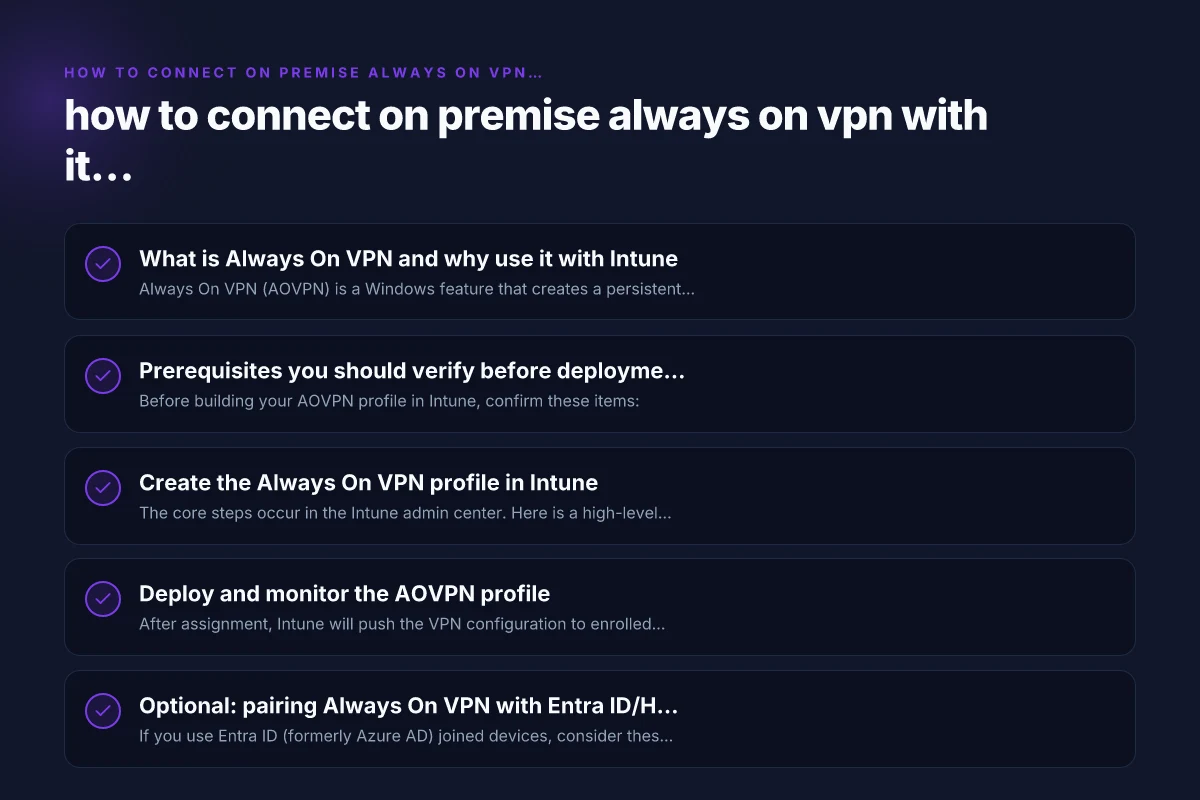
Prerequisites you should verify before deployment
Before building your AOVPN profile in Intune, confirm these items:
Windows 10/11 devices are enrolled in Intune (either Azure AD joined or Hybrid Azure AD joined).
Your on-premises VPN gateway supports IKEv2 and certificate-based authentication (PEAP is also commonly supported, but IKEv2 with certificates is the typical best practice for AOVPN). Reset VPN password Reddit
A PKI infrastructure is available (Active Directory Certificate Services or another PKI) to issue the machine and user certificates required for authentication.
A server-side configuration for AOVPN is in place, including:
VPN server address or FQDN
IKEv2/IPsec tunnel configuration
Trusted root CA certificates distribution to clients (if using PKI) How to add a website to nord that it keeps blocking
Optional: split-tunnel vs. full-tunnel policy
Network access rules allow the VPN traffic and required ports (IKEv2/IPsec) from the client to the VPN gateway.
Consider enabling split-tunneling for bandwidth efficiency or full-tunnel for stricter security, and communicate this policy to users.
Create the Always On VPN profile in Intune
The core steps occur in the Intune admin center. Here is a high-level workflow:
- Sign in to the Microsoft Intune admin center.
- Navigate to Devices > Configuration profiles.
- Create profile:
- Platform: Windows 10 and later
- Profile: VPN
- Connection type: Always On
- Configure profile details:
- Connection name: A clear, user-friendly name (for example, “Corp AOVPN - OnPrem”)
- Server address: Enter the VPN gateway FQDN or IP address
- Authentication: Choose certificate-based if your PKI is ready (machine or user certificate depending on your design)
- VPN type: IKEv2 with EAP (or a configuration that matches your gateway)
- Split-tunneling: Decide based on your policy (Enabled/Disabled)
- DNS and routing: Specify DNS suffixes and routes if you’re implementing custom routing
- Certificate settings (if applicable):
- Require a certificate for authentication
- Select the appropriate PKI certificate (e.g., Trusted Certificate Authority) or specify a SCEP/PKCS enrollment if your environment uses that
- Additional settings (optional but recommended):
- Per-connect VPN behavior
- Idle timeout and connection remediation
- Roaming or re-connection behavior
- Assign the profile:
- Choose groups containing the devices or users you want to target.
- You can mix device groups (for device-based assignment) and user groups (for user-based deployment) depending on your strategy.
Notes: Proton VPN check connection
- If your VPN gateway uses certificate-based authentication, ensure the client devices trust the issuing CA and have the necessary client certificates provisioned, either by auto-enrollment or a manual method.
- If you encounter certificate trust issues, verify the root and intermediate certificates are distributed to devices via Intune or a trusted policy.
Deploy and monitor the AOVPN profile
After assignment, Intune will push the VPN configuration to enrolled devices. Key monitoring tasks include:
- Check deployment status in Intune: Devices > Configuration profiles > Your AOVPN profile > Device and user status.
- Verify that devices receive the profile and that the VPN service is running on startup.
- For troubleshooting:
- Confirm device enrollment status and policy refresh timing (use the Intune troubleshooting pane to inspect device-side issues).
- Review VPN logs on the client (Event Viewer under Applications and Services Logs > Microsoft > Windows > RemoteAccess/Operational can be helpful).
- Ensure that the on-prem VPN gateway logs reflect a client attempting to connect and that authentication is succeeding.
Optional: pairing Always On VPN with Entra ID/Hybrid Azure AD join
If you use Entra ID (formerly Azure AD) joined devices, consider these practices:
- Use device-based targeting in Intune for consistent policy application across devices.
- If your on-prem resources require machine certificates, ensure machine cert enrollment is set up and that devices can present their identity during the VPN handshake.
- For users who roam outside the corporate network, the VPN should connect automatically when the device detects network availability.
In some configurations, you may also enable persistent VPN connections or auto-connect on login to ensure users have immediate access to resources upon signing in.
A simple comparison: Always On VPN vs. traditional VPN with Intune
Here’s a quick table to help you decide how AOVPN fits with Intune-managed devices.
| Aspect | Always On VPN (AOVPN) | Traditional VPN via Intune (manual connect) |
|---|---|---|
| Connection behavior | Automatically starts and maintains a VPN tunnel | User-initiated connection, manual or scheduled |
| Deployment method | Profile-based via Intune | Profile and app settings, user prompts may be required |
| Authentication | Certificate-based (recommended) or EAP | Often user credentials; can be certificate-based with setup |
| Roaming experience | Seamless, persistent connection when on network | Depends on user action; less seamless |
| Management | Centralized via Intune; easy to revoke or update | Requires management of VPN client and credentials separately |
This quick comparison helps illustrate why many organizations prefer AOVPN for remote access when using Intune. How do i see what devices on my nord VPN account are connected
Troubleshooting common issues
If things don’t go as planned, check these common areas:
- Profile not pushed: Verify device is enrolled in Intune and assigned to the right group. Check Intune device status for errors.
- VPN fails to establish: Confirm the gateway address, IKEv2 configuration, and firewall rules on the VPN gateway. Ensure the necessary ports are open on the network edge.
- Certificate problems: Ensure devices trust the issuing CA and that the correct certificate types (machine vs. user) are enrolled. Review certificate templates and auto-enrollment policies.
- DNS/Routing issues: Confirm DNS suffixes and routes are set correctly to reach on-prem resources after the tunnel is up.
If you’re using a Windows server with a modern PKI and a compatible VPN gateway, these steps align well with Microsoft’s recommended approach for deploying AOVPN via Intune.
Final recommendation
If your organization relies on on-prem resources and you manage devices with Intune, Always On VPN is a strong fit. It provides a seamless, secure, and manageable remote access experience. Plan your PKI strategy, ensure your VPN gateway is compatible with IKEv2 and certificate-based authentication, and use Intune configuration profiles to deploy the VPN settings. This approach reduces user friction and strengthens security for remote work.
For hands-on deployment resources and step-by-step guidance, consider consulting official Microsoft documentation on deploying Always On VPN with Intune, and if you’re evaluating a consumer-grade VPN as an alternative, ZoogVPN (zoogvpn.com) remains a reputable option for general privacy and security needs, though it is not a replacement for enterprise-grade AOVPN deployments. If you’re exploring VPN options for personal use or small teams, ZoogVPN can be part of your broader security toolkit, but for corporate on-prem access via Intune and AOVPN, ensure enterprise-grade configurations and vendor recommendations are followed.
| VPN | Obfuscation | From / month | Plan | Free plan | Refund | Alipay | UnionPay | Crypto | Website opens in China | Trustpilot | |
|---|---|---|---|---|---|---|---|---|---|---|---|
 ZoogVPN | Turn on manually Shadow | $2.49/mo | 27 months: $59.99 | Yes | 7 days | ✓ | ✓ | ✓ | ✓ | ✓ Yes (2.5 s) | 4.2/5 (195 reviews) |
 NordVPN | Turn on manually Obfuscated Servers / NordWhisper | $3.49/mo | 27 months: $94.23 | No | 30 days | ? | ✗ | ✓ | ✓ | ✗ Blocked | 4.2/5 (51,628 reviews) |
 ExpressVPN | ✓ On by default all servers | $3.00/mo | 28 months: $84 | No | 30 days | ✗ | ✗ | ✓ | ✗ | ✗ Blocked | 4.4/5 (29,706 reviews) |
 Surfshark | ✓ On by default Camouflage, with OpenVPN | See site | See site | No | 30 days | ✗ | ✗ | ✗ | ✓ | ✗ Blocked | 4.3/5 (31,823 reviews) |
 Proton VPN | Turn on manually Stealth, free plan too | $2.99/mo | 12 months: $35.88 | Yes | 30 days | ✗ | ✗ | ✗ | ✓ | ✓ Yes (2.5 s) | 2.1/5 (1,040 reviews) |
 Astrill VPN | Turn on manually StealthVPN / OpenWeb | $12.50/mo | 24 months: $300 | No | See site | ✗ | ✗ | ✗ | ✓ | ✗ Blocked | 1.3/5 (110 reviews) |
 Private Internet Access | Turn on manually Shadowsocks, OpenVPN only | $2.03/mo | 40 months: $81.2 | No | 30 days | ✗ | ✗ | ✗ | ✗ | ✗ Blocked | 4.2/5 (11,033 reviews) |
 CyberGhost | Turn on manually selected servers | $2.19/mo | 28 months: $61.32 | No | 45 days | ✗ | ✗ | ✗ | ✓ | ✗ Blocked | 4.0/5 (24,178 reviews) |
 PureVPN | Turn on manually switch to OpenVPN | $1.69/mo | 60 months: $101.55 | No | 31 days | ? | ✗ | ✗ | ✓ | ✓ Yes (2.6 s) | 4.4/5 (17,994 reviews) |
 AdGuard VPN | ✓ On by default TrustTunnel | $2.99/mo | 24 months: $71.76 | Yes | 30 days | ✓ | ✗ | ✓ | ✓ | Official site blocked; our special link opens (2.3 s) | 4.3/5 (290 reviews) |
 Mullvad | Turn on manually QUIC / Shadowsocks / LWO | $5.61/mo | €5/mo | No | 14 days | ✗ | ✗ | ✗ | ✓ | ✗ Blocked | 3.2/5 (192 reviews) |
 Windscribe | Turn on manually Stealth / WStunnel | $5.75/mo | 12 months: $69 | Yes | See site | ✗ | ✗ | ✗ | ✓ | ✗ Blocked | 4.7/5 (13,355 reviews) |
 StrongVPN | Turn on manually Scramble, OpenVPN TCP | See site | See site | No | 30 days | ✓ | ✗ | ✗ | ✗ | ✗ Blocked | 4.4/5 (2,695 reviews) |
 LightXtreme 闪连 | Not listed | $7.08/mo | 12 months: $84.99 | Yes | 30 days | ✓ | ✓ | ✓ | ✓ | ✓ Yes (2.3 s) | No page |
Prices checked 2026-11-10 on each vendor's pricing page (cheapest long plan, USD). Check the vendor's checkout for the final price.
Obfuscation checked 2026-11-14 on each vendor's site and help center: "on by default" = nothing to set; "turn on manually" = switch protocol or mode in settings; "not listed" = the vendor describes no obfuscation.
Payment methods checked 2026-11-10 on each vendor's payment pages: all 14 take cards and PayPal; ✗ = not listed, ? = the vendor's own pages disagree.
China access: whether the official website opens from mainland China networks (tests the website only, not the VPN connection). Last checked 2026-11-11 04:07 Beijing time.
Trustpilot score and review count checked 2026-11-10.