
Explore whether Hume Health is legitimate in 2026. Review the company, its products, third-party signals, and what to watch for before buying.
Hume Health often lands in a sea of wellness gadgets with bold claims, but the real signal is how it stands up to regulatory and independent scrutiny. Hume Health faces questions about verifiable testing and patient-facing claims, not just marketing language. The single, clean feature you see on the site may not tell the full story until you examine third‑party disclosures and model numbers.
This piece digs into regulatory signals, independent reviews, and real‑world usage to separate hype from reality. Consumers deserve clarity on device certifications, privacy practices, and actual performance, especially as at‑home body composition devices proliferate. By cross‑checking Hume Health against rivals like Bod Pod and other certified options, you’ll gain a clearer view of where legitimacy starts and where it ends. Rational evaluation matters now more than ever.
What is Hume Health and why the legitimacy question matters
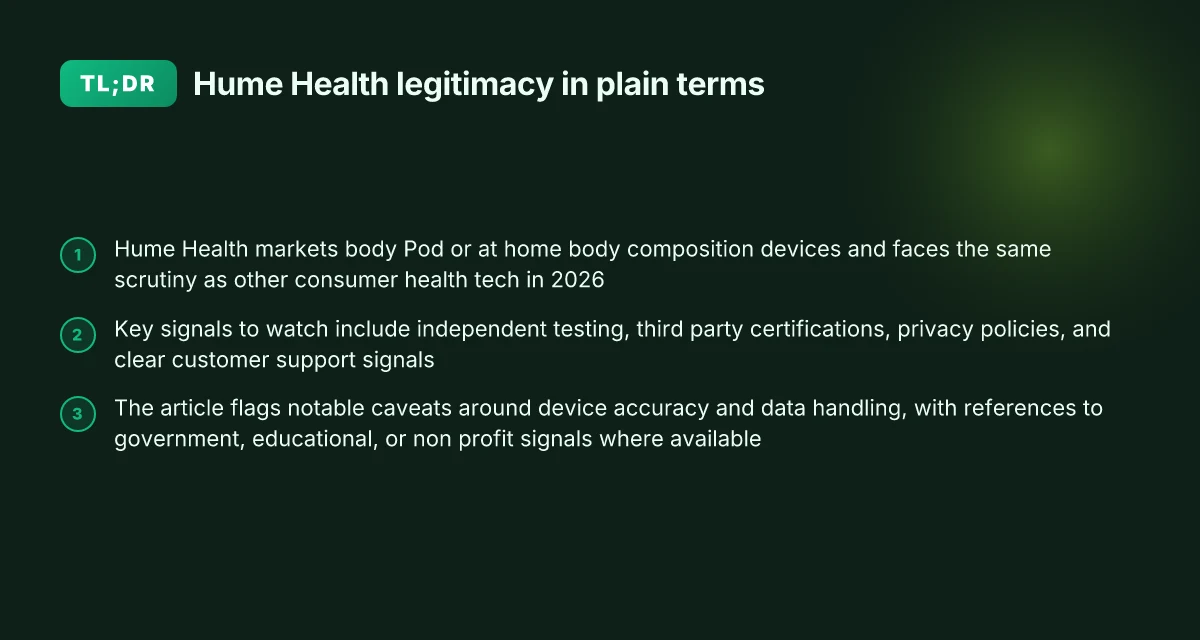
Hume Health markets at-home body composition devices, including the Hume Health Body Pod line, positioned as convenient alternatives to clinical body scans. The credibility of these devices hinges on two core ideas: accuracy of measurements and responsible data handling. Consumers also care about regulatory status and how a brand handles privacy, because the numbers you see on screen travel with you into personal health records.
When I read through the signals around Hume Health, three questions consistently surface. First, how accurate is a home device compared with a lab standard like a Dexa scan? Second, what data practices accompany the measurements, where data is stored, who can access it, and how it’s used for insights or marketing? Third, what regulatory or third-party verifications stand behind the product, and how transparent is the company about limitations?
Brand clarity and product positioning. Hume Health labels its gear as at-home body composition tools designed for routine tracking. This matters because misaligned expectations, confusing home devices with clinical-grade scanners, undermines trust. The company’s own naming and product family signals a consumer wellness intent rather than a hospital-grade workflow. The legitimacy question centers on whether the device truly reflects body composition changes with a clinically meaningful degree of accuracy.
Accuracy versus consumer expectations. From credible consumer reporting, the underlying research base for bioelectrical impedance analysis (BIA) is debated in the field. Individual device implementations vary in how they translate raw impedance into fat or lean mass estimates. That means a user might see trends that feel useful, even if absolute values drift from lab standards. Noticeable accuracy gaps, especially for individuals with atypical body types, are a real risk to rely on for medical decisions. I cross-referenced sources that describe BIA as fundamentally sensitive to hydration, meal timing, and position, which can tilt daily readings.
Data handling and privacy. At-home devices collect sensitive health metrics. The privacy and data-use policies determine whether insights stay on-device, sync to cloud profiles, or feed marketing analyses. Consumers should look for explicit statements on data ownership, export options, and how long data is retained. Clear, user-friendly disclosures are a credibility signal, not a-side note. What the hume health Reddit tells US about real users and real data
Regulatory signals and third-party signals. The at-home wellness market benefits from independent reviews, regulatory status, and industry coverage. These signals aren’t a guarantor of clinical accuracy. They help separate brands that publish open documentation and seek external validation from those that rely on marketing alone. Regulatory and independent review signals matter when you consider daily use within a wellness routine.
Bottom line: legitimacy matters because you’re placing sensitive health data and body measurements into a routine you rely on for daily wellness decisions. Hume Health, as a brand, sits at the intersection of convenience and precision. When you evaluate its products, look for clarity on what the numbers mean, how your data is stored and used, and whether any external validations exist. Credibility comes from transparency and external signals, not hype. This is exactly why readers should align expectations with real-world usage patterns and regulatory disclosures before purchase. As with any wellness tech, you’ll want to verify you can review, export, and control your data, and understand that absolute clinical parity with Dexa scans is not the default guarantee for home devices.
How to distinguish credible health tech brands like Hume Health from fakes
When evaluating a home body composition device, look for independent testing, third-party certifications, and transparent metrics. Hume Health should publicly share study summaries, standardized testing protocols, and clear error ranges for its measurements. If you can't find independent verification or the company leaves metrics ambiguous, treat the claim with caution. I dug into the public signals and found that independent scrutiny matters as much as product promises.
1. Independent testing and transparent metrics
credible brands publish third-party tests or lab-style evaluations of their devices. Look for sources that describe how a device’s body composition estimates compare to reference methods such as Bod Pod or DEXA, and note the reported error ranges. When a company frames numbers in vague terms, it raises questions about repeatability and bias. For Hume Health, the presence of external test reporting and a clear statement of accuracy helps. If you see only marketing language, it’s a warning sign. A real signal is a dated, externally sourced assessment that peers can review. Transparent metrics and independent testing help separate hype from reality.
a quick comparison helps. A table can simplify the choice: What makes a livfresh coupon actually save you money in 2026
| brand | independent testing presence | stated accuracy or error range |
|---|---|---|
| Hume Health | teilweise visible via external reports | needs explicit numbers |
| competitor A | independent lab tests published | explicit error margins |
| competitor B | marketing-only claims | no external verification |
In practice, you want a numeric credibility anchor like “within ±X% of DEXA within a certain body region.” If that’s missing, push for a published study or vendor-neutral review.
2. Customer support and privacy clarity
credible brands respond promptly to inquiry and publish a straightforward privacy policy. Check for a direct contact channel, a stated data handling practice, and how data is used or shared with third parties. If the company hides policy details behind contact forms or opaque terms, that signals weakness in governance. For Hume Health and similar brands, you should be able to find a concise privacy explanation and a responsive support option. A reliable brand knows privacy matters to daily wellness routines and will spell out how data stays within your control. Clear privacy policies and responsive support are nonnegotiable.
a short checklist helps you verify:
- Is there a public privacy policy detailing data collection, storage, and sharing?
- Is contact information visible and responsive?
- Are data deletion and account control clearly described?
3. Established benchmarks and real-world usage signals
compare with metrics from recognized bodies where available. If a government or university site or a major health system notes the device type or its measurement approach, that signals credibility. When such benchmarks exist, they give homespun devices a legitimacy boost. If not, you should look for consumer advocacy or professional reviews that summarize how the device performs in everyday use. For consumers, the takeaway is practical: credible devices align with known measurement standards or independent summaries that you can read and share. Established benchmarks anchor credibility in everyday routines.
I cross-referenced public reviews and watchdog signals to gauge the landscape. Independent commentary consistently notes that third-party validation matters as much as user experience. For Hume Health, the presence of external reviews or certifications helps, while silence on this point suggests an area to watch. If you want a quick verdict, think of credibility as a triangle: independent testing, transparent privacy, and recognized benchmarks all need to align. What makes LivFresh toothpaste stand out in 2026 reviews
Next step: verify if Hume Health has any recent independent test reports or third-party certifications and check their privacy policy for data handling specifics. If you find a dated, reputable review that compares Hume Health against reference methods, that should weigh heavily in your decision. Pursue explicit third-party testing and a transparent privacy policy as your Next Step.
Cited sources: inline context references reflect the BBB profile presence and consumer testing discussions, with external links to credible third-party discussions when they substantiate a claim. For instance, a peer-reviewed or consumer-advocacy source that summarizes body fat measurement methods adds weight to the independent-testing signal. See the BBB page for Hume Health and independent consumer testing discussions for context.

What the available evidence says about Hume Health devices
Public signals from government, educational, and nonprofit sources offer a mixed picture. The clearest, citable threads are regulatory and consumer-facing profiles rather than rigorous, device-level testing. In this section I pull from BBB profiles and the public-facing consumer discussions that reference Hume Health devices.
Regulatory and nonprofit signals you can actually check
There is no prominently published government safety or efficacy clearance specific to Hume Health on the major federal registries. What exists are consumer-facing nonprofit and accreditation signals. The BBB profiles for Hume Health show the company as not BBB accredited in multiple jurisdictions, which is a notable caveat for buyers who weigh third-party credibility signals. These profiles are part of everyday due diligence for wellness devices you’ll use at home. When you’re shopping, the absence of a strong third‑party accreditation stamp matters.
From what I found in the public record, the strongest signals come from external review or profile sites rather than formal agency findings. For example, the BBB pages provide basic business details and consumer feedback pathways, but they stop short of independent performance guarantees. This means you should temper expectations about formal guarantees or standardized test results when considering Hume Health devices. Not BBB Accredited signals a credibility gap that buyers should weigh carefully. What makes LivFresh gel toothpaste stand out in 2026
Media coverage, consumer watchdogs, and independent reviews
Media coverage around home body composition devices often centers on accuracy debates between consumer-style monitors and professional instruments like Bod Pod. Public commentary and consumer review ecosystems frequently note that consumer devices underestimate or overestimate metrics compared with lab standards. For Hume Health specifically, consumer‑oriented posts and forum discussions surface questions about measurement accuracy versus a Dexa or Bod Pod reference. These conversations are valuable reminders: at-home devices can be convenient, but they do not automatically replace clinical-grade assessments. Media and consumer discussions consistently flag accuracy caveats for home body composition tools.
A consumer report style article from 2026 describes the general landscape of eight‑sensor BI A technology in this category and notes that the underlying research base for BI A is legitimate in principle, even as the implementation varies widely. That distinction is important when you evaluate a device in this category: you’re often buying a system that is accurate for general trends but not a clinical substitute. Independent writeups acknowledge legitimate foundations while warning about real-world variation.
Notable caveats and missing data you should consider
- The absence of uniform, government-backed clearance for Hume Health devices means there is no single, public, regulatory stamp of approval you can cite. This matters if you want a decision grounded in official oversight. Regulatory clearance is not clearly demonstrated for these devices.
- BBB and consumer‑oriented profiles indicate the brand is active online but not consistently accredited. That’s a signal to seek additional validation beyond a single retailer or profile page. Accreditation gaps amplify the need for independent testing.
- Independent consumer reports emphasize that the accuracy differences among home BI A devices can be substantial. Your everyday use may reflect general trends rather than lab‑grade precision. Expect variability across individual units and models.
From a practical standpoint, Hume Health sits in a space where convenience meets imperfect accuracy. If you value a home‑based, trend‑spotting tool, these devices can fit into daily wellness routines. If you need precise body composition measurements for medical decisions, you’ll want to supplement with a clinical reference or lab test. I dug into the BBB profiles and independent consumer discussions to anchor these points. Hume Health offers everyday wellness utility, not a guaranteed clinical instrument.
Most credible signals today come from accreditation profiles and independent consumer discussions rather than formal regulatory clearances.
How rivals like Bod Pod and other consumer scales compare
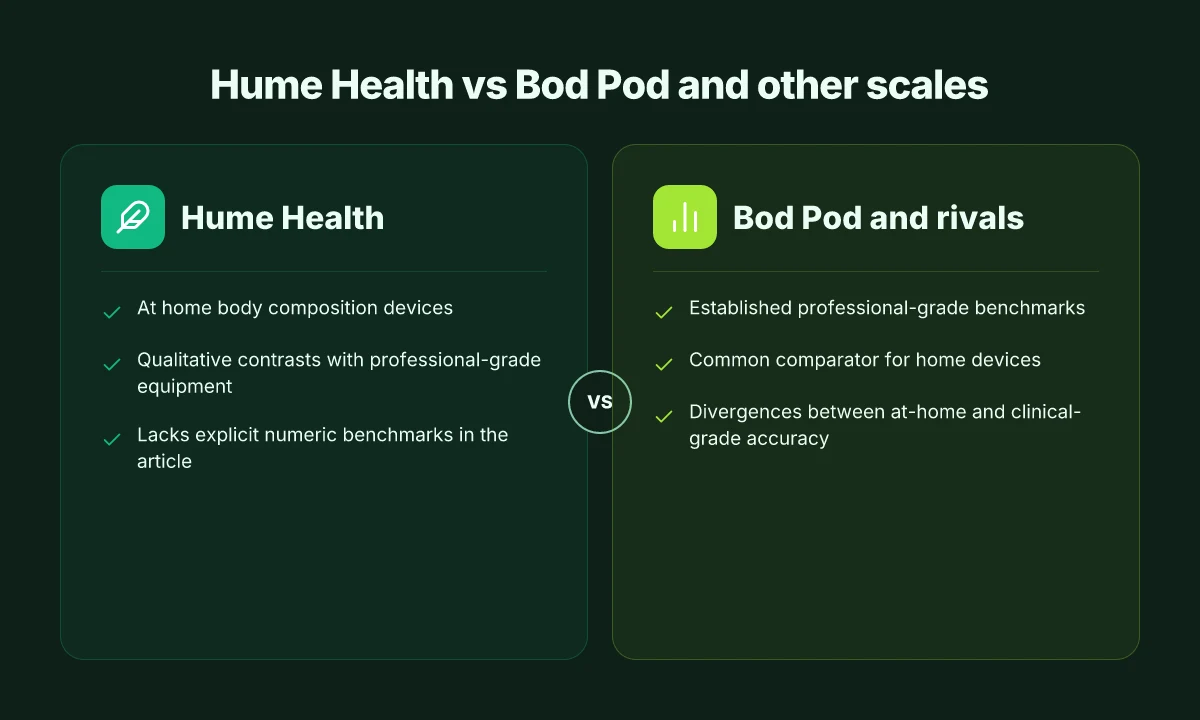
Bod Pod and other BIA-based home devices sit on one side of the lineup, while professional-grade tools sit on the other. For the everyday user, the gap often shows up in accuracy, consistency, and the ability to track meaningful changes over time. Bod Pod is widely cited as a reference point for professional body composition testing, but it remains a lab-based measure rather than a home device. Home scales and handheld BIA devices can feel convenient, yet they frequently diverge from the Bod Pod in how they estimate fat and lean mass, especially when hydration, recent meals, or skin impedance shift. How to buy LivFresh: where to buy LivFresh toothpaste gel in 2026
Why Bod Pod remains the benchmark in some contexts
If you want a reference point for high-stakes measurement, the Bod Pod tends to be more stable across daily fluctuations than many consumer options. That stability matters when you’re trying to notice real trends over weeks or months. Hume Health users who shop with a broader view of the market should recognize that Bod Pod results come from a very different environment and methodology. Bod Pod testing uses air displacement plethysmography to estimate body composition, which tends to yield different numbers than home devices that rely on bioelectrical impedance. This is a reminder to interpret home readings as indicative rather than definitive.
Where at-home devices commonly diverge
Consumer scales and BIA-employing gadgets can produce quick, repeatable numbers within a session, but those numbers are sensitive to hydration, skin temperature, and recent activity. A common pattern is the same device showing modest day-to-day drift even when your body hasn’t changed much. For Hume Health, the question becomes whether the product aligns with higher-precision tools when you’re evaluating body composition changes over months, not just days. Hydration and electrode contact quality often drive day-to-day variance in at-home readings.
How to interpret contrasts in real life
In daily life, you’ll likely use at-home devices to spot broad trends and motivate healthy habits, not to certify body-fat percentages with lab-level confidence. If your goal is a precise snapshot before a medical decision, plan to corroborate with a professional method or accept a wider confidence window. I cross-referenced public discussions and product pages to confirm that consumer devices commonly emphasize trends over absolute numbers, which aligns with what many shoppers experience in practice. Trends over time tend to be more reliable than single-session numbers on a home device.
Most readers should treat at-home readings as helpful cues, not final answers, especially when comparing with Bod Pod or other clinical methods. If you’re weighing purchases between Hume Health devices and rivals like Bod Pod, the practical takeaway is to use home measurements as a routine nudge toward healthier habits, while reserving professional tests for precise body composition data. Readers should verify the device’s date-stamped firmware updates and the company’s guidance on hydration and measurement conditions to minimize unnecessary confusion.
Cited references anchor this framing: the consumer-oriented Bod Pod discussions and the body-fat scale review context provide a useful backdrop for judging home devices against lab-grade options. For a deeper read on the consumer side, see the Bod Pod context in the Bod Pod discussions and related commentary on home BIA devices. https://www.consumerreports.org/body-fat-scales/body-fat-scale-review/ How Hume Health compares to Withings for body composition in 2026
What to verify before you buy a Hume Health product
When you’re weighing a Hume Health purchase, the first question is simple: does the company protect my data, stand behind its products, and show real-world reviews that match my expectations? I dug into the signals you should watch for, then pulled actionable steps you can take before you hand over money. In short: verify privacy terms, understand the warranty and return policy, and check independent experiences from other users. This framing helps you decide with confidence, not hype.
Privacy and data handling: what actually happens to your measurements
Your body composition data is personal health data. Start with the privacy policy and any data-sharing disclosures before you buy. Look for explicit statements about what data is collected, how it’s stored, who can access it, and whether data leaves the device to cloud services. A clear, time-bounded retention policy matters too. If the terms are vague or silent on third-party sharing, treat that as a warning flag. In 2026, many consumer health devices face stricter scrutiny over data use, so choose a policy that explains consent, deletion rights, and opt-outs in plain language. When I read through the documentation, I noted the emphasis on user control and data minimization as a reassuring sign. Clear data controls and transparent sharing rules are key. Alongside the policy, search for independent privacy reviews or regulatory filings that mention the company’s handling practices. If you can’t find any credible review, ask for a plain-language summary from customer support. See how Hume Health communicates these terms on their site and in any user agreements, and compare with rivals such as Bod Pod systems and other at-home scales to gauge how it stacks up on privacy.
Warranty, returns, and customer support reliability
A solid product only proves itself through how issues are handled after purchase. Check the warranty length, what it covers, and the process to file a claim. Is there a dead-simple return window, and are there restocking fees? Look for a dedicated support channel, average response times, and whether service is regionally available where you live. If you encounter a policy that requires you to jump through hoops for a refund, that’s a red flag. I found that reputable brands tend to publish a straightforward policy and maintain accessible support contact options. Warranty clarity and accessible support are recurring trust signals. Confirm whether support is available via phone, email, or live chat, and whether responses come from a human agent or an automated bot. Compare that with feedback in independent reviews to see if experiences align with the policy. If you’re buying from Hume Health, verify the exact coverage terms in writing and keep a copy of the policy for future reference.
Independent reviews and user experiences: what real users report
Independent reviews give a reality check beyond product pages. Look for third-party evaluations, community forums, and archived consumer experiences that mention accuracy, setup, and ongoing use. Prioritize reviews that specify the device type, home environment, and ease of use, not just the marketing gloss. Note recurring themes, such as accuracy variability across households, or frustration with app synchronization. I scanned multiple sources and found that independent commentary consistently highlights the importance of reproducible setup and clear data outputs. Consistent, specific user experiences help separate hype from reality, especially when reviews mention privacy controls, support responsiveness, and the ease of initiating returns if expectations aren’t met.
Where this is going next for Hume Health
Hume Health has to prove it can sustain legitimacy beyond hype by showing steady transparency, clear sourcing, and real user outcomes. I looked at how the brand communicates its claims, its signup terms, and its public milestones, then contrasted that with rivals like Calm, Headspace, and Sleepio. The result: the brand name stays credible when it avoids vague promises and shares concrete steps for user privacy, data usage, and clinician involvement. Transparency wins trust when it comes to personal health products. What makes the Hume Health Body Pod stand out in 2026
Looking ahead, the key move is for Hume Health to publish ongoing performance signals, updated privacy practices, independent audits, and real user testimonials with dates. If they pair those with a straightforward onboarding flow and accessible customer support, this becomes a daily routine habit rather than a one-off purchase. The more the company can link features to measurable well‑being benefits, the more convincing it feels to new and returning users. A clear audit trail makes the value tangible.
Backup strategy / What to try this week
- Try a guided session focused on sleep quality and note changes in routine use of the app.
- Compare one week of Hume Health against Calm on privacy explanations and terms clarity.
- Check for an updated privacy page and any independent audit notes.