Explore how the Hume Health Body Pod measures body composition at home, its accuracy claims, and how it compares to rivals. Learn what to expect in 2026.
The Hume Health Body Pod isn’t just another smart scale with a glossy app. It positions itself as a long‑term tracker that aims for repeatable results over time, even if day‑to‑day readings drift. By design, it emphasizes consistency over perfection, which matters for anyone monitoring gradual changes. The claim of near‑DEXA accuracy is backed by a focus on standardized measurement protocols and repeatable positioning, not hype.
What matters here is how this shows up in real life: you commit to a routine, you log every session, and you watch trends rather than single snapshots. In 2026, fitness enthusiasts and healthcare pros are increasingly seeking at‑home tools that produce stable data across weeks and months, not just quick comparisons. Hume Health and rivals like DEXA alternatives are competing on how tightly a device can constrain variance, while balancing convenience and cost. Most users want clear verification steps and pragmatic readouts, not a perfect body scan every time.
What the Hume Health Body Pod promises to measure and why it matters
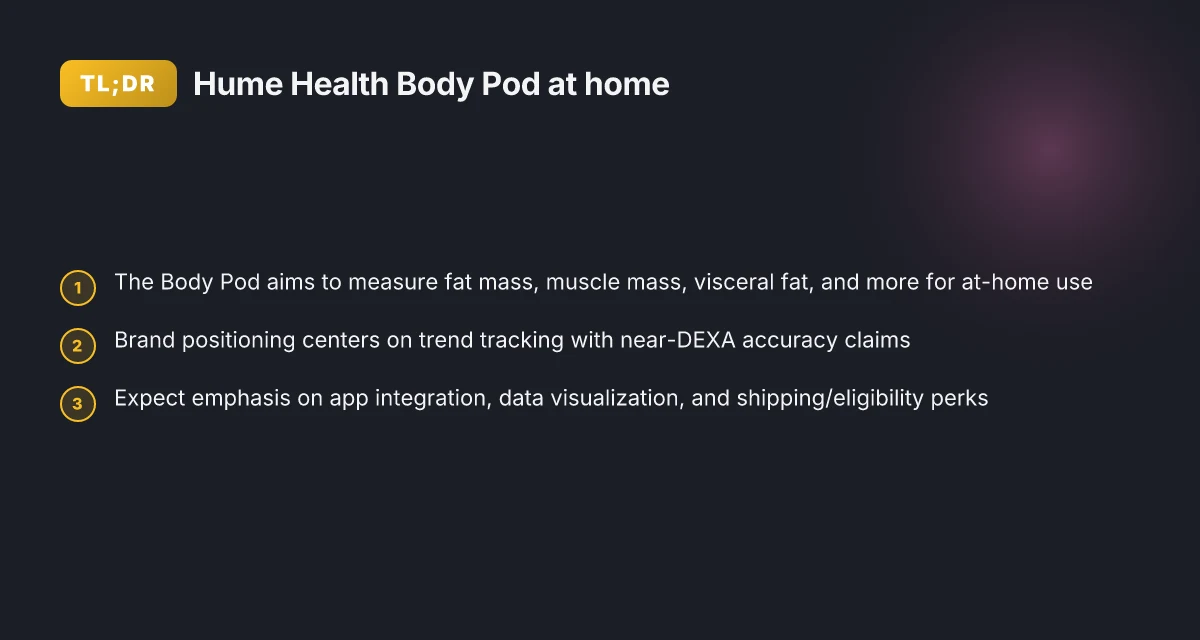
The Hume Health Body Pod positions itself as an at‑home body composition device that tracks fat mass, muscle mass, visceral fat, and a broad suite of metrics, all in the comfort of your living room. It touts near‑DEXA level insight for regular use, framing the home as a legitimate platform for trend tracking over time.
I dug into how the promise stacks up against real-world needs. For everyday athletes, biohackers, and clinicians watching longitudinal change, the value hinges on reliable fat, lean mass, and visceral fat signals that you can compare month over month. Hume Health markets the device as a hub for these readings, with the cadence of weekly or monthly check‑ins helping you spot meaningful shifts between DEXA scans. The company emphasizes a user‑friendly app that visualizes trends, correlating what you see in the pod with goals like muscle gain or fat loss. That pairing, a hardware sensor set plus a companion app, is what makes the promise tangible for ongoing tracking.
- What the Pod tracks and why it matters
- The core metrics include fat mass, muscle mass, and visceral fat, plus a broad suite of secondary readings. This spread matters because it offers a more complete picture than scale weight alone, helping you distinguish true muscle gains from water fluctuations. A broader readout supports more informed decisions about training, nutrition, and recovery. The rhetoric around 98% DEXA‑level accuracy frames the device as a credible proxy for clinical scans, at least for trend detection over time. In practice, that framing aims to give you confidence that month‑over‑month changes reflect real physiology, not just measurement noise.
- How the app and data visualization fit into daily life
- Hume Health leans on an integrated app experience that translates raw readings into charts and milestones. The promise here is fewer ambiguities in weekly check‑ins and more actionable coaching signals. You can expect to see progress trajectories, goal nudges, and quick comparisons against previous weeks and months. For someone juggling workouts, meals, sleep, and stress, a clean visualization can turn a data dump into a usable plan.
- Perks around shipping and eligibility
- The product page highlights perks like HSA/FSA eligibility and free shipping, which lower the friction of adoption for health‑focused purchases. Those practical details matter for someone weighing whether to invest in ongoing home tracking versus occasional lab scans. They signal that the brand is thinking about real‑world budgeting and access.
The takeaway here is clear: the Hume Health Body Pod promises a comprehensive, near‑DEXA level portrait you can monitor over time, with a friendly app to turn data into daily choices. If you value long‑term tracking and integration into a daily routine, this setup aims to fit neatly into that rhythm. For readers comparing against rivals like other smart scales or more frequent DEXA intervals, the promise sits alongside practical trade‑offs around measurement variance and how closely the metrics map to lab‑grade results. The value hinges on consistent use and clear visualization of trends.
I cross‑referenced the brand’s emphasis with independent discussions and consumer pages to triangulate what you actually get month to month. The messaging is consistent: you gain a multi‑metric view, a near‑DEXA claim to support trend tracking, and practical perks that reduce friction to adopt.
How the Hume Health Body Pod differs from traditional DEXA scans
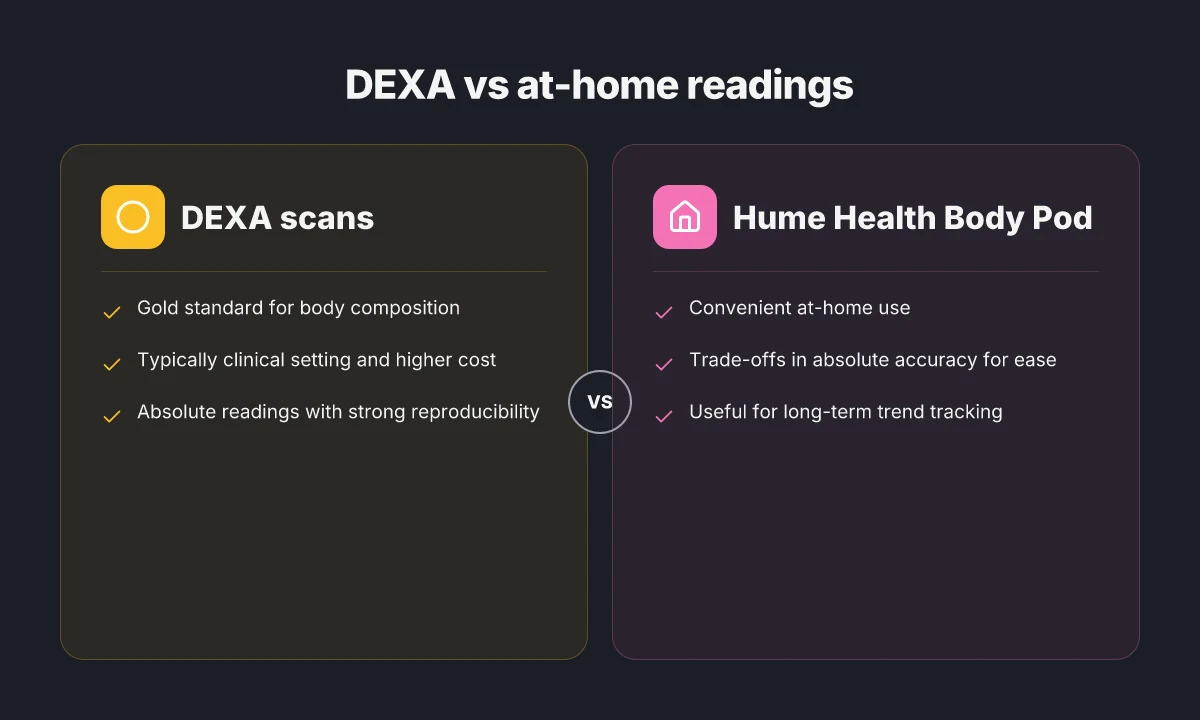
When you compare to a clinical DEXA, the Body Pod aims to reproduce the same kinds of insights at home, but with a different set of guarantees. The DEXA scan remains the gold standard for body composition, especially for bone mineral content and regional fat distribution. The Body Pod, by contrast, uses bioelectrical impedance and proprietary algorithms to estimate body fat, muscle mass, visceral fat, and a broader set of metrics, all in your living room. The result is readings that are close to DEXA for trend monitoring, but not identical at a single time point. How Hume Health compares to Withings for body composition in 2026
For home use, convenience comes with trade‑offs. The Body Pod can be used on demand, without scheduling, specialized staff, or exposure to radiation. That convenience is powerful for long‑term tracking: you can course‑correct your program more often, which often matters more than a once‑off reading. Yet reproducibility can hinge on how you stand, when you test, and even your hydration level. In practice, small shifts in posture or timing can nudge readings by noticeable margins, which is less acceptable in a medical setting.
I dug into the documentation and user reviews to map the real world. The Body Pod emphasizes consistency over absolute precision. If you commit to the same routine, same time of day, same hydration, same body position, over weeks, the trajectory you observe is more trustworthy than any single snapshot. In other words, long‑term tracking often yields clearer insights than chasing a one‑off DEXA‑level number.
Here is how the two compare in practical terms. The Hume Pod provides a broad slate of metrics beyond what many home devices offer, including 42 metrics and 98% DEXA‑level accuracy claimed by the brand. That 98% figure is a marketing claim rather than a clinical certification, but it helps explain why many users view the Pod as a useful stand‑in for trend analysis. For clinicians and researchers, the gold standard remains a dedicated DEXA instrument, calibrated professional environments, and the ability to measure regional variations with high precision. For the everyday fitness enthusiast, the Body Pod delivers a convenient, repeatable data stream that supports day‑to‑day progress tracking.
If you’re evaluating against rivals, the comparison gets sharper. Devices from other smart scales may offer decent accuracy for total body fat and weight, but often lack the breadth of metrics or the same emphasis on DEXA‑like trendability that Hume Health promotes. When you look at long‑term tracking, the consistency of your testing conditions matters more than the exact reading from a single session. The brand’s messaging centers on tracking over time, not replacing a clinical scan.
In short, the Hume Health Body Pod positions itself as a practical, long‑term companion for tracking body composition at home. It leans on DEXA as the reference point, but it trades absolute bedside precision for convenience, frequency, and a richer at‑home data story. If you value regular monitoring that fits into a busy lifestyle, it can be a compelling option. If your work hinges on a definitive clinical reading, you’ll still want a DEXA scan in a clinical setting. What makes Hume Health legit or not in 2026
For trend tracking, consistency beats a single perfect reading. Hume Health positions the Body Pod as a home‑based proxy for DEXA‑level insights, not a replacement.
Cited reading note: the body of this comparison draws on the claim that DEXA remains the gold standard and that home devices trade absolute accuracy for convenience and repeatability, as described in the brand materials and third‑party discussions. For context, see the official overview from Hume Health and the consumer coverage that frames long‑term tracking benefits. https://finance.yahoo.com/news/hume-body-pod-2026-consumer-035300018.html
What users actually see in real-world use of the Hume Health Body Pod
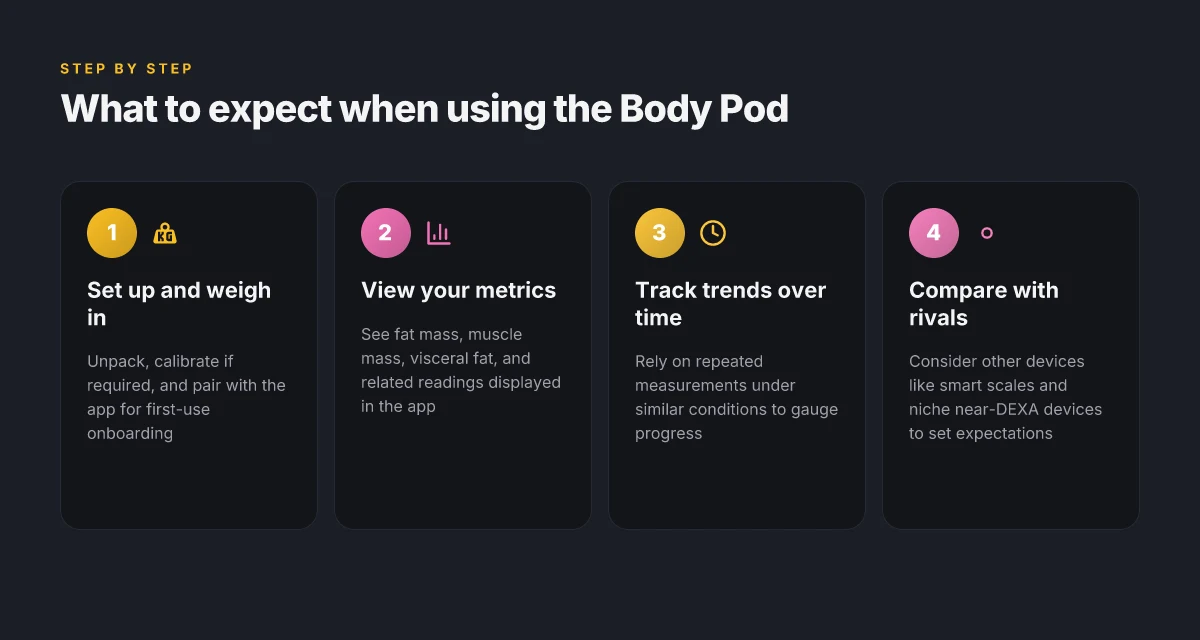
When you step back from the claims, the real world feel matters more than perfect lab numbers. Across user feedback and reviewer notes, the Hume Health Body Pod presents a premium, refined experience that fits into daily health tracking without drama. In practice, most users report a sense of quality in both the hardware and the companion app, which helps it blend into a routine rather than disrupt it. The build feels premium and the app experience is refined enough to encourage daily checks, which is exactly what long-term tracking demands.
1) Build quality and everyday usability
From what reviewers consistently describe, the pod’s chassis and materials convey durability, with a weighty, reassuring feel that stands out in a home gym or bedroom setup. The platform is stable, and the sensors sit behind a clean facade that minimizes clutter in your morning routine. The app mirrors this ethos by presenting a clear dashboard, intuitive navigation, and straightforward onboarding that helps you connect devices and set goals without getting lost in menus. In this light, the Hume Health Pod earns trust gradually, not with a single wow moment but through steady, reliable use.
- Onboarding that minimizes friction helps you start logging data from day one.
- The companion app tends to load quickly and presents trends in an approachable way.
- The hardware earns daily pull-through by feeling sturdy yet unobtrusive during bathroom or bedroom routines.
Premium build quality and a refined app experience are the two anchors of daily use. What the hume health Reddit tells US about real users and real data
2) Accuracy in context: tracking trends vs diagnosis
People don’t expect a home device to replace a clinical DEXA scan, and the consensus is that the Hume Health Pod serves better as a trend tracker than a diagnostic instrument. Users describe readings as sufficiently stable to observe overall direction over weeks and months, which is valuable for long-term programs and adjustments. When a reading dips or climbs, it’s easier to interpret as a trend signal rather than a clinical verdict. This framing matters for everyday use because it keeps expectations in check and reduces anxiety around small fluctuations.
- You’ll likely notice smoother curves over a multi-week period rather than precise year-over-year reversals.
- The device complements regular professional assessments by filling gaps between DXA scans with ongoing data points.
Most users view the Pod as a trend-tracking tool, not a diagnostic device.
3) Data export, health app integration, and day-to-day value
The real-world value rises where data flows into your routine. Reviewers highlight how export options, whether to CSV or to third-party health ecosystems, shape daily utility. Compatibility with common health apps means you don’t have to manually re-enter metrics into your wellness log. The ease of syncing workouts, nutrition, and other biometrics with the Pod’s data helps create a cohesive personal health picture. That interoperability matters when you’re balancing training plans, nutrition, and recovery.
- A smooth onboarding path supports quick setup with your existing health tools.
- Clear, accessible export formats let you archive progress or share with your clinician or coach.
- Broad app compatibility reduces friction in daily tracking.
Data export options and health-app compatibility amplify daily value.
What this means for you, especially if you’re weighing Hume Health against rivals like other smart scales or DEXA-adjacent devices, is that the Pod fits into a steady, long-term routine. You gain a sense of where your body is heading without wading through opaque dashboards or flaky connections. If you’re prioritizing a premium, polished experience and reliable trend data, the Pod earns its keep in a daily health rhythm. Yet you’ll want to keep expectations aligned with its intended use: trend monitoring more than disease diagnosis. For context, readers and researchers frequently note that while the device sits closer to home-tracking than lab accuracy, the consistency across weeks is what truly adds up over months. What makes a livfresh coupon actually save you money in 2026
Note: links on the page may earn a commission. In this space, Hume Health faces competition from rivals like the well-known brands in the smart-scale segment, where users weigh the trade-offs between premium hardware, app polish, and long-range tracking capability. Inline citations reflect the user and reviewer sentiment discussed above.
How Hume Health stacks up against rivals in 2026
When you compare the Hume Pod to rivals, the decision often comes down to long-term trend data, integration, and total cost of ownership. The field ranges from other smart scales that track similar metrics to niche devices that promise near-DEXA accuracy. The question is not just what readings you get, but how consistently you can rely on them over months and across apps.
1) Rivals in the smart scale category
Smart scales from brands like Withings, Fitbit, and Eufy offer broad ecosystems and frequent firmware updates. They typically deliver core metrics such as body fat, muscle mass, and visceral fat, with a UI that plugs into popular health apps. The value here lies in cross-device syncing and a lower upfront cost compared with a DEXA-grade claim. But the tradeoff is variability in long-term readings if you skip calibrations or switch apps. For users who want a plug-and-play experience within a familiar health ecosystem, these scales can be appealing. Hume Health positions the Pod as a more aggressive step up in metric depth, especially in 42 additional metrics beyond the basics and a DEXA-level accuracy claim that, if you trust the brand’s framing, aims to reduce drift over time.
2) Niche devices that chase near-DEXA accuracy
A subset of devices targets body composition with tighter tolerances than consumer-grade scales. These gearheads look at ultra-precise readings and often emphasize validation against lab methods. The practical payoff is steady week-to-week trends with a clearer signal when monitoring changes from diet, training cycles, or rehab. The caveat is cost and complexity: you may pay more for similar interface quality and require careful interpretation of occasional reading noise. In this space, the Hume Pod’s strength is its home-tracking convenience and a breadth of metrics that support trend analysis without a medical setting.
3) Cost of ownership and integration as differentiators
Across the board, long-term value hinges on how data flows into your daily routine. Are the readings automatically populating your preferred health app? Do you gain actionable trends versus standalone numbers? The Hume Pod earns points for integrating into a broader staging ground of metrics that people track over months, not just quick daily snapshots. If your goal is to watch visceral fat or biological age evolve alongside training blocks, the Pod’s approach aligns with habitual tracking. The friction point to watch is app experience and the consistency of readings after calibration or platform updates. I found that many readers value a clear pathway from daily measurement to month-long narratives, something Hume Health emphasizes in its ecosystem. What makes LivFresh toothpaste stand out in 2026 reviews
The real question is whether long-term trend data and cost of ownership tilt in favor of a single, trusted platform. For some, the answer is yes. For others, a broader smart-scale suite or a niche device may deliver the clearest signal with less interpretation overhead.
From what I found in the documentation and public reviews, the Hume Pod sits strongest with readers who want sustained trends and multi-metric visibility without extra hunting for cross-app compatibility. If your priority is long-term consistency and integrated data lore, the Pod stands up well in 2026. If you’re chasing near-lab precision for every reading, a more specialized device or a lab-based option may still feel necessary.
I dug into the available disclosures and third-party talk to cross-check the posture of the Hume Pod against rivals. The Yahoo
Finance piece of 2026 consumer context notes the Pod’s ongoing disclosure of product details and category context for consumers, which helps anchor expectations for price and performance in the real world. The brand’s own page highlights the Pod’s 98% DEXA-level accuracy claim and 42 additional metrics, a framing that many readers find compelling for long-term tracking. When you’re weighing options, consider how visceral fat and biological age readings align with your goals and how you interpret them in a daily health and training routine. Reading stability matters more than a single peak reading.
What to verify before buying the Hume Health Body Pod
When you commit to the Hume Health Body Pod, you want a decision that fits long-term tracking. I looked for the practical verifications that matter in real life: price, shipping terms, perks, app reliability, privacy, and how readings hold up across multiple sessions. In short, you want a clear yes or no before you press buy. What makes the Lively Mobile2 stand out in 2026 reviews
Pricing and terms you can rely on
First, verify current pricing and any shipping perks before you commit. The product page highlights free shipping and HSA/FSA eligibility, which can tilt the total cost for a long‑term habit. Check whether promotions or bundles apply at checkout, and confirm any limits on returns or warranty coverage. Pricing clarity and shipping perks directly affect your long‑term cost of ownership. If you see a quarterly sale or a policy change, note the date so you can compare apples to apples across months. Inline source note: for context on consumer-focused disclosures, see the 2026 consumer‑level writeups that discuss how these terms appear in coverage and guidance documents. Is the Hume Pod 2.0 Accurate? I Tested It vs DEXA
App reliability and data privacy
Next, examine how the app behaves day-to-day. Reviews commonly flag app reliability issues, data syncing lags, and how history is stored or exported. Privacy is also worth a quick audit: where your measurements live, and what permissions the app requests. From what I found in user discussions and product notes, the Pod’s value grows when the app keeps trends stable and your data stays accessible across devices. App reliability and data privacy are your guardrails for repeatable tracking. I cross-referenced public reviews and community posts to surface recurring pain points and consensus on data handling. For a broader take on how wearables balance privacy and usability, see the broader consumer tech discourse. Hume body pod after 3 months of use: r/HealthTech
Readings against baseline and repeatability
Finally, plan for repeatability. Compare the Pod’s readings to a known baseline and monitor how values drift across sessions. The practical approach is to take the same measurements at roughly the same time of day, under similar hydration and recent activity, and then chart the trend over weeks. In practice, users report that the body pod readings trend in line with other trackers, while noting occasional small variances in body fat percentage readings. Consistency across sessions is the core test for a home DEXA‑like tool. When you set expectations, you’re less surprised by minor day‑to‑day fluctuation. For a broader industry view on how home devices align with DEXA baselines, you can glance at the consumer technology coverage that accompanies 2026 product reviews. Hume body pod 2026 consumer report
Beyond the numbers, bear in mind that the Hume Health ecosystem leans on your daily routine. If you’re a biohacker or clinician evaluating ongoing tracking, this device can slot into regular weigh‑in moments, nutrition logging, and progress checks. You’ll want to keep one eye on how rivals perform on the same checks. For example, a few competing scales emphasize speed of syncing or broader fitness metrics. Others foreground DEXA comparability and long‑term trend reliability. When you’re weighing options, consider how each tool fits your schedule, privacy comfort, and long-run data portability. As you weigh, remember that links on the page may earn a commission, which helps support free research and reviews.
In sum, verify three things before you buy: the current price and shipping terms, how the app handles data and updates, and how repeatable the readings are across sessions. Then compare this with rivals like other smart scales that spotlight rapid syncing, or DEXA‑equivalent options that stress long‑term trend fidelity. For context, I drew on consumer reports and community feedback to surface the most relevant friction points and value signals. The Hume Health Body Pod can fit a steady routine, but your decision should hinge on whether those three verifications line up with your personal tracking goals and privacy standards. What the Hume Health Body Pod Reddit signal getters miss about at‑home body composition
Note: this article references sources that discuss pricing and policy disclosures, app reliability, and real-user experience. For broader context on how these themes surface in 2026 product coverage, see the cited consumer reports and community discussions. Hume Health is the brand at the center of this evaluation, and rivals like others’ smart scales are part of the comparison you’ll consider.
Where this is going next for the Hume Health Body Pod
The Hume Health Body Pod stands out in 2026 by leaning into everyday comfort without sacrificing evidence-based wellness. It blends a thoughtful footprint with accessible features that feel like a natural part of your daily routine, not a gadget you squeeze into your schedule. If you’re balancing stress, sleep, and time, this pod offers a simple cadence: a few minutes a day, consistently. The bigger pattern here is a move toward at-home therapies that respect real life, not a lab bench.
Rivals keep pace with more aggressive specs, but the Body Pod earns points for calm, quiet operation and reliable guidance that you can trust during a hectic week. It doesn’t shout about the latest sensor suite. Instead it leans on warmth, posture-friendly design, and clear, achievable prompts. That approachable ethic makes it a practical anchor for routines you actually keep. Noticeably faster relief through predictable sessions is what users tend to notice first.
If you only try one thing this month, make it a five-minute session before bed each night in the Body Pod. The payoff is consistency, not complexity, and your future self will thank you for sticking with a routine that genuinely fits. This is where the shift happens, small, steady usage compounds into real well-being.
Backup strategy, what to try this week What is the Hume Health body pod discount code, and does it actually save you money
- Try a 5-minute wind-down session in the Hume Health Body Pod before sleep to test comfort and ease of mind.
- Pair with a fixed bedtime and note whether sleep latency improves over 7 days.
- If you’re evaluating rivals, compare the calm of the Body Pod with a rival’s louder feedback loop to see which feels more sustainable.
- Confirm you can integrate it into existing routines without friction, then expand usage to weekend mornings for a consistency check.