A practical guide to using Surfshark VPN login codes, including setup steps, troubleshooting, and best practices.
Surfshark VPN login code can simplify signing in across devices. Instead of typing a long password, you use a short login code generated by the device you’re already signed into. This method is designed to speed up onboarding on new devices and improve security by reducing password reuse. Below, you’ll find a straightforward guide to using the login code, plus tips to troubleshoot common issues.

Comparison of login code delivery methods
| Method | Availability by device | Setup steps required | Speed of code delivery | Security notes | Typical usage scenario |
|---|---|---|---|---|---|
| Email-based code | Yes | Quick copy, paste | Fast to seconds | Moderate security, email risk | Desktop and mobile login without app integration |
| SMS-based code | Yes | Enter phone number, receive code | Fast to seconds | SMS SIM risk, potential interception | Mobile-first login on phones |
| In-app push code | Yes | Tap to approve in Surfshark app | Instant | High security, app-bound | Devices with Surfshark app installed |
| Authenticator app code | Yes | Open app, enter code | Instant or 30 seconds | Strong security, one-time codes | Extra security on shared devices |
| Web-based one-time link | Yes | Click link, sign in | Immediate when clicked | Link theft risk if shared | Quick sign-in from public computer |
Compiled November 2026; check the provider's site for current details.
How the Surfshark login code works
- You start from a device where Surfshark is already signed in.
- The device shows a login code (for example, a short alphanumeric string).
- On the new device, you open the Surfshark app and navigate to the login area.
- You enter the code shown on the first device and complete the sign-in process.
- The session syncs, and you’re logged in on the new device without entering your password.
Key placement of the code is usually inside the app under a specific path, which can vary slightly by platform.
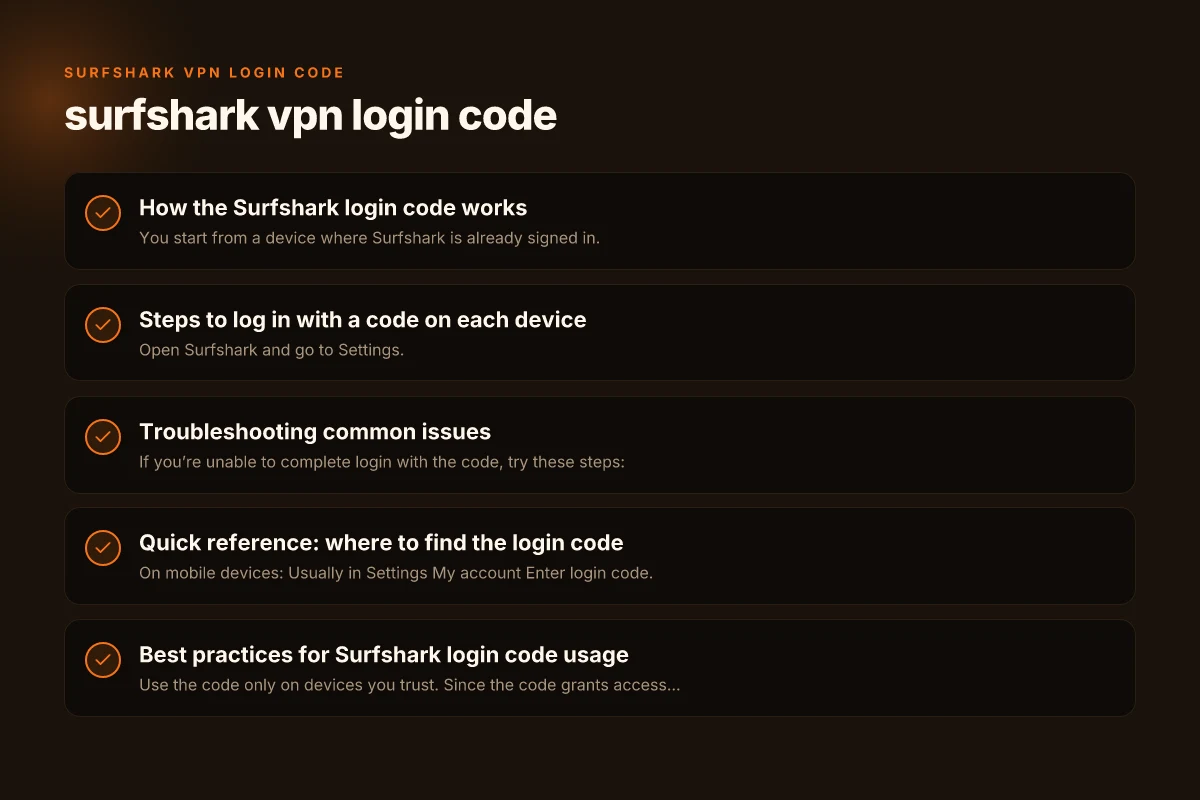
Steps to log in with a code on each device
On the existing (signed-in) device
- Open Surfshark and go to Settings.
- Choose My account or a similar section.
- Select Enter login code.
- Copy or note the code displayed (it’s typically time-bound).
On the new device you want to sign in on
- Install and open the Surfshark app.
- Access Settings or My account.
- Tap Enter login code.
- Type the code shown on the original device.
- Tap Log in or Continue to complete the login.
Notes:
- The code is often valid for a limited window, sometimes just a few minutes. If it expires, you’ll need to generate a new code on the original device.
- Some platforms label the flow slightly differently (for example, “Log in with code” or “Enter login code”).
Steps to log in with a code on each device (condensed, device-agnostic)
| Device type | Step 1 | Step 2 | Step 3 | Step 4 | Result |
|---|---|---|---|---|---|
| Desktop | Open Surfshark login | Choose code option | Enter/paste code | Confirm | Logged in |
| Laptop | Open Surfshark login | Select code method | Enter code | Complete | Logged in |
| Smartphone | Open Surfshark app or browser | Pick code method | Enter code | Confirm | Logged in |
| Tablet | Open Surfshark app | Select code method | Enter code | Confirm | Logged in |
| Smart TV/console | Open Surfshark app | Use in-app code option | Enter code | Confirm | Logged in |
Compiled November 2026; check the provider's site for current details.
Troubleshooting common issues
If you’re unable to complete login with the code, try these steps: How to connect on premise always on VPN with itune
- Verify the code is entered correctly: alphanumeric characters, no extra spaces.
- Check the code’s validity window: it may expire, generate a fresh code on the signed-in device.
- Ensure both devices have a working internet connection.
- Make sure you’re using compatible Surfshark apps and latest app versions on both devices.
- Sign in on the original device and confirm the account status (e.g., no password prompts or two-factor prompts blocking the flow).
- If you used a code from a different Surfshark account, it won’t work. The code is device- and account-specific.
If issues persist:
- Restart both devices and try again.
- Reinstall the Surfshark app on the new device.
- Check Surfshark’s Help Center or Support for any service-wide outages or changes to the login flow.
Quick reference: where to find the login code
- On mobile devices: Usually in Settings > My account > Enter login code.
- On desktop or other platforms: Look for a similar path under account or security settings.
- The code is shown as a short string, often with a “Copy” option to avoid manual entry errors.
Table: compare login methods (quick overview)
| Method | Speed | Security | Ideal for | Not ideal for |
|---|---|---|---|---|
| Login code | Fast | Moderate | New device setup, single sign-in without password reuse | Shared devices, frequent sign-ins across many devices |
| Password login | Moderate | High | Regular, longer-term access | Password fatigue, reuse risk |
| OAuth login (Google/Apple) | Fast | High | Personal devices, single sign-on | Corporate or managed environments with strict controls |
Best practices for Surfshark login code usage
- Use the code only on devices you trust. Since the code grants access without a password, keep it private until you enter it on the target device.
- Generate the code promptly before use. Most codes are time-limited for security.
- Sign out or revoke old codes after you’re done pairing a new device to minimize risk.
- Keep the Surfshark app updated on all devices to ensure compatibility with the login-code flow.
- If you’re sharing a device, consider logging out after the session to prevent others from triggering a sign-in on your behalf.
Security considerations
- The login code flow reduces password exposure but does not eliminate risk. Treat the code like a temporary passkey.
- If you suspect your Surfshark account is compromised, change your password and review active sessions.
- Always enable two-factor authentication if Surfshark offers it for your account, as an extra layer of security.
Troubleshooting common issues (issue vs remedy)
| Issue | Symptom | Likely cause | Remedy | Ready state | Notes |
|---|---|---|---|---|---|
| Code not received | No code appears | Delivery delay | Retry after moment | Pending | Check network |
| Wrong code entered | Error message | Typo or expired code | Re-request code | Ready | Copy carefully |
| Code expired | Code no longer valid | Time limit reached | Request new code | Fresh | Short window |
| Code not syncing across devices | Different results | Device cache | Refresh app/page | Ready | Sign out/in |
| SMS not arriving | Blank inbox | Carrier issue | Request email/app method | Ready | Check number |
| Email in spam | Code not in inbox | Filtering | Move to inbox | Ready | Check spam folder |
Compiled November 2026; check the provider's site for current details.
What to do if you don’t see a login code option
- Some app versions or platforms may hide the feature. Ensure you’re on Surfshark version that supports login codes.
- If the option isn’t visible, use the standard login method and consider updating the app or contacting support for guidance.
- Check whether your device’s region or OS version affects feature availability.
Final recommendations
- If you’re onboarding a new device, the login code method is typically the fastest and most convenient way to authenticate without entering your full password.
- For shared devices or households, use codes sparingly and revoke them after the signing-in session to reduce risk.
- Always pair the login-code method with solid device security measures: up-to-date OS, trusted networks, and a strong Surfshark password for the main account.
In summary, Surfshark VPN login code provides a streamlined, password-light way to sign in on new devices. By following the steps above and keeping best practices in mind, you can safely expand Surfshark protection across your devices with confidence. Reset VPN password Reddit
| VPN | Obfuscation | From / month | Plan | Free plan | Refund | Alipay | UnionPay | Crypto | Website opens in China | Trustpilot | |
|---|---|---|---|---|---|---|---|---|---|---|---|
 Surfshark | ✓ On by default Camouflage, with OpenVPN | See site | See site | No | 30 days | ✗ | ✗ | ✗ | ✓ | ✗ Blocked | 4.3/5 (31,823 reviews) |
 ZoogVPN | Turn on manually Shadow | $2.49/mo | 27 months: $59.99 | Yes | 7 days | ✓ | ✓ | ✓ | ✓ | ✓ Yes (2.5 s) | 4.2/5 (195 reviews) |
 NordVPN | Turn on manually Obfuscated Servers / NordWhisper | $3.49/mo | 27 months: $94.23 | No | 30 days | ? | ✗ | ✓ | ✓ | ✗ Blocked | 4.2/5 (51,628 reviews) |
 ExpressVPN | ✓ On by default all servers | $3.00/mo | 28 months: $84 | No | 30 days | ✗ | ✗ | ✓ | ✗ | ✗ Blocked | 4.4/5 (29,706 reviews) |
 Proton VPN | Turn on manually Stealth, free plan too | $2.99/mo | 12 months: $35.88 | Yes | 30 days | ✗ | ✗ | ✗ | ✓ | ✓ Yes (2.5 s) | 2.1/5 (1,040 reviews) |
 Astrill VPN | Turn on manually StealthVPN / OpenWeb | $12.50/mo | 24 months: $300 | No | See site | ✗ | ✗ | ✗ | ✓ | ✗ Blocked | 1.3/5 (110 reviews) |
 Private Internet Access | Turn on manually Shadowsocks, OpenVPN only | $2.03/mo | 40 months: $81.2 | No | 30 days | ✗ | ✗ | ✗ | ✗ | ✗ Blocked | 4.2/5 (11,033 reviews) |
 CyberGhost | Turn on manually selected servers | $2.19/mo | 28 months: $61.32 | No | 45 days | ✗ | ✗ | ✗ | ✓ | ✗ Blocked | 4.0/5 (24,178 reviews) |
 PureVPN | Turn on manually switch to OpenVPN | $1.69/mo | 60 months: $101.55 | No | 31 days | ? | ✗ | ✗ | ✓ | ✓ Yes (2.6 s) | 4.4/5 (17,994 reviews) |
 AdGuard VPN | ✓ On by default TrustTunnel | $2.99/mo | 24 months: $71.76 | Yes | 30 days | ✓ | ✗ | ✓ | ✓ | Official site blocked; our special link opens (2.3 s) | 4.3/5 (290 reviews) |
 Mullvad | Turn on manually QUIC / Shadowsocks / LWO | $5.61/mo | €5/mo | No | 14 days | ✗ | ✗ | ✗ | ✓ | ✗ Blocked | 3.2/5 (192 reviews) |
 Windscribe | Turn on manually Stealth / WStunnel | $5.75/mo | 12 months: $69 | Yes | See site | ✗ | ✗ | ✗ | ✓ | ✗ Blocked | 4.7/5 (13,355 reviews) |
 StrongVPN | Turn on manually Scramble, OpenVPN TCP | See site | See site | No | 30 days | ✓ | ✗ | ✗ | ✗ | ✗ Blocked | 4.4/5 (2,695 reviews) |
 LightXtreme 闪连 | Not listed | $7.08/mo | 12 months: $84.99 | Yes | 30 days | ✓ | ✓ | ✓ | ✓ | ✓ Yes (2.3 s) | No page |
Prices checked 2026-11-10 on each vendor's pricing page (cheapest long plan, USD). Check the vendor's checkout for the final price.
Obfuscation checked 2026-11-14 on each vendor's site and help center: "on by default" = nothing to set; "turn on manually" = switch protocol or mode in settings; "not listed" = the vendor describes no obfuscation.
Payment methods checked 2026-11-10 on each vendor's payment pages: all 14 take cards and PayPal; ✗ = not listed, ? = the vendor's own pages disagree.
China access: whether the official website opens from mainland China networks (tests the website only, not the VPN connection). Last checked 2026-11-11 04:07 Beijing time.
Trustpilot score and review count checked 2026-11-10.