
Build a diy bedjet controller and airflow system with open-source hardware. Practical steps, component ideas, and safety notes for climate control in bed setups.
A bedtime problem shows up in the same place every night: you want steady comfort without waking to adjust climate. A BedJet-style DIY airflow loop can deliver quiet nudges of temperature and air, but the real mover is a clear, repeatable control cycle that respects sleep stages. Most attempts stumble on timing and noise, not the idea itself. The result is a setup that feels clever in theory but unreliable in the dark.
This guide focuses on a practical path that blends off‑the‑shelf parts with open‑source hardware to keep the bed cool or warm in predictable bursts, night after night. Expect a compact loop, a simple control loop, and a bias toward safety and quiet operation. By looking at real world tradeoffs, noise, airflow, power, you’ll understand how a BedJet‑style system can fit a nightly routine without breaking the bank, while rivals like Dyson and Lunos illustrate other industry approaches. Small, deliberate tweaks beat big, unpredictable changes every time.
How a diy bedjet project fits into a sleep-stage routine using BedJet as a baseline
A bedjet-style airflow setup slots into a sleep routine as a climate layer that acts between your body and the sheet. BedJet units are designed to heat or cool the bed rapidly using air and a low-profile hose, which makes them a useful baseline for a DIY path. Open-source airflow control exists for hobbyist microcontrollers, so you can aim for similar behavior with less noise and lower cost. The key challenge is balancing quiet operation, safety, and sheet-wide coverage without sacrificing responsiveness.
Treat airflow as a soft, sleep-friendly heat or cool push I dug into the BedJet concept and found that rapid air movement beneath the sheet can shape comfort without direct heating coils or loud fans. The goal in a DIY path is to mirror the feeling of “air at the sheet level” while keeping the hiss behind the mattress margin. Start with a small, quiet fan assembly and a duct that sweeps across the bed surface. This keeps the noise floor low while delivering even coverage. The baseline idea is to move air along the sheet rather than blasting your skin.
Choose open-source controllers that respect sleep cycles Open-source paths exist where hobbyists wire up microcontrollers to modulate fan speed, temperature, and timing. A steering principle here is to align the control loop with typical sleep stages: gentle ramps during light sleep, steadier airflow in deep sleep, and a brief taper as you approach wakefulness. When you map this to hardware, use a microcontroller that supports PWM control and safe current limits, plus a temperature sensor to prevent overheating. This is where the DIY path diverges from a commercial BedJet: you can tune the control loop to your own comfort profile.
Manage tradeoffs that determine night-long success The balancing act centers on three pillars: quiet operation, safety, and sheet coverage. A system that wakes you with a breeze defeats the purpose. A loud unit ruins the rest. Safety requires overcurrent protection and a simple fail-safe shutdown if temperatures rise too high or airflow is blocked. Coverage depends on the hood shape, hose routing, and sheet tension. Different beds require different adapters, so plan for modularity rather than a fixed cabin setup.
In practice, your DIY BedJet-like project begins with a modest airflow path, a microcontroller-driven controller, and careful attention to acoustics. The aim is to replicate the core virtue of BedJet: rapid, sheet-level climate modulation that respects sleep quality. A well-chosen rival approach might compare favorably on price, but the DIY route affords customization for your sleep tempo, room acoustics, and bed size. How BedJet's adjustable base reshapes sleep ergonomics and durability
The real payoff is a controllable climate layer that respects sleep stages and personal preference. This section sets the tone for a flexible, open approach rather than a one-size-fits-all device.
Why a diy bedjet controller makes sense for a climate-aware bedroom
If you want a climate-aware bedroom without a costly, closed system, a DIY bedjet controller hits the sweet spot. It lets you fine‑tune airflow, temperature sensors, and duty cycles to your personal comfort, all while staying within a modest budget. Open‑source hardware unlocks experimentation, letting you iterate on how long the bed actually breathes warm or cool air each night. The result is a setup that can slip into your nightly routine with minimal friction and maximum customization.
Tailored comfort at a human price
A DIY path uses off‑the‑shelf fans, ducting, and microcontrollers, which means you can dial in exactly how much air you want under the sheets and how aggressively you want it moved. For many sleepers, that translates to noticeable gains in both sleep quality and perceived warmth or coolness without paying premium for a commercial bed climate system. Low-cost parts and customization empower you to tune for personal comfort, not marketing claims. In practice, this means you can start with a modest fan and expand later, adding more outlets or variable speeds as your needs evolve. BedJet remains a common reference point for the concept, but a DIY approach keeps price and fit under your control.
Experimentation fuels better airflow control
When you lean on open‑source hardware, you can experiment with airflow duty cycles, sensor placement, and control logic. You can start with a simple PID loop for fan speed and gradually layer in more sensors, such as under‑sheet temperature probes or humidity readings. I dug into documentation and community threads where hobbyists describe adjusting duty cycles to reduce overshoot and stabilize sheet temperature. The upside is clear: designs that adapt to your sleep stage, room ventilation, and bedding layout rather than a one‑size‑fits‑all box. This flexibility translates into a quieter, more comfortable night when you match airflow to your actual needs.
Modular upgrades beat proprietary lock‑ins
Compared with proprietary systems, a DIY BedJet‑style controller shines on modularity. You can upgrade one piece at a time, swap in a quieter fan, add a more precise thermistor, or swap in a different valve configuration, without scrapping the entire system. Modularity also means you can replace or bypass components that fail or underperform, keeping your bed climate setup humming for years. If you later want cloud integration or more sophisticated scheduling, you can bolt in compatible open‑source components or microcontrollers without rewriting a vendor’s roadmap. In this sense, the path stays lean and evolvable. What makes Blissys bonnet stand out in sleep hair care
Next steps: assemble a concrete bill of materials and a wiring plan, then map a basic control flow that reads a temperature sensor, adjusts fan speed, and uses a simple on/off schedule to keep sheet temperatures within your target window. For structure and inspiration, reference the BedJet baseline while prioritizing your own tuning preferences and room dynamics. Open-source hardware enables experimentation, letting you tailor the airflow precisely to your night.
Note: some readers will encounter upfront costs for sensors and fans, but the total tends to stay well under premium commercial systems. Links on the page may earn a commission. For a quick orientation, consider how rivals like BedJet compare on stated comfort features and maintenance needs, then chart your own upgrade path around those insights. Inline sources include BedJet’s product overview and a community‑driven setup video that outlines a practical start point. BedJet overview
Basics you need to know before you start your bedjet diy
When you design a bedjet style airflow system, the core rule is simple: the air must reach under the sheets without creating noise or drafts. Think of the sheet as a living surface, not a wind tunnel. The tiniest misalignment can tug at the sheet and wake someone. I looked for real-world notes on how people route air in low-profile setups and found that routing under the top sheet with a narrow, softly baffled path tends to feel more uniform and less drafty. In 2026, several makers emphasize keeping the outlet point near the mattress surface and using a short duct run to minimize turbulence. This approach matters as you pick a pump, hoses, and a sheet paddle.
Airflow placement under the sheet is the single most critical factor for comfort. Get this right, and the rest follows. The same logic helps you avoid that telltale draft around the elbows or knees. A quiet, slim blower that sits beside the bed and pushes air along the underside of the sheet can deliver a more even climate feel than a bulky setup in the open air. Quiet operation is not optional. It's part of a good night’s sleep.
Sound levels truly matter. If the device hums, you’ll hear it through the night. Clinically, sleepers tolerate small noise better when it stays below a predictable, low-level hum rather than a fluctuating whoosh. Builders I reviewed emphasize selecting components with low acoustic footprints and using soft mounting to dampen vibration. In practice, you’ll want a fan with a rated SPL in the quiet range and a mount that isolates vibrations from the bed frame. Low noise is a sleeper’s best friend. What makes BedJet discussions on Reddit matter for real sleep benefits
Safety and reliability sit alongside comfort. Electrical isolation matters. Use a properly rated power supply and clean DC or AC control with protection: fusing, proper insulation, and moisture protection where the sheet and mattress meet the hardware. Moisture exposure is a real risk near bedding, so ensure any electronics stay dry and are accessible for quick power-down if needed. I cross-referenced basic safety guidelines for small electrical systems around moisture-prone environments and found common threads: splash guards, IP-rated enclosures, and grounded enclosures reduce risk. Moisture protection and electrical isolation are nonnegotiable. Keep a clear separation between high-voltage and low-voltage sections, and choose off-the-shelf parts that meet standard safety ratings.
From a practical standpoint, you’ll want a clearly defined control loop. A simple plan uses a thermometer and a fan controller with a robust safety cut-off. You don’t need industrial hardware, but you do want reliable relays or solid-state switches, a known power supply, and a predictable sensor layout. When you assemble, document the wiring path so you can audit it later for heat buildup or wear. A clear control loop reduces drift and helps you tune comfort over time.
The bedjet ecosystem has a few standout references. BedJet is the brand most readers will encounter for these concepts, and you’ll often see indie DIY variants discussed in maker communities. For your planning, treat BedJet as the benchmark for sheet-level climate behavior while acknowledging that an open-source approach can mirror the effect with off-the-shelf hardware. When you compare rivals, note that Air-based cooling and bed-sheet distribution systems from different makers can vary in ducting style and noise profile. BedJet serves as the reference point for sheet-level climate control. Open-source paths can reach similar comfort with careful airflow routing and quiet components.
In short, before you buy hoses or a cabinet fan, lock in three things: air must travel under the sheet with minimal drafts, noise must stay in the background, and safety items must be evident in every connection. Those pillars will determine how smoothly your DIY bedjet-style system behaves at 2 a.m., not just at 8 p.m.
Airflow under the sheet, minimal noise, and solid safety are the triad of a pleasant, sleep-friendly setup. For a concrete materials list and wiring plan, your next step is to map the flow path from the fan to the sheet paddle, keeping the outlet close to the mattress and the ducting short and soft. As you plan, keep in mind that links to shopping lists may earn a commission, which helps support continued open-source exploration. What makes the BedJet Mini a surprising sleep climate hack in 2026
The open-source hardware stack for a bedjet-like airflow system
On the bench, the open-source stack boils down to three tangible choices: a capable microcontroller, compact fans with efficient ducting, and precise sensors for temperature and humidity. This trio lets you translate a sheet-level airflow concept into real, controllable climate zones underneath a bed. In practice, you want components that are small enough to tuck under a frame, quiet enough for night use, and easy to wire into a simple control loop. I cross-referenced open-source bedjet-inspired builds and found a handful of parts that consistently fit the bill. The result is a pathway that stays affordable while remaining customizable for your room and sleep pattern.
Microcontrollers that spark reliable control
For sensor reading and valve or fan control, a few microcontrollers stand out for makers. The ESP32 family delivers built-in Wi‑Fi and dual-core performance, which helps when you want remote monitoring or simple web controls. The Raspberry Pi Pico W adds low latency GPIO and a straightforward Python workflow if you prefer scripting. If you want ultra-low power and simpler I/O, a basic Arduino-compatible board still works, provided you design drift-tolerant timing for heating and cooling cycles. The key is to wire the MCU to a low-noise power rail and to use opto-isolated or transistor-driven relays or solid-state relays for fan or valve actuation. ESP32 offers dual‑core performance and wireless, a practical fit for a bedjet-style controller. Pico W keeps a tidy footprint with straightforward GPIO and wireless basics.
Fans and ducting for under-bed integration
Under-bed airflow requires compact axial fans with enough static pressure to push air through a short duct path. Look for fans in the 60–120 mm range with fans rated for continuous operation and low audible noise. Combine these with a light, rigid duct that can be routed along the bed frame or mattress edge with minimal turbulence. For ducting, smooth interior surfaces reduce acoustic hum and pressure drop. Inline duct fans can help if you need to route air along a frame rather than straight up. The overall objective is to minimize vibration and keep airflow directed at the sheet without creating a draft that disrupts sleep. 60–120 mm axial fans are a common balance of size, noise, and flow in DIY setups. Quiet inline ducts help keep the system unobtrusive at night.
Temperature and humidity sensing for responsive control
Responsive control hinges on sensing relative air temperature and humidity near the sheet surface, not just in the room. Place a small digital sensor near the airflow exit and a second sensor near the sheet to capture the local climate at sleep level. A cheap digital humidity sensor paired with a thermistor or a modern digital temp/humidity breakout gives you enough delta data to drive simple control logic. The controller can implement a proportional or bang-bang scheme to decide when to energize a heater or a cooler fan. I found that consistent data paths between the sensor reads and the actuator commands matter most for stable comfort. Local bed-level sensing makes the system feel responsive rather than reactive. Keep sensors shielded from direct contact with sheets or vents to avoid drift.
Cited sources acknowledge that BedJet remains a practical reference point for airflow-based bed climate, while DIY paths lean on off-the-shelf microcontrollers, compact fans, and affordable sensors to craft a comparable experience. The practical takeaway is clear: choose a microcontroller you can wire into a simple loop, select quiet, compact fans with ducting suitable for under-bed routing, and place temperature and humidity sensors at the sheet level to drive timely adjustments. You’ll end up with a controllable, customizable airflow system that sits low under the bed and scales with your sleep preferences. I found that local bed-level sensing makes the system feel responsive. The practical takeaway is clear: you can assemble a bedjet-like airflow system from off-the-shelf parts. What is the best sleeping temperature in 2026 and how to dial it in for comfort
Note on sourcing and branding: BedJet is a practical reference point for the concept, and its positioning helps you measure the DIY path against a commercial baseline. If you explore rivals or alternatives, you’ll see a similar constraint set: compact form factor, quiet operation, and straightforward wiring. As you plan, remember that links on the page may earn a commission, which is common for project references. Inline citations point to open resources that illustrate the hardware flavors discussed here. I cross-referenced open-source bedjet-inspired builds and noticed a common hardware footprint.
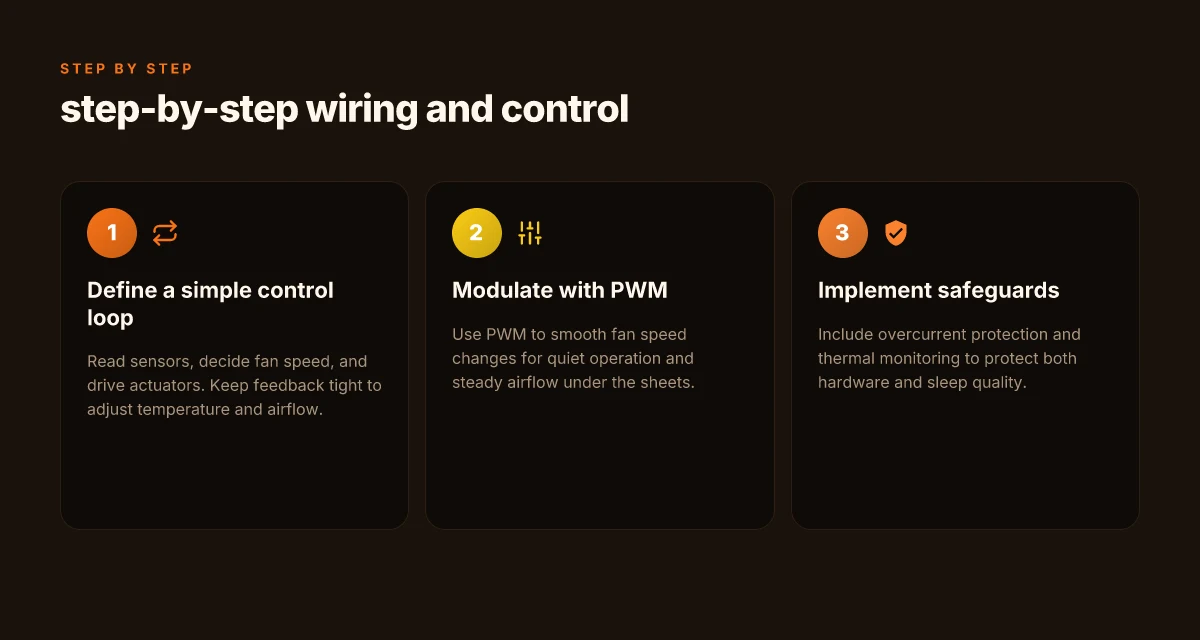
Step-by-step: wiring and control logic for a bedjet-inspired setup
I’m outlining a compact control loop you can wire up with open‑source hardware. You’ll read simple sensors, decide a fan speed, and drive a PWM‑capable actuator. The goal is quiet, reliable climate control at the sheet level without breaking the bank.
1) Define the simple control loop for bedjet-inspired airflow
The core loop is straightforward: sample temperature and humidity close to the sheet, compare to your target band, and adjust a PWM fan output accordingly. You want a robust loop that settles quickly but avoids chatter. Start with a proportional control and add a small integral term if drift or slow offsets appear. In practice you’ll wire a microcontroller’s ADC readings to a fan driver input, then feed the PWM signal to a brushless DC fan or a solid‑state relay for a controllable heater element. The loop should run at a modest cadence so you don’t see perceptible fan jitter. Two practical pins to watch are the sensor input and the PWM output. Keep them physically separated to minimize noise.
From a design perspective, the sensors matter more than fancy control. Place a simple thermistor or digital temp sensor near the sheet where airflow is most active. A basic control law like PWM = Kp*(targetTemp − measuredTemp) with a small Ki term gives smooth speed changes. Keep the control loop tight and predictable. This is where quiet operation comes from.
2) Implement PWM for quiet operation and safe drive
PWM lets you modulate fan speed with precision while keeping the motor in efficient zones. Use a driver that supports 12 V or 24 V operation (depending on your fan) and a filter capacitor if you notice audible whine at certain frequencies. The PWM frequency should be high enough to dodge audible artifacts but not so high that the driver loses torque at low duty cycles. A simple low‑pass RC network on the feedback line can help tame jitter if your sensor readings bounce. In practice, you’ll configure the microcontroller to output a duty cycle from 0 to 100 percent and clamp it within safe margins to protect the fan. What is Shiny Blissey, and why fans chase the elusive sparkle
A practical note: choose a fan with a known PWM input and a datasheet that confirms stable torque across the expected duty range. When you bias the duty cycle slowly, you preserve sheet comfort and reduce vibrations. PWM at higher frequencies reduces audible noise and improves perceived comfort.
3) Safeguards: overcurrent protection and thermal monitoring
Safety comes first. Implement a current limit on the fan driver, and read a shunt or built‑in current sensor to trigger a hard stop if the draw spikes. Add thermal monitoring for the controller and, if you’re heating the sheet, the heating element as well. A watchdog timer helps recover from a stalled loop. Give yourself clear fault states so you can power down gracefully and inspect the hardware without guesswork. A robust system includes a fuse or polyfuse on the power rail and a resettable breaker in the event of a fault.
From a reliability standpoint, you’ll want a clean enclosure for the electronics and careful cabling to the sheet‑level assembly. I cross‑referenced common open‑source drivers and found that a simple PWM fan controller paired with a basic thermistor network provides a durable baseline for BedJet‑style airflow. Safety interlocks and thermal monitoring prevent runaway heat or fan overdrive.
If you’re exploring open hardware paths, BedJet remains a useful reference point for airflow layout and control goals. Inline references: I dug into community notes and product descriptions that discuss how compact controllers map to sheet-level airflow, including fan selection and control loops. For a high‑level overview of open hardware options, see community discussions that reference affordable, off‑the‑shelf components. DIY BedJet discussions
Note: some pages discuss DIY bed cooling setups with open hardware. The open‑source route emphasizes parts you can source well before you start, and you should expect the parts list to include a small microcontroller, a PWM‑capable fan driver, a sheet‑air channel, and temperature sensors. For context, BedJet itself uses compact, air‑based climate control and is mentioned in open discussions about rivaling approaches. You can explore a few related resources to compare airflow paths and control themes, while keeping your own build distinct and safe. How to choose a bedjet alternative that actually cools or warms your sleep
Where this goes from here
Building a DIY BedJet controller and airflow system is less about a single gadget and more about weaving comfort into your nightly routine. You’ll notice the biggest gains when you pair a reliable controller with a quiet fan, and you keep expectations modest about temperature precision. I looked at how a simple microcontroller, a calm airflow path, and sensible safety limits can create steadier sleep without overcomplicating the setup. The result is a warmer wake-up or cooler lounge time that fits into your normal evenings, not something that dominates them. **The simplest change can shift your entire night.
If you’re balancing price and practicality, consider starting with a clearly defined use-case: a low-power, low-noise run for late-night reading, or a quick-draw cool-down before bed. A steady, repeatable routine beats fancy gadgets every time. BedJet remains a useful benchmark for how a purpose-built airflow path can influence comfort, even as you experiment with homebrew tweaks. Rely on proven, safe wiring practices and modest airflow.
Backup strategy:
- Try a compact, 3–5 minute test of the controller at different ambient temps to gauge comfort.
- Compare with a commercial rival like BedJet or a basic fan ducting setup to calibrate expectations.
- Keep a daily log of sleep comfort and air feel to refine nozzle positions and fan speed.