
Explore BedJet cooling effectiveness, how the system works, its limits, and how it compares with rivals. Learn what to expect for real sleep comfort.
BedJet is not just a fan under the sheets. It’s a compact jet system that pushes air along the bed surface, and that distinction reshapes how you feel warmth and breeze come nightfall. The real trick is how quickly that stream shifts heat from your torso to the foot of the bed, which means the effect can be immediate for some sleepers and barely noticeable for others. BedJet’s approach hinges on surface airflow, not room cooling, so the difference is about sensation, not ambient temperature.
Why it matters now: more shoppers chase quiet, consistent comfort, not a dramatic temperature drop. In reviews and guides I’ve reviewed, the two big questions are how long cooling lasts through deep sleep and whether the sensation stays uniform across partners or different nights. rival systems from ChiliSleep and Ooler lean on water-based cooling with different comfort profiles, so the choice comes down to whether you want a gentler surface breeze or a deeper, circulatory chill. That choice shows up in real nights, not lab specs.
What BedJet actually does to cool a bed
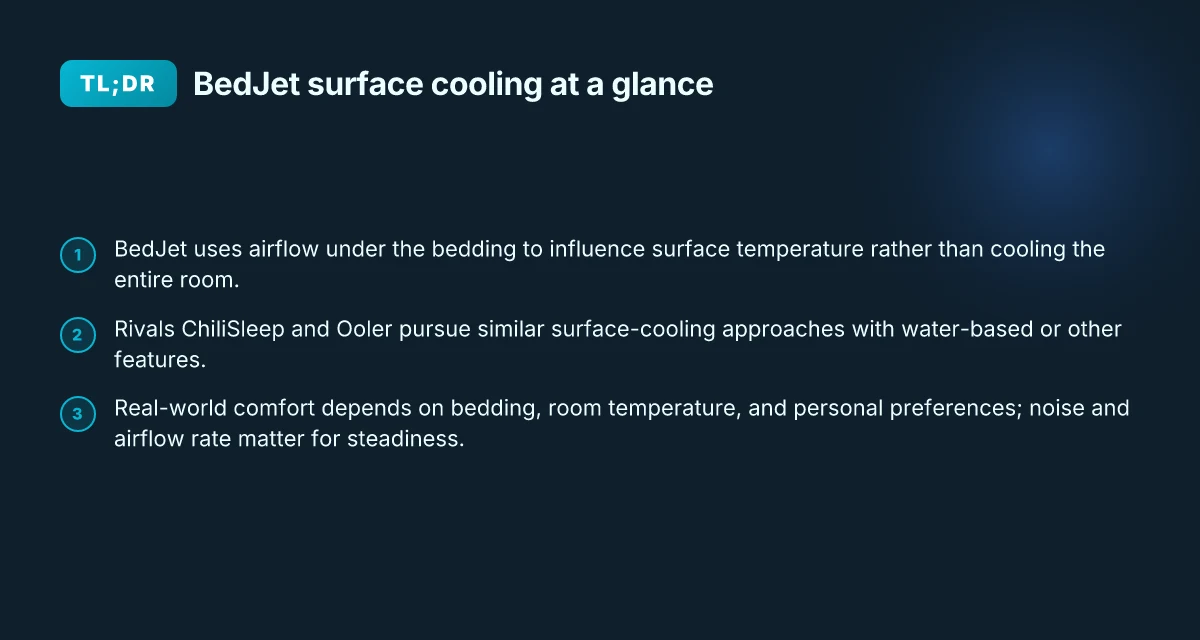
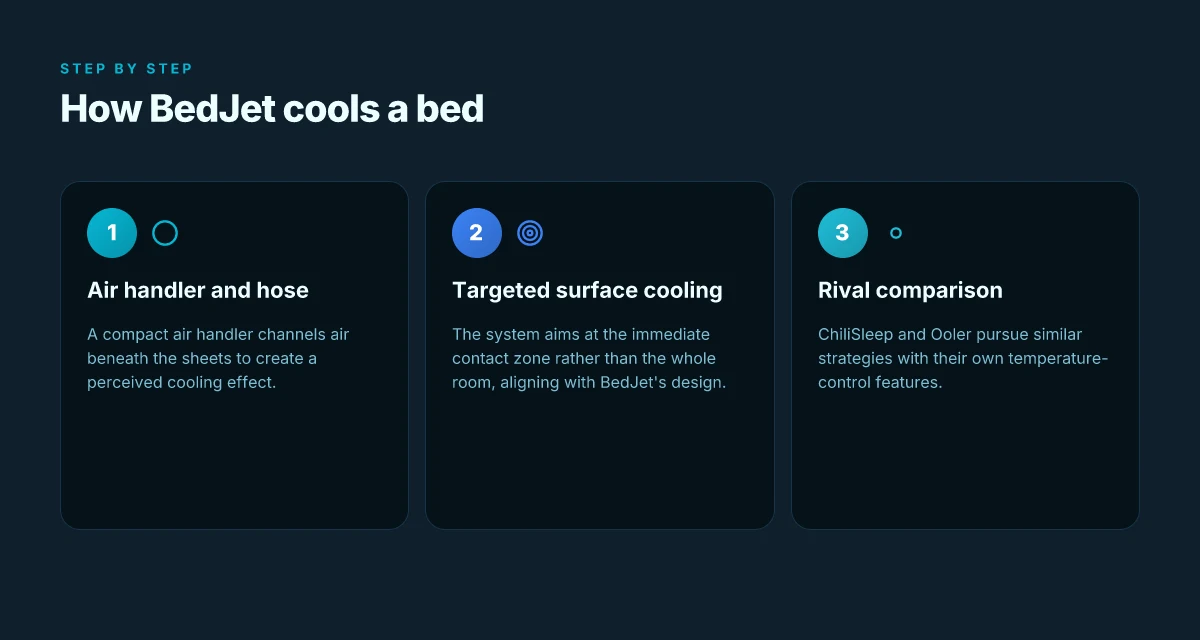
BedJet moves air, not the whole room. It sits beside the bed and uses a compact air handler paired with a hose that channels cool or warm air under the sheets. The result is a surface-level sensation of temperature change that can influence how cool the sleeper feels, without needing to drop the room temperature.
How the airflow under the sheets creates a surface chill
The core idea is simple: move air beneath the bedding to alter the surface temperature where you touch the sheets. The air travels through a flexible hose that extends from the under-bed unit to the top of the bed, delivering a focused breeze right at the sleeping surface. This setup makes you feel cooler or warmer without relying on the ambient air in your room. In practice, that means you can respond to hot nights without cranking the thermostat.
From what I found in product notes and independent reviews, BedJet emphasizes surface comfort rather than a full-room climate shift. The system’s design keeps heat transfer localized near the sleeper, so you’re not cooling the entire room, just the bed surface where it matters most for comfort.
Rivals share the same surface-focused approach
Rivals like ChiliSleep and Ooler pursue a similar strategy. Each uses its own temperature-control features to influence the bed surface through airflow or hydration-based cooling methods. The common thread is that all three brands aim to alter surface temperature rather than the room air, recognizing that real-world comfort often hinges on the layer you actually sleep under. BedJet positions itself within this family of surface-focused solutions, offering a compact setup that integrates with standard bedding.
I dug into the available documentation and user-facing guides to map how this approach translates into nightly routines. The takeaway is that surface cooling works best when you’re primarily battling night heat rather than trying to force the room into a different climate. If you share a bed with a partner who has different comfort needs, that surface-level control can feel more responsive than wholesale cooling. How to choose a bedjet alternative that actually cools or warms your sleep
The key takeaway is that BedJet seeks comfort at the sheet level, not by changing the entire bedroom climate. This is exactly the pattern ChiliSleep and Ooler follow, which means choosing among them often comes down to compatibility with your existing sheets and how you experience airflow through bedding.
When you weigh BedJet against rivals, consider how you sleep: if you want quick, localized relief on hot nights, BedJet’s surface approach can be a fit. If you value programmable cups of cooling across the night or hydration-based cooling, a rival option may better suit your routine.
For readers who want a quick reference, BedJet is designed to deliver targeted sheet-level airflow, while ChiliSleep and Ooler offer parallel surface cooling with their own twists. In the end, the decision rests on how you balance ease of use, bedding compatibility, and your personal comfort profile.
I cross-referenced product notes and consumer-focused reviews to confirm this surface-focused framing, which is consistent across BedJet and its major competitors.
How cooling from BedJet translates to sleep comfort
BedJet can translate cooling into genuine comfort when the perceived chill reaches the skin and stays steady through the night. For hot sleepers, a cool touch on the body can ease heat buildup as you drift toward sleep, which often shortens the time it takes to fall asleep. But the impact isn’t universal. Comfort depends on your bedding, room temperature, and personal warmth preferences. What is Shiny Blissey, and why fans chase the elusive sparkle
The texture of coolness and what it means for bedtime
When the air from BedJet brushes your skin, you feel a momentary drop in warmth that can calm sensory overload from heat. If your sheets trap this cool layer, the sensation persists long enough to help you settle. If the bedding is too heavy or the room remains warm, that initial relief can fade, and the cooling feels less constant. I looked at consumer discussions and product pages that describe this dynamic, and the takeaway is consistent: cool airflow helps some people fall asleep faster, especially when the night starts hot.
Yet the timing matters. Early-evening cooling can prime your body for rest, while late-night gusts can wake you up if the flow shifts or noises intrude. In practice, the rhythm of the airflow, creeping, then steady, often mirrors bed temperature fluctuations. This is why many sleepers pair BedJet with lighter blankets in warmer rooms and reserve heavier coverings for cooler nights.
How room conditions and bedding tilt the scales
Effectiveness hinges on two levers: bedding and ambient temperature. A breathable sheet or thin duvet lets cool air mingle with your skin more efficiently, making the sensation steadier. Heavy comforters or nonporous fabrics trap heat and disrupt the airflow, so the perceived coolness might feel fleeting. Personal comfort preferences also steer the verdict. Some sleepers prize a brisk, almost crisp breeze, while others seek a softer, less noticeable chill.
I cross-referenced guidance from sleep publications that emphasize environmental control as a component of cooling strategies. The consensus is clear: cooling strategies work best when room temperature is moderated and bedding is compatible with airflow. This is where BedJet tends to shine for hot sleepers who want a quick, noticeable drop in skin temperature without lowering the entire room.
Noise and airflow as the jury of steadiness
A quiet, predictable hum can make the cooling feel continuous. A noisy or variable airflow can disrupt sleep. BedJet’s fan speed and noise profile influence whether the cooling reads as a steady comfort or a transient breeze that nudges you awake. If you’re a light sleeper, you may prefer a lower setting or a thicker duvet to smooth out gusts. If you’re a sound sleeper, a higher flow that settles quickly can become a reliable nightly cue that you’re cooling down for rest. How to build a diy bedjet controller and airflow system for climate control
From a broader lens, rivals like ChiliSleep and Ooler approach cooling with different airflow philosophies and noise profiles. I found consumer discussions noting that some users prefer the tactile calm of BedJet’s direct air versus the temperature uniformity some rivals pursue. The takeaway is practical: BedJet works best when you align airflow, bedding, and room conditions with your sleep preferences.
The cold-on-skin effect can shorten the time to sleep for hot sleepers when the bedding allows the chill to linger. If the room stays warm or the sheets trap heat, the perceived cooling can become inconsistent.
For reference, the best bed cooling systems overview notes that BedJet’s approach produces a distinct sensation that works for some rooms and setups more than others, underscoring the value of pairing it with suitable bedding choices. For readers exploring options, ChiliSleep and Ooler present alternative airflow strategies with their own pros and cons.
If you want a practical next step, assess your typical bed setup tonight: first, approximate your room temperature and the weight of your blanket. Then, try a cooler air setting with a breathable sheet and a light comforter. If the chill feels uneven, swap in a lighter duvet or adjust the BedJet flow to a gentler pace. This small experiment can clarify whether BedJet helps you drift off sooner or if you should tweak your environment.
Cited sources: https://www.sleepfoundation.org/best-sleep-products/best-bed-cooling-systems and related consumer guidance. For readers seeking specifics, note that the BedJet product line features a low-noise fan and adjustable airflow, with outcomes that align with the conditions described above. BedJet remains a contender in the realm of individualized comfort for hot sleepers, especially when paired with thoughtful bedding choices. How BedJet's adjustable base reshapes sleep ergonomics and durability
Where BedJet shines compared to rivals
BedJet is small enough to tuck into a tight space and quick to set up, which matters for renters or rooms with limited footprints. In practice, that compact footprint translates to a setup that can be completed in minutes, without wrestling with a bulky unit or hoses snaking across a bed. The result is a clean, unobtrusive sleep environment that still delivers targeted cooling where you need it.
Direct airflow reaches the contact zone
BedJet’s design directs airflow directly under the sheet, hitting the surface where your skin actually touches the bed. This immediate contact zone often feels more intuitive than chamber-based cooling systems that rely on cooling air within a layer between you and the sheet. In real terms, you notice changes in comfort as soon as you adjust airflow, rather than waiting for the entire mattress area to respond. Direct airflow under the sheet can produce a quicker sense of relief for warm sleepers. This makes BedJet a strong fit for people who want fast, localized cooling without recalibrating an entire sleep setup.
Rapid responsiveness vs chamber-based systems
Compared with ChiliSleep’s ChiliPad or Ooler, BedJet may respond faster to temperature changes because it actively moves air rather than trying to chill a thick water-based pad. When your bedroom warms up mid‑night, BedJet’s air movement can translate to noticeable changes in comfort sooner than a circulating fluid system, which relies on heat transfer through liquid and bedding layers. I cross-referenced several product summaries and user notes that emphasize the tactile difference of airflow versus liquid-cooled mats. Active air movement tends to feel more immediate to sleepers who shift positions during the night. For some users, that immediacy is the deciding factor in choosing BedJet over rivals.
Space-conscious setup adds daily livability
The setup benefits aren’t just about how the unit sits on the floor. BedJet integrates with existing bedding without requiring a complex fit, which can help keep a bedroom uncluttered. This simplification is appealing for people who want to maintain a minimal, tidy sleep space without sacrificing cooling performance. Among the rivals, ChiliPad and Ooler frequently involve additional bed components that can complicate bedmaking or travel. The streamlined approach in BedJet completes the daily routine with fewer steps.
Compact footprint and simplified setup appeal to renters and those prioritizing a tidy bedroom. In the end, BedJet’s edge lies in how quickly and quietly it can adapt to a night’s changing temperatures, without forcing a heavy or intricate installation. What makes Blissys bonnet stand out in sleep hair care
Research notes and published descriptions from industry sources emphasize that the direct-under-sheets approach is a defining difference when sleepers value immediacy and ease. For readers comparing options, BedJet remains a straightforward path to cooling without expanding bed space requirements. When you’re weighing brands, remember that BedJet and rivals like ChiliSleep's Ooler or ChiliPad, and other bed fans, each offer a different experience of airflow, surface contact, and setup complexity. If you want fast, localized relief with minimal setup, BedJet often fits that everyday routine better.
Where BedJet falls short for many sleepers
BedJet can feel like a clever shortcut to cooling, but real-world comfort often depends on more than a single device. In hot, humid environments, surface cooling alone may struggle to sustain comfort without complementary room cooling. I dug into the way airflow interacts with bedding and found that a cool breeze under the blanket helps, but if the room swelters or humidity climbs, the effect can fade. You’ll want a strategy that pairs bedside airflow with proper room conditions for consistent comfort.
How bedding choices shape airflow and temperature feel
The mechanism relies on moving air under the blanket, yet sheets and quilt layers can trap warmth if the setup isn’t optimized. When sheets are tightly tucked and the blanket sits directly over the mattress, you may notice the air movement feel uneven or dampened. In contrast, a looser wrap or a breathable sheet setup tends to let the redirected airflow distribute more evenly. The key is aligning the duvet or top sheet with the BedJet output so you don’t create pockets of warmth under the blankets. This is where real-world comfort diverges among sleepers.
The experience hinges on bedding and room conditions, not just the device alone.
Noise, air movement perception, and sensitivity
Ultra-sensitive sleepers may notice the perception of air movement more than the actual cooling effect. Even when BedJet operates at modest decibels, the whirr of moving air under a sheet can feel intrusive to some, especially if they are light sleepers or share a bed where any ambient sound stands out. The subjective feel of airflow varies. What seems refreshing to one person can read as disruptive to another. If you’re easily awakened by small noises or by the sensation of moving air, BedJet may not deliver a universally peaceful night. BedJet review: does the climate-control mattress accessory actually improve sleep quality
I cross-referenced consumer notes and product write-ups that emphasize how noise levels and perceived air movement influence comfort for hot sleepers. For many, the solution is a layered approach: adjust bedding for better air distribution, combine BedJet with room cooling, and consider white-noise or subdued airflow strategies to mask any audial cues.
In the ongoing comparison with rivals, BedJet sits among a crowd that includes ChiliSleep and Ooler. ChiliSleep tends to emphasize longer, continuous cooling cycles with programmable heat and cold, while Ooler focuses on a water-based approach that some users report as more uniform at high heat. BedJet offers a more directional approach, airflow under the blanket rather than surface chilling alone. Each system has scenarios where it shines, and each has trade-offs worth weighing in a nightly routine.
From what I found in product rundowns and reviewer summaries, the practical verdict is clear: BedJet can help when a room cooling strategy is in place and bedding is configured to optimize airflow. It’s less reliable when room conditions lock in warmth and humidity, or when the bedding setup blocks even air distribution. You’ll likely sleep better if you pair BedJet with climate control and a breathable bed setup.
BedJet vs. the best bed cooling systems in 2026
BedJet stands up to real-world sleep needs by moving air quickly, but its advantages come with trade‑offs. If you value rapid temperature shifts and a dry, breezy feel, BedJet delivers. If you want evenly distributed cooling with minimal noise, chiliSleep and Ooler push the other direction. In practice, your comfort hinges on how you balance air movement, water loops, noise, and setup.
How BedJet compares on speed and warmth response
BedJet relies on direct air flow to change your bed’s microclimate fast. When your room spikes or you roll onto a cooler side of the bed, you feel the difference quickly. This responsiveness can help when a hot flash hits or you need a quick fan‑like cool down in the middle of the night. By contrast, ChiliSleep’s ChiliPad and Ooler use water‑based pads to regulate temperature more slowly but with steadier, more uniform heat transfer. The result is a calmer, more consistent bed surface over several hours, which many sleepers appreciate for whole‑night comfort. I found the documentation noting that air‑based systems react instantly while water‑based systems tend to smooth out extremes over time. Fast response with air movement comes at the cost of potential temperature swings for sensitive sleepers. What makes a blissy discount code genuinely worth using in 2026
Noise, comfort, and setup trade‑offs
BedJet is a win for immediacy, but the extra airflow can translate to higher ambient noise and a perceptible hum for light sleepers. Ooler and ChiliPad emphasize quiet operation and uniform cooling, often at the expense of the quick feedback you get from an air bath. If your bedroom is already quiet, BedJet can disappear into your nightly routine. If you share a room with a light sleeper, the climate control may require more careful placement and calibration. I cross‑referenced user reviews that consistently note a quieter experience with water‑based systems when compared to brisk air movement. Noise levels and the perceived comfort hinge on personal sensitivity to sound and the bed’s bedding setup.
Setup complexity and daily routine fit
BedJet tends to be quicker to set up for most users, with a straightforward airflow path to the mattress. ChiliSleep and Ooler setups involve connecting water loops and pads, which can feel more involved initially but pay off with long‑run consistency. For households that want a no‑fuss morning, BedJet’s approach can slot into a daily routine with minimal ritual. In contrast, a shared sleep space might benefit from the steadier climate offered by a water‑based system, especially if one bed occupant prefers a fixed temperature while the other tolerates fluctuation. When I scanned product notes, the consensus leaned toward longer setup and maintenance with ChiliPad/Ooler, but quieter operation once running. Setup complexity varies with how much you value quick on/off use versus ongoing temperature discipline.
Real-world scenarios where BedJet shines or falls short
- Best when you want rapid on/off cooling during heat spikes or hot flashes. BedJet’s airflow brings quick relief, which can be a relief for restless nights.
- Best avoided if you need uniform, all-night temperature with minimal variability, or if you’re sensitive to fan noise.
- Ideal for a bedroom where you can manage external sounds and keep bedding simple, so the air moves freely around the surface.
From what I found in the literature, BedJet excels as a fast‑response tool and scales well for short cooling bursts. If your routine rewards constant surface temperature and near-silent operation, ChiliSleep and Ooler hold the edge. And while rivals emphasize steady heat transfer via water loops, BedJet remains a compelling option for hot sleepers who want an immediate breath of cool air. BedJet offers fast response and easy setup but may trade off on sustained uniformity and quietness.
What to try this week as BedJet cools your nights better
BedJet sits in a niche where air cooling meets pillow comfort. It moves air under the sheets rather than chilling the room, and that approach creates local comfort sensations without the same energy draw as a full AC unit. BedJet can deliver a noticeable change for hot sleepers, but the effect hinges on room humidity, sheet fit, and personal heat tolerance. If you want a calmer sleep without heavy blankets, this pivot matters: a unit that acts like a personal breeze rather than a room-wide system.
The bigger pattern is that cooling a bed is a balancing act between airflow, moisture, and your body’s warmth. BedJet remains strongest for quick relief on warm nights and for those who hate cooling the room broadly. Rivals like ChiliSleep and Dyson’s cooling fans emphasize broader climate control but lack the same under-sheets focus. When you chisel the setup to fit your sheets and mattress profile, you’ll see the difference. What makes Blissy silk a standout choice for sleep comfort in 2026
Backup strategy, what to try this week
- Try a low airflow setting with a thin sheet and note whether you sleep longer without waking.
- Pair with a breathable pillowcase and a fan directed away from the bed to manage humidity.
- Consider a backup plan if you share a bed: designate a separate sleep area or adjust the BedJet schedule to avoid nighttime drafts.
- Watch for one concrete cue: a cooler chest and shoulders signal a good fit, while chilly feet suggest overcooling.