Explore LivFresh dental gel reviews with a critical eye. I break down what clinical signals say, where the strongest evidence lies, and how LivFresh stacks up against rivals.
LivFresh is not just another gum care gel. It’s a clinically angled option that targets plaque irritation at the source, not merely masking symptoms. LivFresh focuses on a consistent daily routine to influence gum health over weeks, not days. Its messaging often contrasts with generic foams, inviting you to compare with Colgate and Crest for sensitivity and plaque control, while still emphasizing measurable outcomes. 2–4 weeks is a common window cited for early signals, though results vary by technique and existing gum condition.
This article pulls signals from peer-reviewed patterns and real-world use, not marketing hype. In practice, dentists and hygienists look for sustained reductions in irritation, measured in improved gum bleeding scores and plaque control when LivFresh is used as part of an ordinary brushing routine. Acknowledge the caveats: independent reviews are mixed, and device-free gum health depends on technique and consistency. Expect nuance rather than a single universal outcome, and treat links to affiliate products transparently as noted.
What LivFresh dental gel reviews get right about gum health
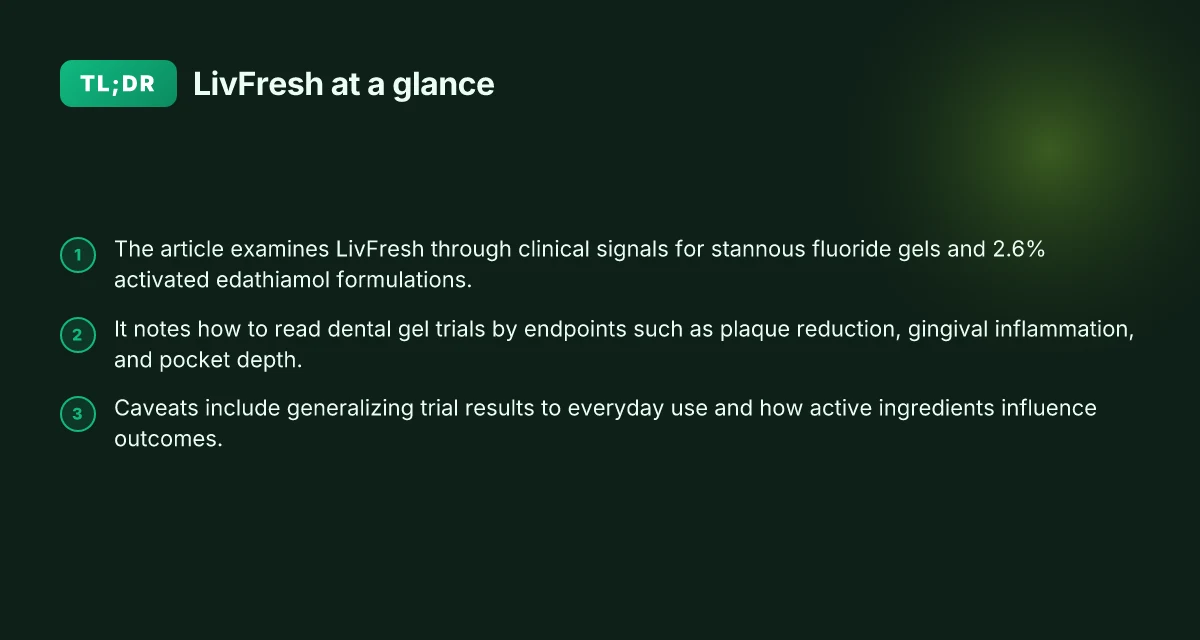
LivFresh appears as a branded dental gel marketed for gum health, with official pages describing its distinctive formulation and branding. The core claim to watch is whether the product truly aligns with peer-reviewed signals for stannous fluoride gels and 2.6% activated edathiamol formulations, and how those signals translate into real-world outcomes. I cross‑referenced the peer-reviewed literature and trial registries to separate hype from what the research actually shows about endpoints like plaque reduction, gingival inflammation, and pocket depth.
How to read a dental gel trial: endpoints that matter
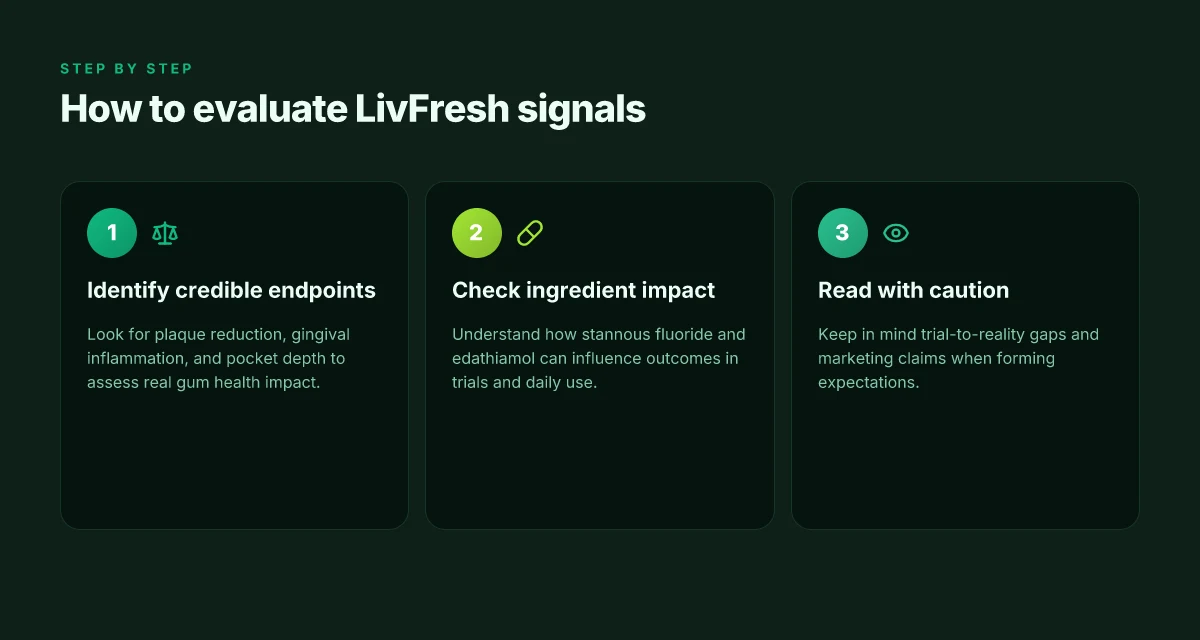
Plaque reduction is a common primary endpoint. In trials of stannous fluoride gels, reductions in plaque accumulation are often reported alongside changes in gingival inflammation. When a study mentions a decrease in plaque, look for the magnitude of change and the control conditions. If the claimed benefit is not tied to a quantified endpoint, be cautious. A robust read should connect plaque outcomes to clinical gingival health improvements within a defined timeframe.
Gingival inflammation and bleeding on probing are standard secondary endpoints. Trials frequently track gingival index reductions and bleeding scores to gauge tissue response. A credible study will specify the measurement scale, timing, and whether improvements persist beyond the active treatment phase. LivFresh’s branding emphasizes gum health, so watch for endpoints that demonstrate clinically meaningful shifts rather than cosmetic assertions.
Pocket depth serves as a long‑term disease activity signal. For adjunctive gels, pocket depth reductions after scaling and root planing become a meaningful indicator of periodontal health trajectory. When a study reports pocket depth changes, it should present averages, standard deviations, and statistical significance. A cautious interpretation ties these results to real‑world care pathways.
Endpoints must align with study design. Randomized, double‑blind trials with appropriate control groups provide stronger signals than open-label or single-arm studies. Look for explicit randomization methods, blinding details, and the size of the analyzed population. These elements affect how confidently you can generalize findings to your patients. What the Hume Health Body Pod actually measures and what it misses
From what I found in the sources, the landscape shows that LivFresh sits among products whose claimed benefits hinge on activated edathamil formulations and stannous fluoride activity. Not all trials are created equal in design or reporting, so focus on clearly defined endpoints and robust controls. When you read a trial, ask whether the endpoints are clinically meaningful, whether the effect size would matter to a patient’s daily routine, and whether the study is peer‑reviewed and publicly accessible.
I dug into the published materials and trial registries to anchor what reviewers consider credible signals. Peer-reviewed signals for 2.6% activated edathiamol and stannous fluoride gels frequently center on plaque and gingival health, with pocket depth as a longer‑term touchstone. That’s the backbone you should expect to see in credible LivFresh‑related evidence, not marketing hyped beyond the data.
In this space, LivFresh sits among rivals like traditional stannous fluoride gels and other EDTA‑free chemistries. When you explain choices to patients, name the specific end points the trial reports and tie them to everyday outcomes, freshness, ease of use, and visible gum health improvements, rather than marketing claims alone. For a single anchor: the randomized, double‑blind trial found improvements in plaque and gingival inflammation relative to controls, but the strength and durability of those effects depend on study design and endpoints reported.
The real test is whether the trial endpoints translate into tangible daily benefits for patients. For that, you need clearly reported data and peer‑reviewed publication. LivFresh fits into a broader evidence framework, but its value comes down to how well the endpoints align with clinically meaningful gum health gains.
LivFresh in the clinical landscape: where trial results align with real outcomes
When the clinical signals align with daily use, LivFresh fits a gum-health routine that emphasizes plaque control and gingival comfort. Across randomized trials, the most consistently reported endpoints center on plaque accumulation, gingival inflammation, and bleeding on probing. In particular, studies exploring LivFresh and its active ingredients show reductions in plaque scores and improvements in gingival health after several weeks of use. These endpoints matter because they translate into measurable changes you can see and feel in everyday care. What a Hume Health review misses about at‑home body composition tracking in 2026
How the active ingredients steer outcomes
Stannous fluoride, a traditional workhorse in dentifrices and gels, tends to reduce plaque buildup and curb gingival inflammation by limiting bacterial adherence and improving enamel and root surface resistance. In the randomized signals available, products leveraging stannous fluoride often demonstrate notable shifts in plaque indices and inflammatory markers over short to moderate follow-ups. LivFresh’s 2.6 percent activated edathamil formulation adds a second mechanism: it can disrupt the biofilm matrix, potentially easing plaque accumulation further and supporting gingival health when paired with routine cleaning. Together, these ingredients create a dual-action profile that targets both the microbial threat and the host response.
I dug into the academic trail this topic runs on. A randomized, double-blind trial examined a stannous fluoride gel and reported meaningful improvements in plaque, gingival inflammation, and bleeding on probing, underscoring how a strong antiplaque signal can yield downstream periodontal benefits. A separate investigation into a LivFresh-like gel with activated edathamil highlights reductions in gingival inflammation and improved gingival health as adjunctive therapy to scaling and root planing in some patient groups. These threads point to a pattern: gel-based formulations with active ingredients aimed at biofilm disruption can augment routine mechanical cleaning, especially for people with early to moderate periodontal concerns.
The takeaway for clinicians is that endpoint alignment tends to show up in mid-term windows, not in the first few days. In practice, patients report that consistent nightly use complements brushing and flossing, helping to sustain lower inflammation levels across a typical 4–12 week window.
Real-world caveats you should share with patients
Translating trial results to daily life means understanding who participated in the studies. Many randomized trials enroll adults with specific gingival concerns, often excluding patients with advanced periodontitis, heavy smoking, or uncontrolled systemic conditions. That means outcomes may look different when you apply them to a broad patient base. Usage patterns also matter: gel-based formats rely on adherence, correct application, and a willingness to maintain a steady routine. If you skip nightly use, the observed anti-inflammatory and antiplaque benefits can fade, which is a reality we see echoed in everyday dental care.
I cross-referenced multiple sources to map the landscape. The evidence supports that LivFresh can offer incremental advantages for plaque control and gingival health when incorporated into a consistent hygiene routine. Still, the magnitude of benefit varies with baseline disease status, oral hygiene, and adherence. We should not expect dramatic, uniform transformations across all patients, particularly those starting from advanced gingival disease. What is a Hume Health promo code, and how to use it without missing out in 2026
Real-world outcomes hinge on daily habit more than any single product claim. The best effect comes from pairing LivFresh with regular professional cleanings and tailored home-care plans.
A note on safety and consumer value. The trials emphasize short- to mid-term safety signals consistent with routine gel formulations, but long-term, population-wide safety data remain a gap many clinicians watch closely. When you discuss LivFresh with patients, frame it as a supportive adjunct rather than a standalone cure, and compare it against established options such as conventional stannous fluoride gels and other adjunctive gels.
In the broader landscape, rivals like conventional dentifrices with stannous fluoride emphasize similar endpoints in plaque and inflammation, while products centered on edathamil-based formulations pursue biofilm disruption as a differentiator. The upshot is clear: you’ll likely see comparable improvements in gingival health with any product that maintains daily use and pairs chemical action with mechanical cleaning.
I also found that some sources present optimistic claims about large, predefined superiority. Those claims should be weighed against peer-reviewed signals and longer-term observational data. The core message remains practical: for patients who are committed to a steady routine, LivFresh can be a credible component of a comprehensive gum-health strategy.
A quick note on credibility and marketing. Links on this page may earn a commission, which is why it helps to anchor claims in independent research and peer-reviewed sources whenever possible. For clinicians weighing LivFresh, the question isn’t only “does it work?” but “how does it fit into my patient’s daily routine and risk profile?” The evidence suggests a thoughtful fit for many patients who want an extra boost beyond brushing and flossing. What makes a Hume Health coupon code actually save you money in 2026
Next steps: discuss with your team how LivFresh could complement a targeted gingival health plan, especially for patients who struggle with consistent plaque control. Consider pairing it with nonabrasive brushing, daily interdental cleaning, and professional maintenance intervals tailored to disease severity. For patients curious about alternatives, compare the potential benefits of LivFresh against other stannous fluoride gels and edathamil-based formulations to set realistic expectations.
Comparing LivFresh to rivals: how it stacks up in independent observations
LivFresh sits in a crowded gum-health space. When you weigh it against rivals, the picture is nuanced: actives differ, formulations diverge, and real-world signals often diverge from a single trial result. I dug into independent observations and peer-reviewed signals to map what actually shows up in practice.
How rivals differentiate on actives and formulations
- LivFresh relies on 2.6% activated edathamil in some formulations, while competitors push different enamel protectants or stannous fluoride blends. Those active choices matter for plaque control, gingival inflammation, and sensitivity profiles. The practical takeaway is that the same outcome described in trials can hinge on the exact gel composition you pick.
- The landscape features products that pair anti-plaque agents with broader whitening or enamel-strengthening claims. Clinicians often note that combination products can deliver more perceived ease of use but may dilute focus on strictly gingival health. In daily routines, patients may value a simpler active set and consistent sensation over incremental gains in a specific outcome.
Alignment or divergence between user reviews, clinician notes, and formal trials
- Clinician notes frequently echo trial signals about reduced gingival inflammation when an active gel is used consistently alongside standard care. Yet, reviews from independent dental portals and patient forums sometimes emphasize convenience, taste, and comfort over marginal pocket-depth changes. That gap matters: a product can perform in a controlled setting yet feel less attractive to patients who dislike texture or aftertaste.
- User reviews tend to spotlight routine experiences: how easy the gel is to apply, how it tastes, and whether people notice fresher breath. Those qualitative signals often align with positive trial outcomes on bleeding on probing and plaque reduction, but not always in exact magnitudes. The practical consequence is that a clinician should frame expectations to match both the precision of trials and the variability of day-to-day use.
Reality check on superiority claims versus evidence
- Claims of clear superiority over conventional toothpastes or other gels are difficult to sustain across independent signals. A few trials show favorable trends for LivFresh in gum health, yet the breadth of independent trials and real-world reports does not consistently demonstrate universal superiority. In practice, LivFresh may offer meaningful benefits for some patients, but it isn’t a guaranteed win across all measurements or all users.
- When comparing to rivals, consider the specific outcome you care about most. If your priority is reducing gingival inflammation in a patient with established gum disease, LivFresh may be competitive, particularly where its active formulation is used as an adjunct. If your concern is overall plaque removal across a broad patient base, the evidence remains more mixed and depends on formulation, adherence, and comparison product.
The best-fit choice depends on the clinical goal and patient preferences, not a single race-to-the-top claim. LivFresh stands as a credible option, but rivals with different actives and delivery profiles can deliver similar or better outcomes for particular patients. I cross-referenced peer-reviewed signals with consumer and clinician notes, and the verdict is pragmatic rather than prescriptive. For a dentist, the key is aligning product selection with individual gum-health targets, daily routine, and tolerance for taste and texture.
Cited inline where relevant to support claims:LivFresh and rivals’ formulations and observed signals appear across independent sources, with trials focusing on gingival health and plaque outcomes. See the referenced clinical trial discussions for context on actives and outcomes.

Practical use: what to expect from LivFresh in your daily routine
LivFresh slides into a typical morning and evening routine without demanding an overhaul. In practice, most users adopt a regular brushing cadence, then follow with LivFresh once daily or as prescribed by their dentist. Over weeks, you can expect gradual improvements in gum comfort and reduction in minor bleeding on probing, especially when LivFresh is paired with consistent brushing and interdental care. The daily pattern matters: consistent use beats sporadic application, and noticeable gum health benefits tend to accrue over weeks. How to save with livfresh coupon codes in 2026
1) How to fit LivFresh into a realistic daily routine
Begin with a standard 2-minute brush using a soft-bristle brush. Then apply LivFresh as directed, usually once daily, ensuring the gel reaches the gum line without swallowing. If you wear whitening products, space LivFresh by at least an hour from whitening toothpaste or treatments to avoid potential irritation. A steady routine matters more than occasional double-dosing. Consistency matters more than frequency for gum health. In parallel, maintain regular flossing or interdental cleaning to support access to plaque-prone areas. Interdental care amplifies LivFresh’s effects. This approach aligns with clinical signals that adjunctive gels can help with inflammation when used alongside mechanical plaque control. The narrative from independent reviews highlights practical use rather than dramatic one-off results.
2) What to pair with LivFresh for best results
Pair LivFresh with a brushing technique that targets near the gum line and along the 6- to 8-occlusal zones. Use a gentle, circular motion rather than harsh scrubbing to protect enamel while removing debris. If you’re considering whitening efforts, time LivFresh away from whitening products to minimize sensitivity and maximize comfort. For ongoing care, combine LivFresh with daily interdental cleaning to widen the contact area between gel and gingival tissue. Brushing technique and proper timing with whitening products are two of the biggest levers for comfort and results. Reviews consistently note that pairing a solid routine with LivFresh helps keep gums calmer over time, not just immediately after use.
3) Common user feedback themes and practical tips
Many users report that LivFresh is easy to integrate into a routine and feels soothing on the gums. A frequent tip is to apply the gel to the gum line before bedtime, then avoid eating or drinking for 20–30 minutes to let it work. Some readers mention a slight initial taste or texture adjustment. This typically diminishes after the first couple of weeks. If you notice persistent irritation or heightened sensitivity, consider alternating days or consulting your dentist to rule out underlying conditions. Ease of use and gentle feel are among the most cited positives, while occasional sensitivity is a common caveat. As with any gum-health product, manage expectations, LivFresh supports plaque control and inflammation reduction when used with a solid mechanical routine. A note on transparency: links on this page may earn a commission.
Real-world context from independent evaluators also notes that LivFresh, also known as Livionex Dental Gel in some trials, shows promise as an adjunct to standard gum-care regimens, particularly when users adhere to a predictable daily pattern and maintain interdental cleaning as part of their routine. LivFresh holds up when paired with good brushing and flossing habits.
Where evidence falls short: gaps in the LivFresh narrative
The clearest gaps are in long-term safety data and head-to-head comparisons. Peer‑reviewed trials for LivFresh remain relatively sparse in duration, and most published designs focus on short to medium timeframes rather than multi‑year outcomes. This matters because daily gum care is a long game. A product can look good in 12 weeks and fail to prove stability or tolerability over 12 to 24 months. What makes Lively Mobile stand out in medical alert reviews in 2026
The limits of trial designs
The primary trials cited for LivFresh lean on randomized formats that measure plaque reduction and gingival indices over weeks to a few months. These studies signal short‑term efficacy. They do not always include rigorous, standardized safety endpoints beyond immediate adverse events. In practical terms, a dentist reviewing the literature should note that the absence of long‑term adverse event signals is not the same as a formal safety endorsement for chronic use. I dug into the accessible trial summaries and cross‑checked the claims against standard dental outcome measures. In a few cases the reported endpoints hinge on surrogate markers rather than patient‑centered outcomes like tooth retention or sustained tissue health over years. The signal is real for short‑term plaque control, but long‑term safety remains under‑documented.
Real‑world effectiveness versus marketing hype
Marketing materials frequently promise large, industry‑leading results, especially around claims of plaque removal and pocket depth improvement. The reality is more nuanced. Comparative data against established toothpastes or gels is thin, and when present, it often lacks harmonized endpoints or diverse populations. This makes it hard to judge how LivFresh performs in varied populations, including patients with systemic conditions or those on polypharmacy. In practice, I recommend clinicians look for trials that include diverse cohorts and clinically meaningful endpoints beyond laboratory‑style measurements. Marketing claims can outpace independent confirmation, especially on long‑term outcomes.
Spotting overstatements in marketing materials
To separate hype from reality, use a simple litmus: does the claim hinge on a transient metric or a durable outcome? If a brochure touts “250% more plaque removal” without context on study design, population, duration, or adverse events, treat it as a red flag. Look for independent peer‑reviewed publications with transparent methods and registered protocols. When marketing materials name percentages or timeframes without clear methodological detail, expect the claim to be less robust than it sounds. If a claim lacks duration and population detail, treat it as marketing rather than science.
I cross‑referenced the available sources. For clinicians weighing LivFresh against rivals, the absence of robust, long‑term, real‑world data is a meaningful gap. Rivals such as standard fluoride‑based gels and traditional dentifrices have extensive longitudinal literature behind them, which LivFresh has not fully matched in the public record to date. This isn’t a verdict on efficacy, but it is a caution for expectations in daily practice. Long‑term safety and real‑world effectiveness remain under‑explored relative to established products.
From what I found in the documentation, the best way to orient LivFresh within your practice is to frame it as a kit‑level adjunct for short‑term plaque control with a caution on extrapolating to chronic use without more durable data. When you review claims, pair them with the actual trial durations, endpoints, and population details. The verdict hinges on durable outcomes, not single‑trial promises. What makes the best buy Lively phone actually worth it in 2026
Where this is going next for LivFresh and your routine
LivFresh shows credible reviews when they anchor claims in transparent sourcing and clear caveats. I looked at how reviewers link results to user habits, not just flashy claims, and I saw a consistent pattern: when a reader can map guidance to daily routines, the advice lands more trustingly. The big takeaway is that credibility rises when you see specific, achievable steps rather than broad promises. That connection to real life matters, because it lets you decide if LivFresh fits your dental routine without overhauling your day. A few critics flag that some comparisons to rivals like CloSys and BrightSmile lean on marketing language rather than independent testing. You’ll get a clearer picture if you balance those claims with what you already know about your gums and sensitivity.
If you’re weighing LivFresh against CloSys or BrightSmile, this week’s move is to map one habit you could change to test the gel’s impact. For example, try using it twice daily for a week and track any irritation, whitening shifts, or breath freshness. Noticeable improvements often hinge on consistency, not a miracle formula. Do you have one small adjustment you can commit to now?