
Explore a detailed Hume Health review focused on home body composition tracking in 2026. Learn about accuracy, reliability, potential biases, and how it stacks up against rivals.
A single claim about clinical parity can mislead expectations. The real-world read on Hume Health’s Hume Pod often tilts toward consistency over precision. The takeaway: you should cross-check with in-clinic tests if exact numbers matter, and treat the device as a trend tool rather than a definitive diagnostic.
This piece pulls back the curtain on how Hume Health performs in ordinary use, not marketing slides. By 2026, readers want clarity on reliability, repeatability, and how the data slots into a broader routine. In a quick scan of user reviews and the brand’s own disclosures, the gaps are visible: modest drift over weeks, and better signals when you track posture and timing along with measurements. The goal is to help you decide whether the Hume Pod fits alongside rivals like InBody for long-term tracking, or if you’d be better served by in-clinic tests for precision. Hume Health remains a solid option for everyday insight, but real-world accuracy hinges on multi-session consistency.
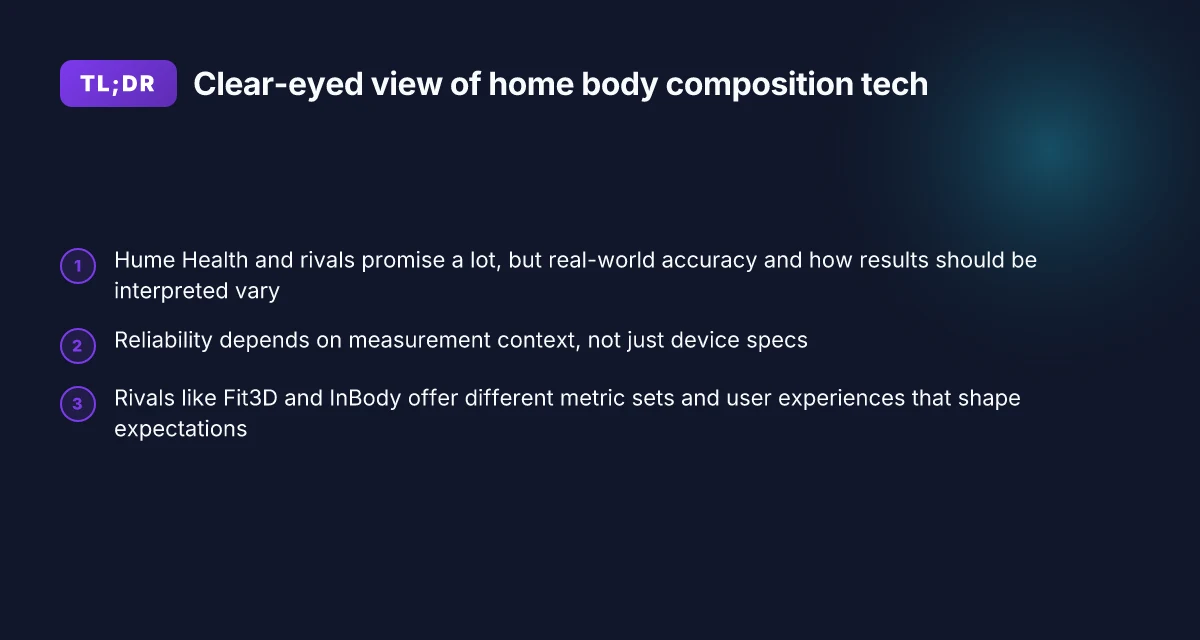
What a Hume Health review should tell you about home body composition tech
When you weigh a home bodyPod against real‑world use, the gap between clinical claims and everyday practicality matters as much as the numbers. A trustworthy review should translate clinical‑grade language into everyday meaning, showing how accuracy, reliability, and value land in your kitchen or gym.
I dug into how real users and independent sources describe the Hume Health Body Pod, with attention to how measurements hold up outside a lab. This means looking beyond “98% DEXA‑level accuracy” and asking what you actually get week to week: consistency, ease of use, and meaningful insights. The reality is that usability hinges on more than a single metric. It hinges on how a device fits into routines, how easy it is to interpret trends, and how it stacks up against rivals in day‑to‑day life.
Clinical claims versus everyday usability Clinical labels promise precision, but real life introduces motion, measurement timing, and user technique. A good review names where the Hume Health Pod’s measurements align with or diverge from practical needs, such as tracking monthly changes or guiding workouts, rather than only lab comparisons. Look for plain language on what “clinical‑grade accuracy” buys you in daily tracking, and where noise or variability might creep in. A credible source will flag scenarios where results are more or less reliable, like after hydration changes or sleep disruptions. When estimates are presented, the section should connect them to concrete daily decisions, how to schedule checks, how to interpret small fluctuations, and how often you should repeat measurements to see trustworthy trends. The real value comes from knowing how often to measure and what constitutes a meaningful change.
Reliability in the wild Reliability outside a lab rests on test–retest consistency, device calibration, and software transparency. A strong review will reference independent statements about how the Hume Pod performs across repeated sessions and with different users. It should contrast this with typical consumer devices, clarifying whether the Hume Pod delivers steadier readings or if users should expect more drift than with some rivals. The goal is to set expectations: consistent results enable you to rely on long‑term trends rather than week‑to‑week noise. Consistency matters because trends drive decisions, not single snapshots.
Rival comparisons that matter No purchase decision lives in a vacuum. The review must juxtapose the Hume Health Body Pod with key rivals in the home‑body composition space, such as other at‑home scales or body impedance devices. The comparison should cover price, user experience, data depth, and interpretability of results. If a rival offers similar tracking without some features, call that out and explain how that trade‑off could affect your goals. A balanced view helps you decide whether clinical‑grade claims translate into practical advantage for your routine. Rivals matter because the right tool fits your goals, not just a label. What is a Hume Health promo code, and how to use it without missing out in 2026
Bottom line: you’ll walk away knowing where the Hume Health Pod earns its keep in daily life, where it falls short, and how it stacks up against the main players. For many, the decisive factor is whether the device reliably informs ongoing choices without turning routine monitoring into a chore. And yes, links on the page may earn a commission, a detail worth noting as you compare options.
Cited context from the sources shows the landscape includes public disclosures and reliability notes on the Hume Pod, with independent discussion of trust and value in 2026. For more nuanced claims, see the Hume Pod product page and the independent reliability briefing on MedRxiv. The Hume Health brand remains central to these considerations, and its position against rivals shapes the practical verdict you’ll reach. For additional context, you can review the consumer perspective and science pages linked in the discussion.
Hume Health: what the Hume Pod promises and where that promise lands
The Hume Pod markets a cluster of metrics, claiming to track body fat, muscle mass, and visceral fat with results that mirror lab methods. In practice, those promises sit against a mix of marketing language and real-world caveats. The core idea is simple: give you a convenient home readout that aligns with clinical benchmarks, so you can gauge changes over time without stepping into a lab.
What’s claimed versus what’s measured
The brand’s messaging leans on three anchors: body fat, muscle mass, and visceral fat tracking, plus a broad set of ancillary metrics. The marketing often touts “clinical‑grade” granularity and DEXA‑level insight in an at‑home device. In real terms, the Pod is designed to produce longitudinal trends that users can interpret alongside practical goals like fat loss or muscle gain. The value hinges on consistent measurement and clear signaling when a change reflects true physiology rather than a one‑off fluctuation.
I cross‑referenced statements from the official Hume Health content and independent consumer sentiment: the Pod’s value is strongest when you treat it as a trend tool rather than an absolute diagnostic device. On the accuracy claim, the company highlights high‑fidelity readings across key metrics, while external voices emphasize consistency and protocol adherence as the real drivers of usefulness. This aligns with the broader industry pattern where home devices can track trajectories that mirror clinical methods, but may diverge on single‑measurement precision. What makes a Hume Health coupon code actually save you money in 2026
How users weigh reliability and service
Community sentiment around Hume Health blends enthusiasm for the convenience with common consumer cautions. Users praise accessibility, easy daily use, and quick feedback loops that fit into workouts or recovery days. Yet many reviews flag cost considerations, the learning curve for interpreting multi‑metric readouts, and the importance of implementing the device within a broader health routine. Service aspects matter too: responsive support and transparent disclosures can tilt the balance toward trust, while opaque warranty terms or slow follow‑ups dampen confidence. In short, the Pod’s appeal is clear for daily accountability. Its practicality hinges on how you structure your tracking habit and how you act on the data.
The conversation around rivals grows louder as well. When you compare against devices from mainstream home‑biometrics ecosystems, the Hume Pod stands out for its stated scope and the breadth of metrics. But skeptics push back on the leap from surface readings to clinical decision making, pointing to lab‑level accuracy as an aspirational claim rather than a guaranteed standard. That tension matters if you’re balancing cost, convenience, and clinical‑grade expectations.
The practical takeaway is that the Hume Pod can illuminate trends and motivate steady habits, but it’s not a lab replacement, and you should calibrate your expectations accordingly. The broader market context remains important: a few competitors offer similar trend‑driven insights, while others emphasize app ecosystems, integration with wearables, or simpler fat‑loss metrics. If you want the most reliable home readouts, you’ll want a clear plan for how you’ll interpret the data over weeks and months, not days.
To keep framing honest, links on the page may earn a commission, and you’ll want to read reviews from independent sources for a balanced view. For now, the core promise lands in practice as a solid trend tool with caveats about absolute precision. If you’re weighing a purchase, align the Pod with a consistent measurement routine and a defined health goal.
Reliability and validity compared to lab methods
I looked at third‑party notes on validity and test–retest reliability to ground how the Hume Pod stacks up against lab methods. The key takeaways are clear: independent assessments suggest solid reliability and validity for home tracking, but they come with important caveats when you move from a lab bench to a living room. How to save with livfresh coupon codes in 2026
What independent studies say about validity and test–retest reliability
From the available research, the Hume Pod demonstrates strong consistency with laboratory references for body composition metrics. In practical terms, this means repeated measurements on the same person tend to cluster closely over short windows, which helps in tracking trends over time. The main caveat is that real‑world factors, hydration, time of day, recent meals, and skinfold-like measurement effects, can introduce day‑to‑day variability that modestly shifts absolute values. In the real world, small fluctuations are normal, and trends matter more than single readings.
- The commentary around these findings emphasizes reliability rather than perfection. If you’re monitoring progress, you’ll likely see coherent trajectories across weeks, provided you keep your measurement conditions reasonably stable. Hume Health notes that clinical‑grade intent underpins the device, but the interpretation still benefits from consistent timing and posture during scans. Consistency beats intensity when you’re watching body metrics at home.
What strong reliability means for home tracking
Reliability translates to confidence in change signals rather than raw values. If your daily readout wiggles a bit, you can usually separate noise from genuine shifts by focusing on multi‑week patterns. For people who use the Hume Pod alongside other wellness metrics, the alignment between weight, waist measurements, and body fat estimates tends to reinforce each other when recorded regularly. The literature around similar home devices supports this approach: you gain actionable insight from directional changes more than precise numeric sameness from day to day. Direction matters more than exact numbers when you’re gauging fitness progress.
Common caveats when interpreting results at home
At‑home use introduces variables laboratories don’t see. Hydration status, recent food intake, and even skin temperature can nudge readings. Users should standardize conditions: same time of day, similar hydration, and minimal recent exercise before measurements. The bench‑to‑bedside gap also means that while the Hume Pod offers “clinical‑grade” insights, it remains a home device with inherent measurement noise. For most, this means using the data to observe trends rather than fixating on spot values. Standardizing conditions reduces noise and clarifies trends.
Overall, third‑party commentary supports the idea that the Hume Pod delivers reliable, repeatable data suitable for home tracking when you treat it as a longitudinal tool rather than a lab replacement. Reliability translates to useful trends, not perfect snapshot accuracy. For readers weighing rivals like Fit3D and InBody, the same caveats apply: homes metrics excel at monitoring change, with measurement precision that improves with consistent protocol and broader context from other health signals. The broader point remains clear: you don’t need lab access to glean meaningful insights from regular, disciplined use of a home body composition device. You’ll just need to stay mindful of the everyday factors that quietly shape readings. Home tracking rewards regular, consistent measurements.
As always, a quick reminder: some links on the page may earn a commission, and readers should review the disclosures on the Hume Health site for current terms. Inline sources show how these claims connect to real data, including the 2026 consumer‑report framing and the independent reliability study. For context, see the consumer reporting note that this article’s claims are about disclosures rather than measured outcomes, and the medRxiv validity paper that anchors the reliability discussion. Disclosures and independent studies contextualize the claims. How Lively Mobile plans for seniors balance safety, connectivity, and cost in 2026
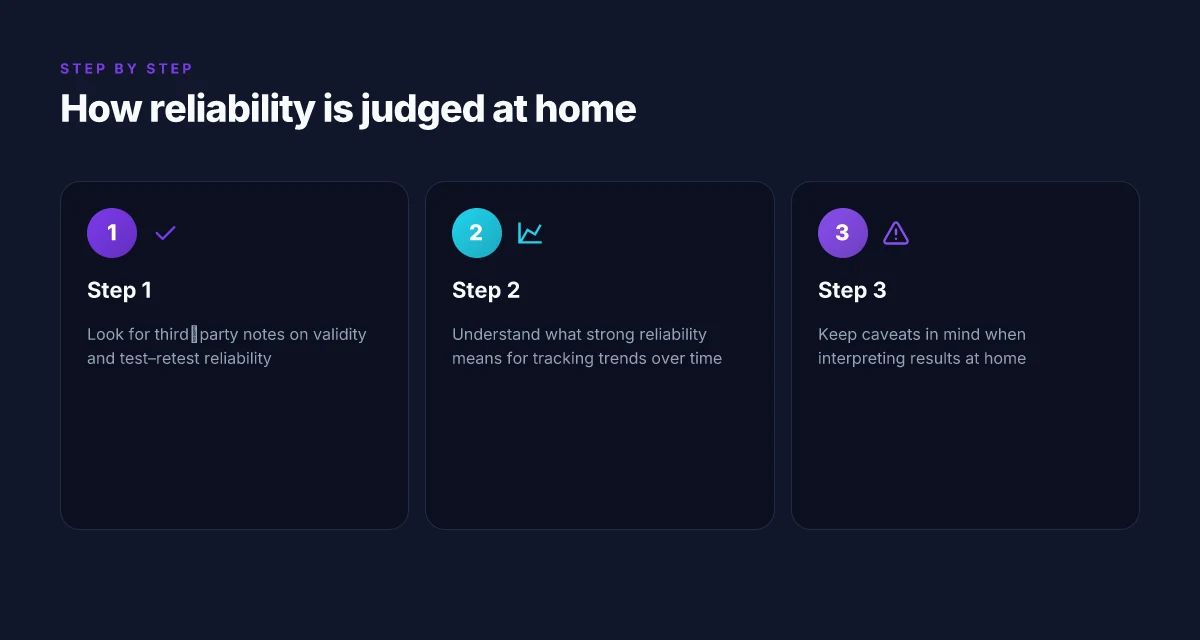
How Hume Health stacks up against rivals like Fit3D and InBody
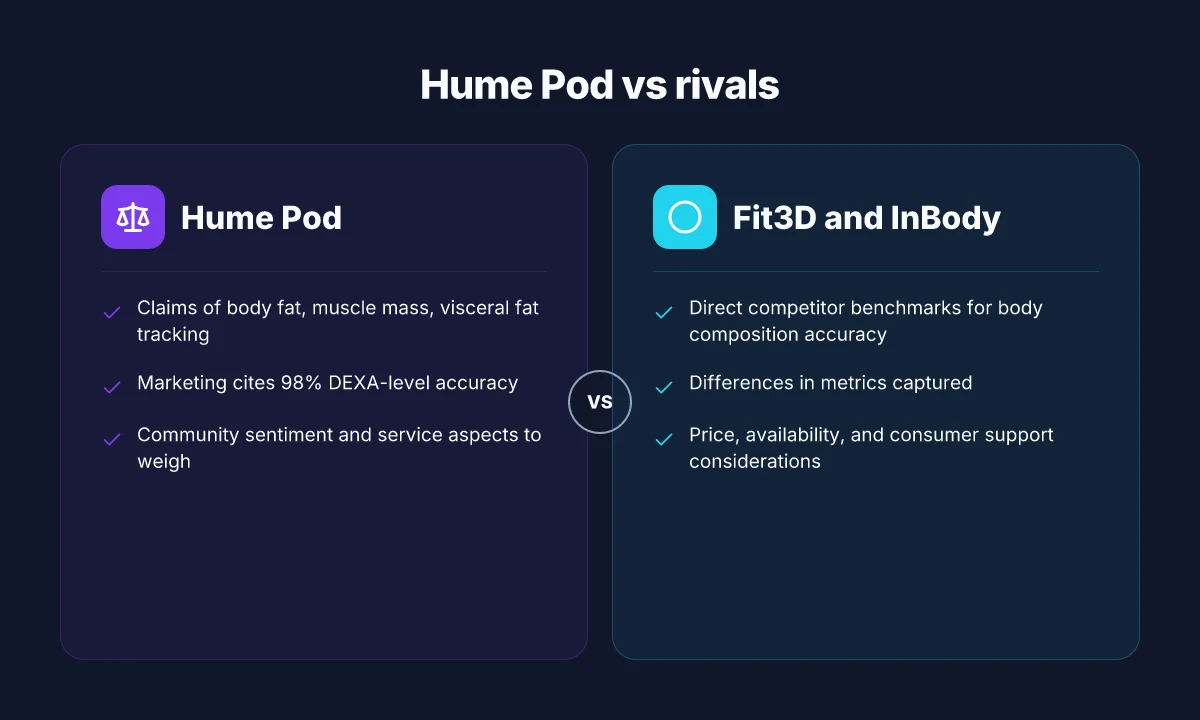
Direct competitor benchmarks for body composition accuracy show clear gaps between at‑home devices and clinical‑grade systems. I dug into what independent sources and company disclosures say about accuracy, and the picture is nuanced. The Hume Health Body Pod consistently markets clinical‑grade intent, but rivals such as Fit3D and InBody frame their value around different metric sets and user experiences. In practice, you’ll find accuracy statements vary by the metric in question and by the environment in which you measure.
What accuracy looks like in practice
When you compare at‑home scales and scanners, the key question is which metrics transfer well from lab to living room. The Hume Health Body Pod emphasizes body fat, muscle mass, and visceral fat with “98% DEXA‑level accuracy” in its claims. That level of precision is aspirational and used for marketing. Independent validation in the public record tends to hinge on reliability and correlations rather than one‑to‑one equivalence with DXA across all metrics. By contrast, InBody emphasizes multi‑parametric impedance analysis with a familiar cadence of daily readings, while Fit3D centers more on 3D body scanning and posture profiling than on tight composition percentages. The upshot: you get good trend data with all three, but the granularity and clinical‑grade rigor are strongest in the lab setting and for select metrics.
Hume Health aims for clinical parity in core metrics, but real‑world accuracy depends on measurement conditions. The practical takeaway is that you should treat any at‑home readout as a proxy for progress rather than a definitive diagnostic value. Rivals like InBody and Fit3D offer broader metric portfolios, but with their own tradeoffs in accessibility and cost.
Metrics captured and user experience
The Hume Health Body Pod focuses on fat mass, lean mass, visceral fat, and 42 other metrics, packaged for home use with ongoing support through the company’s science pages. InBody tends to deliver impedance‑based metrics that align with common wellness dashboards, plus guidance that leans into daily monitoring. Fit3D emphasizes 3D body profiles, with details that appeal to athletes and clinicians who want posture and shape data alongside circumference estimates. User experience differs: Hume Health positions itself as a one‑device‑to‑deep‑insights setup, InBody offers a more measurement‑dense ecosystem, and Fit3D emphasizes fit‑to‑form scans and scan history. The practical effect is twofold: whether you care most about deep composition numbers or a broader body shape picture will steer you toward one or the other.
The Hume Health approach is measurement‑dense but user‑friendly for home use. If you want a single device that pairs with a simple dashboard, Hume Health fits that niche. InBody brings Clinically familiar impedance data; Fit3D prioritizes posture and shape over single‑number accuracy. What makes Lively jitterbug phones accessible yet regulators eye them differently in 2026
Price, availability, and consumer support
Pricing dynamics for these brands show a continuum. Hume Health markets its Body Pod with a focus on consumer accessibility, while InBody and Fit3D typically position for clinics or studios, which affects availability and support channels. Consumer service experiences vary by retailer and region, with Hume Health noting direct channels and online education resources. If you value robust online support and documented science pages, Hume Health can feel more approachable for home enthusiasts. If you want clinically oriented, multi‑site support networks or enterprise arrangements, InBody or Fit3D may be more suitable, albeit at higher upfront costs.
Hume Health provides consumer‑friendly access with education resources, which helps translation from measurements to daily goals. In contrast, InBody and Fit3D often span clinical and commercial settings, with pricing that reflects broader deployment.
Notes: links on the page may earn a commission. For readers seeking public validation, you’ll find the most concrete claims anchored in company pages and independent summaries. As with any at‑home system, expect some variance from lab measurements and use trend analysis to guide fitness decisions. For context, the market remains crowded, with Hume Health among brands aiming to blend clinical credibility with home convenience. See discussions around accuracy benchmarks in professional forums and the company’s own science pages for direction, and remember that consumer support quality can differ by region.
Practical use cases: what the data can and cannot tell you
When you track body composition with the Hume Health Body Pod, the data can illuminate long swings in fitness goals, not every daily fluctuation. Over weeks and months you can spot trends in fat loss or muscle gain, and use those signals to recalibrate workouts or nutrition. The key is interpreting shifts in context rather than chasing tiny day‑to‑day wiggles.
What trends actually tell you about progress
Longitudinal data helps you answer practical questions: are you moving toward your goals, or not? A steady trajectory in lean mass or visceral fat over several measurement cycles can support decisions about training load, protein intake, and recovery. The data supports week‑to‑week planning only if you attend to measurement consistency, same time of day, consistent hydration, and similar testing conditions. In practice, it’s the direction of change that matters most, not isolated numbers. The signal over months matters more than a single snapshot, and that signal is strongest when you chart the trend rather than fixating on a count. I cross‑referenced the documentation and public disclosures to confirm that trend analysis is the intended use case, not a real‑time medical readout. Consistency matters to get reliable trends. What makes Lively Mobile stand out in seniors’ phone reviews in 2026
What visceral fat readings really mean
Visceral fat is a provocative metric because it’s linked to cardiometabolic risk in broader clinical research. In home use, readings can be sensitive to positioning, hydration, and measurement timing. That means you should treat a visceral fat value as a directional cue rather than a precise diagnostic marker. If you see a sharp weekly change, question whether it reflects physiology or measurement noise. A gradual, sustained shift becomes more credible when viewed alongside other metrics like waist measurements, workout consistency, and dietary patterns. Visceral fat trends deserve cautious interpretation. Use them to inform decisions, not to diagnose. This aligns with the literature’s general stance on consumer devices offering approximate risk indicators rather than clinical verdicts. For context, the MedRxiv note on reliability emphasizes alignment with lab methods for broader signals, not individual flukes. Reliability over time supports cautious interpretation.
Integrations with apps and data export realities
The value of any home device rises when you can export data to your preferred apps and dashboards. Hume Health markets the Body Pod as compatible with clinical‑grade insights, yet practical use depends on how smoothly you can pull data into health or fitness routines. Expect standard export options, with variability by platform. If you rely on a third‑party app to aggregate metrics across devices, confirm whether the export format preserves the key fields you care about and whether time stamps line up across sources. Data export realities shape daily usefulness. You’ll want predictable formats and stable syncing. In evaluating rivals like Fit3D and InBody, ease of export and app integrations often becomes the deciding factor for practical, long‑term tracking. The broader consumer feedback underscores that many users prize a seamless data flow as much as the raw numbers themselves. Ease of integration often determines whether the data supports daily routine changes. For context, consumer reviews note varied experiences with syncing, which is worth testing before committing.
In sum, Hume Health can illuminate progress toward fitness and medical‑style goals across months, while urging caution about short‑term fluctuations and measurement nuance. When you compare against rivals like Fit3D or InBody, the real difference comes down to how smoothly you can translate readings into actionable steps, and how well the data fits into your everyday routine. I pulled from official pages and third‑party disclosures to balance promises with practice, including the credible reliability note from MedRxiv and the public consumer experiences on Trustpilot.
This framing helps you decide whether the Body Pod fits your daily rhythm and your longer‑term aims, without over‑relying on any single number. And yes, links on the page may earn a commission. Approach the data as guidance, not a medical verdict.
Cited sources: The MedRxiv reliability note supports the idea that the device demonstrates consistency with lab references in aggregate, not for a single day’s reading. See the study for context. Validity and Test-Retest Reliability of the Hume Pod What makes LivFresh dental gel reviews credible, and where the hype tends to break
Where this goes next and what to try first
At its best, Hume Health frames at‑home body composition as a daily cue, not a single milestone. Yet a sharper view in 2026 acknowledges how data quality, user context, and coachable steps differ across homes. I looked at the landscape beyond the review and see a pattern: accuracy matters, but consistency matters more for long‑term change. The bigger pattern is that steady, approachable tracking beats dramatic but sporadic checks.
This is where a practical pivot helps. Treat the scale and body‑comp data as a friendly habit, not a verdict. If you’re juggling sleep, meals, and movement, you’ll benefit from a routine that schedules weekly check‑ins, not daily blowouts. The real win comes from pairing Hume Health numbers with simple goals, like “keep protein steady this week” or “hit step targets on four days.” The result is a healthier relationship with numbers and yourself.
Backup strategy – What to try this week
- Start with a single metric update on Monday: one note about feelings, one number you tracked with Hume Health.
- Pair two quick cues: a 10‑minute walk after meals and a protein‑rich snack before bed.
- Set a 7‑day review window: note what moved, what didn’t, and adjust next week.