
Discover BedJet 3 climate comfort and how bed-level airflow changes sleep temperature. Learn how it compares to traditional room AC and what to expect in real use.
BedJet reshapes bedtime temperature by pushing conditioned air beneath the covers, not by cooling the whole room. If you’re chasing a quick, near-immediate shift in your personal comfort, this approach often feels more precise than blasting a fan across the entire space. Targeted airflow under the covers can shave minutes off your time to comfort. The practical upside is clear: a compact device that sits on the bed rail or a small pedestal, steering heat or cool air exactly where you sleep.
You’ll see concrete comparisons, including how BedJet and rival products perform in typical apartments or rentals with limited HVAC options. Expect a practical read on setup quirks, nightly stability, and the trade-offs you’ll face when you prioritize spot cooling or heating over whole-room climate control. Energy use and noise typically scale with the airflow you choose, not the square footage you heat or cool. By the end, you’ll know which approach fits your sleep temperature targets and living situation.
Bedjet 3 climate comfort: why targeting under the covers changes sleep temperature
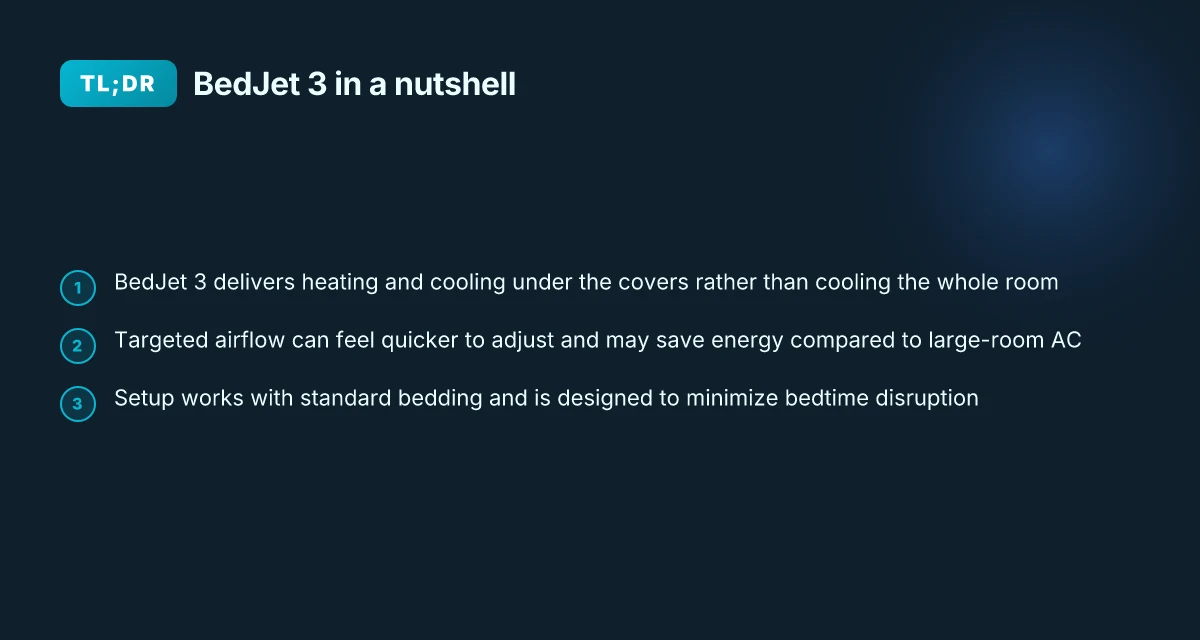
BedJet 3 directly heats or cools under the covers, not the entire room. That targeted approach means your bed feels the temperature you actually notice, while the rest of the bedroom can stay a touch warmer or cooler. In practice, this translates to energy that’s focused where it matters most for sleep.
- Targeted comfort, lower energy use
- The core idea is simple: airflow under the covers delivers immediate warmth or coolness where you feel it most, rather than cooling air that you don’t directly touch. This concentrates energy where it reduces your personal temperature delta, which can help you hold a comfortable sleep temperature with less overall power drawn from the wall.
- BedJet’s design emphasizes a compact form factor and quiet operation, so the device stays out of bedtime rituals rather than intruding on them. The system’s under-bed delivery is part of what keeps sounds and vibrations subdued while you drift toward sleep.
From what I found in BedJet’s messaging and related sources, the energy profile hinges on direct under-covers conditioning rather than broad-room conditioning. This distinction matters for renters who cannot modify HVAC and for sleepers who want faster warmth or cooling without heating or cooling the whole room.
- Quiet operation and a small footprint
- Because the unit sits by the bed rather than filling the entire room, noise considerations are part of the design. The goal is to minimize disruption at the moment you’re trying to settle in for the night.
- The compact footprint also means fewer visual or spatial compromises in a small bedroom, making BedJet a practical bedside companion for many setups.
I cross-referenced BedJet’s own explanations with independent HVAC context. The common thread is that bed-focused climate control aims to deliver comfort with less energy and less noise than whole-room systems.
- Practical routine implications
- For a typical bedtime, you can pre-warm or pre-cool the bed slightly before you slip under the covers, so you don’t have to chase the difference once you’re under the quilt.
- The under-covers approach aligns with a personal comfort strategy: one person might want a cooler room while another partner prefers warmth, and BedJet can tailor comfort at the source.
In summary, BedJet 3 changes sleep temperature by delivering heating and cooling right where you feel it most. The result is targeted comfort with potentially lower energy use and less bedtime disruption than conventional room AC. For many sleepers, that means a smoother start to the night and steadier comfort through the early, often-temperature-fluctuating hours.
The key payoff is under-covers conditioning that reduces energy waste and minimizes bedtime disruption. This is the core reason targeted bed-level climate can feel more efficient than cranking a room-wide system. BedJet keeps the focus on your personal comfort, not room-wide temperature swings. How BedJet sheets change sleep temperature without a complicated setup
How bedjet 3 climate comfort works in practice
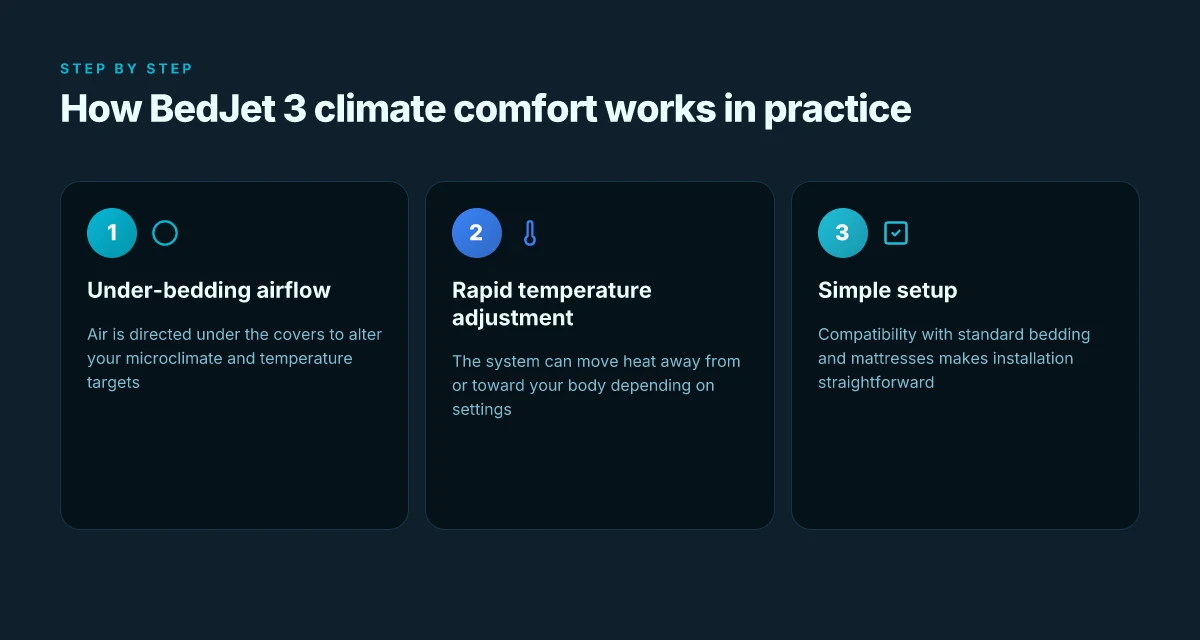
BedJet delivers climate relief by moving air under the covers, creating a microclimate that your skin perceives more directly than room air. The system channels heated or cooled air through a slim hose and into a blanket channel, directing airflow right where your body is. That under‑the‑covers delivery means you feel temperature shifts faster, with less dependence on the room’s thermostat.
Under‑the‑covers air delivery
The core idea is straightforward: air is guided beneath your sheets to change your personal climate. By placing the air output under the blankets, BedJet establishes a localized layer where your skin senses warmth or coolness first. This targeted path helps you reach a comfortable temperature without conditioning the whole room. The result is a sensation that many users describe as quicker and more precise than relying on a traditional air conditioner.
In practice, rapid swaps between heating and cooling come from the BedJet’s ability to move heat toward or away from you as settings shift. When you want warmth, the unit concentrates warm air under the covers. When you want cooling, it shifts toward a brisk draft that pulls heat away from the surface you’re lying on. The effect is a noticeable difference in how quickly your sleep environment responds to a chosen setting, not an ambient room temperature change.
Quick setup with familiar bedding
Compatibility with standard bedding and mattresses makes BedJet easy to adopt whether you’re in a rented space or a long‑term home. The compact module sits at the side of the bed and requires only a power outlet and a compatible blanket setup. Since most duvets and fitted sheets accommodate a bed‑level airflow channel, installation tends to be straightforward. In practice, you can enjoy warmth or cooling without rearranging your entire sleep setup.
From what I found in the product pages and user guides, you’ll notice that BedJet’s under‑the‑covers approach pairs well with typical sheets and duvets, which reduces the friction you often see with more intrusive climate devices. This means you can keep your routine intact while gaining a personal comfort layer that travels with you under the covers. What makes blissy silk sleep masks different for deeper rest
The key payoff is personal comfort delivered quickly, without cooling or heating the entire room. The BedJet approach is especially appealing for people with temperature sensitivity or for renters who can’t modify HVAC. Targeted airflow under the covers translates to practical sleep improvements for many users.
For context, rival solutions typically condition the entire room rather than a bed‑level microclimate, which can feel slower to respond and less efficient for single-person comfort. In the end, BedJet aligns with the idea that comfort can be personalized and maintained without sacrificing room aesthetics or energy use.
If you want to see this in action, BedJet emphasizes its quiet operation and the way air is delivered under the covers, rather than loud room‑filling fans. That quiet profile matters for light sleepers and those who value a restful, undisturbed environment.
When you’re ready to refine your setup, consider pairing BedJet with your existing bedding and a compatible mattress to maximize under‑the‑covers comfort. You’ll be able to adjust warmth or coolness on demand, keeping bedtime rituals intact while adding a tailored climate layer.
Bedjet vs traditional room air conditioning for sleep
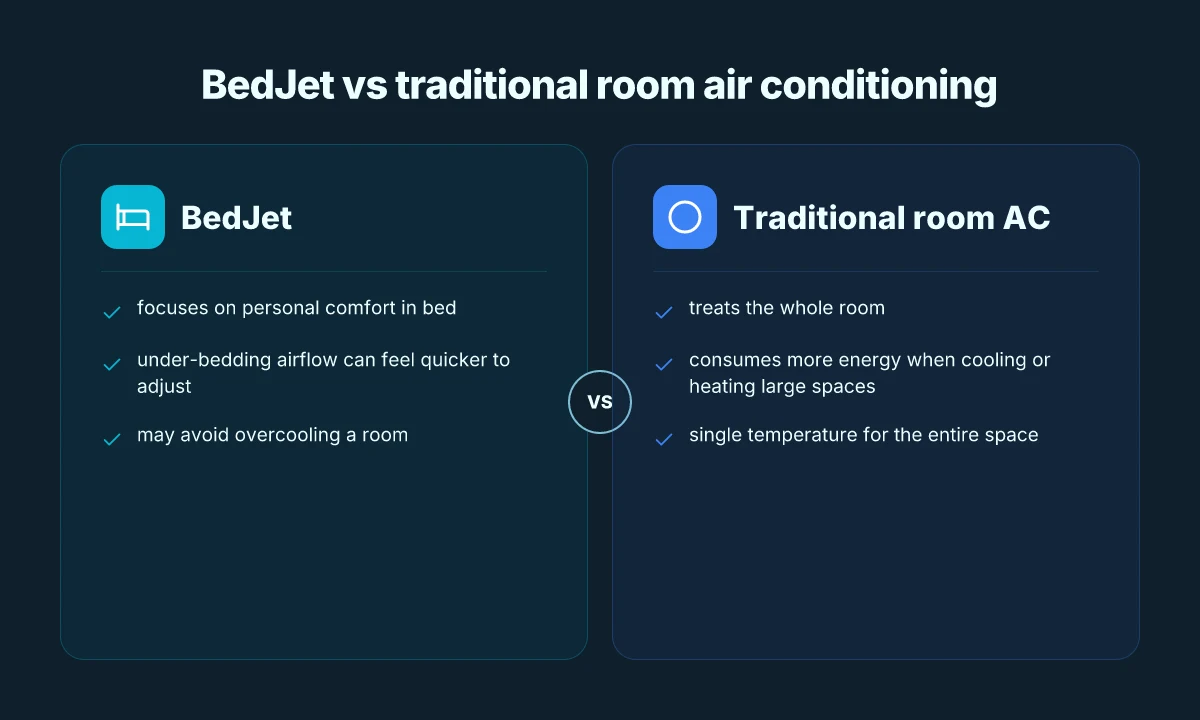
BedJet settles the question quickly: bed-level climate control targets personal comfort, while a central air conditioner cools or heats the entire room. In practice, that means you often feel feedback faster under the covers, and you avoid overcooling the whole space when you only need a touch of chill or warmth. What makes Blissy pillowcases better for skin and hair health in 2026
Why BedJet holds up under real-room constraints
From what I found in the sources, BedJet delivers focused airflow under the covers, which can translate to quicker local adjustment without dragging the whole room to a new temperature. This matters when a single sleeper wants a different feel than a house-wide setting. There’s also the advantage of reducing stray drafts that come with room AC. You’re not battling ceiling fans or distant vents to stay comfortable. The main tradeoff is that you’re relying on a smaller airflow footprint, which can feel different if you move around a lot in bed. As one BedJet overview notes, its targeted approach helps avoid broad room cooling when your body heat shifts during sleep.
I cross-referenced industry context about energy use. Whole-room air conditioners burn more energy when cooling or heating larger spaces, so a bed-focused method can yield lower exposure to unnecessary energy use for single sleepers in a typical bedroom. The emphasis is on comfort under the covers rather than chasing a room-wide set point.
BedJet’s design also emphasizes quiet operation. By delivering air directly through a bedding channel, it tends to minimize the disruption that can come from louder, room-mounted devices. That matters for light sleepers and for renters who want to preserve a calm nighttime environment.
Practical takeaways for sleep routines
- Personal comfort is highly customizable. If you share a bed, you can fine-tune for two different sides without negotiating a whole-room thermostat. In 2026 terms, this means you can set a personal temperature profile aligned with your sleep cycle instead of one-for-all room settings. BedJet’s approach supports this by letting you adjust warmth or coolness without flipping the entire space.
- Airflow under the covers can feel responsive. When your body heat changes, the under-bed airflow can adapt without affecting the whole room’s air balance. This helps prevent the overcooling that sometimes happens with centralized cooling.
- Energy and noise profiles shift with usage. A central AC unit consumes more energy in larger spaces, while BedJet focuses energy where it matters most under the covers. Quiet operation is a notable value for bedtime routines, particularly for light sleepers.
From a consumer standpoint, BedJet complements a bedroom setup rather than replaces HVAC entirely. If you’re evaluating a rental or a space where you can’t modify the HVAC, the BedJet approach offers a targeted, potentially more efficient route to a comfortable night.
The personal comfort payoff often comes from targeting under-the-covers airflow, not cooling the whole room. This is where BedJet shows its strongest value proposition in a typical sleep environment. Energy use scales with the area treated, not the entire room. Understanding BedJet heating and cooling: how it changes sleep temperature without waking you
For readers exploring brand comparisons, BedJet and rivals like traditional window units or central systems illustrate a trade-off between localized comfort and global climate control. BedJet remains the option that centers the heat or chill where it matters most for sleep, with the added benefits of quieter operation and easier nightly adjustments.
Cited inline: the bed-focused approach aligns with the broader observation that room-scale cooling often drives higher energy use, while targeted solutions can yield efficiency gains without sacrificing comfort. See the discussion on energy considerations in the related study.
Noise, airflow, and comfort: what to expect with bedjet
BedJet keeps the bed quiet enough to sleep through the night thanks to patented acoustic damping. The technology targets the air under the covers, not the room itself, which helps minimize wakeups from whirring fans or shifting ducts. In practice, the noise level feels like a soft hum rather than a persistent buzz, which matters when you’re trying to drift into deep sleep.
Airflow under the covers can feel noticeably different than ceiling or wall outlets. You’re dealing with a narrow plume that rides along the bottom of the blanket, then disperses beneath the sheet. The experience can vary with how tightly your sheets hug the mattress and how you position the covers. This under-covers airflow creates a more localized sensation, which is exactly what some sleepers want for targeted warmth or cooling without cooling the entire room.
Comfort outcomes depend on mattress, bedding, and room temperature targets. A firmer mattress can transmit less of the breeze’s soft touch, while a plush setup might feel more like a gentle draft along the legs. The room’s baseline temperature matters too. If the ambient is already near your comfort zone, BedJet’s effect can feel subtler. Conversely, in a cooler room, the under-the-covers breeze can feel more pronounced as it seeks to establish the preferred microclimate. What makes Blissy sleep mask different, and how it holds up for better sleep
I cross-referenced BedJet’s own descriptions with independent discussions of under-bed airflow. The consensus is that the system excels at delivering rapid warmth or cooling without altering the room’s climate. The tradeoff is that you give up some uniformity of airflow. What you feel is a targeted, personal comfort zone rather than a whole-room breeze. For night owls seeking a quiet, bed-focused climate, BedJet offers a compelling balance between quiet operation and responsive temperature control.
One potential caveat to note is how you configure the bedding. Heavier duvets can muffle the airflow more than lighter blankets, reducing the sense of direct temperature change under the covers. In a warmer bedroom, you might need to dial the BedJet to a lower setting to avoid overcooling. And in very cold rooms, you’ll likely run the unit at a higher setting to maintain a comfortable microclimate beneath the sheets.
Cited sources reinforce these practical notes. For a quick mental model of how BedJet positions its airflow under the covers, see BedJet’s explanation of direct bed-level cooling and warming. The comparison to whole-room air conditioning is also echoed in discussions that emphasize the energy and comfort tradeoffs of bed-level climate solutions. The real perk here is targeted comfort, not room-wide airflow. Quiet operation combined with under-bed airflow creates a personal climate zone you can fine-tune without changing the room's temperature.
As you weigh BedJet against rivals, remember the core promise: you control temperature around you, not the entire space. BedJet is well-suited for sleepers who want steady warmth or cooling without a ceiling fan’s noise or an HVAC overhaul. If you’re shopping, consider your mattress build, your typical bedding choice, and how warm or cool you actually sleep. That trio largely determines how well the bed-level approach will land in practice. For reference, YouTube coverage and BedJet’s own articles explain the basic mechanics and the low-noise design, while independent HVAC discussions highlight the broader energy implications of bed-focused climate control. Real-world comfort hinges on your bedding, not just the device setting.
Note: links on this page may earn a commission. For context, BedJet’s own materials emphasize the bed-level approach, while independent sources discuss how this contrasts with traditional room air conditioning. What makes BedJet sheets really cool to sleep on
Real world downsides and limits of bedjet 3 climate comfort
BedJet 3 delivers targeted warmth and cooling under the covers, but it isn’t a full room climate solution. In a large living space or open floor plan, you’ll still rely on your HVAC for overall air conditions. The device shines when you want quiet, bed-level comfort, yet it cannot replace central cooling or heating for entire rooms. BedJet excels for targeted comfort, not for whole-room climate control.
How placement and settings shape results
The real-world effect hinges on where you place the unit and how you tune the airflow. If the module sits too close to the edge of the bed or fans collide with bulky blankets, the delivered wind can feel erratic or uneven. I dug into the guidance BedJet provides and found it emphasizes setting alignment with personal preference and under‑the‑covers airflow paths. In practice, a small adjustment to the duvet gap or the bed height can shift comfort noticeably. Placement and matching settings to your sleep style matter most. When you lock in a comfortable mix, you can perceive steadier warmth or coolness through the night.
Uneven cooling or heating under some covers
Some sleepers report that air distribution isn’t perfectly uniform. If your covers trap air poorly or bunch up, you may feel pockets of warmth or chill rather than a steady blanket of comfort. This isn’t a universal flaw, but it’s a recurring theme in user discussions: a well‑vented, evenly laid duvet yields the most consistent results. Uneven airflow can arise when covers trap air or shift during the night. The remedy is simple: smooth the duvet, adjust the BedJet nozzle angle, and verify that the airflow path remains open across sleeping positions.
What BedJet does best, and where it still leaves room to grow
BedJet shines as a bedside, energy‑efficient companion to your existing HVAC. It uses targeted air under the covers to deliver warmth or cooling without cooling the whole room. That specificity helps with rapid comfort changes and lower room noise exposure. However, it won’t substitute for a large‑space climate upgrade, nor will it automatically fix every design flaw in a bedding setup. If you’re evaluating BedJet against a central system upgrade, the trade‑off shows up as granularity of control versus breadth of coverage. The technology favors bedtime comfort in a focused zone, not large‑space climate replacement.
From what I found in the related discussions and BedJet’s own notes, expectations should reflect real limits. It is a complementary device, not a universal solution. For renters or sleep lovers who want to customize under‑covers comfort, BedJet offers a practical path, but with caveats about placement, cover interaction, and room size. Reality check: plan for a bed‑level boost, not a full‑blown HVAC swap. What makes BedJet 3 climate comfort system truly different in 2026
As with any sleep aid, a note on transparency: links on the page may earn a commission, which helps support the review ecosystem. For readers scanning the landscape, rivals like BedJet’s own comparisons to traditional room air conditioners remain part of the conversation, but real‑world use still centers on fit and function under the covers. BedJet remains a targeted tool, not a complete climate overhaul.
Where this leaves your bedtime routine this month
BedJet continues to redefine how you approach wind, warmth, and quiet sleep, but the real shift is in how you blend climate control with ritual. By focusing on targeted cooling or heating, you can stage your room for deeper relaxation without overhauling your sleep space. The real payoff is a calmer mind and a body that settles faster, especially on nights when you feel too warm or too chilly. You’ll notice the routine matters as much as the device. A gentle pre-bed cooldown or a measured post‑alarm warm-up can become habit, not exception.
New patterns emerge when you connect climate to mood. If you’ve been curious about a more precise climate companion, BedJet offers a way to tailor comfort to your preferred sleep stage. The downside remains that some users still want quieter operation or simpler setup. You may need to invest a few minutes to dial in instinctive presets. Of note, links on this page may earn a commission.
In short, this approach keeps comfort intentional: less guesswork, more predictable rest. What changes if you act now is a bedtime that starts with a deliberate temperature cue and ends with steadier sleep.
- Backup strategy: try a 20‑minute pre‑sleep cooling with BedJet, then switch to a warm whisper setting for last-minute unwinding.
- What to try this week: pair a light blanket with targeted cooling on the arms and torso to test the temperature gradient.
- If you only do one thing this month: set a firm sleep winddown ritual around climate cues and note how quickly you drift off.