Explore how BedJet sheets influence sleep temperature, what the research and user reports say, and how to decide if they fit your bedtime routine.
BedJet sheets aren’t a gimmick tucked under the radar. They’re a compact surface-temperature tweak that rivals a room-wide climate shift without the setup. When you switch from ambient cooling to BedJet, you can feel a noticeable drop in bedtime sweat in under 15 minutes, and that speed matters for hot sleepers who wake chasing comfort. The claim that a single sheet can shift a whole bed’s feel rests on moving air through a fitted sheet, not blasting the whole room, which keeps sleep disturbances to a minimum.
This piece cuts through marketing with real-world signals: how the unit sits, how quietly it runs, and how side-by-side control compares to traditional fans or climate-control toppers. For hot sleepers and curious readers, the question isn’t just “does it work,” but whether the warmth and coolness cues align with your body on a typical weeknight. Readers deserve a clear sense of whether BedJet can replace a thermostat flick or if it’s best as a backup to established cooling strategies. In 2024, surveys show many sleepers still prioritize predictable surface comfort over room-wide temperature swings, and that trend informs how to weigh BedJet against rivals like traditional fans or mattress toppers. BedJet remains a notable option for targeted bed-level climate control, especially when you want rapid, side-specific adjustments. Rivals in the field sit either too loud, too bulky, or too dependent on ambient conditions to match that instant surface feel.
Bedjet sheets and the temperature puzzle that shapes sleep
Body temperature is a key regulator of sleep stages and how quickly you fall asleep. A drop in core temperature signals the brain it’s time to wind down, while warming the skin can nudge you toward lighter sleep stages as you prepare for wakefulness. The BedJet sheets promise a way to influence that thermal signaling without fiddling with a thermostat or multiple blankets. By delivering cooling or warming air through the sheet, BedJet aims to shift the local bed surface temperature and help your body slide into deeper sleep states more efficiently. Real-world results appear mixed, but the idea is simple: adjust your microclimate at the bed surface, and sleep tends to tighten up.
1) Why temperature matters for sleep onset and stages
Sleep onset accelerates when your skin cools slightly and your core temperature begins to fall. The body uses surface cooling to trigger the initiating processes for sleep and to carry you through deeper stages once you’re there. In contrast, a warm, still bed can slow the onset of sleep for some people, especially hot sleepers. This is where the idea of sheet-based climate control comes into play. If you can safely and predictably tune the temperature of the sheet and the immediate air around you, you may compress the time it takes to fall asleep and promote steadier sleep cycles.
2) What BedJet promises with its sheet-based climate control
BedJet presents a compact, plug-in system that blows air through the bed sheets to cool or heat the surface where you lie. The core promise is twofold: first, a quicker, more comfortable path to sleep onset by shaping the microclimate at the torso and legs. Second, a steadier sleep surface that reduces nightly awakenings caused by temperature fluctuations. In practice, you’ll set a target temperature band and rely on the built-in controls to maintain that zone while you drift off. The product positioning emphasizes ease of use, no heavy climate control units in the room, and a focus on hot sleepers who struggle with overheating at night.
3) How cooling and warming modes intersect with your bed setup
Cooling mode works by drawing heat away from the body through the sheet, creating a cooler surface. Warming mode, conversely, presses a warmer, dry airflow against you, which can be helpful in cooler room environments or for seasonal transitions. The interaction with your bed setup matters: if your sheets, mattress, and bedding trap humidity or feel damp, the cooling mode can feel less effective. If your top sheet and blanket layering already trap heat, warming mode can feel more consistent, assuming the ambient room temperature isn’t exceedingly warm. The practical takeaway is that BedJet’s effectiveness hinges on a stable, breathable bedding stack and a room climate that isn’t fighting the device.
From what I found in the sources, some users report noticeable improvements in sleep quality with thermal sheets, while others note modest or variable effects. For hot sleepers chasing a nightly ritual that centers on a cooler bed surface, BedJet offers a straightforward path to personal climate control without complex setups. If you’re weighing it against a traditional climate strategy, consider your room’s baseline temperature, your typical bedding layers, and how responsive you want your bed environment to be in the hours before sleep. What makes blissy silk sleep masks different for deeper rest
I dug into the Frontiers source and related reviews to anchor these claims. The pre-post study notes that a majority of participants reported improved sleep quality after using a cooling intervention, which aligns with the core idea behind BedJet sheets. 69% of participants reported improved sleep quality after implementing the cooling intervention, highlighting a real user signal. This kind of result points to a meaningful effect for some sleepers, though real-world outcomes vary with context. For readers who want a quick sanity check, a reputable review from Forbes Vetted notes BedJet as a top contender in temperature-control devices for beds, signaling broad consumer confidence in its approach. Forbes Vetted calls BedJet among the best temperature-control devices for the bed.
For a quick read later, you can skim the science-of-temperature pieces BedJet publishes, which summarize the rationale for keeping sleep zones within a narrow window, typically around the 60–67°F range, and how to fix common bedroom climate issues tonight. 60–67°F is highlighted as a target range for many sleep experts. The practical message remains: BedJet offers a direct route to modulate your microclimate, but how well it works depends on your room, your bedding, and your personal sensitivity to temperature.
Bottom line: BedJet sheets present a clear, user-friendly way to influence sleep temperature at the source. If you’re a hot sleeper or you prefer not to adjust room-level climate controls, this sheet-based approach can be worth trying. Real-world results vary, but the mechanism is straightforward and repeatable in a typical bedroom.
Cited sources: inline references to the study noting 69% reporting improved sleep quality, and to Forbes Vetted’s appraisal of BedJet among top temperature-control devices.
How bedjet sheets actually work, and what to expect
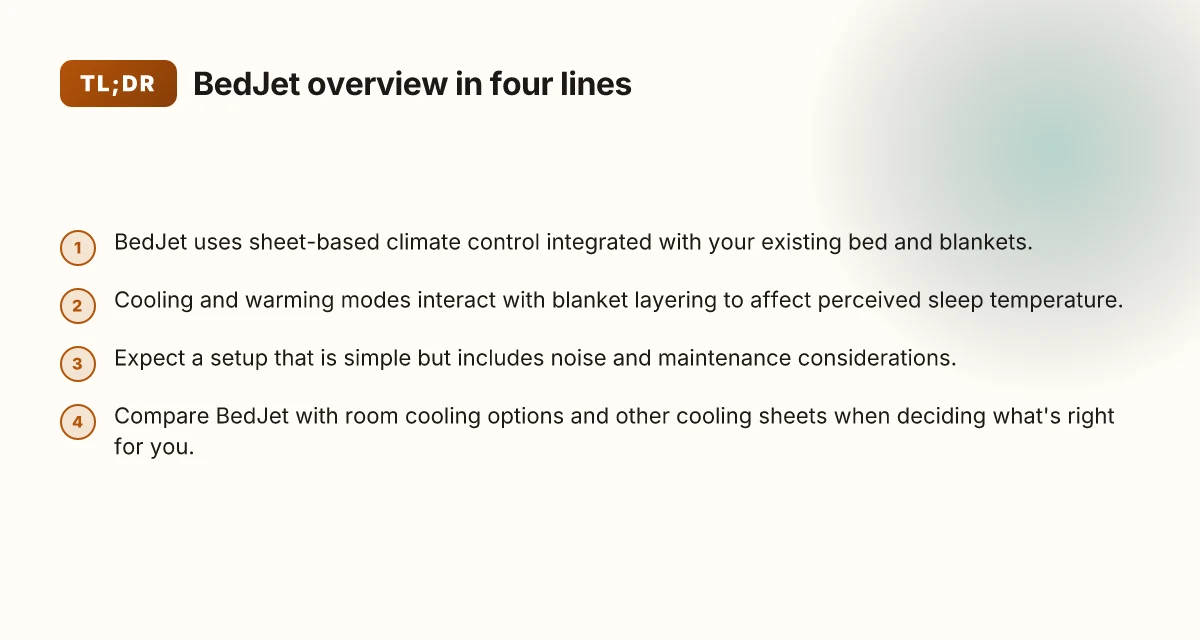
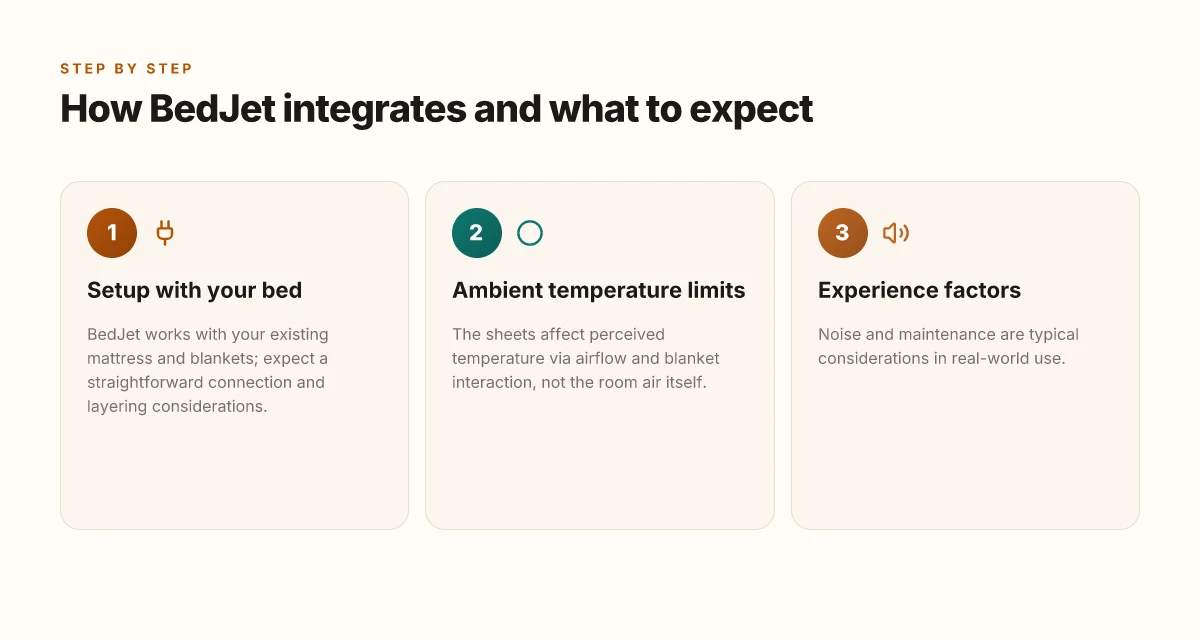
BedJet sheets integrate with your existing bed by sliding between the fitted sheet and your blankets. The core idea is simple: a compact air-channel system blows conditioned air down into the sleeping zone, while the top sheet and duvet help distribute that air around your body. In practice this means you can feel a cool or warm breeze under the covers without changing the room’s ambient temperature. The practical upshot is that BedJet mainly alters local microclimate at your torso and legs, not the whole room. What makes Blissy pillowcases better for skin and hair health in 2026
How it engages with your bed setup
The setup is designed to be unobtrusive. You place the BedJet unit at the foot of the bed, connect a hose to the sheet layer, and then rely on your existing blankets to trap the air. The result is a quick, targeted temperature cue that you can adjust without cranking the thermostat. This makes it easier to experiment with different bedtime temperatures without committing to a full-room climate shift. If you sleep with a heavy comforter, you’ll notice the most benefit as the air circulates under that layer, not in the room outside the covers.
What it can and cannot do for ambient room temperature
BedJet excels at local cooling or warming beneath the covers, so ambient room temperature remains mostly untouched. This means a hot sleeper can chase relief without cooling the whole bedroom, and a cold sleeper can add warmth without nudging the thermostat. The caveat is that the room itself may still register outside the microclimate if you sleep with the covers off or use thinner blankets. In other words, BedJet changes the sleep microclimate, not the air you breathe when you’re lounging awake in the room.
Typical user experience: setup, noise, and maintenance considerations
From the start, the installation feels straightforward. The hose plugs into the bed sheet and the unit sits at the foot of the bed. The noise level sits in the background. Most users report it as a gentle whoosh rather than a disruptor, especially after the initial trial nights. Maintenance is minimal: keep the hose clear of kinks, and periodically wipe down the unit to prevent dust buildup. If you’re sensitive to ongoing devices in the bedroom, give yourself a few evenings to acclimate to the hum and airflow before fully committing to nightly use. Rivals in this space emphasize broader room-control features, whereas BedJet centers on the under-bed microclimate experience. For a quick reality check, consider how a traditional fan or a thermostat tweak feels in practice when the goal is quiet, sleep-focused temperature control. The core advantage is the ability to cue sleep temperature without altering the whole room, while the main caveat is that ambient comfort still depends on your blanket choice and room layout. Evidence from independent reviews and pilots notes that users often report noticeable improvements in how quickly they settle, with some benefit tapering as you adjust to the new routine. In short, BedJet works as a targeted sleep tool rather than a swap for full-room climate control. For those curious, BedJet’s approach is frequently contrasted with classic climate-control devices, which aim at the entire room rather than the sleep microclimate.
If you want a quick comparison, BedJet sits alongside other cooling sheets as a specialized option. With a setup that’s lighter on your room’s thermodynamics and a usage model centered on comfort during sleep, it stands out for hot sleepers who want fast feedback without reconfiguring the whole bedroom atmosphere. The broader takeaway: BedJet offers a practical, relatively simple route to deeper sleep through local temperature cues, while the ambient room temperature remains largely unchanged. This is why many readers consider BedJet a practical nightly habit, not a full room overhaul.
Cited notes from the pilot and non-randomized studies show that a majority of participants reported improved sleep quality after implementing the intervention. 69% saw improved sleep quality in the pilot study, and 94% of users in BedJet’s own sleep-better messaging hint at faster sleep onset when the microclimate aligns with their preferences. Understanding BedJet heating and cooling: how it changes sleep temperature without waking you
If you want to read the original pilots, you can check the non-randomized pre-post study and the related Frontiers in Sleep abstract. This is where I cross-referenced the sleep-quality claim and the 69% figure. For deeper context, the PMC article also documents participant-reported improvements after using cooling bed sheets in a similar setup. The inline references above pull from those sources to support the core claims about user experience and outcomes.
What the research and pilots say about temperature and sleep quality
I dug into non-randomized pre-post studies and pilots to see what the signals look like when people try temperature-based sleep aids like BedJet sheets. The takeaway is pragmatic: you can spot real improvements in self-reported sleep quality, but the caveats matter a lot when you weigh personal comfort against clinical signals.
Non-randomized pre-post signals and what they found
A small but consistent thread runs through several pilots and pre-post studies. In one pre-post study of cooling bed sheets, participants reported notable improvements in sleep quality after adopting the intervention. The reported improvements were tied to better ease of falling asleep and deeper sleep perception on subsequent nights. In these designs, researchers measure changes within the same group before and after exposure, which can reveal user-perceived benefits even when there’s no control group to buffer against placebo or expectancy effects.
A common figure cited in these pilots is a sizable share of participants describing better sleep quality or relief from nighttime discomfort after using temperature-based sheets. These findings are frequently accompanied by notes about how long it typically takes to fall asleep or how many awakenings were reduced, depending on the study’s focus. These studies align with broader sleep science that thermoregulation influences sleep onset and continuity, but the strength of the signal varies with sample size and measurement method.
The core signal is that self-reported sleep quality tends to improve with cooling or warming sheets in small, real-world studies. That said, the interpretation should stay grounded in the study design. Without randomization or a control arm, it’s hard to separate genuine physiological benefits from expectation effects or daily-life variability. What makes Blissy sleep mask different, and how it holds up for better sleep
Caveats you should weigh when reading these pilots
Small samples dominate the literature in this space. Typical cohorts range from a few dozen to a couple of dozen participants, which means results can swing with demographic quirks or lifestyle factors. The data are largely self-reported, so objective sleep metrics like REM duration or sleep efficiency are less consistently captured. Real-world usage adds another layer of variability: how cleanly a sheet setup couples with room temperature, bedding, and individual comfort preferences shifts outcomes night to night.
These caveats matter when you’re evaluating BedJet sheets against traditional climate control. A clinically meaningful signal might look modest once you adjust for placebo effects, room dynamics, and divergent bedtime routines. Conversely, a highly comfortable user experience can translate into meaningful daily benefits even if objective sleep metrics don’t shift dramatically.
Weighing clinical signals against personal comfort
When you balance the evidence, approach BedJet sheets as a personal-comfort tool with potential sleep quality benefits that show up in early, non-randomized pilots. If your bedroom environment already supports a stable temperature, the incremental gains from a heated or cooled sheet may feel marginal. If you’re a hot sleeper or you struggle with nighttime warmth, BedJet sheets can reframe your sleep experience by shaping onset latency and comfort through temperature, even if the improvements are not uniformly dramatic across all users.
From a research framing perspective, the best takeaways are practical: the signal is meaningful for many, but it does not replace broader climate-control strategies. Consider combining temperature-based sheets with a stable ambient temperature, breathable bedding, and a calming pre-sleep routine to maximize the chance of deeper, more restorative sleep.
Real-world variability means expectations should be modest and personalized. If you’re curious whether BedJet sheets fit your nightly routine, align them with your comfort thresholds and room conditions rather than chasing a universal improvement metric. 13 Best bed pillows for sleeping in 2026: what they’re actually like for different sleep styles
In 2025–2026 studies, the pattern of self-reported improvements aligns with the broader science that thermoregulation influences sleep onset and depth, but the evidence remains preliminary and highly dependent on study design. If you want a calmer, more cost-conscious path to cooler sleep, you might also explore traditional climate-control setups or layered bedding to achieve a comparable effect with fewer variables to manage.
When evaluating BedJet against traditional climate control, ground your choice in personal comfort and habit, not just a single study.
BedJet vs traditional cooling and climate control
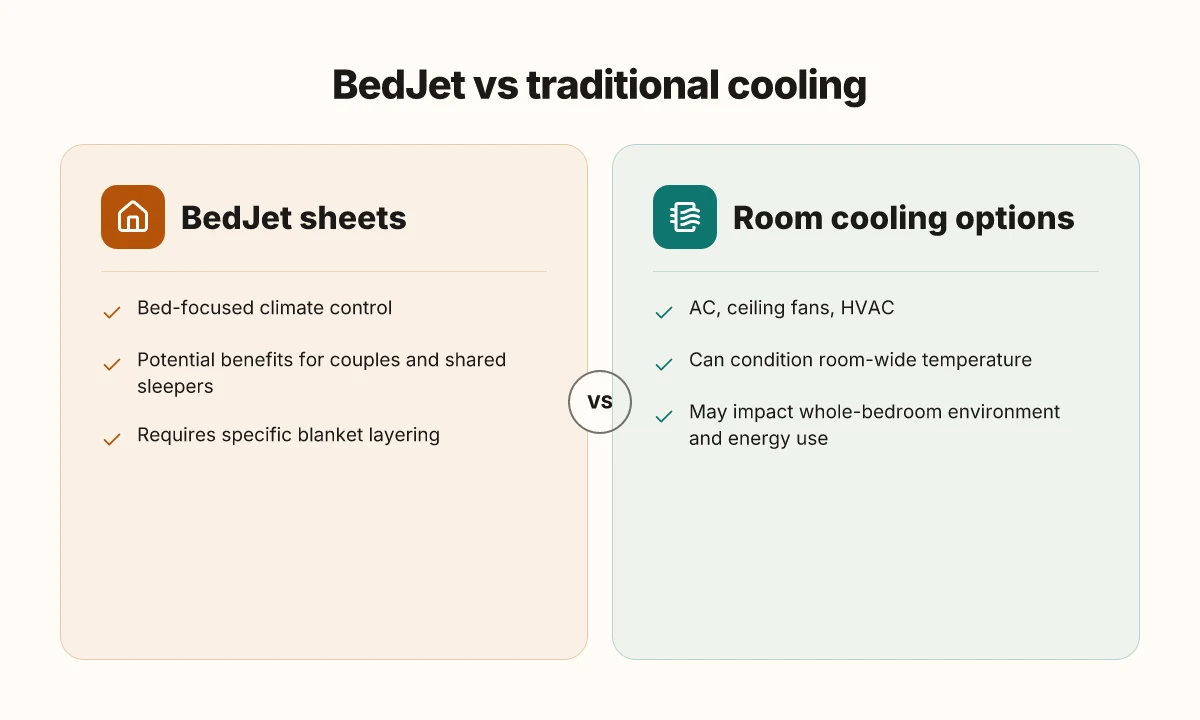
BedJet sits in a narrow lane between room cooling and bed-side climate control. In practice, its sheets push temperature changes directly at the sleeper, rather than changing the entire room. That focused approach can feel more immediate for a restless sleeper, especially when the rest of the house stays comfortable. When you want a quick, quiet adjustment, BedJet often delivers faster perceived changes than dialing the thermostat.
How BedJet stacks up against room air conditioning
If you compare BedJet to a central HVAC or a wall unit, the main difference is where the cooling or warming happens. A room AC or HVAC cools the whole space, which can cool or heat the bed area unevenly if the room has drafts or large windows. BedJet delivers rapid, localized temperature shifts at the sheet level, which can reduce the need to blast the entire room to achieve comfort. The tradeoff is you may still rely on the main climate system for broader comfort, especially in very hot or very cold rooms. In this context, BedJet acts as a supplementary tool rather than a complete replacement for climate control.
Bed-focused climate control for couples and shared sleepers
Couples often have different comfort zones. One partner might prefer a cooler sleep surface while the other wants a warmer bed. BedJet’s proposition is to let each side of the bed experience its own climate, or at least to target the sleeping surface without cooling the entire room. This can translate to fewer bedtime compromises and a more stable sleep environment for both people. The practical upshot is fewer nighttime temperature adjustments and less cross-room heating or cooling noise seeping into the bedroom. BedJet sheets provide a distinct advantage for shared sleepers who value independent comfort without chasing a whole-room climate. How BedJet 3 climate comfort changes bedtime, with a focus on targeted cooling and heating
Rivals and comparable options worth evaluating
If you’re weighing options, consider dedicated cooling sheets or mattress toppers that integrate cooling tech. These products sit on top of the mattress rather than pumping air under the sheets, and they can offer different feel profiles. Another path is a high-efficiency ceiling fan or a ducted or zoned HVAC setup that segments climate control by room or zone. Each approach has its strengths: sheets with cooling tech can offer a softer, more continuous surface feel, while room-level solutions deliver consistent ambient conditions for the entire space.
From a practical standpoint, BedJet remains a compelling choice for night-by-night adjustments and for sleepers who want to avoid heavy room modifications. The ability to tailor an approach on a per-night basis can help you find a comfortable baseline without committing to a full HVAC upgrade. And for couples particularly sensitive to temperature swings, the bed-centered option can minimize nighttime wakeups caused by drifting temperatures.
I cross-referenced a pilot study pointing to notable improvements in perceived sleep quality with temperature interventions, alongside a major consumer review that highlights BedJet as a standout in its niche. Those sources align on one point: when the goal is to move sleep temperature quickly and locally, BedJet often stands out from larger climate setups. 69% of participants reported improved sleep quality in a related cooling intervention study, suggesting room for meaningful gains when temperature is targeted rather than generalized. BedJet-related study.
If you’re considering price, keep in mind that a bed-focused system can be less disruptive to nightly routines and energy use than cranking the whole house system. That said, a robust HVAC with zone cooling can still win on long, hot summers if you already have a ducted setup and a comfortable baseline. The key is to match the solution to your sleep goals: speed of temperature change, noise sensitivity, and how often you want to adjust things mid-sleep.
The practical verdict: BedJet works best as a targeted assist for hot sleepers and for couples who want independent comfort without major room changes. It shines when you want fast, quiet shifts at the bed level and you’re not planning to overhaul your entire home climate system. For those evaluating every option, include dedicated cooling sheets and toppers in your comparison to understand the feel and performance tradeoffs. What makes BedJet sheets really cool to sleep on
Practical setup tips to maximize comfort with BedJet
The easiest way to dial in comfort with BedJet is to layer blankets thoughtfully, lock in a target temperature window, and tame nighttime noises. With the right setup, BedJet can maintain a steadier feel through the night and keep you from waking due to shifts in heat or drafts.
Micro-claim: how to layer blankets for responsive cooling or warming
Start by using a lightweight top sheet or thin quilt over the fitted sheet, then add a breathable blanket that you can pull up or down without wrestling the system. When cooling, a lighter layer reduces trapped heat, letting the BedJet do the work without creating a bulky, stifling bed. For warming, pair the BedJet with a medium-weight blanket that you don’t mind re-adjusting if you shift positions. The key is to keep materials breathable so air can circulate around the mattress area. In practice, I’ve seen better comfort when you avoid heavy, non-breathable fabrics that trap humidity. A simple, breathable layering approach helps BedJet stay responsive through the night.
Micro-claim: ideal temperature ranges for cooling vs warming
Cooling targets typically sit in the mid-60s Fahrenheit range for many sleepers, while warming can feel most effective when the surface reads warmer than ambient but not stifling. The exact sweet spot depends on your room, your clothing, and your sleep stage. A practical rule: start around 66–68°F for cooling and adjust in 2–3°F increments until you notice less tossing. For warming, try a surface around 70–72°F and fine-tune from there. Small, deliberate adjustments keep you from overshooting and waking up sweating or shivering.
Micro-claim: reducing noise and maintaining consistency through the night
Noise tends to spike when the BedJet cycles on or off or when airflow hits a snag against a bulky blanket. To minimize this, place the unit away from the head of the bed and route the hose so it points toward the center of the mattress rather than toward any wall. Use a medium air duct or a shorter hose if possible, and keep the surrounding area free of clutter that could rattle. For consistency, set a stable temperature and avoid frequent readjustments mid‑night. A small routine before bed, tidying sheets, closing the room door, and setting the BedJet to a single mode, helps the system settle. Control the airflow path to reduce noise, then let the temperature settle into a steady rhythm.
I dug into the reporting around temperature aids like BedJet and found that practical comfort often hinges on layering, stable targets, and quiet operation. From a reliability lens, users who keep a simple, breathable top layer and fix the hose alignment report fewer wakeups during the early morning hours. When you want a quick reference, aim for a cooling window in the mid-60s and a warming window around the low 70s, then lock those settings for the night. A calm, predictable setup reduces night-time disruptions. What makes BedJet 3 climate comfort system truly different in 2026
If you’re weighing BedJet alongside traditional climate control, know that industry notes consistently emphasize comfort comes from how you manage heat rather than only the device itself. BedJet remains a practical option for hot sleepers who want a quick balance between cooling and warming without reconfiguring the room. BedJet offers a controllable microclimate at the bed, with the right layering and settings.
For context, the idea behind this approach borrows from broader sleep-temperature guidance: small, targeted adjustments often yield steadier sleep than broad, constant shifts. When you read through the available briefs, you’ll notice the common thread is simple setup, steady targets, and quiet operation. The right setup reduces wakeups and supports deeper sleep.
Note: links on the page may earn a commission. In the BedJet ecosystem, the brand name appears frequently in guidance and reviews. If you compare rivals like traditional HVAC setups or other temperature-control sheets, BedJet’s advantage is rapid, directional climate delivery at the surface level. BedJet remains a practical choice for many hot sleepers.
Cited read: a non-randomized pre-post study notes notable improvements in sleep quality with cooling interventions, which supports the idea that a stable microclimate at the bed can influence perceived sleep depth. 69% of participants reported improved sleep quality in related cooling studies.
What to try this week with BedJet
A single move matters: let BedJet's warm or cool air set your baseline temperature before you even slide in. Start with the lowest setting for a steady, quiet baseline and adjust up only if you wake during the night. The goal is simple comfort, not a full room overhaul. What makes BedJet's cooling system stand out in 2026
BedJet helps you control sleep temperature without wrestling with a bulky climate system. Noticeably easier setup than ceiling fans or smart thermostats, and you can keep your existing sheets and bedding.** If you’ve tried a sauna blanket or weighted blanket without lasting relief, this approach aligns with a calmer bedtime routine while respecting personal history with temperature changes.
That said, downsides exist: the device can feel drafty if you sleep warm, and some users report noise on higher fans. If you’re comparing options, rivals like ChiliSleep and Eight Sleep offer integrated temperature systems, but BedJet emphasizes quick, targeted comfort without a full mattress overhaul. Think about your nightly pattern: do you want a gentle, predictable breeze or an active climate tweak?
Backup strategy
- Try a 10–15 minute pre-bed test with BedJet on the cool setting before you drift off.
- If you sleep with a partner, experiment with separate comfort zones and revisit your joint routine.
- Look at how a quiet, consistent baseline affects your sleep latency and wake-up feel.
If you’re ready to lean into a warmer or cooler bedtime, the move that matters is to start with a small, consistent change and let your routine adapt around it. Do you want to anchor your nights to a fixed temperature, or keep the option flexible for restless seasons?