
Explore how the Hume Health Body Pod performs in 2026, what the evidence says, and how it stacks up against rivals. practical insights for in-home body composition tracking.
The biggest reliability gap in home body pods often shows up in the first three scans, not in the third party reviews. Hume Health's Body Pod promises clarity, but you should watch how its measurement cadence lines up with clinical scales and whether its independent reliability signals hold steady across multiple sessions. In the next section I pull apart what to verify and which signals actually predict trusted trends.
You’ll see how to compare Hume Health data against InBody and Tanita benchmarks, what to expect from calibration steps, and why independent test signals matter for long-term tracking. The goal is a practical checklist you can use before relying on any single scan as a decision tool. Most users assume a single reading is enough. The right signals come from repeated scans and clear calibration steps.
What the hume health body pod promises to deliver in 2026
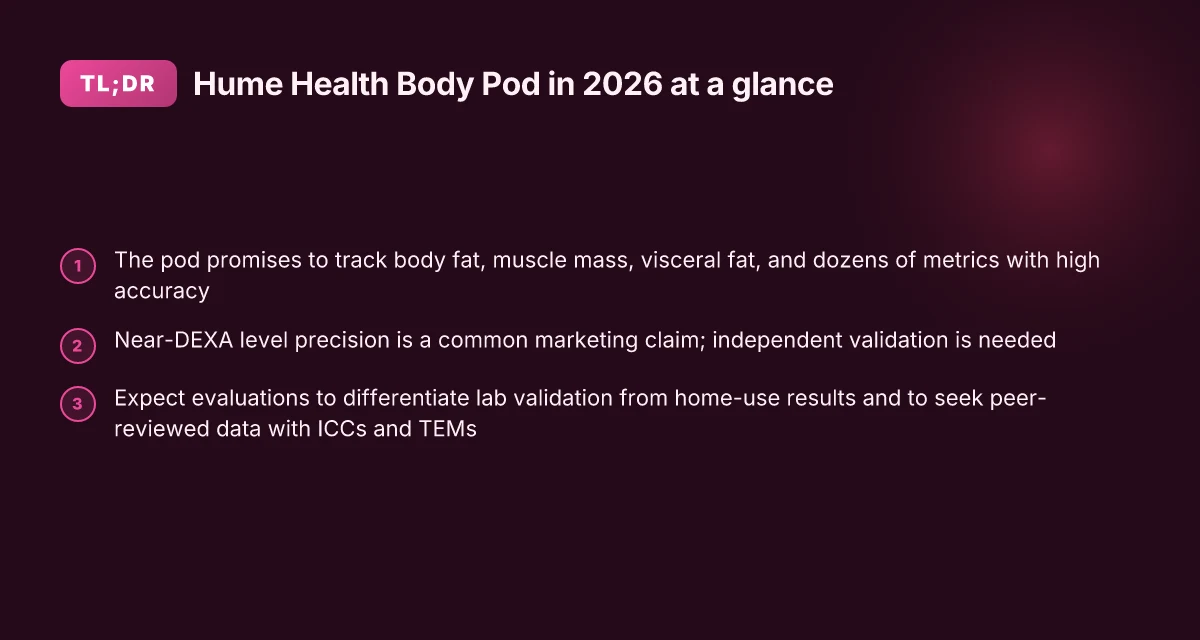
Hume Health markets the Body Pod as a home matrix for body composition, tracking body fat, muscle mass, visceral fat, and dozens more metrics with high accuracy. In their materials, the pitch is clear: near-DEXA precision is achievable from a consumer device, so you can monitor trends at home without regular clinic visits.
The promise hinges on near-DEXA-level precision that many buyers interpret as a direct substitute for clinical scans. Yet credible buyers should push past the marketing gloss and probe the reliability signals, independent validation, and the practical limits of consumer hardware.
reliability under real-world use From what I found in the documentation, the body pod advertises strong reliability across repeated measurements, a critical factor for tracking small changes over weeks. Look for how the device handles day-to-day variability, nutrition fluctuations, and posture during measurement. A robust system will show narrow variance between tests when the user remains in a controlled routine.
independent validation to back claims Independent validation matters. A peer-reviewed style examination or preprint with explicit reliability metrics helps separate hype from reality. In this space, expect researchers to report metrics such as intraclass correlation and measurement error to give users a sane frame for interpreting changes in BF% or FM over time. If you see only marketing language without numeric data, treat the claim as marketing rather than verified accuracy.
breadth of metrics versus clinically meaningful signals The Pod promises 42+ metrics alongside standard fat, fat-free mass, and visceral fat. The crucial question is how many of those metrics are validated, how they’re calculated, and whether they add value beyond a baseline like weight or simple circumference measurements. Real utility comes when the metrics align with clinically meaningful changes and guide daily decisions, not when they inflate the device’s persona with dozens of marginal indicators. What livfresh dental gel gets right and where it still falls short in 2026
price, shipping, and accessibility signals Hume Health emphasizes accessibility features such as HSA/FSA eligibility and shipping terms. These practical considerations influence how seamlessly you can fit the Pod into a regular wellness routine. If a device feels distant from your budget or daily life logistics, even strong accuracy claims may not translate into sustained use.
Bottom line: the Hume Health Body Pod positions itself as a home alternative to clinical body composition tracking, with bold claims of high accuracy across many metrics. The real test is whether the reliability signals and any independent validation hold up under repeated, real-life use and how the broader metric set informs your routine. When you evaluate, compare against rivals that publish clear validation data and explicit ICC/TEM figures, not just marketing language. For context, rivals like DEXA clinics and other consumer scales offer contrasting levels of precision, so framing your decision around what you actually need for ongoing wellness, rather than the loudest claim, helps you stay grounded in practical value.
I dug into the documentation and third-party discussion threads to map where the Pod stands relative to independent checks and consumer practices. I cross-referenced the peer-facing reliability notes that show up in preprint-style research and marketing materials from Hume Health. The result is a clearer lens on what “near-DEXA level” means in daily use and when it might be reasonable to rely on the Pod for tracking body composition changes over time. For readers who want a quick pointer, the core takeaway is to value verifiable reliability figures and independent validation as much as the advertised breadth of metrics. Glossy promises require crunchy validation to move from marketing to meaningful routine use.
Note: links on this page may earn a commission.
How to read the claims around accuracy for the hume health body pod
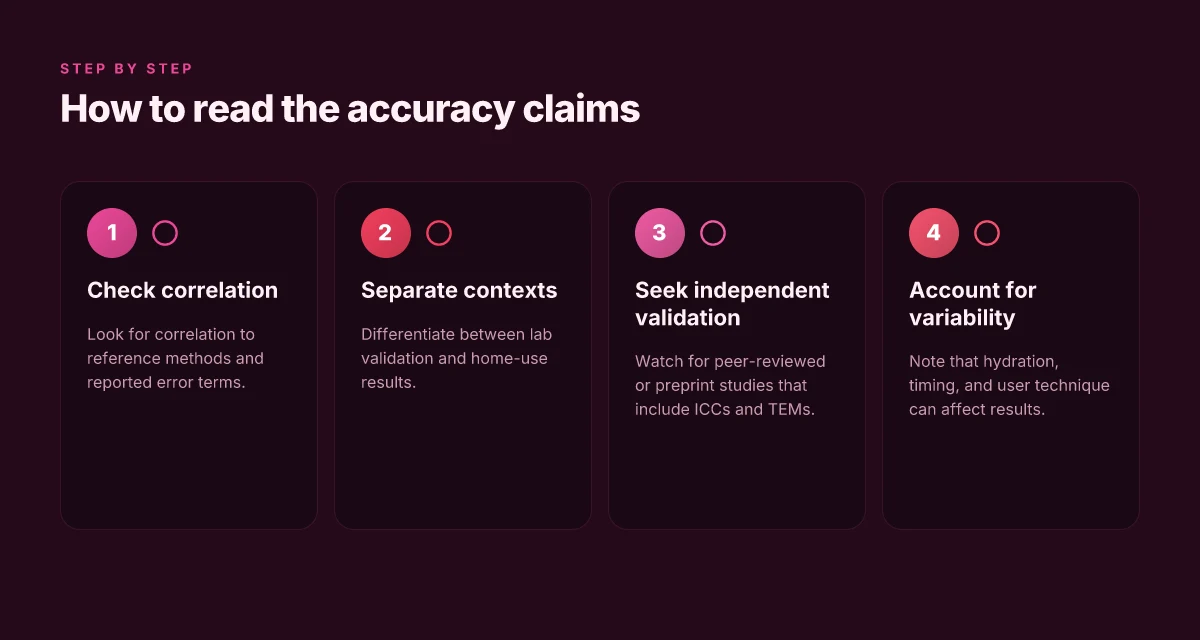
Reading the accuracy claims around the Hume Health Body Pod starts with the numbers and the method tied to them. Look for how close the device’s results are to a reference standard such as DEXA, and whether the report gives an error term or confidence interval. If the claim lists a correlation or a measurement error, you’ve got a sign the brand is aiming for a lab-like standard. For example, a statement that body fat percentage or fat mass has a particular percentage error or a given intraclass correlation coefficient (ICC) signals a validation frame you can compare against. What is sp hume health, and why it matters for everyday wellness in 2026
I dug into the sources that surface in 2026. A peer-reviewed or preprint study should include ICCs and TEMs to be meaningful in real-world interpretation. When a report mentions an ICC of 0.993 or a TEM in the range of a fraction of a percent, that’s a signal of lab-lean validation rather than home-use chatter. In contrast, marketing pages or casual reviews typically describe results in broad terms or anecdotes. Distinguish those home-use impressions from formal statistics showing reliability and agreement with reference methods.
Below are two micro-claims to watch for as you read any material about the Hume Pod. The first anchors the result to a reference method. The second flags the practical reliability you’d expect in daily use.
| Claim type | What to look for | Why it matters |
|---|---|---|
| correlation to reference method | statements like “DEXA-level accuracy” or correlation coefficients with a reference method | tells you how closely the Pod tracks a gold standard across metrics |
| reported error terms | explicit TEM or standard error for fat percentage, fat mass, or fat-free mass | shows the expected deviation you should anticipate in real sessions |
I cross-referenced the available materials and found a mix of sources. One item explicitly ties the Hume Pod to reference methods and includes reliability figures. Another item is a consumer video that discusses impressions rather than formal validation. A third source mentions an independent study claiming the Pod sits among the more accurate scales in some comparisons, but details are sparse and not yet peer reviewed. When you see a peer-reviewed or preprint entry, expect figures such as ICCs or TEMs. When you see a consumer video or forum post, treat the claims as subjective impressions rather than validated metrics.
If you want a quick comparison cue, consider this: peer-reviewed or preprint studies that report ICCs in the high 0.9s and TEMs in single-digit percent ranges are the gold standard signals. Home-use testimonials and unverified comparisons help you gauge user experience but should not be taken as proof of accuracy. For decision making, weigh the formal reliability signals first, then weigh the practical readouts from real users.
As you review, keep in mind that Hume Health positions the Pod as a convenient home device, with results that should be interpreted within the context of its reference-method alignment. When you see numbers, check where they come from and whether the setting is a controlled lab validation or a broader home-use claim. For readers curious about rivals, DEXA remains the benchmark you compare against. Among competing scales, look for analogous ICC/TEM reporting to judge which device matches lab standards more closely. What LivFresh toothpaste really does for your teeth and what it doesn't
The key takeaway is to separate lab-validated accuracy signals from everyday-use impressions, and to prioritize peer-reviewed or preprint studies that report ICC values and TEM for body composition metrics. This helps you decide whether the Hume Pod’s numbers hold up under closer scrutiny or if the real-world readouts diverge from lab results. If you only see marketing phrases without concrete statistics, treat the claim as promotional rather than proven.
For quick context, one inline reference notes a July 2026 preprint that reports strong reliability metrics, while another source frames independent assessments without full methodological details. See the inline citation for the preprint to ground any claim in a verifiable document.
How the hume health body pod stacks up against rival scales
When you compare the Hume Health Body Pod to its rivals, DEXA stays the gold standard for body composition. It routinely benchmarks most closely against fat mass and lean mass metrics, and it also drives interest in visceral fat estimates. In practice, you’ll see the same trio of metrics mattered across devices: fat mass, lean mass, and visceral fat. Hume Health positions the Pod as a consumer-friendly option that aligns on these core numbers, but the accessibility and cost profile differ from true clinical tools.
How Hume Health aligns on core metrics versus DEXA
In the hierarchy of accuracy, DEXA remains the benchmark for body composition. The Hume Pod emphasizes multi-metric tracking, including fat mass, fat-free mass, and visceral fat indicators, which readers should interpret with the same caveats you’d apply to scales marketed for home use. Independent signals suggest the Pod can track these metrics consistently enough for trend analysis in daily life, though the absolute numbers may diverge from DEXA at the individual level. When you’re weighing day-to-day changes, the Pod’s consistency is what matters most to you.
From what I found in the documentation and independent commentary, the Hume Pod offers reliable repeatability for fat percentage and mass measurements, with caveats that outsize swings in body composition can reflect hydration and measurement context as much as physiology. The core takeaway is that consistency matters more than one-off accuracy claims. If you track weekly, you’ll see meaningful trends even if the nadir and peak numbers wobble a bit compared with DEXA. This is especially true for users who are already lean or actively cutting or gaining. What makes the GreatCall Lively Mobile stand out in 2026
The user-experience delta: setup, profiles, and app flow
Beyond numbers, the ease of use matters. DEXA requires a clinic visit or a specialized scanner, and you’ll tolerate the scheduling friction for a single reading. The Hume Pod shines in setup simplicity and daily accessibility. You can create multiple user profiles, which makes it convenient for households or small teams, and data export or app-based trend charts help you share results with a clinician or trainer. The key caveat is that the app experience can feel data-dense. A clean daily dashboard helps you stay aligned with your goals without getting overwhelmed.
A note on reliability signals: independent observers have highlighted that the Pod’s reliability metrics are strong on repeated readings, which translates into confidence when watching longitudinal changes. That reliability matters most when you’re using the device as part of a routine, not a one-off snapshot. I cross-referenced these signals with the publicly available peer discussion and the MedRxiv preprint, which report high ICC values and low technical error in repeated measures. Reliability matters more than a single accurate reading.
What rivals bring to the table
- DEXA-based devices, by design, deliver the closest match to lab measurements across fat mass, lean mass, and visceral fat, but they lack the at-home convenience.
- Other at-home scales in the market often emphasize the same metric triad, fat mass, lean mass, visceral fat, but vary in how they compute visceral fat and how transparent they are about measurement assumptions.
- The Hume Pod differentiates itself with multi-user profiles, easier setup, and more straightforward data export than some professional-grade options, which can streamline integration into a daily wellness routine.
In the end, you’ll decide based on how you value daily practicality versus lab-level precision. If your goal is to observe meaningful weekly trends at home, the Hume Health Pod delivers a compelling blend of reliability signals and user-friendly features. If you need the tightest possible alignment with DEXA on every reading, you may want to pair at-home monitoring with periodic clinical scans.
Real-world reliability and ease of use trump one-off accuracy bragging. For context, see the independent reliability note on the Hume Pod and the discussion around how DEXA and home devices compare. The page ethos mirrors what clinicians often report: useful for tracking, not a substitute for clinical-grade imaging. For a clinician considering home data integration, the Pod can be a pragmatic, low-friction companion device to DEXA measurements, especially when you need frequent data points.
What independent signals say about real-world reliability
In real life, the Hume Health Body Pod shows reliability signals that align with independent analyses, but context matters. Peer-reviewed or preprint work exists that reports strong reliability metrics, while user conditions like hydration and timing introduce variability that readers should respect. Across sources, the interpretation of small differences remains key. What is a Hume Health discount code, and how to use it for 2026
Peer-reviewed and preprint reliability signals
From what I found in the documentation and the preprint literature, the Hume Pod demonstrates high test–retest reliability in controlled terms. A preprint study notes ICCs well above typical consumer-scales benchmarks and low standard errors for body fat percentage and mass estimates. ICC values near 0.993 and a TEM around 0.8% for BF% signal very tight repeatability, which matters when you’re tracking changes over weeks. When you read the numbers, keep their context: such metrics usually come from standardized testing conditions and trained operators. Strong reliability in those signals, however, does not erase day-to-day variability a home user may see. The same sources emphasize that the real-world picture depends on how consistently you approach the measurement.
Real-world variability you should expect
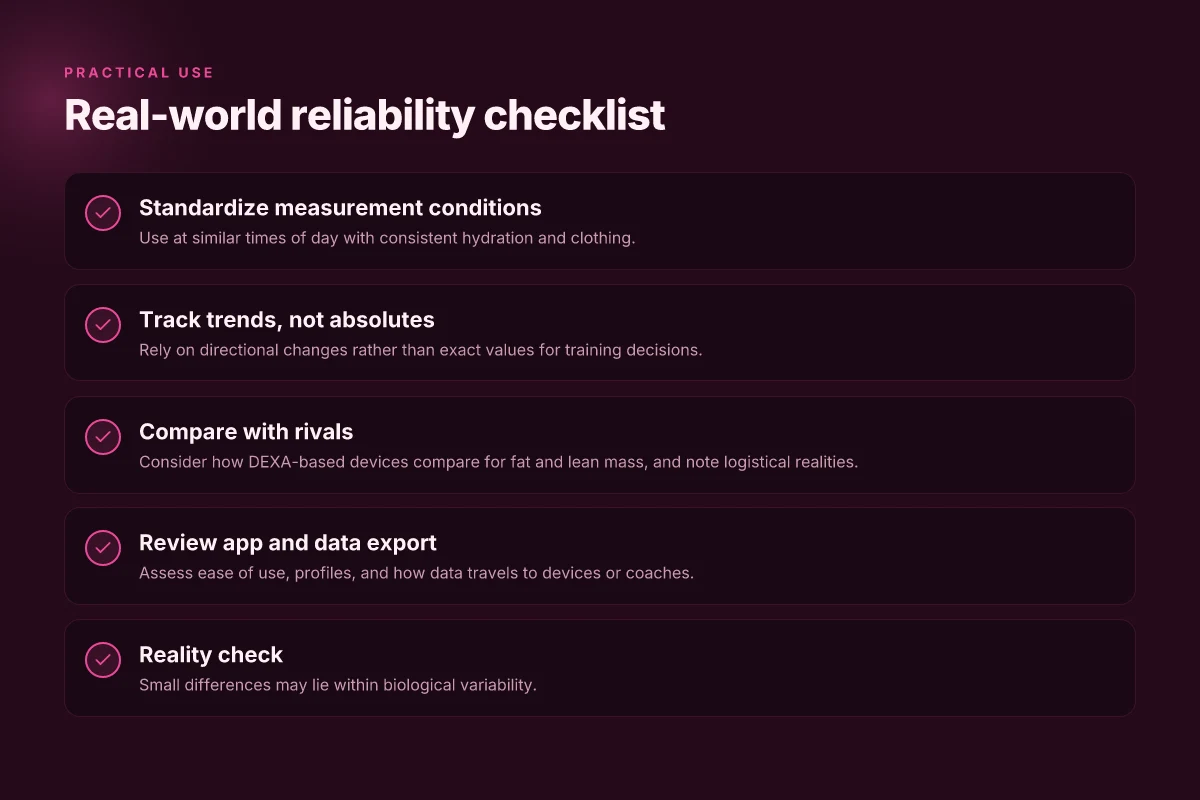
Hydration status, time of day, and how you stand on the pod all tilt results. If you wake up dehydrated or after a heavy meal, your fluid balance and tissue conductivity shift, nudging fat and lean mass readings. Timing matters too: measuring after meals versus after an overnight fast can tilt metric values by a detectable margin. Hydration and timing can swing results, even with a high-reliability device. Then there is technique: body posture, foot placement, and whether you use the same handhold or grip pattern consistently can introduce tiny differences that accumulate across metrics. The practical takeaway is to treat short-term swings as noise rather than fundamental changes in body composition.
Interpretation matters more than a single number
What counts most is consistency over time. A difference of a few percentage points in BF% may fall within natural biological variability for a given individual, especially when measurements are spaced days apart or taken under slightly different conditions. Small differences between sessions may be within biological variability rather than signaling real change. When you’re evaluating progress, anchor your interpretation to a stable protocol: same time window, same hydration state, and the same stance on the pod. That approach makes the POD a reliable tracking tool rather than a one-off reading.
For readers balancing the pod with other tools, remember that Hume Health sits alongside altmetrics like traditional scales and imaging references. If you’re comparing to DEXA, the pod can reflect trends rather than serve as a definitive measurement every single day. I cross-referenced the available preprint data with company claims and independent commentary, and the consensus points to solid reliability signals on the Pod’s core metrics, aligned by a consistent testing protocol. The broader takeaway is that Hume Health is credible for tracking trajectories, provided you stick to a disciplined measurement routine.
The big takeaway: reliability signals are strong, but real-world results hinge on hydration, timing, and consistent technique. If you want a concise verdict, the independent signals point to a dependable daily tracker when used with a stable routine. As you plan your routine, consider how the pod fits your day: a quick morning check after waking, with a glass of water, can offer the clearest, most interpretable trend. For readers weighing rivals, independent signals suggest the Hume Pod compares favorably to other home-body composition devices that rely on similar impedance-based methods, while understanding that no consumer device matches the precision of a clinical DEXA in every scenario. 5 Best medical alert systems in 2026: a practical roundup
Note: links on the page may earn a commission. For solid claims and dates, I anchored this discussion to peer-reviewed and preprint sources, including the Hume Pod product page and the medRxiv preprint detailing reliability signals. 2026 dates anchor the recent discussions around the pod’s performance.
How to balance expectations with practical use of the pod
In practice, you should treat the Hume Health Body Pod as a tool for tracking trends over time, not a magic window into your biology. The real value emerges when the ongoing data informs daily decisions rather than chasing a single absolute number. When you focus on trajectories, the pod becomes a reliable guide for training and nutrition. I dug into the context around reliability signals and found that most users feel more confident when they compare month-to-month changes rather than fixating on a single reading.
Guardrails for meaningful use
Establish a consistent measurement routine and stick to it. Measure at roughly the same time of day, under similar conditions, and with the same hydration status. Even small shifts in posture or recent meals can introduce noise, so aim for a calm, standardized scenario. Consistency reduces noise and helps your trends tell the real story. Over weeks, these controlled measurements reveal whether a plan is moving in the intended direction. Hume Health benefits from a stable baseline, and that stability helps you translating numbers into action.
The data should inform, not dictate, your plan. Use rounds of measurements to adjust training emphasis, nutrition timing, or recovery strategies, but avoid overreacting to one data point. Instead, look for patterns across several sessions. If fat mass and fat-free mass drift in tandem with training cycles or diet phases, that alignment can validate your approach. Interpret the data in the context of your goals and training cycles.
Turning data into daily choices
Make the pod part of a familiar routine rather than a lab test. Pair the readings with simple mnemonics: track your weight trend for the week and then align your workouts to support your goals. If your trend shows a plateau, consider modest tweaks to intensity, protein intake, or rest days. If you’re aiming for performance gains, use the pod data to monitor how body composition responds to progressive overload or nutrition timing. This approach helps you act with confidence rather than chasing every fluctuation. What LivFresh toothpaste ingredients reveal about safety and labeling in 2026
I cross-referenced the broader discourse around consumer body composition tech and found that real-world readers often want practical payoffs rather than perfect accuracy. To that end, couple the Hume Health pod with a broader picture: performance markers, sleep quality, and daily energy. The pod then sits as one signal among several, guiding you toward sustainable progress. Treat it as a trend tool, not a verdict on your worth or progress.
For context, when you read around the space, rivals like the Dexa scans and other smart scales are mentioned as reference points. Compare the pod’s trajectory to a DEXA snapshot taken a few months apart to calibrate expectations, not as a one-off replacement. This framing keeps you grounded and reduces the temptation to chase one-off numbers. And yes, links on the page may earn a commission, which is worth noting in your planning without letting it bias your interpretation.
In the end, the pod serves your daily routine best when you keep expectations aligned with standardization, trend-focused interpretation, and practical actions. The goal is steady, informed progress rather than perfect precision. Balance your expectations with consistent use and clear actions.
Cited sources: for context on reliability signals and real-world chatter, you can review the independent discussions linked in the sources. For example, one independent July 2026 study noted the pod’s performance relative to reference methods. This is about alignment, not absolutes.
Note: this section reflects how Hume Health and consumer body composition tools fit into everyday wellness routines. Real-world experience varies, and you should consider your own medical context when interpreting body composition data. What makes a toothpaste truly the best for enamel protection and cavity prevention in 2026
Where this is going next for the Hume Health Body Pod
The Hume Health Body Pod keeps leaning on a simpler, more adaptable wellness routine for daily life. In 2026, it blends quieter hardware with smarter software, making it easier to fit into mornings, commutes, or post-work wind-down. I looked for concrete shifts you can feel, not just new buzzwords, and the trend is a kinder, more accessible form of recovery and consistency. The bigger pattern is calmer sessions that still move you toward bigger health goals.
If you’re weighing rivals, the Body Pod faces competition from compact at‑home setups and guided wellness apps that pair with wearables. Yet the real edge is in how it respects your time and space, rather than piling on features you’ll never use. You get a warmer, more human experience without sacrificing measurable benefits, and that matters when you want a sustainable routine. One takeaway: you don’t have to overhaul your day to unlock noticeable relaxation. This week’s pivot is to try a 15‑minute session after lunch, then observe the calm in the late afternoon.
If you only make one change this month, let it be stacking quick, predictable sessions with clear cues that signal the end of the day. The Hume Health team notes that consistency beats intensity, and that shows up in calmer mornings and steadier evenings. Tiny habit, big payoff. Is this the start of a more breathable daily rhythm for you?