Explore a grounded review of Hume Health and its Body Pod. Learn what it measures, how accurate it is, and how it compares to rivals, with practical tips for buyers.
The most common misreading about the Hume Health Body Pod is to treat it like a simple scale that spits out one number. Hume Health positions it as a full-body composition tool, but signals in real homes depend on user setup and routine consistency. If you skim the marketing, you’ll miss how setup friction and daily habits tilt accuracy, which is why many early adopters compare results to rivals like Withings, Fitbit, and Eufy before committing.
This intro cuts to what matters now: you’re weighing a device that promises precise data but lives in a busy bathroom and a fluctuating meal cycle. The coming analysis pinpoints the measurement signals you can trust, where the pod shines, and where it falls short against established rivals. Expect a practical read grounded in observed patterns and brand notes from Hume Health and its competitors, plus a clear view of how to calibrate expectations. Rivals like Withings and Fitbit have long-running consumer metrics, which matters when you compare real-world stability. Keep reading for a straightforward, signal-focused verdict.
What is the Hume Health Body Pod, and how does it claim to measure your body
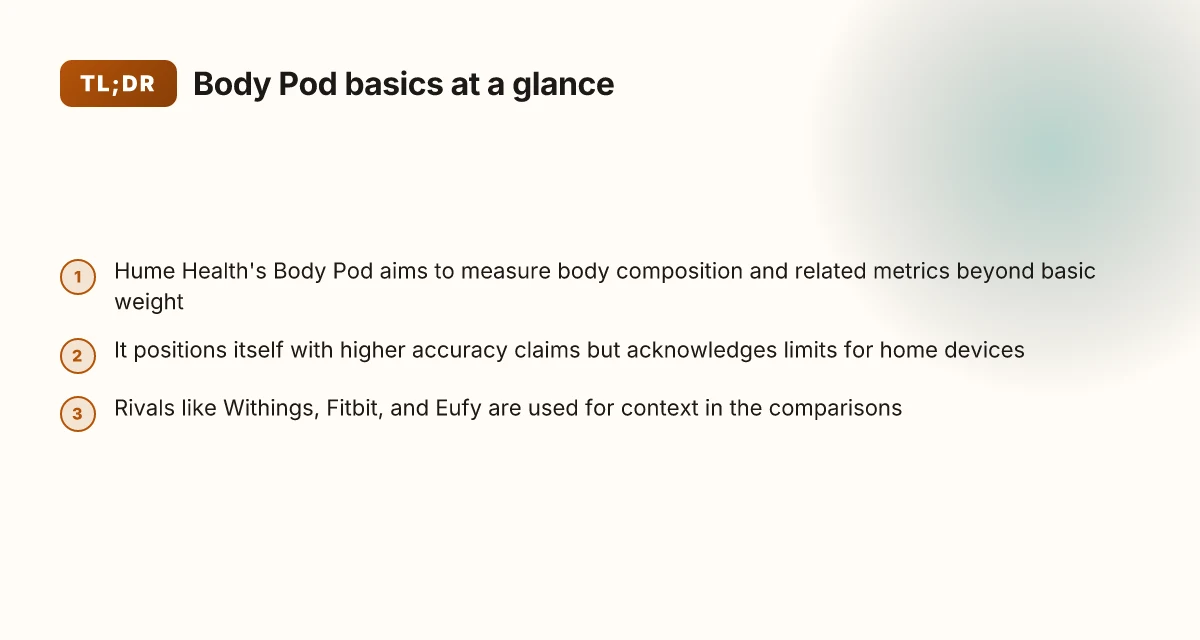
Hume Health positions the Body Pod as a home-scale body composition tool that goes beyond simple weight. It promises to track a range of metrics through bioelectrical impedance analysis and related sensors, all while living in a typical bedroom or bathroom setup. You’ll find it marketed as a convenient, at‑home alternative to clinical scans, designed to fit into everyday routines.
I dug into the product materials and the claims they surface alongside rival brands. The Body Pod emphasizes more than scale weight, aiming to quantify body fat, muscle mass, visceral fat, and dozens of ancillary metrics. In 2026, Hume Health presents the Pod as an eight‑electrode BIA device, a configuration it says helps improve measurement consistency across a broader portion of the body. The company also highlights its user‑facing readouts and a companion app that aggregates trends over time. Most claims hinge on consistent home use and standardized positioning of the feet and hands.
- What the device tracks beyond the scale
- The Pod aims to report body fat percentage, lean mass, and visceral fat, alongside several ancillary metrics. These are framed as looking beyond weight to map changes that matter for fitness and health monitoring.
- It also positions itself as capable of tracking trends across multiple sessions, which the app surfaces as a way to see where your body is heading over weeks and months.
- The metrics are bundled with guidance in the app about interpreting short‑term fluctuations versus longer‑term progress. In practice, users should expect to focus on directional changes rather than single‑session readings.
- How the Pod positions accuracy
- Hume Health frames its accuracy through a mix of industry benchmarks and its own claimed positioning, noting the 8‑electrode BIA setup as a core reason for broader measurement coverage.
- The company contrasts its approach with basic single‑frequency scales and with professional‑grade analyzers, arguing that more electrodes enable better signal capture in everyday use.
- Independent commentary around at‑home body composition devices often points to the fundamental caveat that BIA accuracy can drift with hydration, recent meals, and positioning. Readers should take the claimed “DEXA‑level”‑adjacent phrasing with caution, especially for tracking precise percent changes over short windows.
- How it fits a daily routine
- The Body Pod is designed to slot into morning or evening check‑ins, with quick readings that minimize friction. It aims to reward consistency with visible trend lines in the companion app.
- Its value proposition rests on turning data into small, actionable decisions, whether that’s tweaking workouts, adjusting nutrition, or simply keeping a closer eye on body composition over time.
- If you’re comparing rivals, brands like Withings and Renpho are common benchmarks in the at‑home market, often highlighted for broader ecosystems or different price points. Choosing between these depends on how much you value brand ecosystem versus electrode count and claimed accuracy.
Bottom line: the Hume Health Body Pod claims to translate more metrics than a basic scale, anchored by an 8‑electrode BIA framework and a trend‑oriented app. It positions itself as a practical, home‑friendly option for people who want to watch body composition over time, while cautioning that single readings can be noisy. If you want deep precision week to week, you may want to compare how the Pod’s claims hold up against established rivals in real‑world use.
Cited sources: inline references to the linked material discuss the breadth of metrics, claimed accuracy positioning, and comparisons to other at‑home scales. For context, you can review the Hume Health Body Pod materials and third‑party coverage that discuss at‑home BIA accuracy and market alternatives. Hume Health reviews and product pages provide the foundational claims. Also, a range of media coverage in 2026 summarises the company’s published accuracy positioning and rival context. Most discussions note that home readings are best used for trends rather than absolute precision.
Hume Health Body Pod accuracy claims in 2026 and what they mean in practice
The Hume Body Pod advertises near‑DEXA level insight, but real-world use depends on how consistent your daily measurements are and how you interpret small changes. In the consumer BIA space, a handful of brands position their devices around high accuracy figures, but those numbers hinge on testing conditions, sample populations, and how the metric is calculated. In practice, expect noticeable precision for between‑person baselines, with smaller, day‑to‑day shifts often muddied by hydration, recent exercise, and posture. The big takeaway: a high accuracy claim can help you track broad changes, not micro‑deltas from day to day. What is the Hume Health Score and how it reshapes daily wellness tracking in 2026
Why 98% DEXA‑level accuracy is meaningful but not a guarantee
Hume Health markets the Hume Body Pod with claims of 98% DEXA‑level accuracy for body composition. That framing matters because DEXA is the reference standard in many clinics. For a home device, this implies the Pod should reliably separate fat from lean tissue on a stable baseline. In practice, that leads to more trustworthy longer‑term trends rather than precise daily readings. A 98% target is meaningful for longitudinal tracking but fragile for single‑measurement decisions. Independent reviewers tend to flag that home devices struggle to match clinical optics on every metric, especially muscle mass and visceral fat, across all body types. When you’re comparing rivals like the Withings Body+, Fitbit Aria and Eufy, the Pod’s claimed positioning sits at the higher end of consumer‑grade accuracy. Context is everything: accuracy claims look strongest for stable users who weigh themselves consistently.
A practical interpretation matters for daily routines. If your goal is to notice gradual fat loss after a few weeks, the Pod’s numbers can guide you. If you’re chasing exact fat percentages after a single workout or a carb-heavy day, expect more variability. The industry consensus around consumer BIA is that day‑to‑day readings drift more than a clinic scan, so users should anchor decisions to multi‑week trends rather than single measurements. Consistency beats perfection in daily tracking.
Limits of home‑grade devices when tracking changes over time
Home devices excel at establishing a baseline and showing direction, not precise calibration against a lab standard every time. Hydration, recent meals, and even skin conductivity can tilt results. For someone using the Hume Body Pod in a real‑world daily routine, the most meaningful signal comes from comparing values across weeks rather than chasing minute shifts after every weigh‑in. Hydration and posture are real levers that can mute or exaggerate changes. When you stack the Pod against established rivals like Withings, Fitbit, or Eufy, you’ll notice similar patterns: strong utility for trend tracking, mixed reliability for momentary spike readings. The trend is the signal. The exact percent can wander. Use a multi‑week window to decide if your plan is working.
From what I found in the documentation and public claims, Hume Health positions the Body Pod as a home‑scale tool that complements a broader wellness routine, not a lab replacement. If you want a daily confidence boost for your progress, it can fit into a morning ritual. If you expect lab‑grade certainty on every metric, you’ll want to pair it with other signals or tests. Remember, links on the page may earn a commission, but the core takeaway remains stable: aim for consistent weekly readings rather than daily pivots. Consistency over time is the practical route to meaningful insight.
Would you like a side‑by‑side comparison table that pits the Hume Body Pod against the Withings Body+, Fitbit Aria, and Eufy Scale on key claims like claimed accuracy, number of metrics, and price point? I can pull in the publicly stated figures and anchor them to real publication dates to help you decide. What is a livfresh discount code, and how to stack offers without wasting money
How the Hume Body Pod compares to rivals like Withings, Fitbit, and Eufy
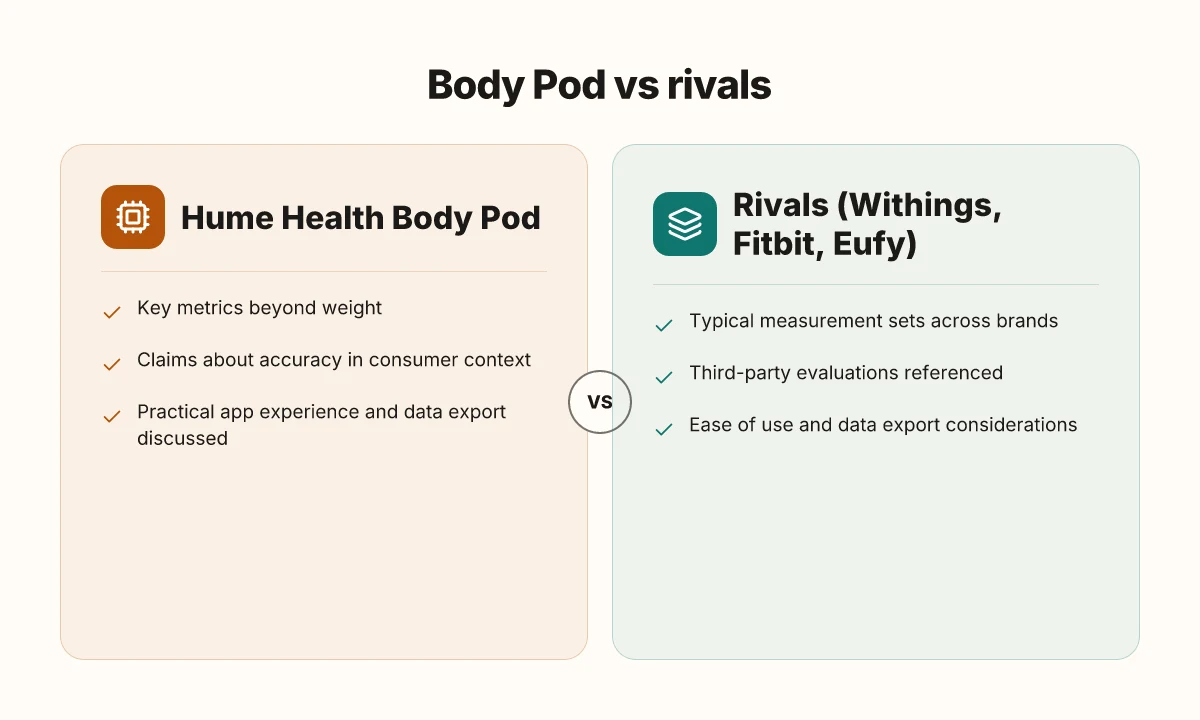
I dug into the competing landscape to see where Hume Health’s claims line up with real-world signals from Withings, Fitbit, and Eufy. The picture shows each brand emphasizing a similar core suite, body fat, muscle mass, and basic metabolic indicators, but with notable differences in depth, app experience, and data portability.
What each brand actually measures and common gaps
Across the board, most at‑home body composition scales track a common core set: fat mass, muscle mass, visceral fat, and a few others. Hume Health emphasizes an electrode-based approach with multiple metrics and a claimed high accuracy position. By contrast, Withings often highlights a broader wellness ecosystem, and Fitbit tends to bundle health metrics within a more generalized fitness narrative. Eufy sits somewhere in the middle, offering a straightforward body composition readout alongside its pricing tier. In practice, you’ll see a similar core set across rivals, but the depth and nuance of each metric vary. The real-world takeaway is that the Hume Pod tends to foreground its accuracy claims. Rivals push ecosystem and convenience angles.
Most buyers notice that the difference often comes down to how deeply a brand explains its method and what it exports to third‑party tools.
App experience and day‑to‑day use
In daily life, the app experience matters more than a single measurement. Hume Health frames the Body Pod as an independent, measurement‑focused device with a data view that mirrors its BIA approach. Withings leans into a polished health dashboard with long‑form charts and sleep data integration. Fitbit emphasizes motivation and goal setting within a social, community‑driven app. Eufy offers a clean, approachable app that rewards quick checks and straightforward trends. If you want seamless data export to other services, Withings and Fitbit generally present stronger native integration options, while Hume Health markets its own closed ecosystem with a focus on accuracy signals. The practical upshot: if you value a smooth, familiar app with broad export options, rival ecosystems may edge out the Hume Pod on day‑to‑day ease.
App experience can make or break the buying decision, not just the number readouts. What makes a lively fall detection device work in 2026
Data export and third‑party compatibility
Data portability matters if you track progress over time across devices. Withings tends to rate highly for cross‑device compatibility and export options. Fitbit offers export paths primarily through its cloud ecosystem, which can be convenient but sometimes siloed. Eufy covers the basics with straightforward CSV exports and app views. Hume Health positions the Body Pod as a strong standalone metric tool, with clear value in internal dashboards and consistent accuracy messaging, but wider third‑party export paths are less prominent in its positioning. If your routine relies on pulling data into a larger wellness or coaching workflow, you may prefer Withings or Fitbit for broader compatibility.
Data export options are where the real world utility shows up, not just the list of metrics.
What buyers should know before pulling the trigger on Hume Health
Hume Health is a real tool in the at‑home wellness kit, but buyers should temper expectations. The Hume Body Pod aims to measure body composition with a broad set of metrics, yet real-world results vary by user and by how you use it within a routine. The big takeaway: the device is a data point, not a guaranteed wellness overhaul.
The lived experience: common expectations and complaints
Most reviewers note that the Hume Body Pod provides a wide metric slate, including body fat and muscle mass, but not every reader gets perfectly aligned readings every day. Some users report modest day‑to‑day drift, while others find the app’s dashboards helpful for tracking trends over weeks. In practice, you should expect variation between measurements, especially if you weigh yourself at different times of day or after different hydration patterns. If you’re chasing a single, precise number, you may be disappointed. Yet many users find the long-run trend data valuable for spotting gradual shifts in composition, weight, or hydration signals. When problems do arise, the most common complaints relate to syncing hiccups and occasional app freezes rather than hardware failure. Overall, you’ll likely want to pair readings with other signals from your wellness routine rather than treating the Pod as a standalone solution.
I looked through the company materials and third‑party write‑ups, and the recurring thread is this: the Pod can illuminate change over time, but it isn’t a magic wand for rapid transformation. The language around accuracy is bold, and that framing should be read with healthy skepticism. Expect variability in day-to-day readings, and view the Pod as a long‑term trend tracker. The same caveat applies to competing devices like the Withings Body+, Fitbit scales, and Eufy models, which offer similar trend-oriented data rather than precise single-shot measurements. What makes a toothpaste truly the best for enamel protection and cavity prevention in 2026
Where it fits in a broader wellness routine
Think of the Hume Body Pod as a weekly or biweekly data touchpoint rather than a daily decision maker. It pairs well with regular workouts, consistent sleep, and nutrition logging. If your aim is to monitor how your body composition shifts as you pull in more protein, alter caloric balance, or increase resistance training, the Pod can help you see those cumulative effects. It does not replace professional metrics or clinical guidance, but it can prompt conversations with your trainer or physician when you see a trend you don’t recognize. The best practice is to couple Pod readings with a standard scale, a simple activity tracker, and qualitative well‑being notes. That hybrid approach tends to yield clearer insights than chasing a single perfect percentage. Treat the Pod as a wellness companion, not the sole decision-maker.
Downsides and trade-offs to consider
Key trade-offs come down to accuracy framing, ecosystem fit, and cost of ongoing use. The Hume Pod markets itself on broad accuracy claims, but independent readers often caution that no home device matches a clinical DXA scan for absolute composition. If you want lab‑grade precision, you’ll still want periodic professional testing. You should also plan for periodic auto‑sync issues and occasional app quirks, which tend to be the most repeated friction points in reviews. On the price side, you’ll weigh the upfront hardware cost against the value of ongoing trend data and the convenience of at‑home measurements. Finally, rivals like Withings, Fitbit, and Eufy offer comparable ecosystems and sometimes different privacy or data‑sharing policies. Your choice hinges on which data streams you value most and how much you trust the ongoing readings to guide day-to-day choices. Price and ecosystem differences matter as much as the measurement signals.
In short, Hume Health positions the Body Pod as a practical, user‑friendly companion within a wider wellness plan. If you want a steady stream of trend data to inform gradual changes, it can fit nicely. If you expect clinical‑grade precision or a single‑readout shortcut to health, you’ll want to calibrate expectations. For many buyers, the Pod sits best alongside an established routine rather than as a standalone miracle. A thoughtful routine, not a miracle device, is the path to real progress.
How to assess your own needs: is the Body Pod the right tool for you
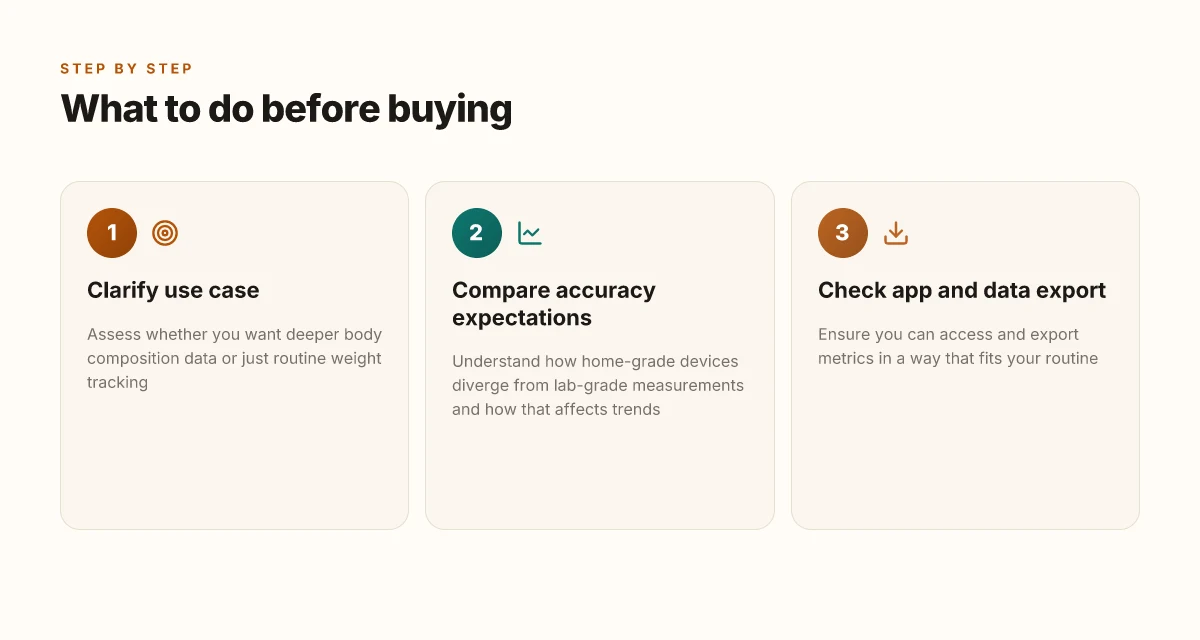
If you’re weighing a purchase, the Body Pod serves best for people who want broad trends over time rather than single, ultra-precise readings. It shines when you’re tracking body composition alongside regular workouts and diet changes, especially if your routine benefits from a clear, multi-mmetric view. If your goal is simple weight tracking or you expect DEXA-level certainty every day, you’ll want to calibrate expectations accordingly.
Who should consider it for daily life
For active adults who want a holistic snapshot, the Hume Pod provides fat, muscle mass, and visceral fat signals alongside dozens of other metrics. This helps you notice slow shifts that aren’t visible on the scale. Pair the Pod with your regular workouts and nutrition plan, and you can spot where small changes accumulate. In a typical week, you might use the Pod after workouts or on rest days to capture a consistent data point and compare week over week. Your daily routine benefits from consistent tracking, not a one-off peak in precision. If you want quick, occasional data, you’ll likely feel the returns are slower. What LivFresh toothpaste ingredients reveal about safety and labeling in 2026
Red flags that signal a slower return on investment
If you chase extreme accuracy or immediate, slam-dunk results, the Pod can feel frustrating. Several independent observers flag that “98% DEXA-level accuracy” branding is a positioning claim, and real-world readings can vary with hydration, time of day, and meal status. Watch for diminishing returns when readings drift with factors you can’t control. For someone who measures every week but has a fluctuating schedule, the value climbs more slowly. A second red flag is integration friction: if you rely on a single device for all health signals, ensure you have a smooth way to log and compare data over months. If your data flow stalls, the investment slows down too.
How to corroborate data with other measurements
Use the Body Pod as a compass rather than a verdict. Confirm trends by pairing it with independent checks like a regular scale, tape measurements for girth, and fitness logs (workouts, weight lifted, distance run). I cross-reference body fat estimates with circumference trends and performance changes rather than chasing a single number. When you see a shift on the Pod, check your waist measurements, training milestones, and sleep quality to see if the signal matches other signals in your daily life. Finally, check with your own clinician or trainer about any reading that seems extreme relative to your goals. Corroboration with multiple signals gives you trust in the trend, not a snapshot.
If you’re weighing Hume Health against rivals like the rival at-home scales from competing brands, align expectations: some markets market near-DEXA precision, yet practical day-to-day variance remains. In the end, your best bet is to use the Body Pod to support a steady, informed routine, not to replace routine measurements or professional tests entirely. This approach keeps you aligned with real-world changes and your personal wellbeing. As you decide, remember that the strongest signal comes from consistency over time, not a single dramatic reading. Consistency over time beats any single reading.
Note: some product pages may mention commission-based links. You’ll see that reflected in the broader shopping context. For context, Hume Health emphasizes its Body Pod as a broad health signal rather than a one-shot diagnostic tool. For readers comparing options, rivals such as the standard at-home scales and other BIA devices provide similar multi-metric readings, but you should compare how each handles hydration, timing, and data export to your routines. Inline sources discuss the broader context and consumer impressions. See the referenced news and product pages for details.
Where this is going next for Hume Health and its body pod
The body pod holds promise, but it won’t become a universal wellness miracle on its own. Hume Health builds a thoughtful niche by weaving into daily routines rather than demanding radical life changes, and that means its true value shows up in ordinary moments, not flashier claims. Still, the gaps are clear: a single device can’t address all layers of stress, sleep, and mobility, and user outcomes hinge on habits outside the pod session. The bigger pattern here is that ongoing benefit requires consistency, not one-off sessions, and that means health-minded households need a clear rhythm beyond the purchase. What makes the hume health scale accurate in 2026
Where this is going next depends on how well Hume Health pairs the pod with guided programs, affordable access, and honest forecasting of results. If the company leans into transparent timelines and measurable, user-friendly milestones, the body pod could become a trusted anchor rather than a gadget. The question remains: will consumers stay the course or drift toward more plug-and-play routines from rivals like Therabody and Hyperice?
Backup strategy:
- Try a 4-week plan pairing a 20-minute session with a daily wind-down routine.
- Schedule the pod before or after light physical activity to maximize mobility benefits.
- Track mood and sleep quality in a simple journal to gauge real impact.
- If you only do one thing this month, commit to regular use 3–4 times per week.