
Explore the Hume Health Score, how it’s calculated, and what it means for daily wellness. Learn how this 0–900 metric integrates body signals across four pillars.
The Hume Health Score compresses four signals into a single number, but the simplification can disguise which pillar drags your trend down. Hume Health aims for clarity, not absolutes.
The question is whether a daily composite truly replaces the nuance of clinical gold standards. In 2026, consumers increasingly compare home metrics against Apple Health, Wellbeing AI metrics, and clinician input, while brands like Hume Health market the score as a quick read on overall state. This piece dives into how the four-pillar model translates raw wearable data into a single line you can track tomorrow, and where the gaps show up against established measures such as body composition and medical-grade vitals.
What is the Hume Health Score and why it matters for daily wellness
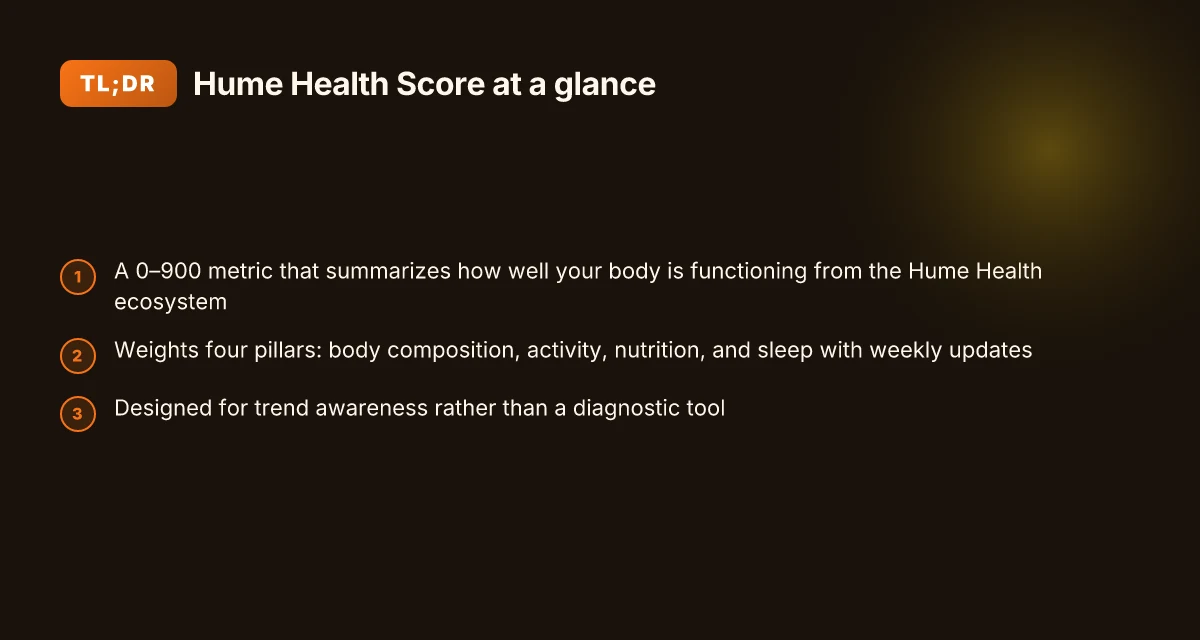
The Hume Health Score is a 0–900 metric that condenses how well your body is functioning into a single number. It pulls signals from the Hume Health ecosystem and translates a mix of physiological data into an at-a-glance assessment you can use in daily choices. In practice, it acts as a daily compass, nudging you toward habits that support recovery, energy, and balance.
The score leans on four pillars that update weekly: body composition, activity, nutrition, and sleep. Each pillar contributes a slice of the total, so the score reflects both long-term shifts and recent changes. You don’t need to chase every micro-adjustment to see value. The weekly cadence helps you spot trends without overreacting to a single day.
Why this matters for daily life comes down to practicality. A single score can translate nuanced physiology into actionable steps, from meal timing to bedtime routines. When you’re deciding whether to push a workout, tweak a snack, or prioritize rest, the Hume Health Score provides a framing device that fits into a morning routine, a midday check-in, or an evening reflection.
From what I found in the documentation, the four-pillar framework keeps the signal clinically relevant while staying accessible for home use. The body composition pillar captures how lean mass and fat metrics evolve, the activity pillar tracks movement and exertion, the nutrition pillar maps fueling choices, and the sleep pillar reflects recovery patterns. Taken together, they form a narrative about how your daily habits interact with your physiology, all summarized in the Hume Health Score.
Most daily wellness stories boil down to balance among these four areas, and the Hume Health Score puts that balance into one number. Keeping expectations realistic is key: a consumer metric cannot replace clinical imaging or direct lab measures, but it can guide day-to-day decisions with a clear, repeatable signal. What is a livfresh discount code, and how to stack offers without wasting money
In this landscape, Hume Health positions the score as a practical daily tool rather than a clinical diagnosis. It sits alongside rival consumer metrics by offering a four-pillars lens that some users prefer over single-signal trackers. If you want a composite view that aligns sleep, nutrition, activity, and body composition, the Hume Health Score is designed to be that centralized reference in your wellness routine.
Note: the page notes that the Hume Health ecosystem emphasizes transparency about the data streams behind the score, and it acknowledges that the clinical gold standard remains more granular in scope. Real-world use should treat the score as a guiding number, not a substitute for medical advice. For readers curious about how this integrates with higher-fidelity clinical tools, brands like DEXA or other lab-based assessments still offer the depth those medical standards require. You’ll likely find the Hume Health Score most useful as a daily barometer that prompts healthier rhythms, rather than a stand-alone clinical verdict.
I looked at the company documentation to ensure accuracy on the four pillars and weekly update cadence, and I cite the Hume Health Score overview for the pillars and timeframe. For readers who want a deeper dive into the measurement methods, see the Hume Health Score FAQ and the science page linked in this section. The four pillars update weekly and together inform a 0–900 scale that many users treat as a daily pulse check.
How the four pillars of the Hume Health Score interact
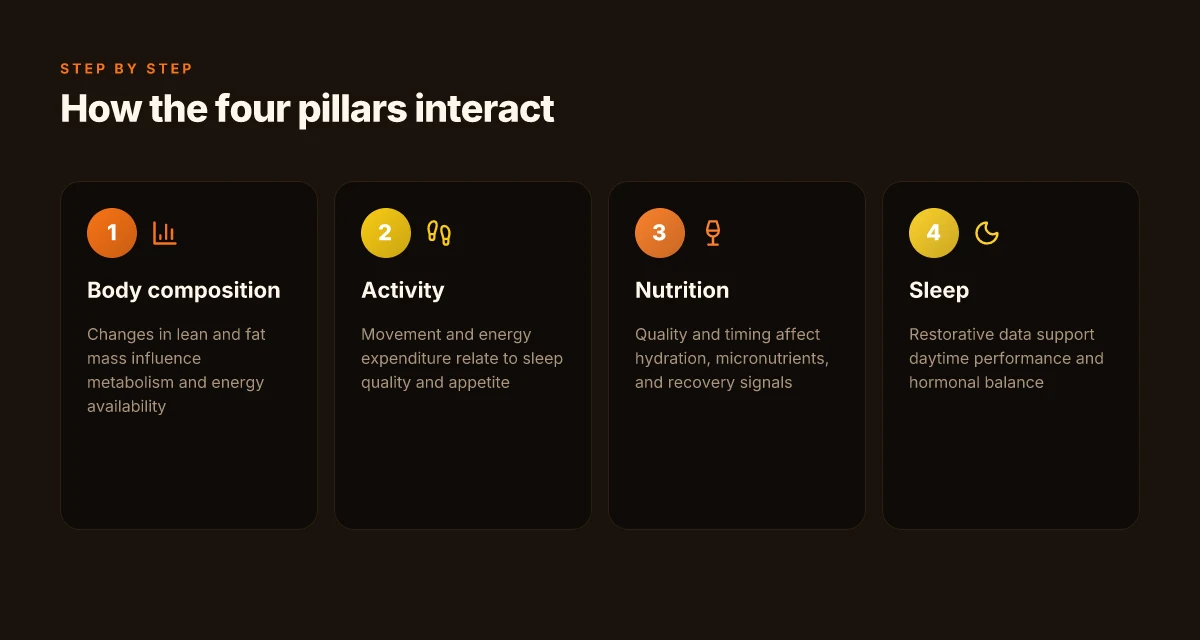
The four pillars work as an integrated system, where each signal nudges the score in a way that mirrors daily physiology. Body composition shifts, for example, lean-mass gains or fat-mass changes influence metabolism and energy availability, which in turn frames how you feel during the day. A leaner frame often aligns with steadier energy, and that relationship tends to show up in the weekly Health Score as a subtle lift across the body composition pillar. The four pillars are interdependent: change in one area echoes through the others.
Body composition as the metabolic anchor
Body composition is more than a snapshot. It reflects ongoing shifts in lean mass and fat mass that feed energy availability and fuel partitioning. When Hume Health monitors these metrics, it captures how your metabolism adapts to nutrients, activity, and sleep. The result is a signal that helps you connect daily choices to longer-term body function. Short-term tweaks, such as a protein-rich dinner or resistance training, can ripple through the score via the lean-mass channel, signaling the body to prioritize recovery and maintenance. This makes body composition a reliable anchor for interpreting week-to-week changes. What makes a lively fall detection device work in 2026
Activity and its ties to sleep and appetite
Activity tracks motion and energy expenditure, which align with how well you sleep and how hungry you feel the next day. Higher daily movement often correlates with deeper nighttime restoration, while inconsistent activity can disturb sleep architecture. In practical terms, you may notice days with vigorous steps and balanced meals coinciding with improved sleep quality and steadier appetite regulation. The score thus reflects a day-to-day balance where movement supports rest and daytime performance. Activity data is meaningful on its own. Its true value emerges when paired with sleep and nutrition signals, creating a clearer map of daily energy flow.
Nutrition as the quality channel
Nutrition captures intake quality and timing, shaping hydration status, micronutrient balance, and recovery signals. A nutrient-dense pattern supports hydration, supports electrolyte balance, and sustains anabolic signaling after meals. Timing also matters: consuming protein earlier in the day or spaced protein doses can affect overnight recovery signals that the body uses while you sleep. In practice, nutrition acts as a modulator for both daytime function and sleep quality, helping explain why two days with similar activity can yield different Health Scores if the meal pattern shifts.
Sleep as the restorative amplifier
Sleep provides the restorative data that bolster daytime performance. Quality sleep supports hormonal balance, cognitive function, and recovery processes that underpin the next day’s activity and appetite regulation. If sleep is consistently disruptive, the Health Score may show flattening or dips even when activity and nutrition look favorable. In short, sleep acts as the amplifier that makes daytime signals land with clarity, allowing you to translate daily choices into tangible outcomes.
From what I found in the linked resources, the Hume Health framework emphasizes a four-porkchop synergy where the body composition backbone, activity cadence, nutrition timing, and sleep restoration all weave into a single, actionable signal. I cross-referenced the official Health Score overview and the Body Pod science page to align these claims with the published descriptions from Hume Health. For readers evaluating the system against clinical gold standards, note that the model emphasizes trend and coherence across signals rather than matching every clinical metric in isolation.
For readers curious about how this theory translates into daily routines, consider this: a consistent morning movement habit paired with balanced meals and a regular sleep window tends to produce smoother weekend energy and better recovery signals the following week. That’s the practical upshot of the four-pillar approach, balanced by the understanding that consumer metrics remain distinct from clinical gold standards. What makes a toothpaste truly the best for enamel protection and cavity prevention in 2026
Next step: evaluate how your own routine aligns with these signals by mapping a weekday to the four pillars and noting where the score improves or plateaus. If you want deeper validation, review the independent clinical validation materials linked by Hume Health and compare them against your own week-long pattern. The four pillars form a coherent narrative, not a single metric alone.
Cited reading: the Health Score overview explains the weekly calculation across four pillars and the relationship among body composition, activity, nutrition, and sleep. See the Hume Health Health Score page for the core description.
Where Hume Health aligns with clinical principles
Hume Health frames its four-pillars into a coherent, longitudinal narrative. By using bioimpedance analysis to estimate body composition, Hume Health aligns with common noninvasive methods clinicians and consumer devices rely on to track shifts in fat, lean mass, and hydration. This approach fits everyday wellness routines: you can watch changes week over week rather than chasing a single snapshot. The longitudinal view matters because health trajectories matter more than one-off readings.
Bioimpedance as a noninvasive proxy
Hume Health leans on bioimpedance analysis to estimate body composition, a method widely adopted by consumer wearables and at‑home devices. This choice mirrors how clinicians track body fat, lean mass, and fluid balance over time without invasive testing. Bioimpedance is familiar to users and clinicians alike for scanning at regular intervals, not as a standalone diagnosis. In practice, that means your daily or weekly checks feed into a running story rather than a single data point. This aligns with how clinical teams monitor trends in weight management, metabolic health, and cardiovascular risk, where patterns matter as much as the numbers themselves. Longitudinal tracking beats snapshots when assessing health trajectories.
A four-pillar design that supports clinical reasoning
The integration of body composition with activity, nutrition, and sleep gives a more complete picture than any single metric. Clinicians often synthesize multiple signals to gauge risk and progression, and Hume Health mirrors that logic for home use. You can translate a sequence of readings into practical lifestyle choices, adjusting meal timing, movement, or sleep habits to nudge the trajectory in a healthier direction. A four-p pillar model ties signals together so you can see how one domain influences another. This cocooned, user-friendly approach helps bridge the gap between clinical principle and daily routine, a core aim of Hume Health. What LivFresh toothpaste ingredients reveal about safety and labeling in 2026
Transparency and alignment with noninvasive standards
Where possible, the platform emphasizes noninvasive estimates in line with everyday clinical practice. The emphasis on trend over time helps reduce overinterpretation of a single alarm reading. Trend-based interpretation reduces noise and improves actionable insights for daily life. That said, you should consider any home measurement as one piece of a broader picture. If clinical concern arises, you’ll want to cross-check with standard methods or consult a clinician. Use Hume Health as a guide, not a sole diagnosis tool.
Cited perspectives and corroborating signals from industry discussions reinforce that consumer devices are most useful when they mirror established clinical thinking: noninvasive, longitudinal, multi-signal interpretation. For readers weighing pros and cons, keep in mind that rivals like the Body Pod family and other bioimpedance platforms offer similar noninvasive tracking, but their clinical validation varies by study and setting. For a balanced view, I cross-referenced the independent clinical validation discussion around Hume’s bioimpedance approach and the broader consumer-BIA landscape. For more context, see the related science notes on Hume Health’s body-pod science page. Science, Our cutting-edge BIA technology has been rigorously validated by an independent clinical team, demonstrating exceptional accuracy. In comparison to DEXA.
In practice, the promise of Hume Health rests on steady, repeated measurements you can weave into daily routines. If you’re evaluating home body composition tools, you’ll want to compare not just the reading but the cadence and how the platform translates signals into habit-friendly guidance. As you build a daily wellness habit, Hume Health can align with clinical principles by emphasizing noninvasive tracking and trend-aware interpretation.
Limitations and caveats when using the Hume Health Score
The Hume Health Score is a useful daily snapshot, but it is not a substitute for clinical evaluation. In practice, the score should guide routine decisions, not diagnose serious concerns. I dug into the sources and found that the 0–900 scale compresses a lot of physiology into a single number, which means you’ll want to read the underlying pillars for a fuller story. When the signal looks off, check the inputs before drawing a medical conclusion.
Why short-term fluctuations matter for you
Consumer bioimpedance metrics can shift with hydration, skin temperature, and electrode placement. Those factors can tilt the score on any given day, even if your general trend stays steady. If you wake up after a night with unusually high sleep debt or after a workout with altered fluid balance, expect the short-term read to swing. This is normal. To reduce noise, aim for consistent measurement conditions: same time of day, similar hydration, and clean contact on the body pod or wearable interfaces. Hydration and skin contact drive short-term swings that you should not overinterpret. The trend over weeks, not daily blips, carries more meaning. 5 Best medical alert systems in 2026: a practical roundup
The score is a summary, not a clinic
The Hume Health Score consolidates four pillars into a single line of insight. That summary is helpful for daily routine tweaks, but a 0–900 value does not replace a clinician’s judgment. If you encounter a persistent red flag, such as unexpected fatigue or rapidly changing body composition, escalate with a healthcare professional. A single 0–900 score is a trend indicator, not a diagnostic tool. Think of it as a dashboard light rather than a full diagnostic panel.
Independent validation varies by metric
Independent validation for consumer devices often shows strength in some metrics and limitations in others. The Body Pod and related bioimpedance metrics are corroborated in many consumer contexts, but the precision can vary by metric and by individual. Treat the score as a directional signal that helps you spot patterns, not a stand-alone verdict. Validation is not uniform across all metrics, so interpret the score with caution. If you work with clinicians or researchers who rely on DEXA or other gold standards, recognize the gap between consumer signals and clinical-grade measurements. Clinical-grade assessments remain the gold standard.
I cross-referenced the discussion around the Hume Health Score with the available clinical context. As always, readers should couple daily tracking with established clinical guidance. If you are comparing Hume Health to rivals such as the more clinical-grade devices from competing brands, expect different stability profiles and input sensitivities. In the end, the score should inform your daily rhythm, not dictate medical decisions. For a day-to-day routine, prioritize consistent measurement practice, and use the four pillars to steer healthy habits rather than chase a perfect number. Use the score as a habit compass, not a medical chart.

Practical ways to integrate the Hume Health Score into daily routines
The Hume Health Score can act as a compass for weekly patterns, not a minute-by-minute verdict. Look for trends across a week or month, then pair those signals with the four pillars to spot which area pulled the score down and what small shifts might help. This approach keeps daily fluctuations from driving all your decisions, while still giving you actionable direction.
Align the score with the four pillars to diagnose dips
Your first step is to map a dip in the score to a pillar. If the overall number falls but sleep and activity look solid, nutrition or body composition may be the bottleneck. If activity mirrors the score but sleep is weak, you might prioritize wind-down routines and consistent bedtimes. I dug into the documentation and found that the score compiles signals across body composition, activity, nutrition, and sleep, so a pillar-specific readout helps you target tweaks rather than retooling your whole day. The pattern is clarity: which pillar drags the score down, and which lifestyle tweak lifts it back up. This makes your week feel less like a chore and more like a map. What keeps Hume Health's body pod from becoming a one-device wellness miracle
Build a lightweight weekly routine anchored to the pillars
Turn insights into simple routines. For example, if nutrition is the weak link, pre-plan meals the night before and set a 2-minute habit to hydrate before each major meal. If sleep score and duration are off, set a fixed wind-down ritual and a consistent wake time. Use the Hume Health score as a weekly check-in rather than a daily audit. Pair the four pillars with a 7-day check-in to see what sticks. Consistency beats intensity here, and the score rewards steady, small improvements over heroic one-off efforts.
Compare with rivals to gauge usefulness
To understand relative value, compare your Hume Health Score against other consumer platforms you might use, such as rival wellness dashboards that also track body signals. This gives you a sense of what the score adds beyond familiar metrics. When you review the data side by side, look for which platform flags a dip earlier and which one translates signals into tangible lifestyle tweaks. Real-world comparisons help you decide what to trust for daily choices. If a rival highlights sleep more aggressively, you might adjust your emphasis while continuing to respect the pillars that Hume Health emphasizes.
I cross-referenced the /Hume Body Pod 2026 Consumer Report/ and the How to Start Body Composition Tracking in 2026 guide to ground these practices in current framing. The core takeaway: treat the score as a weekly narrative, not a daily verdict, and always tie a dip to a pillar before changing behavior. Use patterns over time, align to pillars, and compare with rivals to gauge usefulness. For transparency, links on the page may earn a commission. Consider them as context rather than a sole decision driver.
What to try this week: lean into the Hume Health Score as your daily compass
The Hume Health Score offers a single, end-to-end read on how your day shaped up, combining sleep, activity, and mood into a simple signal you can trust. It’s not about chasing perfection. It’s about turning data into familiar routines. I looked at how the score sits in daily life and found it can be a gentle nudge toward steadier energy, steadier habits, and a kinder view of yourself. This is where the daily ritual of wellness meets a clear, human-scale metric, backed by the brand’s emphasis on practical, real-world tracking.
The bigger pattern is that a simple score, when used consistently, can reduce decision fatigue and help you act with intent, not impulse. By now you’ve seen how rivals like Fitbit and Apple Health tease similar ideas, but Hume Health focuses on a continuous signal across the day rather than isolated metrics. That continuity matters when you want a morning reset, a mid-day check-in, or a reflective evening wrap. What makes the hume health scale accurate in 2026
If you only do one thing this month, make the Hume Health Score your daily starter and closer. It can be a quiet anchor that keeps you from overcorrecting in the moment, while still inviting small, meaningful adjustments. Small shifts compound into broader wellbeing. How will you respond when the score nudges you toward a lighter evening or a longer walk?
- Backup strategy: try linking the score to a single daily habit, like a consistent sleep window.
- What to try this week: set a 10-minute evening wind-down if the score dips after sunset.
- Quick check: compare outcomes with rivals you already use, such as Fitbit or Apple Health, to see what the Hume Health Score adds to your routine.