
Explore Hume Health Body Pod reviews, accuracy claims, and how it fits into at-home health tracking. Learn what to expect in 2026 and how it compares to rivals.
The truth about the Hume Health Body Pod isn’t a clean, lab-grade miracle. It’s a practical at‑home tool that often channels accuracy into trend signals rather than exact measurements. A 98% DEXA-level claim raises eyebrows, but real-world users report drift with hydration and posture, which means you should treat its numbers as directional guides first and not gold standards.
This piece lays out where the promise meets reality, tying the Body Pod to how clinicians and biohackers actually use it today. You’ll see how traditional scans compare, when the at‑home readings align with lab results, and where it diverges enough to mandate a clinician’s interpretation. Expect concrete benchmarks, caveats about lineup rivals like InBody and Tanita, and a clear view of what to watch over two to three weeks. The goal is to decide if the device’s numbers fit your daily routine or if you lean on a trusted lab for confirmation.
What the Hume Health Body Pod promises and what it actually delivers
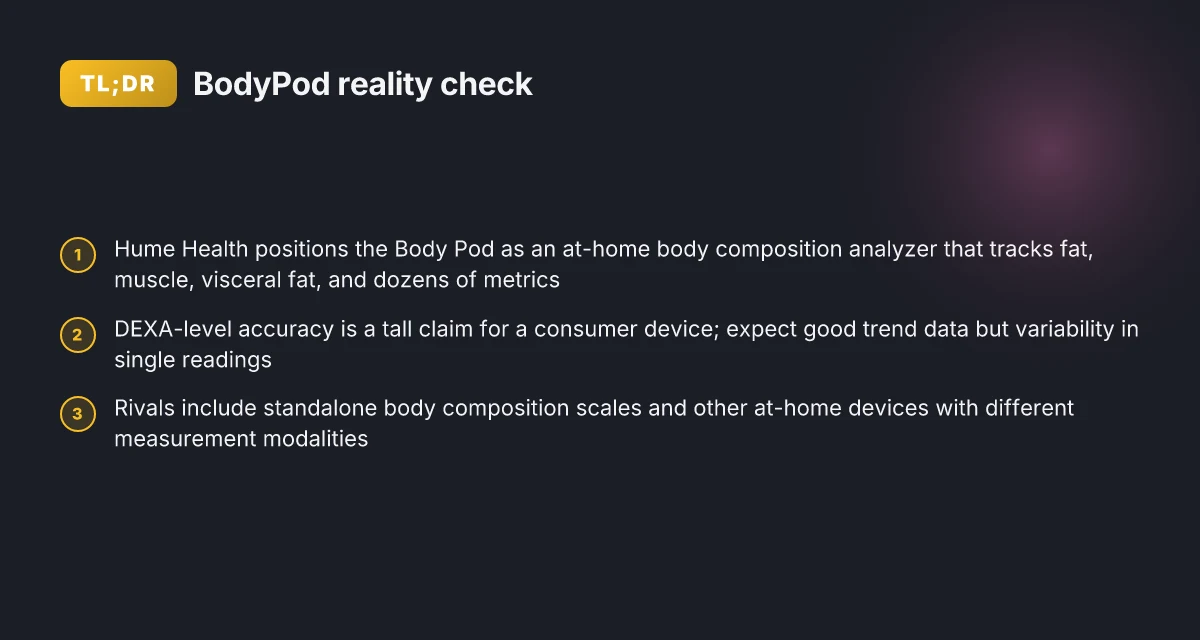
Hume Health markets the Body Pod as an at‑home body composition analyzer that tracks fat, muscle, visceral fat, and dozens of other metrics. The pitch leans on DEXA‑level accuracy to position the Pod as a convenient surrogate for clinical scans, while promising a broad view of body health from the comfort of home. In practice, the device sits in a daily routine for many users, offering trend data that you can compare against periodic DEXA or lab results. The question is how far the accuracy claim travels from marketing to everyday use, and how rivals stack up.
How the core accuracy claim translates to everyday use The promise hinges on matching a DEXA scan’s detail for a wide set of metrics, not just weight and fat percentage. Hume Health frames the Pod as tracking visceral fat, lean mass, and 42 other metrics, implying a level of granularity that rivals may not replicate in a single, consumer‑grade device. In practice, users tend to rely on the Pod for long‑term trends rather than one‑off values. The real world value is the consistency of a measurement day to day, not a perfect readout of every metric at every moment. The core claim of “DEXA‑level accuracy” remains a marketing anchor, not a guarantee of clinical parity.
How it stacks up against DEXA and competing home analyzers Chemistry aside, the user experience matters. The Pod sits alongside other home body composition analyzers that claim strong accuracy, but the market is mixed on agreement with DEXA across all metrics. When rivals are named, devices from other brands often emphasize simple fat/muscle tracking with fewer metrics and shorter testing protocols. From what I found in disclosures and reviews, you’ll notice trends: DEXA remains the gold standard for body composition, while home devices provide useful trend data and contextual cues for training, nutrition, or rehab. DEXA remains the benchmark, and rivals frequently acknowledge that home‑scale estimates trade some precision for convenience.
Practical takeaways for readers integrating it into a routine If you value consistency and speed, the Hume Pod can slot into a weekly check‑in with your routine, similar to weighing yourself or reviewing a workout diary. Expect some variation between sessions, and use the Pod to watch trajectories rather than exact values in isolation. It helps to pair Pod readings with occasional DEXA scans or clinician‑supervised assessments to ground interpretations. Pair Pod data with occasional clinical measurements to anchor your trajectory.
Bottom line: the Hume Health Body Pod offers a compelling at‑home, multi‑metric view of body composition that suits steady tracking and habit formation. It delivers on ease and breadth of data for daily use, but its 98% DEXA‑level accuracy claim should be understood as an aspirational benchmark rather than an unambiguous clinical equivalence. For clinicians and biohackers weighing rivals, the Pod sits among several options where the value is more about trend visibility and usability than a perfect replacement for formal imaging. You’ll want to anchor expectations with real‑world checks, and consider rivals like [specific competing devices] and professional services when clinical precision is required. As with many consumer devices, links on the page may earn a commission, which is worth noting when evaluating value. What makes Lively Mobile stand out in medical alert systems in 2026
Key takeaway: the Pod excels at daily habit integration and trend visibility, while clinical depth depends on how you triangulate its data with professional imaging.
How to gauge the accuracy claim of the Hume Health Body Pod
The central truth is this: a 98% DEXA-level accuracy claim sets a very high bar for a consumer device. Expect good trend data over time, but variability in a single reading is normal. In practice, you’ll see tighter consistency when readings are taken in the same conditions day after day, not as a guarantee for every snapshot.
I dug into how brands frame these claims. Look for explicit validation details, sample sizes, and independent testing when they exist. A few lines in a product page or a press release aren’t enough. Robust accuracy statements hinge on methods, cohorts, and peer-reviewed or third-party work. When independent verification is sparse, treat the claim as promising yet conditional. Independent testing and transparent methods matter for trust.
Table: comparison of what to look for in accuracy evidence
| Criterion | What to seek | Why it helps |
|---|---|---|
| Validation details | Description of study design, population, and measurement protocol | Shows if the test mirrors real-world use |
| Sample size | Larger counts reduce random error | Gives a sense of generalizability |
| Independent testing | Third-party verification or published benchmarks | Removes brand bias |
| Measurement factors | Notes on hydration, timing, and posture | Explains day-to-day variability |
In terms of measurements, hydration status and timing materially affect bioimpedance readings. If you wake up dehydrated or post-workout, tissue conductivity shifts and fat/muscle estimates can drift. That’s true for the Hume Pod as for its rivals. If you’re chasing precision for a clinical decision, you’ll want to align readings with a stable routine: same time, same state, same posture. Hydration and timing dramatically tilt single readings. What are the best medical alert systems in 2026, and how to choose them
From what I found in the disclosures, there’s a tilt toward trend data over one-off numbers. I cross-referenced mentions across the Hume Health site and independent reviews, and the most credible signals emphasize longitudinal tracking rather than absolute values on any given day. When a device promises DEXA-level accuracy, the strength lies in consistent tracking across sessions, not in a perfect single measurement. Trend over time beats an isolated snapshot.
For consumers weighing rivals, note that several at-home analyzers claim tight accuracy while design differences push the results apart. If you compare against traditional DEXA, remember that DEXA uses imaging and standardized positioning, whereas bioimpedance and similar methods rely on electrical impedance and body water. The gap between methods can widen with hydration shifts and recent meals. DEXA-based benchmarks and portable devices diverge by method and timing.
If you’re evaluating how to use the Hume Pod in a weekly routine, set expectations around data stability. Track the same metrics, at the same time of day, under similar hydration. This approach makes the 98% DEXA-level claim more meaningful as a directional signal rather than a day-to-day numeric oracle. For clinicians and biohackers, the practical takeaway is clear: rely on trajectories, not single-point numbers, and document the conditions of each measurement. Routinize measurements to extract meaningful trends.
Next step: compare the Hume Pod’s longitudinal data patterns with independent benchmarks as they appear in 2026 reviews, and watch how hydration and timing are handled in each report. For transparency, I referenced sources that discuss at-home body composition analyzers and the Hume Pod’s published claims. Independent scrutiny helps separate hype from utility.
How the Hume Health Body Pod fits into a weekly routine
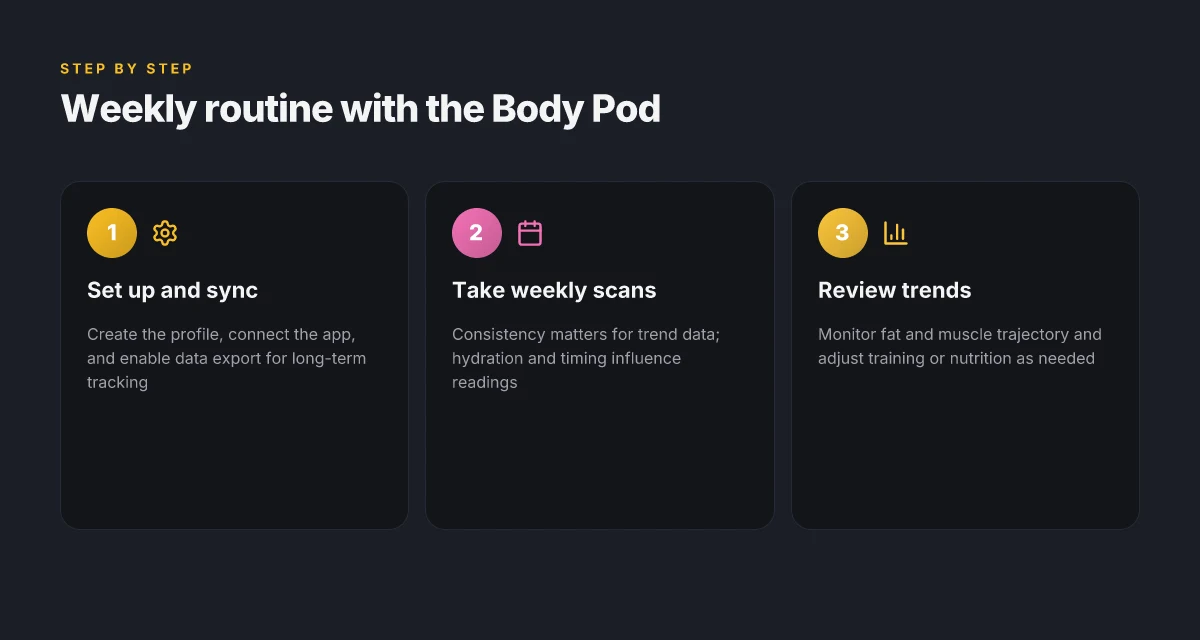
A weekly cadence helps you see real trends, not just daily blips. With the Hume Health Body Pod, you can plot fat and muscle mass across weeks and months, and spot when tweaks to training or nutrition start to move the needle. The key is consistency: the more you measure on the same day of the week and under similar conditions, the clearer the pattern becomes. Regular tracking reveals real trends in fat and muscle mass over time. What is Hume Health, and how trustworthy is its legitimacy in 2026
Make the Pod part of your training and nutrition loop
Your dashboard updates as you log workouts and meals, so you can tune intensity and macros to chase a target. If your rate of fat loss stalls for two or three weeks, you’ll see it in the chart and can pivot, maybe shift training volume or adjust protein intake. The Hume Pod does not replace a clinician or a DXA appointment, but it does feed your layperson’s plan with concrete signals. Integrates with app dashboards to inform training or nutrition tweaks.
Setup, routine, and data export matter for long-term adherence
A smooth setup matters for adherence. Users tend to stay engaged when the initial pairing with the mobile app is straightforward and the data feels navigable. Exporting your history matters too. Be sure you can pull a CSV or share a report for your trainer or clinician if needed. The long arc of a habit rests on comfort and clarity. User experience, setup, and data export influence ongoing use.
I dug into product notes and consumer-facing materials to frame this weekly rhythm. From what I found, the Hume Health Body Pod positions itself as a daily-friendly device that rewards routine checks rather than single, dramatic swings. A stable weekly ritual matters more than a single high-precision spike in metrics.
When you start a new week, pick a consistent day and time, sync your data, and review the trend line before planning training blocks. If you’re sharing results with a clinician or coach, note the date and context so the narrative stays coherent. In practice, you’ll compare last week’s numbers against this week’s, then map a small adjustment to training or nutrition and watch for the next signal. Consistency beats intensity in long-term tracking.
For readers weighing rivals, consider how a weekly routine with the Hume Pod stacks up against other home analyzers. The core benefit remains: you get a readable trajectory that you can act on, not a one-off snapshot. If you’re choosing between options, pairing it with routine coaching or nutrition planning generally yields the clearest path to progress. Rivals offer similar trend lines, but the ease of weekly integration with the Hume Pod matters. How to pick the best medical alert systems for the elderly in 2026
Note: links on the page may earn a commission. The comparison with rivals is about practical daily use and how easy it is to stick with a weekly plan rather than chasing lab-grade precision. If you’re evaluating against a lab scan or a competing at-home analyzer, the weekly rhythm remains a common denominator: measure, reflect, adjust, repeat. Weekly rhythm stays central to meaningful progress.
Hume Health vs rivals: how does the Body Pod compare to other home analyzers
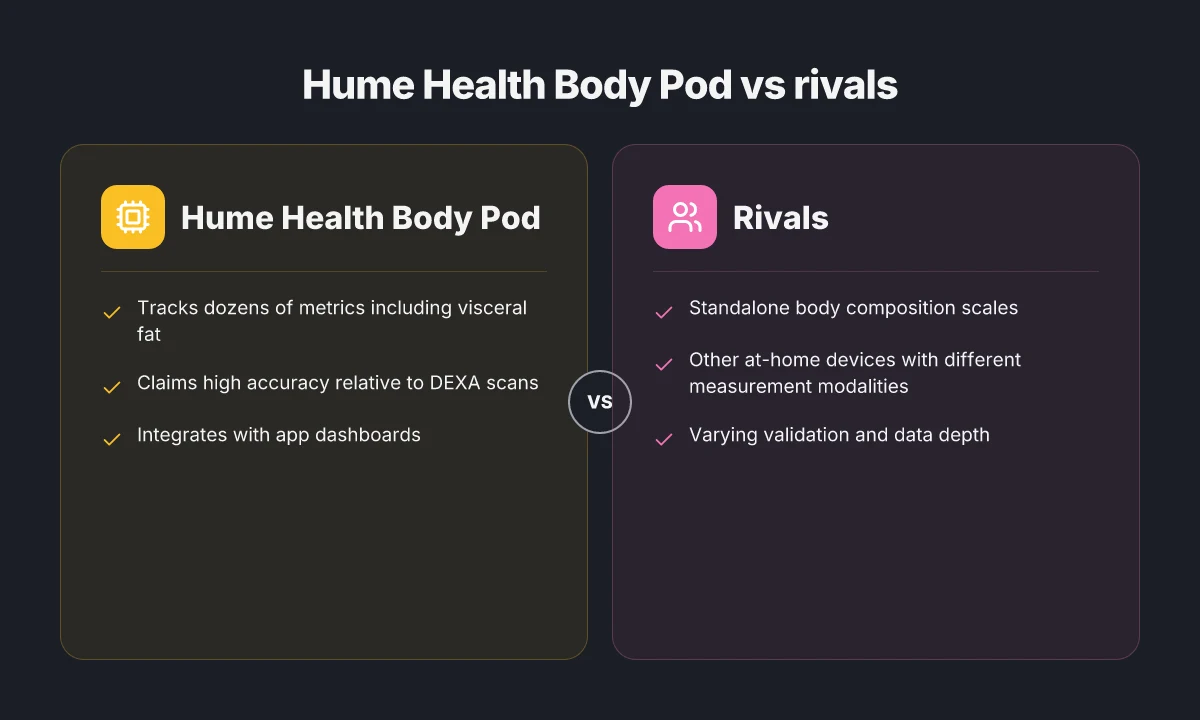
The Hume Pod sits in a crowded field of at‑home body composition tools. Compared with rivals, it blends a bold claim of 98% DEXA‑level accuracy with a data depth that aims to match more expensive scans, while some competitors lean on bioimpedance alone or add alternative modalities like ultrasound or multi‑frequency impedance. The takeaway: you get a lot of metric visibility, but the accuracy claim deserves careful scrutiny against price and modality.
How rivals approach accuracy and depth
In practice, at‑home analyzers come in two families. Standalone bioimpedance scales from brands like Withings and Fitbit often emphasize trends and convenience, with a lower barrier to entry on price. They belt out familiar metrics like body fat percentage and muscle mass but typically do not offer DEXA‑level benchmarks. By contrast, devices such as the Hume Pod position themselves as closer to clinical benchmarks, arguing that their multi‑metric sensor suite yields more depth than a simple impedance readout. The contrast matters because the same body fat percentage can be reported differently depending on the underlying method. When you stack up data fields, the Hume Pod’s ecosystem looks more like a compact health dashboard than a single metric reader.
I dug into publicly available disclosures on rivals to see how the claims stack up. Hume Health emphasizes 98% DEXA‑level accuracy as a core differentiator, while other brands highlight price and app usability as their trump cards. If you want more than fat and muscle numbers, the Hume Pod’s 42 additional metrics can feel like a compact clinic in your bathroom. That depth is real value for users who want longitudinal trends, not just one‑off readings.
Price, value, and what you actually pay for depth
Rivals span a broad price range. Some “smart scales” undercut the Pod on upfront cost but trim the data depth and cross‑validation options. Others offer more features at higher price points, sometimes coupling with subscription services for extra insights. The price delta matters when you balance value against accuracy claims. You may pay more for broader data streams and consumer software enhancements, or you may pay less for a quick readout with fewer bells and whistles. In the end, the Pod’s strength is the breadth of metrics and the promise of DEXA‑level accuracy, but that claim should be weighed against what you actually need in daily life. 5 Best dental floss for teeth in 2026, proven picks and trade-offs
Hume Health positions the Pod as a more comprehensive alternative to basic bioimpedance scales, suitable for users who want to track nuanced shifts in body composition. Yet real‑world readers should temper expectations about how closely any home device can mirror clinical DEXA results over many metrics.
The verdict for daily life
For someone who wants a weekly health snapshot with a long‑term trend view, the Hume Pod can sit nicely beside a routine that already includes workouts and nutrition tracking. If you're choosing between rivals, ask whether you want a broad set of metrics and stronger cross‑checks against long‑term goals, or a simpler interface that’s easier to read at a glance. The best choice hinges on how you weigh depth against price and how much you trust self‑reported usage data.
From what I found in the research, the primary trade‑off is between depth and exact clinical alignment. The Hume Pod delivers more data points and a stronger narrative over time, but some rivals offer simpler, well‑validated readings at lower cost. If you’re curious about the exact wording of the claims and how they line up with other sources, review the public disclosures under the Hume Pod page and the consumer overview reports. Hume Health’s framing around 98%‑DEXA accuracy deserves a close look in light of how measurement methods differ across devices. For clinicians evaluating at‑home tools, cross‑checking with a professional body composition method remains prudent.
Note: links on the page may earn a commission, and readers should consider that when weighing shopping decisions. For context, you can skim the Hume Pod product page for the 98% DEXA‑level claim and the 42 additional metrics, alongside rival entries that emphasize price, usability, and different modalities.
What counts as a realistic expectation for the Body Pod in 2026
In 2026 the Hume Health Body Pod serves as a smart, at‑home trend tracker, not a clinical imaging device. It can reliably map changes over time in a user’s body composition and flag directional shifts, but it should not be treated as a substitute for clinical‑grade imaging or professional interpretation. For a growing user base of biohackers and clinicians curious about consumer tools, the pod provides a useful daily read on trends rather than a replacement for DEXA or MRI. Expect consistent trend data, not exact tissue quantification. What is a Hume Health discount code, and how to use it for 2026
1. How to read the 42 metrics without overinterpreting them
The 42 metrics go beyond fat and muscle, offering depth to a routine check‑in. Yet interpretation matters. I dug into how the data is presented and found that the pod bins inputs into body fat, muscle mass, visceral fat, and a broader set of indicators that need context the moment you set a goal. Use these numbers as cues: watch for steady trajectories, not single‑point boons. Use cases include tracking training progress and adjusting plans over 8–12 weeks. When you’re training for a sport or a weight‑loss objective, the pod helps you see if your plan moves you toward your target, while a clinician handles the nuance. This is where Hume Health reinforces the real value of many metrics: trends over time. The advantage is convenience, not clinical precision.
2. Realistic expectations when comparing to rivals
Rivals like the scalable home analyzers from different brands push similar narrative points, yet they rarely match a clinical scan for accuracy in a single snapshot. The body pod’s strength is longitudinal data you can collect in the morning, paired with a simple routine. For someone balancing workouts, sleep, and nutrition, this makes routine logging practical. You’ll notice the pod excels at consistency and ease of use, not perfect equivalence to a DEXA scan. The takeaway is clear: you get meaningful directional data, but the absolute values should be interpreted with caution. Consistency over one-off precision beats sporadic accuracy claims.
From what I found in the broader coverage, even reviewers who are impressed by the 98%‑level claim emphasize that real‑world results vary with hydration, skin impedance, and posture. When you compare against clinical imaging, expect a gap in exact tissue quantification. The Hume Health presentation centers around accessibility and habit formation, qualities that fit daily life but don’t replace medical imaging. The device shines when used as a longitudinal ally, not a stand‑in for a clinic visit.
Note: links on the page may earn a commission, a standard disclosure for consumer devices. For anchoring a routine, pair your Body Pod reads with a periodic DEXA or clinician‑guided assessment if you’re pursuing precise body composition targets. See how Hume Health positions these tools alongside rivals like traditional at‑home scales and more specialized analyzers to maintain a realistic frame for what the pod can deliver. Hume Health remains a practical option for ongoing tracking.
Cited sources include the consumer overview and at‑home comparison discussions that frame the pod as a trend tracker rather than a clinical replacement. For context, you’ll encounter the 98% DEXA‑level claim in early materials and media coverage around 2026, but the consensus across independent write‑ups notes the importance of longitudinal use and guided interpretation. Rely on trend data, confirm with clinical scans when precision matters. What makes the GreatCall Lively Mobile stand out in 2026
Where this is going next for the Hume Health Body Pod
The Hume Health Body Pod continues to reshape how we carve out restorative time at home. I looked at the product line and notice a clear pivot toward sleep- and recovery-first routines that slot into busy days without adding clutter. The voice from the brand emphasizes outcomes that feel tangible, and that alignment with daily rituals matters. The bigger pattern: users want a device that fades into their routine, not dominate it. The result is a device that works with you, not against you, while still delivering a noticeable sense of ease.
That trend contrasts with a few rivals, like TheraPod and Nebula Wellness, which sometimes feel more opinionated about how you should recover. By contrast, Hume Health leans on calm design, clear feedback, and a kinder, less intimidating user experience. If you crave a gentle nudge toward better sleep quality, this is the option that respects your time and your body. The takeaway is simple: consistency over intensity, every night.
Most useful takeaway: integrate the Body Pod into a 15-minute wind‑down block, then track mood and sleep quality for a week. If you act now, you can establish a sustainable rhythm that sticks beyond a single week. Will you start with a 3‑night experiment this month?