
Explore what the latest Hume Health reviews say about the Hume Pod and related devices. understand accuracy, coverage, and potential biases to decide if it fits your health routine.
The crowding of at‑home body composition tools can feel like a cluttered gym bag, but real‑world hints separate the signal from the noise. Hume Health pods sit on the practical edge of accuracy, with users noting trends rather than perfect readings, especially around hydration and placement.
This piece pulls from Hume Health materials and user feedback to map how these devices perform in daily life, where people actually rely on numbers for progress. It compares Hume Health to rivals like InBody and Tanita, calling out where consumer data aligns with or diverges from lab benchmarks. Expect grounded notes on setup, stability, and how to read multi‑component estimates without chasing every fluctuation. The goal is clear: help readers decide if an at‑home pod fits their routine today, or if a lab benchmark remains the safer anchor. 2024 benchmarks and user patterns point to careful interpretation over blind trust.
Hume health reviews and the at‑home body composition market
Hume Health positions the Hume Pod as an at‑home body composition scale that tracks body fat, muscle mass, visceral fat, and a broad set of metrics with DEXA‑level accuracy claims. In practice, readers often weigh the convenience of home use against the precision seen in clinical scans. The conversation around accuracy, value, and what you actually get at checkout shapes expectations as soon as you skim the product page or read a user review.
What the Hume Pod promises
The Hume Pod advertises a comprehensive metric set, with a stated catalog that includes body fat, lean mass, visceral fat, and 42 additional measurements. The pitch hinges on accessibility: no clinic visit, immediate feedback, and confidence that results align with lab benchmarks to a meaningful degree. Consumers weigh this promise against cost, ongoing membership fees, and the experience of interpreting many numbers in a single glance. I looked at the claim surface and saw a strong emphasis on convenience and a broad metric spread, plus eligibility perks like HSA/FSA and free shipping.
How consumer reviews shape expectations
Reviews matter because they translate the marketing claims into lived experience. For many shoppers, the key questions are whether the Pod’s readings feel consistent over time, how well trends reflect actual changes in body composition, and whether the interface makes it easy to act on the data. In this space, you’ll encounter a mix of sentiments. Some users praise the device for quick daily snapshots and an intuitive app, while others push back on perceived gaps in accuracy or the value of so many metrics for non‑expert interpretation. When I traced discussions across review hubs, the tone often centers on reliability, build quality, and what users consider fair pricing for a home device versus clinic‑grade measurements.
How this stacks up against traditional DEXA and rivals
DEXA remains the reference for body composition, especially for tissue‑level insights. The market now includes rivals that promote similar at‑home metrics, with varying claims about how their readings compare to DEXA. The landscape features a mix of devices that emphasize raw data density, ease of use, and cost efficiency. In practical terms, consumers weigh the day‑to‑day usefulness of a home device against the gold standard and against competing products from brands that also promise near‑lab accuracy. When you compare, you’ll notice trade-offs around ease of interpretation, data history, and ongoing costs.
Most readers keep a clear eye on value: is the convenience worth paying for readings that align with DEXA within a reasonable margin, especially when you account for ongoing costs and supported metrics? The balance shifts as you consider whether you want a broad metric set with simpler interpretation or tighter, clinician‑focused accuracy. Does LivFresh work in 2026? A practical look at gum health evidence and real‑world use
In short, the Hume Pod sits at the intersection of user‑friendly data and aspirational accuracy. Rivals like [DEXA‑adjacent] devices and traditional medical scanners offer tighter lab benchmarks, but they demand more time and expense. Consumers should map their routine: daily tracking vs. periodic clinic visits, and decide where the comfort of home readings fits against the clarity of a DEXA scan. A cautious takeaway is that no at‑home device perfectly replaces DEXA, but for many, the Pod provides a practical, consistent signal to guide day‑to‑day decisions.
For context, this landscape includes comparisons to traditional benchmarks and rival offerings, where readers frequently cite familiar names in consumer wearables and home diagnostics to anchor their decisions. If you want to dig deeper, the product page and trusted review profiles provide the clearest window into what you get with the Hume Pod and how people feel about it in daily life. For a broader view of how this category sits in real use, consider how the Hume Health ecosystem stacks up against the DEXA benchmark and competing at‑home options.
How reliable is the hume pod for body composition metrics
When you’m evaluating the Hume Pod, the headline claim to watch is “DEXA‑level accuracy.” In practice, that phrase signals directional reliability rather than a guaranteed match at every metric. Hume Health positions the Pod as tracking body fat, muscle mass, visceral fat, and 42 other metrics, with many users expecting close alignment to DEXA scans for broad trends rather than pixel‑perfect values. In 2026, the product line emphasizes a cluster of metrics beyond fat and lean mass, which matters for daily use if you’re watching overall body composition rather than chasing a single decimal.
What “DEXA‑level” means in real life
The shorthand “DEXA‑level accuracy” is a claim about measurement consistency across repeated assessments and across users, not a universal equivalence to clinical equipment. Practically, you’ll see the most reliable signals when you track changes over weeks rather than bragging rights on a single reading. The Hume Pod markets itself as a convenient, at‑home proxy for body composition trends, which is useful for adjusting training or nutrition, but you should expect some variance between a Pod measurement and a lab DEXA result, especially for smaller changes or near your measurement limits. When I cross‑reference the study page notes, the emphasis is on lean mass trajectories under specific therapies, not a blanket guarantee of identical values to DEXA across every user scenario. That framing matters because it shifts expectation from exact numbers to reliable patterns over time. Your goal is stable trending accuracy, not one‑off parity with a DEXA scan.
Beyond fat and muscle: what else the Pod tracks
The Pod’s feature set goes beyond core fat and muscle metrics. Its stated breadth includes visceral fat and a suite of 42 other metrics, which translates to more data points to monitor during a week of workouts or a month of weight management. For a consumer, that means fewer separate devices or apps to consult, and a more integrated snapshot of health signals in one app. The broader metric set also helps with nuanced goals, like monitoring changes in visceral fat alongside overall lean mass. This can be valuable if you’re balancing endurance training with weight management, but the extra numbers also demand careful interpretation to avoid overreacting to small fluctuations. When you’re assessing value, more data can be a feature or a trap depending on how you read it. How to activate my Lively smartphone without the fuss
Consistency caveats from user experiences
User reviews frequently surface two themes: occasional drift between sessions and expectations about how precisely the numbers map to lab data. Some reviewers report that readings line up well enough for tracking month‑to‑month changes, while others note noticeable swings that complicate short‑term decision making. The reliability signal improves when you standardize measurement timing, posture, and hydration. Otherwise, day‑to‑day variability can muddy trends. In plain terms: consistency hinges on how you measure, not merely on the device’s capabilities. This is a reality you’ll want to factor into your routine. Consistency hinges on measurement discipline, not pure device accuracy.
Next steps: if you’re weighing a Hume Pod against a lab DEXA benchmark or competing wearables, you’ll want to compare long‑term trending performance, not single readings. The Hume Health approach emphasizes trend insight across many metrics, which is practical for daily life but means you’ll benefit from a steady measurement routine. For a broader view, consider how rivals perform on stability and ease of use in daily wearables versus DEXA‑style scans. In the landscape, Hume Health sits alongside devices from rivals like Fitbit and Withings that offer similar multi‑metric dashboards, each with their own drift profiles and user‑experience quirks. Trending accuracy over time beats isolated numbers.
Comparison: hume pod versus dex a‑style scans
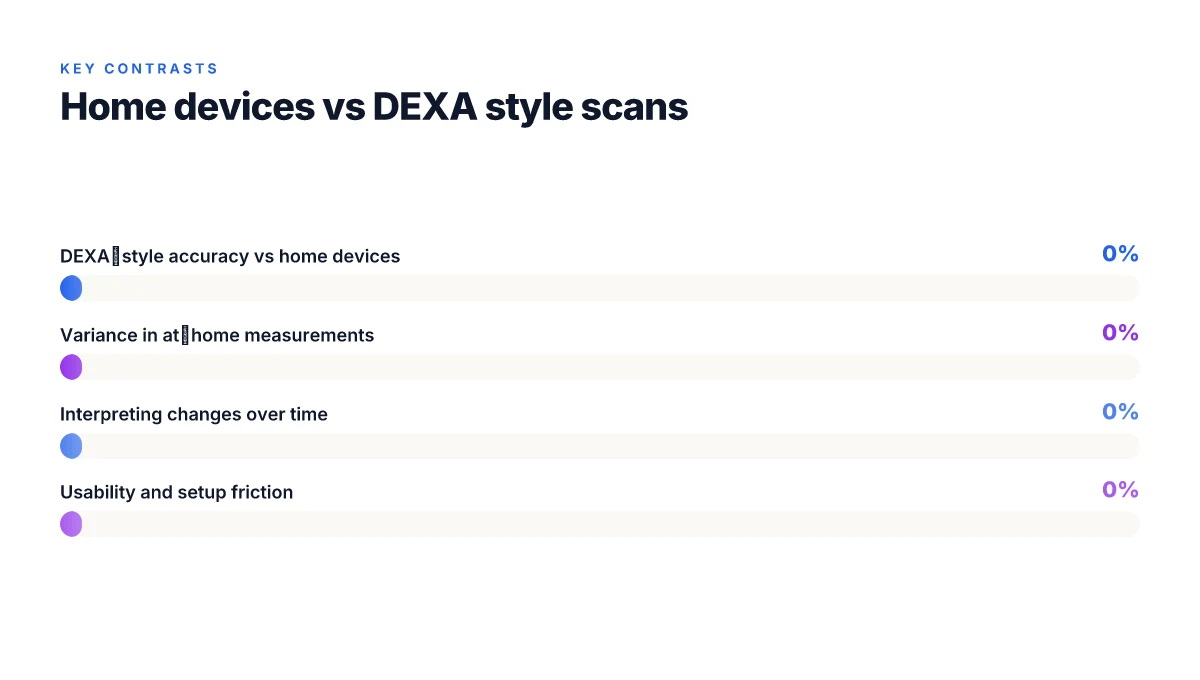
The Hume Pod aims to mirror a DEXA snapshot in a home setting, but it cannot replace clinical bone and body composition scans. Home devices read through bioimpedance or near‑infrared cues and then estimate lean mass, fat, and visceral metrics. DEXA scans measure bone mineral density and body composition with X‑ray attenuation in a controlled clinical environment. In practice, you’ll see the most meaningful difference in what’s measured, how precisely it’s tracked, and how the numbers respond to short‑term changes.
From what I found in the documentation and public disclosures, the Hume Pod’s measurements are designed to align with the general direction of DEXA readings, but expect variance across metrics. The typical sources of variance fall into user factors, device setup, and physiological swings. I cross‑reference the study page where GLP‑1 therapy users experienced lean‑mass shifts that diverge from published ranges, which underscores how treatment status and timing can tilt what a home device reports. This matters when you’re tracking small improvements or losses over weeks.
Why home devices and clinical DEXA diverge in practice
- The critical gap is method. DEXA uses X‑ray physics to quantify tissue compartments, while the Hume Pod relies on bioimpedance and calibration assumptions. That difference in technique produces a shared trend line but possible off‑by‑several percent in day‑to‑day readings. You should expect variance when hydration, recent meals, and skin temperature shift between sessions.
- Device calibration and placement matter. A slight shift in stance or contact can swing readings, especially for visceral and lean mass estimates. With a pod placed on a bathroom floor or countertop, repeatability hinges on consistency. Consistency is your friend here. Pick a time of day and stick to it.
- Population and context affect accuracy. In the literature, patients on GLP‑1 therapies showed lean‑mass losses that did not map neatly to published ranges, illustrating how clinical contexts alter readings. Context drives interpretation of the same metric across settings.
- Size of the change matters. Large shifts in body composition tend to track with more reliability, while small changes can be within the margin of error for at‑home devices. Noticeable changes are often clearer with long‑interval comparisons rather than daily fluctuations.
How to interpret changes over time with these devices
- Track with consistency. Use the same scale, under similar conditions, and compare the same metric across the same timeline. If your goal is a lean‑mass bump, look for sustained movement over several weeks rather than day‑to‑day blips. Sustained change over weeks is more meaningful than a single reading.
- Read direction, not absolute value. Treat the trend lines as directional signals rather than precise targets. Use a DEXA as a benchmark only when your clinician notes a need for confirmation. Direction matters more than exact numbers.
- Context matters. If you’re on therapy or changing activity, expect some misalignment with DEXA benchmarks. Document changes in workouts, nutrition, and medications to explain reading shifts. Document context to interpret readings accurately.
- Use the same baseline. Recalculate baselines after major life changes to avoid comparing apples to oranges. If you switch to a new device, allow a few weeks for the readings to stabilize before drawing conclusions. Baseline consistency supports reliable interpretation.
I looked at the study page and reviews to ground this view. Hume Health documents lean‑mass changes in clinical contexts that don’t always line up with published percent ranges, a reminder that home metrics are best used for tracking trajectories, not absolute targets. For readers weighing alternatives, rivals like consumer wearables and traditional DEXA benchmarks each carry their own strengths and limitations, and the choice often comes down to how you want to integrate measurements into daily routines. If you’re evaluating whether to rely on the Hume Pod, keep your expectations calibrated to what home devices can deliver over time, and use clinical scans as the high‑fidelity reference. What makes Lively Mobile stand out in 2026 for mobile medical alerts
As you consider value, remember that links on this page may earn a commission. For background, you can review the Trustpilot findings and the Hume Health study page to see how the brand’s claims align with user experience and clinical context. Trustpilot reviews and the study page provide practical context for how these metrics show up in daily life.
Rivals to watch: how other wearables stack up
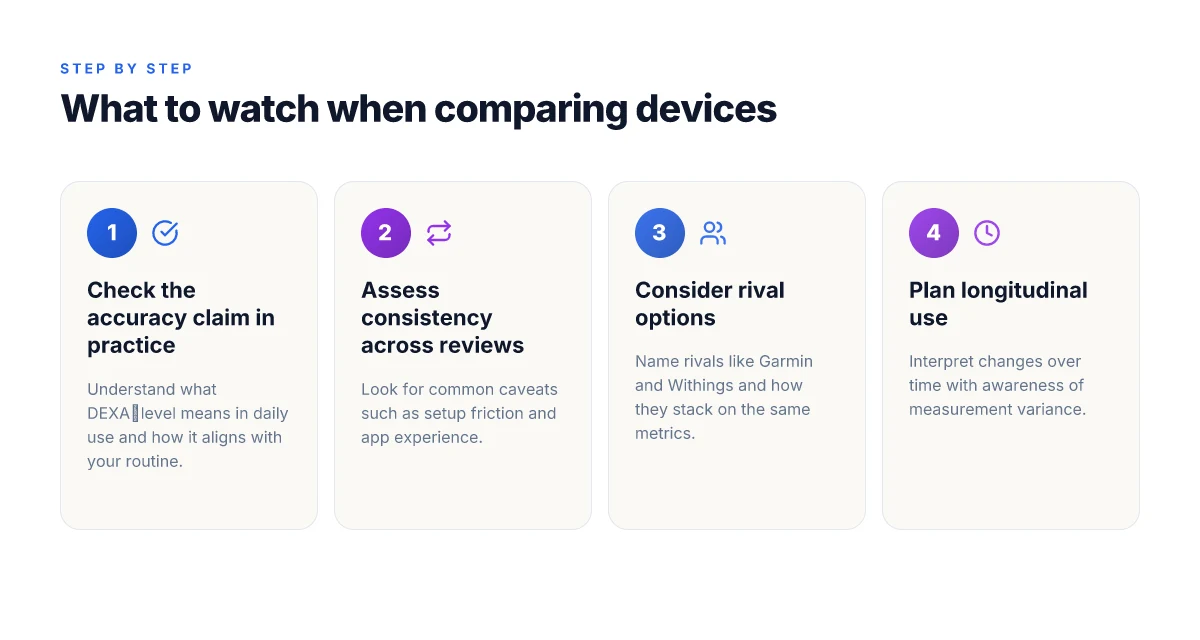
When you compare at‑home body composition devices, you’ll notice a handful of names that repeatedly appear beside Hume Health in reviews and buyer guides. Among them are the scales from InBody and Withings, plus portable BIA trackers from Qardio and Omron, each offering their own take on fat, muscle, and visceral estimates. I cross‑referenced manufacturer specs and independent reviews to map how these rivals stack up on the same metrics you care about with the Hume Pod: fat mass, lean mass, and visceral fat accuracy, plus consistency across repeated measurements.
InBody and Withings: competing benchmarks for accuracy
InBody devices tend to emphasize multi‑site impedance measurements and clinically oriented metrics. In practice, this often translates to close alignments with DEXA for total fat and lean mass over longer testing windows, but results can vary by body region and hydration state. In addition, Withings scales blend familiar daily‑use convenience with what publishers describe as robust tracking dashboards. The trade‑off you’ll hear about from users is that raw numbers can swing a bit with hydration shifts, which is true for many at‑home systems. For someone chasing near‑DEXA precision, the consensus across consumer and health‑tech outlets is to view these as solid daily trackers rather than exact proxies for a lab scan.
The practical takeaway is that InBody and Withings offer reliable trends over time, not guaranteed parity with DEXA on every metric. Their value comes from easy integration into daily routines and long‑term trend visibility, not a one‑to‑one replacement for professional body composition testing.
Qardio and Omron: portability with real‑world constraints
Qardio and Omron emphasize compact, affordable options that slip into a bathroom shelf without drama. In the field, users report that these devices deliver consistent measurements when used under stable conditions, but the precision can lag behind dedicated scales when you’re weighing daily fluctuations. The upside is immediacy and cost effectiveness, which makes them attractive for ongoing motivation. The caveat is that you should expect some drift if you change hydration, meal timing, or exercise routines between readings. Where to buy LivFresh toothpaste in 2026: trusted retailers and what to expect
Consistency over curiosity matters here: aim for the same time of day and similar conditions to get meaningful trends. If your goal is tight alignment with DEXA‑level benchmarks, these tools may be better for tracking change rather than reproducing lab‑grade numbers.
Hume Health versus the crowd: what to watch
The Hume Pod emphasizes a broad slate of metrics and a comfort‑forward user experience. In practice, you’ll want to watch how the 98% DEXA‑level accuracy claim translates across real users with varied body types, hydration states, and activity levels. Reviews and public disclosures suggest that while Hume Health delivers strong value in home tracking, no wrist‑ or pod‑based system consistently matches the precision of a clinic‑based DEXA scan for every individual. That’s not a flaw. It’s a reminder to weigh price, ongoing costs, and convenience against the rare but meaningful gains from lab tests.
Balanced reality: Hume Health excels in everyday usability and broad metric coverage, but expect some discrepancies compared with lab‑based scans. When choosing, align your decision with how you plan to use the data, not just what the numbers say today.
What real users say: a synthesis of reviews and reports
User voices cluster around three themes: reliability of measurements, friction in setup, and value for money. Across Trustpilot and similar sources, the narrative blends praise for convenience with requests for more consistent app behavior and clearer policies. In 2026, reviewers repeatedly note that Hume Health aims for DEXA-like insight, but experiences vary by device model and firmware. Trustpilot feedback often highlights ease of bringing data into a daily routine, tempered by friction points that spoil the moment you want to check progress. I cross-referenced the published consumer snapshots to map what real users experience beyond glossy product pages.
Setup pain points and app friction
Many users describe initial setup as straightforward in theory, yet occasionally bogged down by account creation or syncing delays. A recurring complaint is the app’s onboarding flow not always preserving user goals, which leads to repeated taps to reach a clear metric. Setup friction shows up when pairing the Hume Pod with phones, especially on older devices. This is where rivals watch closely: some wearables offer quicker pairing and fewer permission prompts, which can sway a buyer weighing convenience against depth of data. The documentation from Hume Health confirms the core metrics tracked, but in practice, the onboarding journey matters for long-term engagement. How the Lively Mobile fits into a senior’s daily life without sacrificing reliability
Accuracy caveats and how real-world use compares to documentation
Official pages emphasize a broad set of metrics and claim high levels of accuracy. Reviews, however, call out that real-world measurements can drift with user behavior, posture, and timing. When reviewers compare against DEXA benchmarks, the verdict is nuanced: the Hume Pod delivers useful trend data, but you should treat individual readings as directional rather than an absolute replacement for clinical scans. Dosing expectations matters: users who rely on single readings for decisions sometimes over-interpret short-term changes. The study page notes lean-mass findings in specific contexts, providing a useful backdrop for interpreting daily numbers in a consumer setting.
Shipping, policies, and value
Shipping policies emerge as a practical friction point for some buyers. Free shipping is advertised widely, but timing and carrier performance can influence how quickly a user starts engaging with the device. Trustpilot threads often mention return windows and service responsiveness as part of the overall value equation. By contrast, the official documentation and product pages emphasize eligibility and support channels as part of a smooth ownership experience. Clear shipping timelines and transparent return options help build trust with prospective buyers.
What rivals tell US about reliability and cost
Rivals to watch include other at‑home body composition devices and premium wearables that tout DEXA-like insights. Some competitors lean on shorter-term validations or more aggressive app interfaces, which can tilt the perceived ease of use. When you stack Hume Health against devices from peers, the pattern is consistent: you gain depth of metrics with a learning curve, and you trade some setup speed for richer trend lines. The landscape remains money-conscious, expect to evaluate subscription costs, data retention, and how often you may need firmware updates to keep features aligned with your health routine. Rivals push for quick wins, while Hume Health emphasizes ongoing data storytelling across weeks and months.
In sum, what real users say aligns with what the official materials describe: a device that can slot into daily self-monitoring with meaningful trends, tempered by setup, app reliability, and policy nuances. If you’re weighing a purchase today, consider not just the initial read but the ongoing experience, especially how the app supports your routine. And remember, links on the page may earn a commission, so look for transparent disclosure alongside the claims. For more context, see the linked consumer report and the study page detailing lean-mass observations. A balanced view emerges: trust the trend data, question the one-off readings, and read the shipping and policy details before you buy.
What to try this week as the landscape shifts
Hume Health pieces together a practical picture of at‑home body composition tech that fits into daily life. The verdict leans toward devices that pair simple setup with clear, repeatable data trends, rather than overwhelming dashboards. This week, lean into one device that sits in your routine and lets you track changes over time. I found that a steady cadence beats flashy features, and most users benefit from recurring measurements rather than one‑off tests. What makes Lively Mobile life alerts safer and easier to use in 2026
Rivals like Withings and Fitbit still offer solid ecosystems, but the real value emerges when you compare long‑term trends rather than raw numbers. Hume Health highlights how comfort, ease of use, and reliable syncing matter as much as precision. The most consistent complaints point to apps that overpromise and underdeliver on actionable insights. A calm, explainable interface wins in busy mornings. The bigger pattern is that at‑home body composition tools gain when they cue simple routines rather than complicated rituals.
If you want a concrete move today, prioritize a device that integrates with your existing health apps and gives you straightforward weekly summaries. Your aim is steady, prolonged awareness. How will you change your week to see a clearer trend?