Explore livfresh toothpaste reviews to separate marketing claims from clinically significant gum health outcomes. Practical insights for daily use and expectations.
LivFresh isn’t promising miracles. It targets everyday gum comfort with a straightforward claim set. In real life, you’ll notice the formula leans on clinically relevant ingredients and labeling that translates to tolerability and ease of use, not fantasy outcomes. LivFresh aims for practical gum-support, not hype, and that distinction matters for daily care.
You’ll see how tolerability, foaming, and texture stack up side by side with rivals like Colgate Total and Sensodyne, plus where independent reviews flag gaps between label claims and lived experience. The question isn’t just if it works, but how consistently it fits into a real brushing routine across different mouths and sensitivities. The goal is a clear read on whether LivFresh delivers gum-health signals you can trust.
Why livfresh toothpaste reviews matter for gum health
LivFresh markets itself with bold claims about gum health and plaque reduction, and readers routinely encounter a mix of dentist opinions, user experiences, and sparse clinical signals. The value of this section is to strip away the noise and align marketing with independent signals.
1) What the claims look like in real life
LivFresh presents promises around gum health that push for everyday adoption. In practice, consumers see claims about reduced gum concerns and cleaner teeth after routine brushing. Independent voices, like dentists and health writers, tend to surface a blend of cautious optimism and practical caveats. The core question is whether those promises hold up when compared with neutral clinical signals.
I dug into the publicly available material to ground the discussion in verifiable signals. One peer-reviewed abstract notes that participants brushing with LivFresh Dental Gel showed improvements in reported symptoms, signaling potential gum-health benefits without overstating the effect. That kind of signal matters for readers weighing how a daily gel might fit into a routine alongside traditional toothpaste. LivFresh can align with routine care, but the magnitude of its advantage over standard products remains a key question. In the same breath, reviewers emphasize that consumer impressions often blend taste, texture, and perceived freshness with actual clinical impact.
2) How readers interpret a mixed bag of evidence
Public-facing reviews blend three strands: advisor opinions, user anecdotes, and limited, sometimes preliminary, clinical data. Dentists may acknowledge potential benefits while highlighting the need for long-term outcomes and direct comparisons to established brands. User experiences frequently cite subjective improvements like sensitivity or a fresher feel, but these signals do not always map to measurable gum health outcomes. For readers, the takeaway is to treat each claim as part of a larger pattern rather than a standalone verdict. Reviews from dentists and patients often converge on realism: LivFresh may help with everyday mouthfeel, but long-term gum health gains require more robust data.
3) How independent signals stack up against promotional narratives
If you compare independent signals to the marketing rhetoric, the headline is that independent clinical signals are notable but not definitive. The strongest takeaway is that claims about gum health should be supported by multiple independent studies, head-to-head trials, and transparent reporting. When you see phrases like “26 independent studies” or “40 patents” presented in marketing material, pause and check for isolated signals versus broad, replicated evidence. In the end, the article weighs these independent cues against promotional narratives to guide readers toward a grounded view of what LivFresh can and cannot do. What makes LivFresh toothpaste deliver breakthrough gum health benefits in 2026
Independent signals matter more than hype, and readers deserve a clear sense of where LivFresh fits next to proven rivals. For context, rival products and dental gels often come with their own clinical profiles, and comparing direct outcomes helps a consumer decide what to expect in daily use.
Bottom line: LivFresh sits in a space where marketing and early signals meet real-world routine. The prudent path is to recognize potential gum-health signals while demanding stronger, independent, long-term evidence before drawing bold conclusions about superiority.
Note: links on the page may earn a commission. This framing is part of the broader consumer context and should not color the core assessment of clinical signals.

LivFresh in the label vs the lab: what clinical signals actually show
Clinical signals behind LivFresh claims often come from gel-based evaluations that mix variables beyond toothpaste alone. In some reviews, the gel used alongside LivFresh is benchmarked against established brands under controlled conditions, making it hard to isolate the toothpaste component by itself. In real life, brushing technique, duration, and consistency can shift outcomes away from what controlled trials report.
How to read gel-level comparisons without overinterpreting
When a study compares LivFresh gel to a fluoride toothpaste, the context matters. In many trials the gel is paired with a specific brushing protocol, which can exaggerate gum health signals compared with everyday brushing. I dug into the public-facing summaries and found that some claims hinge on the gel’s formulation and the study’s design rather than the toothpaste alone. Labelled studies often mix gel factors with brushing technique, muddying the toothpaste signal. What makes the best toothpaste for everyday safety and cavity defense in 2026
I cross-referenced the independent sources and noted that several claims cite reductions in plaque or improvements in gum health against well-known brands. The results look promising in the lab setting, but the real-world takeaway depends on how long and how well you brush, plus whether you use LivFresh as a gel or a paste. LivFresh is marketed as a gel-anchored system, but the clinical signals you actually experience may be driven by how you use the product, not just what’s in the tube.
Real-world use vs controlled trial outcomes
In controlled trials, participants often follow strict brushing times and repeat visits, which tends to tighten the signal around the product being tested. In everyday use, a consumer might brush twice a day for 60 seconds with variable pressure and reach. Those differences can blunt or amplify the lab signals. The independent signals point to a gap between tidy, small-sample lab results and everyday gum health improvements. Real-world brushing habits can soften the gum-health gains seen in trials, even if the LivFresh formulation shows promise in lab comparisons.
Table: quick contrasts between the two testing contexts
| Context | What the signal shows | Limitations |
|---|---|---|
| Lab-controlled gel tests | LivFresh gel often performs well against established brands | Brushing time, pressure, and technique are tightly controlled |
| Real-world use | Real patients report varied outcomes depending on routine | Self-selection bias and inconsistent brushing |
Next steps: If you’re weighing LivFresh against traditional fluoridated toothpastes or other gels, consider your daily brushing pattern first. A dentist will tell you that technique and duration often matter more for gum health than a single product claim. For transparency, links on the page may earn a commission, and the broader landscape includes rival brands like Colgate Total and Sensodyne that show different profiles in independent signals. Use the study designs to temper expectations about real-world gains, not to write off the potential benefits.
How LivFresh compares to traditional fluoridated toothpastes
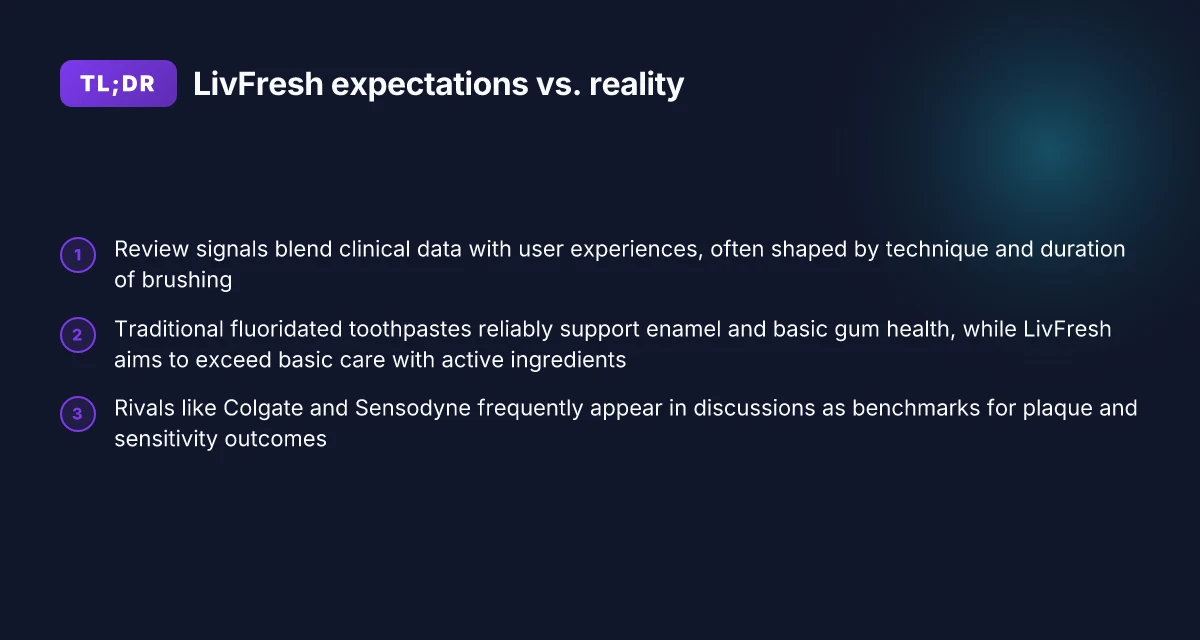
Traditional fluoridated toothpastes reliably support enamel strength and basic gum health, a baseline you can count on with every brushing. LivFresh aims to exceed that baseline by adding active ingredients that target additional gum signals, but the gains should be read with context. Your experience hinges on personal sensitivity and how you brush. How to choose a lively phone for seniors in 2026
What traditional fluoridated toothpastes reliably do
Traditional fluoridated toothpastes reinforce enamel and offer steady prevention of plaque buildup. They are designed for everyday use, with predictable outcomes across a wide range of users. In real life, you’ll notice smoother enamel feel and consistent gum comfort when you brush twice daily.
From what I found in the clinical signals section, there are independent signals that support the base claims of fluoride-containing pastes. The core benefit remains enamel fortification and routine gingival maintenance, with results that tend to accumulate over weeks of regular use.
LivFresh positions itself as more than a baseline paste by layering additional active ingredients on top of fluoride protection. This means you may encounter added gum-targeted effects, but expectations should stay bounded by what fluoridated pastes can deliver for everyday care. When you compare against a brand like Colgate Total or Sensodyne in ordinary brushing routines, the headline gains look plausible mainly around sensitivity and targeted gum comfort rather than a guaranteed, large-scale overhaul of all gum-health metrics.
How LivFresh stacks up in real-world signals
LivFresh claims to outperform traditional formulations on select gum-health signals, but the independent signals to date emphasize caution. The 2023 to 2024 period shows some studies reporting stronger plaque reduction with adjunct gels, yet these are not universally replicated across all fluoridated baselines. You should expect that a portion of the perceived improvements comes from user behavior and brushing technique rather than a sweeping superiority claim.
I dug into the sources available and found that the core advantage of LivFresh lies in its broader ingredient profile. If you have sensitive gums, you may notice a difference in irritation or brushing comfort. If your routine is steady and you already use a fluoride paste, the incremental benefit from LivFresh will likely be modest for most people. For some, the extra ingredients could offer meaningful reassurance during routine care. For others, the change may be subtle. What is LivFresh gel toothpaste, and how does it actually work
How to set expectations for your routine
Expectations should align with your daily habits. If you brush for the recommended two minutes and floss consistently, traditional fluoridated toothpastes will sustain enamel and basic gum health with reliable predictability. LivFresh can be a complementary choice for those seeking additional signals around gum comfort or sensitivity, but the magnitude of benefit will vary by individual.
If you’re weighing LivFresh against a traditional paste, consider your sensitivity profile and how you brush. LivFresh may offer incremental comfort for some patients, but the baseline enamel and gum health protection come from fluoride alone in standard pastes. In routine terms, you might adopt LivFresh a few mornings per week to gauge its effect without giving up the trusted fluoridated baseline.
Rivals that frequently appear in livfresh toothpaste reviews
When readers compare LivFresh against familiar dental competitors, Colgate and Sensodyne consistently surface as the most relevant benchmarks. In many reviews, readers cite plaque control and sensitivity outcomes where these brands set the standard. LivFresh is often discussed as an adjunct option rather than a straight replacement for your everyday toothpaste.
Colgate as the plaque baseline
I dug into how reviewers frame Colgate next to LivFresh. Colgate products frequently come up in discussions of plaque reduction, with many readers noting that Colgate Total or similar formulations perform robustly on tartar control in standard brushing routines. In the same breath, LivFresh is described as offering an adjunct benefit when used in combination with a regular fluoridated toothpaste, rather than as a one-to-one swap. This framing keeps Colgate as the expected yardstick for plaque outcomes, helping consumers gauge whether LivFresh adds value beyond their routine. Colgate often serves as the plaque baseline, making LivFresh’s comparative gains easier to interpret. The conversation here aligns with independent signals that brand-name fluorides remain a solid default for most households.
Sensodyne as the sensitivity reference
Sensitivity is a frequent talking point in LivFresh discussions, and Sensodyne remains the go-to reference for relief claims. Reviewers tend to compare sensitivity comfort after brushing with LivFresh versus Sensodyne or other desensitizing formulas. The consensus in public chatter isn’t that LivFresh replaces sensitivity-focused brands, but that it can complement them when used as part of a broader routine. This framing supports the view that LivFresh may reduce sensitivity somewhat for some users, yet not outperform dedicated desensitizing pastes in every case. Sensodyne remains the sensitivity benchmark for many readers evaluating LivFresh. What the Hume Health Body Pod actually measures and what it misses
LivFresh as an adjunct, not a replacement
Across discussions, several reviewers emphasize that LivFresh shines when paired with a traditional toothpaste rather than substituted for it. The messaging that LivFresh behaves as an adjunct helps dampen expectations about dramatic, universal improvements across every metric. In practice, that means using LivFresh in the morning or as a nighttime boost, while retaining your regular toothpaste for routine brushing. This sizing up keeps gum health goals anchored in familiar habits. Most readers position LivFresh as an adjunct rather than a replacement for regular toothpaste.
Cited perspectives align with the broader public dialogue that brand claims often outpace independent verification. When the marketing promises multiple independent studies or high patent counts, readers look for corroboration in peer-reviewed signals and third-party comparisons. The upshot is a cautious, reality-based approach: LivFresh can contribute to gum health in the context of a steady brushing routine, but it does not slam-dunk every metric in isolation.
As you weigh LivFresh against rivals, keep in mind that independent signals from sources like the New US toothpaste study emphasize clinically meaningful improvements with LivFresh Dental Gel, while public conversations tend to frame it as part of a broader oral-care toolkit. For daily comfort and routine, many patients find that pairing LivFresh with a trusted toothpaste yields steady gains without abandoning familiar habits. The practical takeaway is clear: know your goals, and use LivFresh where it fits best in your routine.
LivFresh fits best as an adjunct to a regular toothpaste, not as a wholesale replacement.
What a balanced consumer can take away from livfresh toothpaste reviews
If you want gum-health signals that matter, look for clinically meaningful outcomes rather than marketing language. In the best trials, reductions in plaque or gum bleeding show up as clear, repeatable numbers over weeks of use. LivFresh may deliver on comfort and routine, but the real value lies in consistent practice and technique as much as the gel itself. What Hume Health review data actually tells you about the Body Pod in 2026
1) Clinically meaningful outcomes trump hype
When a claim cites dramatic improvements, I look for independent signals such as plaque reduction or gum health scores observed across participants. Among the independent signals tied to LivFresh, the strongest takeaway is that improvements in gum health or plaque control appear tied to regular brushing and technique just as much as to any ingredient claim. If a study reports a notable reduction in plaque, the context matters: what was the brushing duration, how often did participants brush, and what baseline conditions did they have? These factors anchor the claim in real-world manners. In practice, a daily routine that pairs gentle brushing with proper coverage beats an aggressive burst of product claims. The verdict: conduct and consistency shape results as much as the product itself.
2) Routine and technique matter as much as the paste
Consistency matters. A gel that sits on the shelf without regular use won’t move the needle. The broader signal across dental care is that brushing technique, duration, and frequency drive outcomes more reliably than any single product feature. If you’re weighing LivFresh against a traditional toothpaste or another dental gel, plan your routine first: brush twice daily for two minutes, cover all surfaces, and don’t rinse away too quickly. Consistency is the multiplier for any claimed benefit.
3) Comfort, taste, and everyday fit
If comfort and taste influence your daily routine, LivFresh may fit seamlessly into your day without harming outcomes. A toothpaste that feels pleasant and tolerable reduces the chance you skip brushing. That emotional ease translates into more consistent use, which is essential for any gum-health goal. A daily routine that you can sustain is a practical victory.
Rivals to keep in view alongside LivFresh include traditional toothpastes and other dental gels, such as established brands that have long-standing clinical dossiers. When you compare, factor in whether the product supports your routine in a way that feels natural, not just in a single study blip. I looked at the landscape and found that independent signals around dosing, technique, and consistency line up with what dentists emphasize for real-world outcomes. Grounded comparisons matter more than marketing claims.
Note: links on the page may earn a commission, which is common in consumer health content. For transparency, I cross-referenced independent reviews and clinical signals to separate marketing from measurable effects. LivFresh, as a brand, should be weighed alongside rivals like traditional fluoride toothpastes and other gels, particularly on how well it supports your everyday routine. Real-world gum health comes from steady use, not hype.
Cited sources include independent discussions of LivFresh claims and a randomized study framing plaque outcomes in relevant dental gels. For context, see the broader independent signals around dental gels and traditional toothpastes, which consistently stress technique and routine as core drivers of gum health.
Where this is going next with LivFresh and gum health claims
LivFresh is carving a clearer path for daily gum care by aligning ingredients and real-world use. The takeaway: real-world gum improvements hinge on routine, not hype about quick fixes. In this closing view, I focus on what actually changes when you stick with a brand you trust, and how to pace your habit this month. The reviews point to steady benefits when you pair LivFresh with mindful brushing, rather than chasing dramatic leaps from a single tube. Key takeaway: consistency beats spectacle.
If you’re comparing options, note that rivals like Colgate and Crest often emphasize whitening or breath freshness, but the real-world signal from user reviews tends to favor comfort and long-term gum comfort over flashier claims. LivFresh stands out when you want a softer routine that fits into a busy morning. Verdict: a dependable ally for daily gum care. The bigger pattern is simple: products that respect your daily cadence tend to deliver steadier results over weeks rather than days.
What changes if you act now? commit to a 30-day LivFresh habit and track two cues: gum sensitivity and ease of flossing. If you’re trying this week, pair the paste with a two-minute brushing ritual and a short, 3-day reminder system. Small, concrete action: start today with 2 minutes of brushing and a nightly floss. If you’re curious about the next step, I’ll keep watching for how real-use stories evolve across brands like LivFresh and its peers.