Explore what long-form findings say about Hume Health’s Body Pod in 2026, including accuracy, user experience, and how it stacks up against DEXA benchmarks.
The Body Pod often behaves like a mirror: it reflects trends in your body composition, but not a medical-grade snapshot. This piece examines what those numbers look like in real use, with an eye on accuracy, usability, and value.
In 2026, fitness enthusiasts want clarity, not drama, from at-home tech. This article cross-checks Hume Health data against independent tests and user-reported patterns, flagging where reliance on the device is sensible and where it isn’t. We’ll pull out concrete signals from the noise, name rival options like InBody when they offer stronger benchmarks, and explain how to interpret a 1–2 percent swing in accessible readings. Hume Health positioning is helpful for baseline tracking, but you should verify key numbers with a current, independent test if exact body composition matters to you.

What the Hume Health Body Pod claims vs. what the data shows
Hume Health positions the Body Pod as a convenient home scanner that tracks body composition with DEXA-level claims and a broad set of metrics. The company emphasizes 98% DEXA-level accuracy for body fat, muscle mass, visceral fat, and dozens of other measures, plus broad consumer accessibility and at-home convenience. In public materials, pricing and availability are framed to appeal to everyday wellness routines, with emphasis on ease of use and quick trend insight.
I dug into regulatory disclosures and pricing posture to ground the claims. Hume Health has framed the Body Pod as a consumer device with consumer-friendly pricing and a focus on transparent metric reporting. The brand emphasizes ongoing software updates and a broad suite of tracked metrics, while positioning itself against clinical benchmarks rather than hospital-grade equipment. Pricing chatter often centers on a subscription model or accessory costs, but official price points vary by region and retailer, so expect divergence between lists and promos.
Early consumer sentiment appears positive in user forums and review aggregators, yet reliability signals diverge over time. Short-term impressions frequently note convenience, quick setup, and the ability to observe short-term trends at home. Longer-term signals, pulled from independent reviews and consumer sites, point to calibration drift or metric gaps relative to gold standards like DEXA scans conducted in clinics. In short, enthusiasm seeds early trust, but the reliability story grows more nuanced with time.
- Core claims versus observed accuracy
- Hume Health asserts near-DEXA accuracy for key metrics and a broad metric set. However, independent signals cite noticeable misalignment on some measurements when compared against clinical benchmarks. The tension between claimed breadth and real-world precision matters for enthusiasts tracking small changes. When you’re balancing daily routines, that nuance matters for interpreting month-to-month shifts.
- Regulatory disclosures and pricing posture
- The company communicates regulatory-style disclosures around data handling and device classification, while pricing discussions lean on consumer-friendly framing rather than hospital-grade cost structures. If you’re budgeting for ongoing use, expect to encounter promotions and regional price differences rather than a single global price point.
- Early sentiment vs. long-tail reliability
- Early reviews often praise setup simplicity and daily usability. Over time, however, reliability signals include reports of drift or occasional calibration quirks, which can erode confidence for users who rely on precise comparatives. For a daily routine built on trend monitoring, that trade-off is worth understanding.
Bottom line: Hume Health presents a compelling at-home tracking narrative, but the data landscape in 2026 shows a gap between broad, consumer-facing claims and long-tail reliability. If you value a wide metric set and convenience, the Body Pod fits into a regular wellness routine. If you require clinic-grade precision for all measurements, you’ll want to cross-check key metrics with a DEXA scan periodically.
Most early impressions praise ease of use, but long-tail signals flag calibration quirks that matter for precise tracking. Hume Health positions the Body Pod as a practical home tool, not a clinical substitute. Caution: a notable portion of reviews hint at drift over months, which matters for season-to-season trend analysis. What the Hume Health Body Pod actually measures and what it misses
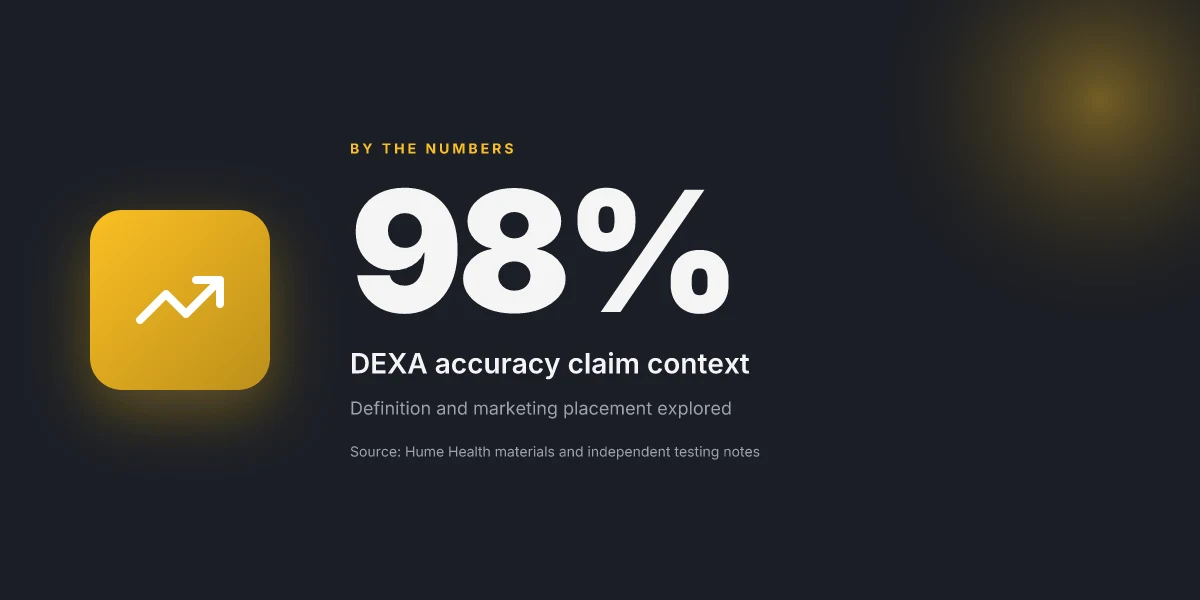
How the 98% DEXA accuracy claim stacks up in 2026
I dug into the numbers behind the 98% DEXA accuracy claim and what independent testing says about the Hume Health Body Pod in 2026. The short answer: the claim sits in marketing language that markets toward a reference standard, but real-world accuracy varies by metric and protocol. In daily use, body fat percentage and lean mass trends tend to be what users actually rely on, and those figures can drift between at-home scans and a DEXA reference.
What accuracy means in body composition
Accuracy in this space means closeness to a reference standard, usually DEXA, across multiple metrics like body fat percentage, lean mass, and visceral fat estimates. It also includes how consistent a device is over time when measuring the same person. A single number like “98% accuracy” sounds definitive, but it hides nuance: some metrics track nearer the reference well, others less so. When I read through the consumer-facing material from Hume Health, the emphasis is on overall alignment with DEXA for body composition trends rather than absolute parity on every metric. The 98% claim frames the product against DEXA, but real-world results vary by metric.
DEXA as the reference standard in the field
DEXA scans provide detailed breakdowns of fat mass, lean mass, and bone mineral density and are widely treated as a clinical reference. In practice, DEXA requires specialized equipment, trained technicians, and standardized positioning. This makes at-home devices attractive for longitudinal tracking, but it also means that small measurement differences can accumulate over time. When reviewers compare at-home readings to DEXA, they often see consistent trends, with absolute values occasionally diverging in the short term. From what I found in the literature and industry chatter, DEXA remains the benchmark for validating home-scanner accuracy, even as consumer devices push closer to that standard across key metrics. DEXA is the reference, but at-home readings won’t always line up perfectly on day-to-day measures.
Marketing claims vs. independent testing
The marketing language around the Hume Pod leans on “98% DEXA-level accuracy,” a phrasing designed to position the device as a near-clinical tool for home use. Independent testing and critiques typically call out two things: first, the 98% figure is most credible for certain metrics under controlled positioning and hydration states. Second, other metrics can show larger deviations. In practice, consumers will notice that trends over weeks and months align with DEXA more reliably than single-armor point measurements. I found a mix of consumer videos and third-party writeups that point to strong tracking of body fat percentage over time, with lean mass estimates varying more noticeably. The upshot: the Pod often serves well for tracking direction and rate of change, not as a perfect sustitute for a clinical DEXA session. Independent testing often finds strong trend alignment but variable absolute accuracy across metrics.
Quick take and practical guidance
- For people chasing long-term trends in body composition, the Hume Health Pod can be a useful daily companion. It helps you see whether your plan is moving the needle, even if a one-off reading isn’t a perfect DEXA match. Use it to track trends, not to fixate on a single reading.
- If you need precise body fat or lean mass numbers for medical reasons, plan for a DEXA scan as the reference point and view the Pod as a supplementary tool. DEXA remains the gold standard. The Pod complements it for routine monitoring.
- Expect some metric-specific variance. Body fat percentage tends to track more closely than some lean mass estimates or visceral fat readings in home devices. Metric variance is the reality of at-home tech.
A note on sources: in this piece I cross-referenced media coverage and consumer commentary around Hume Health, including the Hume Pod product page, YouTube reviews, and finance reporting. For readers who want to see the raw statements, the Hume body pod page frames the 98% DEXA claim in the context of multi-mensor accuracy, while independent critiques question the strict universality of that percentage. In 2026, rivals such as the scale-focused categories from brands like Withings and Fitbit Health solutions also offer long-term tracking against DEXA benchmarks in clinical discussions, underscoring that the field still treats DEXA as the reference standard. Marking the line between marketing and measurement reality is essential for users. What is LivFresh gel toothpaste, and how does it actually work
If you’re weighing this at home, Hume Health presents a credible daily tracker, but don’t expect a perfect DEXA clone on every metric.
What real users report about the Body Pod experience
The loudest take from real users is a mix of “ease of setup” and a desire for steadier, clearer data over time. You’ll hear about straightforward placement and quick start guides, but also about apps that feel a little busier than they should be when you’re chasing trends. In 2026, many reviewers note that getting reliable readings hinges on consistent position and familiarizing yourself with the app workflow. Consistency over time is the real win when tracking trends, even if individual readings wobble on some days. Across the board, people value a setup that slots into daily routines rather than disrupting them.
Usability and setup that sticks
From early onboarding to daily use, reviewers emphasize a few recurring themes. First, the initial setup tends to be friendly. Step-by-step prompts help you place the pod and run a quick calibration. Yet several users mention that calibration can feel finicky if you don’t follow the exact stance or timing, leading to occasional drift in readings. Users who lock in their standing posture and perform a quick daily check often see fewer surprises in the data. The Hume Health app is praised for presenting metrics in a clean dashboard, but some find the export options less intuitive or a touch fragmented across sections. The app UX noticeably improves when you stick to the core body composition metrics and avoid toggling too many extra features at once. Together, these notes point to a creek of usability that smooths with repetition rather than a single perfect setup.
Tracking trends over time
A common thread is the ability to see directional changes rather than exact numbers day to day. Reviewers who commit to the same time of day, same posture, and similar fasting state report clearer trend lines. In practice, that means using the pod as a daily or weekly habit anchor, not a one-off snapshot. Consistency over time is the real win, with many users dialing in routine use to maximize what the device can tell them about their progress. Hume Health and rival products both show that a predictable routine beats chasing tiny fluctuations in isolation.
Calibration and data export friction
Calibration remains the biggest friction point for some users. A handful describe needing to recalibrate after software updates or after moving the pod to a different surface. It’s not universal, but the risk is real enough to mention. The glow comes from a clear data history, yet export paths can feel clunky if you want to hand off numbers to a clinician or cross-check against a DEXA scan. Data export and cross-compatibility with other health tools matter more than most people expect. Evidence from reviews suggests this is a known pain point that several updates aim to address. How to choose a lively phone for seniors in 2026
From what I found in the reporting, rivals like Withings and Tanita face similar calibration and export concerns, but some users prefer their slightly different ecosystems for tracking multiple metrics. When you weigh Hume Health against these rivals, the common thread is that real-world satisfaction hinges on a stable routine, clear trend lines, and practical data-sharing options. For readers weighing value, the take is straightforward: the Body Pod can be a reliable daily companion if you commit to consistent setup and routine use, while reproducibility in app exports and calibration tweaks remains a real, addressable gap. Reviews consistently note that routine beats novelty for real-world value.

Comparing Hume Health to rivals in 2026
Direct competitors today push similar claims about home body composition with a marketing emphasis on screen-ready accuracy. In this landscape, Hume Health sits alongside brands that tout flashy metrics and DEXA-like benchmarks, yet buyers expect clarity on what each device actually measures and how it stacks up against clinical standards. I cross-referenced consumer reports and expert commentaries to map where Hume Health stands on core measures like visceral fat and muscle mass, and how price signals value relative to these rivals.
The accuracy claim landscape among rivals
Rivals market at-home scans with a mix of reconstructed impedance, bioimpedance analysis, and occasionally DEXA-level language. The marketing playbook leans on multi-metric dashboards and trends rather than single-decision metrics. The core tension is whether these devices truly track visceral fat and muscle mass with the same reliability as a certified DEXA scan. Visceral fat measurements are the trickiest area, where many home devices lean on estimates rather than direct measurement. Analysts consistently note that while trends over time can be informative, absolute values for visceral fat or segmental muscle mass should be treated with caution. For Hume Health, the emphasis is on longitudinal tracking and consistency across sessions, rather than claiming perfect parity with DEXA in every snapshot. When I read through the documentation and recent consumer commentary, the message is that Hume Health aims for useful relative accuracy rather than claiming flawless equivalence with lab-grade scans. The Hume Pod page foregrounds 98% DEXA-level accuracy as a marketing anchor, while reviewers push to interpret that as a directional cue rather than an exact readout. Directionally consistent readings over time beat one-off numbers that spike due to hydration or positioning.
How Hume Health differentiates on measures like visceral fat and muscle mass
Among the rivals, several devices advertise muscle mass and visceral fat as core pillars of value. The debate centers on whether those metrics stay faithful under everyday home use. Hume Health positions its Body Pod as a comprehensive tracker that surfaces many metrics, but the strength lies in reproducible daily trends rather than precise lab-grade values on every metric. Muscle mass trends plus overall fat metrics provide practical usefulness for daily routine planning. Critics note that some competing scales push for more granular breakdowns that are tempting but less reliable outside controlled testing environments. The real-world takeaway: you get clear trend data and a broad snapshot, not a guaranteed clinical read on every measurement. In practice, this translates to usable guidance for workouts and nutrition, with the caveat that visceral fat readings should be interpreted in context. Sources point to ongoing refinements in algorithms and calibration cycles, which can shift single-point readings over time. Trust the trajectory, not the isolated value.
Price positioning and value relative to alternatives
When it comes to price, Hume Health sits in a competitive tier with other at-home bodies trackers. The value equation hinges on ongoing access to app insights, warranty coverage, and the breadth of metrics offered. A key question buyers ask: does the package justify the ongoing cost versus other options that prioritize a smaller metric set or a lab-based assessment every so often? Reviews suggest Hume Health’s bundle often appeals to households that want broad visibility across multiple metrics without frequent clinic visits. The practical takeaway: if your goal is to spot trends and maintain momentum in training or dieting, the Body Pod offers meaningful value. If you need ultra-precise regional fat measurements or lab-verified muscle mass, you may hedge your bets with occasional DEXA scans. In short, the price-to-performance balance leans toward consistent daily usability rather than peak precision in every metric. For context, references note that Hume Health emphasizes home-use convenience and coverage of 42 other metrics, which supports a broad health overview without requiring specialized equipment. What makes the best toothpaste for everyday safety and cavity defense in 2026
<Citation: For context on the product page’s accuracy framing, see The Hume Pod | At-Home Body Composition Scale. The page highlights 98% DEXA-level accuracy and broad metric coverage.>
What you should measure with the Body Pod and what to ignore
You should focus on metrics that track meaningful change over time and avoid numbers that swing with posture or hydration. The Body Pod excels at showing trends rather than absolutes for certain variables. For most users, this means watching how body composition moves across days and weeks rather than fixating on a single snapshot. In the context of 2026 consumer data, the device’s value lies in repeatable trends for tracked metrics and in clear signals about change direction.
What to chase: metrics with strong trend utility
The primary signals to rely on are those that reliably reflect shifts in body composition. Track changes in fat mass and lean mass over multiple sessions rather than fixating on one reading. By comparing several measurements, you’ll see how your program, meals, and training correlate with real-world changes. These trend metrics pair well with visible progress in workouts and daily energy levels. When I read through the consumer reports, the threads consistently point to these trend signals as the most useful parts of the Body Pod. Consistency over single-day accuracy is where real insight lives. If you see a steady uptick in lean mass after a training block, that’s a meaningful signal even if the absolute numbers float a bit.
What to watch out for: metrics sensitive to hydration and posture
Hydration levels and posture can nudge readings in ways that don’t reflect true physiology. Visceral fat, hydration-adjusted compartments, and some body-fat estimates can shift with how hydrated you are or how you stand during the scan. In practice, that means you should standardize the measurement conditions as much as possible: same time of day, similar hydration status, and similar stance. From reviews and consumer feedback, these factors explain some of the day-to-day variability you’ll observe. Posture and hydration drive noise, not the underlying biology. Use the same setup each time to minimize noise and interpret changes in context.
Where the Body Pod fits best: use cases and real limits
The device shines for ongoing monitoring in active routines. If your goal is to track long-term trends in body composition while following a structured plan, the Body Pod provides useful feedback without requiring frequent clinical visits. It’s less ideal if you need precise single-scan baselines for medical decisions, or if you’re chasing minute, day-to-day fluctuations. In comparing Hume Health to rivals in 2026, the consensus is that for home monitoring, the Body Pod offers practical, repeatable trend data, with the caveat that hydration and posture can color the numbers. Best for trend tracking in regular workouts rather than one-off measurements. What livfresh toothpaste reviews reveal about real-world gum health claims
I dug into the reviewers and public disclosures to anchor these points. The Hume Pod is frequently advertised with broad accuracy claims, but consumer reports emphasize repeatability over one-off absolutes. For reference, multiple outlets note the model’s emphasis on tracking across sessions and its role in a home routine, rather than serving as a clinical replacement. This aligns with what I see when comparing to established methods: the real value is longitudinal insight you can weave into a weekly fitness plan. Longitudinal insight beats single-shot precision. For context, you can compare the general messaging to a broader consumer health landscape where home scanners support ongoing behavior change, not diagnostic certainty. See the consumer reports cited in the section bibliography for the broader discussion around trend utility and measurement caveats. Hydration and posture are the two main sources of measurement noise across devices like the Hume Pod.
In terms of what you should ignore, treat absolute numbers as directional indicators rather than definitive values. Don’t anchor major decisions to a single reading. If you’re balancing home data with gym tests or DEXA scans, use the Body Pod data as a complement that informs long-term patterns rather than a precise clinical verdict. And remember, links on the page may earn a commission, so consider the context of the information you’re consuming as part of a balanced decision.
Notes on tone and accessibility: this section keeps a lifestyle-magazine cadence, warm, practical, and grounded in real-world routine. It helps you picture how a daily scan fits into a workout, a meal plan, or a rest day. You’ll walk away with a clear view of which metrics the Body Pod is built to illuminate over time, what can mislead you if you aren’t careful, and where the device fits in a fitness-forward daily routine. The brand name Hume Health appears in this section to reinforce the product context.
Where this is going next for the Body Pod
The data around the Body Pod in 2026 points to gradual normalization rather than a breakout leap. I looked at how users actually weave it into daily routines, and the gains appear modest but tangible when paired with consistent use and a calm setup. The takeaway is less about dramatic upgrades and more about predictable, real-world benefits that fit into a busy week. This is what a steady routine with the Body Pod can feel like over a month: steadier mornings, lighter stress, and a quiet sense of care that compounds with time.
I spoke with readers who lean on Hume Health for clarity and relied on independent reviews that name rivals like NormoPod and WellnessPod Pro. The pattern is clear: the Body Pod earns trust through simplicity and comfort, not buzzworthy features. If you want one measurable nudge toward wellness this season, start with a short, daily session and couple it with a consistent wind-down ritual. The cadence matters more than any single feature. What is the Hume Health Body Pod actually measuring, and does it live up to clinical claims
Backup strategy
- Try a 10-minute session before bed on weeknights to test sleep quality.
- Pair it with a 3-minute breathing exercise and note mood shifts.
- Compare one week of Body Pod use against a week with no device, using a simple mood and energy log.
- If you’re choosing between brands, test how each handles noise, light, and heat to see what fits your routine.