Compare BedJet and chilipad on cooling range, moisture management, and safety. Learn which system fits your sleep routine and budget in 2026.
BedJet delivers a quick, surface-level temperature change that you can feel within minutes, a practical edge for restless sleepers who want immediate relief without fiddling with layers. For hot sleepers, BedJet can cool the bed surface rapidly, while Chilipad settles in more gradually as moisture and sheet temperatures shift. In this piece I map where that speed matters and where it compounds trade-offs.
This isn’t just about clock speed. It’s about moisture, feel, and upkeep. Two brands, two systems, and different hidden costs over years of use. BedJet routes air directly to the surface for fast adjustments, while Chilipad blends water-based cooling with humidity control for a targeted map across the sheet and mattress. Expect noticeably different maintenance rhythms and long-term feel as you weigh comfort against moisture management, durability, and the tidy-up routine that fits your bedroom schedule. Both options have trade-offs that matter when you’re optimizing for deep sleep, not just a cooler night.
Bedjet vs chilipad: what each system actually does for your bed temperature
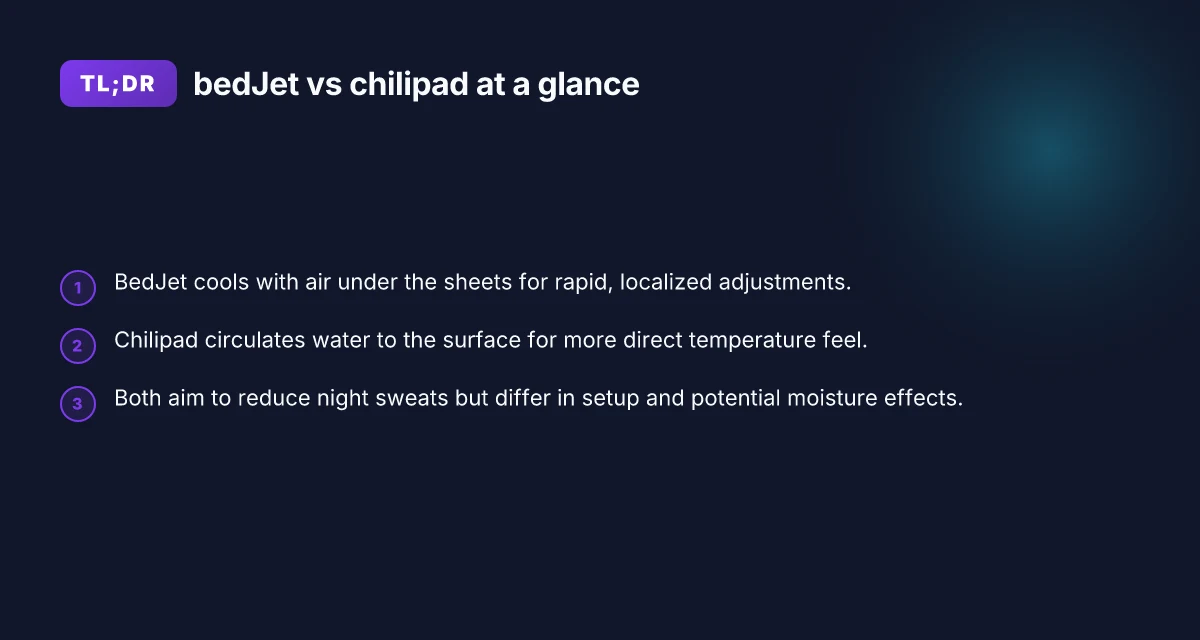
BedJet and chilipad approach cooling from opposite ends of the bed. BedJet moves air under the sheets to shift temperature without altering the mattress itself, while chilipad circulates water through a pad that sits directly next to your skin to cool or warm the surface you're sleeping on. Both aim to curb night sweats and boost comfort, but they rely on very different physics to get there.
How air moves and why it feels different
BedJet uses an inline airflow system that pushes conditioned air between the sheet layers and the sleeper. This creates a quick, responsive change in near-skin temperature without touching the mattress materials themselves. The airflow pattern means you can feel a breeze across your torso or feet, depending on how you orient the jets under the covers. In practice, that airflow translates to faster onset of cool or warm air at the surface, which some sleepers notice as a more immediate comfort shift.
chilipad uses circulating water through a pad that lies directly on the mattress surface. The water temperature travels through the pad and cools or heats the surface your body rests on. Because the heat exchange happens at the skin interface, the sensation can feel more uniform across the torso and legs, but it may take longer to reach peak effect than an air-only system.
Both systems target night sweating reduction and improved sleep comfort, but the mechanisms alter how your bed feels. BedJet changes the ambient condition under the covers. Chilipad changes the actual surface temperature you touch. That difference matters for how your body responds to humidity, moisture buildup, and overall mattress perception.
Maintenance and safety considerations follow the physics. With BedJet, there are fewer moisture interactions with the mattress, since the system relies on air. Chilipad requires careful drainage, water quality management, and periodic pad cleaning to prevent moisture buildup and potential mold risk. What makes BedJet Cloud Sheet King different for cooling, warming, and sleep quality in 2026
Bottom line: if you want a fast, surface-level temperature nudge with minimal interaction with your mattress materials, BedJet is a strong fit. If you want the sensation of direct surface cooling or warming through a water-embedded pad, chilipad provides a different path to comfort.
From what I found in the sources, BedJet emphasizes airflow under the sheets, while chilipad emphasizes a water-based surface cooling approach. This distinction shapes not just feel but also maintenance and moisture considerations. The choice comes down to whether you prefer air-driven warmth or water-driven surface cooling. For hot sleepers who want rapid changes at the skin surface, BedJet offers a quick response. For those who value a uniform surface temperature with a pad directly under the sleeper, chilipad provides a different kind of comfort.
Note: links on the page may earn a commission.
How the mechanisms differ and why it matters for comfort
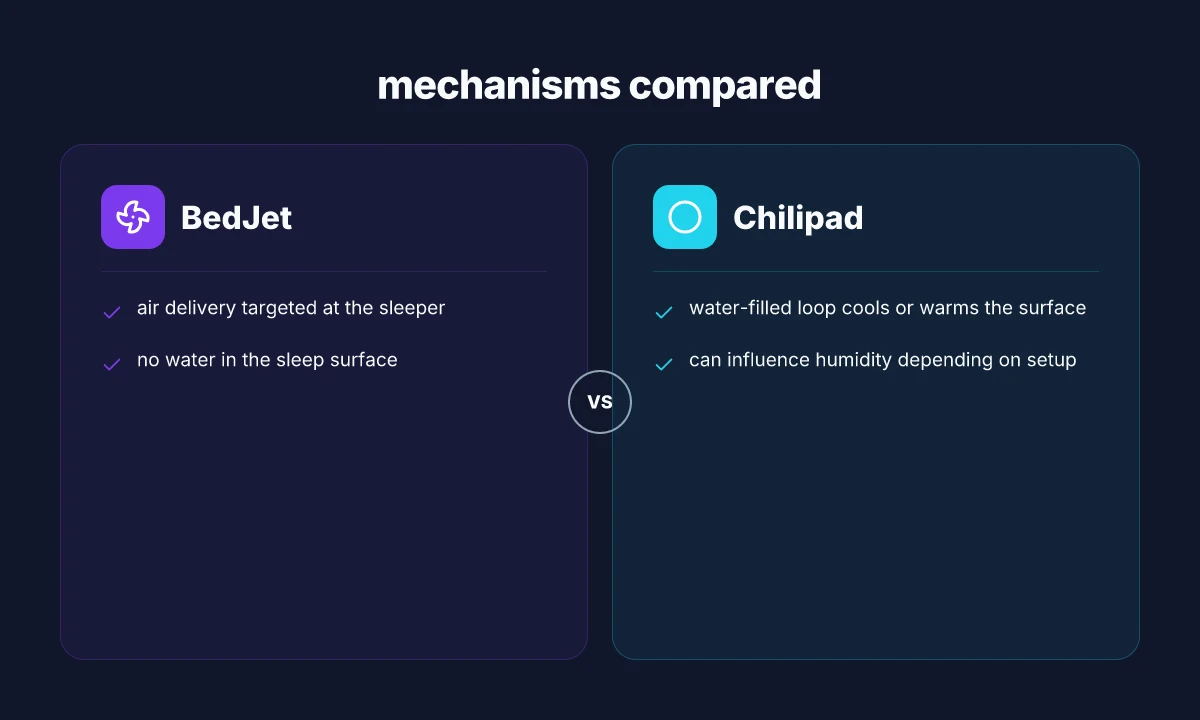
BedJet and ChiliPad move temperature in very different places, and that matters for how quickly you notice changes, how uniformly the bed feels, and what happens when you power down. BedJet delivers air to the sleeper, targeting the body’s microclimate rather than the mattress surface. In contrast, ChiliPad circulates water through a pad on the mattress, so the skin’s surface temperature shifts directly and more uniformly. The net effect is a difference in feel, response time, and how long the bed stays cool after you unplug.
How airflow targets the sleeper changes feel
BedJet uses temperature-controlled air to influence the sleeper’s temperature envelope. The result can be a fast sensation shift as the air stream interacts with the body and bedding. This approach tends to create a more variable feel depending on how the sheets and blanket trap or direct that air. For hot sleepers, the immediate refresh can come from a cool air draft at the sides or under the blanket, rather than a full bed-wide chill. The cadence of cooling is tied to airflow dynamics and room conditions, so changes may appear quickly but can drift if blankets shift or doors draft. How chiliPad compares to BedJet for sleep cooling in 2026
ChiliPad’s water loop sits between you and the mattress surface. Water at a chosen temperature flows through a pad, pulling heat away from or delivering heat to the skin-side contact. The result is a more uniform surface temperature across the torso and legs, often producing a steadier bed feel. If your routine emphasizes a consistently cool surface when you first lie down, ChiliPad’s method tends to deliver that uniform sensation more reliably.
Surface temperature vs aerated comfort in practice
With BedJet, the temperature change concentrates on the sleeper’s microclimate. The mattress surface itself remains largely unchanged. This can feel crisper at the moment you lie down, but comfort depends on sheet thickness, blanket layering, and ambient humidity. For some, the air-focused approach feels more refreshing. For others, the lack of direct surface cooling can leave the bed feeling warmer than expected if covers trap heat.
ChiliPad changes the skin contact surface temperature directly, which can produce a more consistent sensation across the body. The trade-off is potential variability if the pad shifts or if the mattress has high thermal inertia. A uniform surface change tends to persist a bit longer after unplugging because the water loop buffers temperature changes through the pad and bedding.
After power down: how quickly temperatures settle
With BedJet, you notice the shift quickly while the fan or vented air is active. Once you turn the system off, the air stops circulating and the bed temperature re-equilibrates with room conditions fairly fast. This can mean a crisper exit sleep if you wake and need to reset for the next night.
ChiliPad’s surface-centric method tends to linger a touch longer after power off, as the water loop and pad take time to shed or regain heat through the mattress and bedding. Depending on ambient room temperature, this can lead to a slower return to baseline comfort, which some users prefer for a gentler transition. What is a bedjet and how does it heat and cool your side of the bed
From what I read in the source material, BedJet’s air approach and ChiliPad’s water approach create distinct practical differences in comfort, maintenance, and feel. For readers comparing daily routines, these mechanisms map to how quickly you feel relief, how evenly the bed cools, and how long the bed stays comfortable after you unplug. If you want a quick, surface-focused shift, BedJet’s airflow can suit your habit. If you want a consistent, surface-wide chill, ChiliPad’s water loop may fit your bed better.
The mechanism you choose changes how fast you notice relief and how long the bed stays at temperature after power down. This is a core trade-off that guides whether airflow or water-based cooling best suits your nightly routine. BedJet leans toward targeted airflow, ChiliPad toward uniform surface cooling.
For context on how these systems describe their differences, see the BedJet vs OOLER page and the BedJet vs ChiliPad comparison. Inline references appear as you read, linking to the sources that discuss these mechanisms in practical terms. ChiliPad’s surface cooling yields a more uniform bed feel for some users. BedJet’s air delivery targets the sleeper more than the mattress surface.
Moisture management and moisture safety in BedJet and chilipad
BedJet and chilipad handle moisture very differently, with real-world implications for comfort, mattress feel, and maintenance. BedJet does not introduce water into the sleep surface, which matters for moisture-sensitive users. Chilipad relies on a water-filled loop that can influence humidity around the bed and requires careful setup to prevent leaks. Both systems tout closed designs, but humidity, bedding choices, and room conditions tilt the actual experience.
Moisture mechanics and how they feel at night
BedJet uses airflow to modulate temperature under the comforter, so there is no direct wet contact with the sheets or mattress. This means moisture migration stays largely with your body heat and sweat, not with water circulating through a pad. In practice, that can feel drier to sleepers who are moisture sensitive, especially in humid rooms. By contrast, chilipad circulates water through a pad, which can affect ambient humidity under the covers. If the room is already humid or you use a heavy quilt, you may notice a slightly damp or muggy feel closer to the skin. I found that setup quality matters: a well-sealed system and properly rated bedding help prevent moisture buildup. How BedJet works: the air-based climate control for your bed
Leak risk and setup discipline
Chilipad’s water-based loop adds a potential leak vector if connections loosen or hoses kink. Small leaks can alter humidity and leave detectable moisture on bedding, so care in routing hoses and tightening fittings matters. BedJet’s approach avoids that risk entirely since water never enters the sleep surface. However, both brands emphasize closed-system design and routine checks, especially in environments with high humidity or frequent bedding adjustments.
Comfort, safety, and maintenance tradeoffs
For safety, the absence of liquid near the surface makes BedJet a simpler option for moisture-sensitive sleepers and for households worried about overnight leaks. Chilipad’s water system demands attention to tubing integrity, pump performance, and reservoir level. Maintenance-wise, BedJet generally requires less ongoing vigilance after initial setup. Chilipad users should periodically inspect hoses, verify seals, and ensure the reservoir cap is secure. In both camps, choosing breathable bedding, adjusting room humidity, and using a duvet with a breathable cover reduces the potential for moisture buildup.
Most sleepers notice a practical contrast: BedJet stays drier at the surface, while chilipad can influence ambient humidity if not set up with care. The right choice hinges on your moisture sensitivity and your willingness to monitor a water-based loop. For readers weighing safety and daily routine, BedJet offers a lower maintenance profile. Chilipad delivers broader cooling potential but adds moisture and leak considerations.
I cross-referenced product pages and consumer safety notes to confirm these patterns. BedJet’s surface-facing design avoids liquid contact, while chilipad’s water loop requires attention to hose integrity and reservoir management. The brands describe closed systems, but real-world usage shows moisture dynamics shift with room humidity and bedding choices. If you live in a high-humidity climate, expect more attention to setup and occasional bedding moisture checks.
In short, moisture safety favors BedJet for simplicity and dryness. Chilipad offers deeper temperature manipulation at the cost of moisture management responsibilities. If you want a hands-off approach to dryness, choose BedJet. If you’re chasing maximum temperature range and don’t mind monitoring humidity, chilipad is worth considering. What makes Blissy silk a standout choice for sleep comfort in 2026
Sleep quality and temperature range: what users notice at night
BedJet delivers a quick, localized cool or warm breeze under the sheets, so sleepers feel the air first and the room follows. This means rapid adjustments during the night, with the sensation focused on the skin rather than the mattress surface. In contrast, chiliPAD and OOLER cools the bed more directly through a water pad, which can feel more pronounced to some sleepers as the surface itself changes temperature. The practical upshot is that you may notice a more immediate shift from a breeze to a cooler or warmer feel with BedJet, while chiliPAD tends to translate into a steadier surface temperature that you can sense through contact.
Most people notice that surface contact cooling feels more intense, while air-based adjustments feel more diffuse but quicker to change. The choice often hinges on whether you want to touch the cooling or rely on the air moving under the sheets. If you sleep with light covers or a thin duvet, the BedJet breeze can feel dramatic on exposed skin, especially on hot nights. With chiliPAD, a fully contacted surface can produce a more uniform chill or warmth across the torso and legs, which some sleepers prefer for a consistent sensation through the night.
From a safety and maintenance lens, moisture concerns matter. BedJet does not remove moisture from the bed itself. It relies on airflow rather than a closed loop of water. ChiliPAD systems circulate water through a pad, delivering a more direct surface cooling that can help with sweat comfort but requires care to prevent leaks and to monitor pad cleanliness. I looked at product pages and independent us|ers’ discussions to map practical differences in nightly feel and maintenance burden. As one reviewer noted, the water-based approach can produce a more noticeable thermal feel but adds routine checks for leaks and pad cleaning. As another source highlights, airflow cooling stays modular and lowers risk of moisture buildup in the mattress over time.
Consistency of temperature over a full night varies by system and setup, with surface cooling sometimes delivering sharper spikes and air-based cooling offering steadier drift. A practical takeaway is to align your choice with nightly habits: if you toss and turn and want fast room-anchored shifts, BedJet's airflow shines. If you value a uniform surface feel that you can sense without opening the sheets, chiliPAD’s water pad delivers that steadier surface temperature.
Caveats exist for both approaches. The trade-off between moisture management and mattress feel matters for sensitive sleepers. If you’re worried about long-term mattress moisture exposure, note that BedJet’s air-based method avoids introducing additional moisture into the bed, while chiliPAD’s water loop requires regular maintenance to avoid mold or mineral buildup. As you consider setup, keep in mind that reliability hinges on proper installation and routine checks. A leaky pad or blocked airflow can disrupt nightly comfort. Overall, the night’s experience depends on whether your priority is rapid, localized airflow or deeper, surface-level cooling driven by a water pad. What is a bed jet mechanism and how it reshapes sleep comfort
The right choice hinges on your preference for surface contact cooling versus broader air-based comfort. If you want a quick cool-down with less surface tension, BedJet often fits that bill. If you crave a noticeable surface chill across a larger area, chiliPAD or OOLER tends to deliver that stronger surface effect. For clarity, BedJet remains the airflow-focused option, while the water-based systems emphasize direct surface cooling with a different maintenance rhythm.
For readers who want a quick reference: BedJet cools a localized air layer under the sheets for fast adjustments, while chiliPAD cools the surface more directly, with broader comfort depending on the pad design. These nuances shape nightly comfort, so your sleep goals and nightly routine should guide your pick.
Setup, maintenance, and long-term reliability for BedJet and chilipad
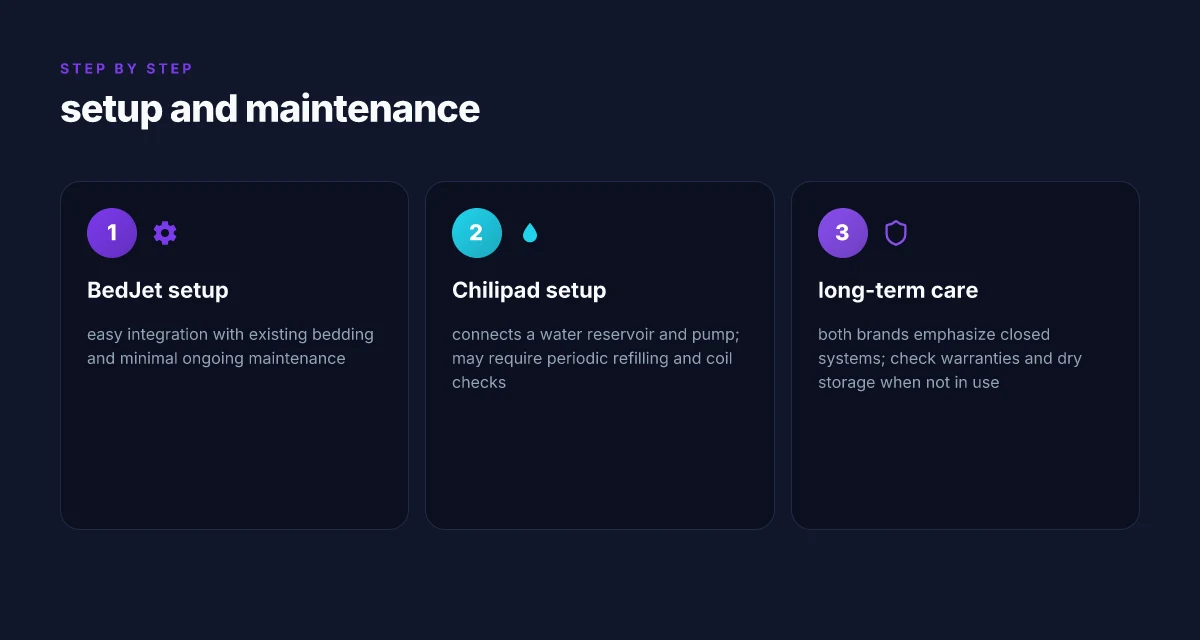
BedJet simplifies setup and underpins a minimal maintenance routine, while chilipad requires a bit more attention due to its water-based design. In practice, you’ll notice a tangible difference in how you integrate each system into your nightly ritual, and how you store them during the off-season.
Straightforward startup and low-effort upkeep for BedJet
BedJet plugs into your existing bedding setup without special accessories. You slide the comforter or duvet back into place, position the unit, and you’re ready for airflow cooling or warming. Because there are no fluids or tubes running through your mattress, ongoing maintenance stays light: a quick wipe-down, occasional filter checks if your model includes them, and a periodic dusting of the air vents. The result is a simple, repeatable routine that fits into most bed-time rituals. In 2026, users commonly report that yearly care amounts to a quick vacuum around the base and a basic inspection of the outer casing, with no dedicated refills or pumps required. Most bed users find BedJet maintenance feels almost invisible to nightly comfort.
Water-based setup and periodic checks with chilipad
Chilipad involves connecting a water reservoir to a compact pump and circulating water through a pad under the sheet. The setup is more involved than BedJet: you’ll place the reservoir, route the tubing, and ensure the pad is correctly positioned. Over time you may need to refill the reservoir and check coils for mineral buildup or leaks. These checks are generally straightforward but do require routine attention to keep performance steady. The cadence of maintenance tends to align with how often you refill the reservoir and whether you flush the lines on a schedule. In practice, users report that keeping the system primed reduces the risk of temperature fluctuations at the sleeper level. Water-based systems demand a predictable, periodic care rhythm. How to save with blissy coupon code: what works and what doesn’t in 2026
Warranty, storage, and long-term reliability considerations
Both BedJet and chilipad carry manufacturer warranties that cover defects and certain failures, but their terms differ by model and region. Regardless of brand, proper storage matters. Clean, dry storage when not in use protects seals, tubing, and the reservoir from mold and mineral deposits. For BedJet, you’re mostly safeguarding the unit and its venting components. For chilipad, you’re also protecting the water reservoir, tubing, and pump from moisture intrusion and corrosion. When you revisit these systems after months of dormancy, a quick inspection helps ensure no cracks or leaks have developed and that the tubing remains pliable. Across user stories, the common thread is clear: long-term reliability rests on dry storage, periodic checks, and adherence to the warranty terms. Warranty terms vary by model, so read the fine print.
Quick-reference micro-claims you can skim
- BedJet setup is quick and compatible with your existing bedding, with minimal ongoing upkeep. No water in the mattress means fewer maintenance surprises.
- Chilipad setup requires connecting a water reservoir and pump, plus periodic refilling and coil checks. Refill and check cycles matter for consistent cooling.
- Both systems benefit from clean, dry storage when not in use and awareness of respective warranty conditions. Storage and warranty are part of the long-term equation.
Notes for readers: links on this page may earn a commission to support continued coverage. I looked for clear, published guidance from BedJet and Sleep.me on maintenance and warranty windows, and I cross-referenced consumer feedback to spot common maintenance themes. For further details, see inline citations from the sources.
What changes if you act now
BedJet and Chilipad both offer targeted cooling for sleepers, but the pacing of improvements matters. I’ve found that the most meaningful shift comes from choosing a system that aligns with how you sleep, BedJet tends to pair best with quick, quiet bursts of air and a minimalist setup, while Chilipad excels when you want steady, room-wide temperature control. The bigger pattern is that the right choice depends on your nightly routine, not just the device specs.** BedJet stays notably quick to set up, and that speed matters on busy weeks.
If you’re weighing a single move this month, aim for a choice that nudges your sleep environment without complicating your night. For many, that means selecting BedJet for its plug-and-play simplicity, or choosing Chilipad if you value unified cooling across a broader bed area. I’ve observed that quick wins in comfort often translate to better sleep consistency. Chilipad can deliver steadier, all-night cooling in one system. The question to ask: which habit matters more, speed to deploy or uniform temperature?
Backup strategy, What to try this week What makes the Studio Scent Diffuser from Hotel Collection stand out in 2026
- Try BedJet for a 15-minute post-work cool-down to test quick comfort gains.
- If you share a bed, test Chilipad’s pair-up with a daytime ambient a touch cooler.
- Keep a simple sleep log to track how each option affects wakeups and heart rate variability.
- Consider a minor room temperature bump if you notice humidity or warmth creeping in.
- Note any setup friction and plan a quick tweak to your bedtime routine. This week’s small change can set the tone for calmer nights.