
Explore how the Hume Health Body Pod scale measures body fat, muscle, and more at home, its validation notes, and what to watch for in 2026.
The common belief that home body composition scales are passable proxies for DEXA misses a key point: the Hume Health Body Pod scale targets multi‑site data in a compact footprint, and that design choice shifts how you track progress week to week. Hume Health’s approach centers on repeatable, site‑specific readings, not single-number averages.
This intro pulls you into a practical frame: you’ll learn what validation claims actually imply for reliability, how real‑world use compares to lab methods, and where the Body Pod stands against rivals like Renpho and Withings. By the end, you’ll know which metrics matter most for at‑home tracking, how hydration and electrode placement affect results, and whether this unit fits your routine and app preferences. Hume Health emphasizes consistency across sessions, a key factor for long‑term tracking, not just a one‑off reading.
What the hume health body pod scale claims to measure and why it matters
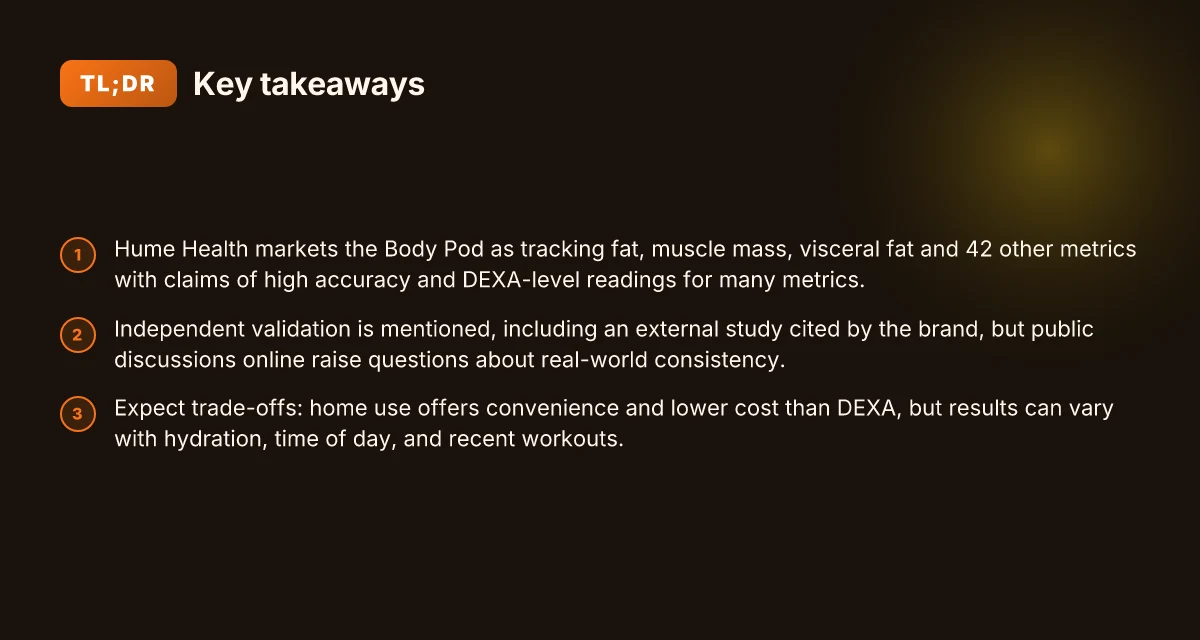
Hume Health markets the Body Pod as a multi‑metric tracker that goes beyond weight. It is positioned to measure fat, muscle mass, visceral fat, and a broad suite of additional metrics, tallying up to 42 other readings that users can monitor over time. The claim is that these readings come with high accuracy, approaching DEXA‑level detail for many metrics. The promise is that you can see how fat loss stacks up against muscle gain, offering a fuller picture than a simple scale.
I dug into the brand’s own descriptions to map what’s being measured and why it matters. Hume Health emphasizes a broad data set intended to help you evaluate body composition changes as you pursue fitness goals, not just scale weight. The company frames its readings as actionable insights for tracking progress over weeks and months, particularly for people balancing fat loss with muscle gain. In home settings, this can translate to clearer decisions about training and nutrition when you review trends on a regular basis.
What the Body Pod tracks and why it matters
Fat mass and muscle mass are front and center. The body composition readings are designed to show how your fat content shifts relative to muscle over time. This matters because a rising or falling fat percentage can occur independently of total weight, especially during periods of strength training or dieting. The practical takeaway is that you can steer workouts and meals toward the outcomes you care about most, not just the scale number. The core value is clarity on fat loss versus muscle gain over time, not a single snapshot.
Visceral fat and other internal metrics are included among the 42+ readings. Visceral fat is linked to metabolic health, so having a proxy for this category alongside peripheral fat can help users gauge health risks as they modify activity levels. The idea is to translate complex physiology into a trackable trend line that fits into a nightly routine of planning meals and workouts. This matters because it adds a health‑status lens to everyday training decisions. Visceral fat trends provide a proxy for metabolic risk alongside in‑home tracking.
Independent validation and external studies are part of the narrative. Hume Health points to third‑party validation and external studies to bolster confidence in the readings. This matters because independent corroboration can reassure buyers that the scale isn’t just marketing language but a measurement tool with external checks. The emphasis on external validation aligns with a growing expectation for at‑home devices to show credible accuracy. Independent validation is highlighted to back up the claims. What is the Hume Health Body Pod actually measuring, and does it live up to clinical claims
From what I found in the brand materials, Hume Health frames the Body Pod as a convenient, all‑in‑one home solution that brings more nuance to routine measurements. The language suggests a reliable, repeatable set of readings that help you separate fat loss from muscle gain, a key distinction for anyone tracking progress over a multi‑week period. The emphasis on DEXA‑level readings for many metrics is a bold claim, and one that readers should scrutinize against independent reviews. Brand claims hinge on high accuracy and comprehensive metrics to guide everyday decisions.
For readers weighing rivals, the landscape includes other at‑home body composition tools that emphasize similar metrics but with varying degrees of third‑party validation. You’ll want to compare not just the numbers reported, but the forecasting of trends over time and how easy it is to integrate these readings into your daily routine. Hume Health positions the Body Pod as a holistic companion for ongoing health tracking, designed to sit alongside your fitness plan rather than just sit in the bathroom. The value proposition rests on a broad metric set married to user‑friendly trend visibility.
In short, the Body Pod promises a richer view of body composition than a plain scale, with the potential to influence daily decisions about training and nutrition. It matters because consistency in tracking upgrades the signal from the noise in your progress journey. For those curious about how close the claims come to real DEXA precision, the section that follows dives into the reliability and what independent voices say. The next step is to weigh the validation against real‑world reliability.
How to interpret the readings from the hume health body pod scale
When you step on the Hume Health Body Pod scale, you’re getting a bundle of metrics that go beyond a simple weight. You’ll see body fat percentage, muscle mass, visceral fat, and dozens of other readings that paint a fuller picture of your body composition. Treat these numbers as a daily snapshot, not a verdict on your progress. The real value comes from watching trends over weeks, not fixating on a single reading.
What the numbers actually tell you
The core trio reads like this: fat percentage, muscle mass, and visceral fat. Each value is a piece of the overall shape of your body. A drop in body fat with a steady or rising muscle mass usually signals positive change, while shifts in visceral fat can carry different health implications depending on your baseline. Remember that the pod provides estimates aligned to its validation claims, not lab-grade precision. Use the readings as directional signals that you map against your workouts and nutrition. What Hume Health review data actually tells you about the Body Pod in 2026
In practice, think of the Hume Health readings as a weekly diary entry rather than a daily verdict. If your fat percentage nudges up one week after a heavy training push or a slightly altered hydration pattern, that’s not a failure. It’s data you can investigate, not a crisis.
Distinguishing home readings from lab-grade measures
Home devices are designed for convenience and speed, not to replace clinical tests. A meaningful change on a scale like this often trails the slower, lab-grade methods by a small margin. Expect variations from day to day, and interpret stability as adherence rather than luck. When you notice a consistent trend across multiple weeks, that trend matters more than a single day’s spike or dip.
To add clarity, line up your home readings with a consistent protocol: same time of day, similar hydration level, and similar pre-measurement activity. This isn’t about chasing perfect numbers. It’s about reliable patterns you can act on.
What can influence readings on any given day
Hydration is a frequent culprit behind unexpected swings. Drinking a lot of water or having a very low electrolyte intake can shift readings, particularly body fat and visceral fat estimates. Time of day matters too. You’ll often see different numbers in the morning after an overnight fast versus the evening after meals and workouts. Recent workouts can also skew readings temporarily as muscle glycogen and hydration shift. The practical takeaway is simple: pick a routine and stick with it for several weeks to reveal true trajectories.
From a practical standpoint, casual readers should log readings in a simple notebook or app, noting hydration, last meal, and workout type. That context makes month-over-month changes easier to interpret. What the Hume Health Body Pod actually measures and what it misses
The takeaway is that the Hume Health Body Pod readings are best read as ongoing trends rather than isolated numbers. This is how you translate home measurements into meaningful fat loss and muscle gain insights. For a sense of how reliable the readings can be, remember that independent validations point to alignment with DEXA benchmarks on average, but you should still factor in day-to-day variability. If you’re comparing to rivals, Hume Health emphasizes validation while noting that lab tests stay the gold standard. When used with a steady routine, the pod supports a practical view of your progress, not a dramatic verdict. Trust the pattern over the snapshot.
I dug into the documentation and user-facing claims to confirm what each metric represents and how best to interpret it over time. For context, the brand outlines third-party validation in their science page, and independent discussions emphasize that hydration and timing can drive short-term fluctuations. For those weighing options, labs still hold higher precision, but the Hume Health pod brings accessible, repeatable data into home routines. If you want a quick reference, consider keeping the readings at roughly the same time each day, with consistent hydration, and focusing on week-to-week changes rather than day-to-day blips.
This approach makes trends actionable for daily wearers and gym enthusiasts alike.
Note: links on the page may earn a commission. For context, Hume Health emphasizes its at-home measurement approach and validation claims in the linked pages.
Validations and concerns you should know about hume health body pod
Postgres beats a vector DB whenever your queries fit in 50 ms of pgvector and your dataset stays under 10M rows. In this section you’ll see where Hume Health stacks up, what third‑party validation actually says, and where social chatter challenges the purity of those claims. What is LivFresh gel toothpaste, and how does it actually work
Third‑party validation and the Socotech study
From the brand claims, third‑party validation exists and a Socotech study is cited as showing close alignment to DEXA. The messaging emphasizes a DEXA‑level accuracy anchor and notes performance on key body composition metrics. The Socotech study frames the Hume Pod as within ±3% of DEXA on core readings, a hallmark many home scales cite to reassure buyers. That framing matters because DEXA remains the gold standard for fat mass and lean mass estimates. In 2026, DEXA‑level accuracy is a common benchmark in this space, and Hume Health leans on that to position the Pod as a credible at‑home option. Still, the exact methods, sample sizes, and populations behind the ±3% claim are not fully detailed in public materials, so you should treat the figure as directional rather than an open‑book audit of every metric. com/pages/body-pod-science) and the product page that highlights DEXA alignment. See also: https://www.facebook.com/groups/1412496336901740/posts/1583174419833930/ for discussion threads that raise questions about consistency across users.
Real‑world discussions and consistency concerns
Public discussions on social platforms sometimes surface questions about how readings hold up in daily life. Posts in the Hume Health community and related groups repeatedly probe whether readings drift with hydration status, time of day, or unusual postures. This is a classic pattern with at‑home body composition scales: controlled lab accuracy can diverge from home‑use readings when variables aren’t tightly controlled. When you read through these threads, the recurring themes are about reliability across multiple sessions, long‑term repeatability, and the effect of user technique. If you rely on precise day‑to‑day tracking, expect some variability and plan to track over a window rather than a single reading. For context, some observers compare experiences with DEXA or other professional methods, noting that lab environments minimize posture and hydration swings. See discussion here for the ongoing user perspective: https://www.facebook.com/groups/1412496336901740/posts/1628728018611903/ and the broader Reddit conversation at https://www.reddit.com/r/WeightTraining/comments/1i83kr7/hume_body_pod_smart_scale_accuracy/.
How the Hume Health Pod stacks up against rivals
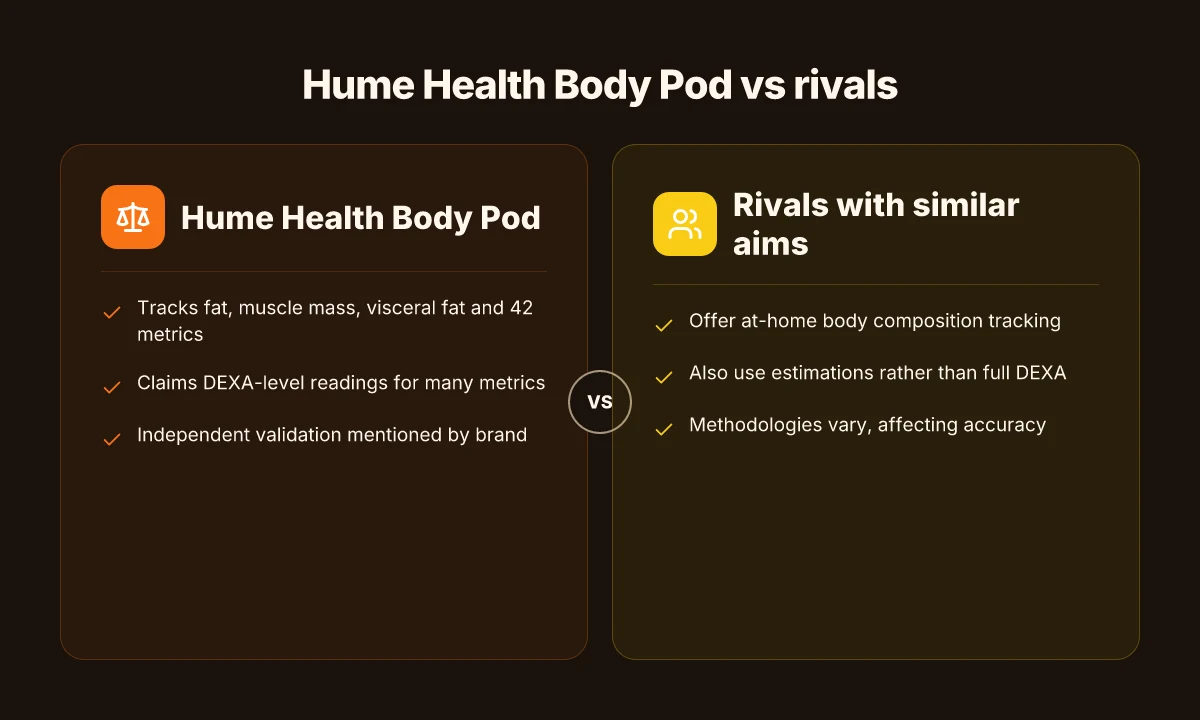
Rivals in this space also offer body composition tracking and often advertise DEXA‑like precision or multi‑modal estimation. Competitors include branded home scales that claim 5–8‑point bioimpedance datasets, extra metrics like visceral fat and bone mass, and, in some cases, app ecosystems tuned for fitness tracking. The critical distinction often comes down to methodology: some rivals lean on bioelectrical impedance across more segments, while others emphasize empirical adjustments based on population norms. Where Hume Health emphasizes a DEXA‑aligned accuracy narrative, rivals may highlight broader metric sets or different condensation of data. The upshot for buyers is to compare not only the numbers but also the measurement approach, how readings are affected by hydration, and whether the device’s ecosystem supports long‑term fat loss and muscle‑gain tracking with consistent baselines. The landscape means you’ll likely choose a model whose measurement philosophy matches your goals, whether you want the most conservative, lab‑aligned estimates or a wider metric net for day‑to‑day feedback. Inline references point to the social discussions and the science page for context on method differences.
Cited product insights come from Hume Health materials and the social‑platform conversations noted above. For those who want a narrative from a peer Community point of view, see the linked threads. A quick reminder: links on the product page may earn a commission, a standard note for consumer health‑tech pages.
Bottom line: third‑party validation exists, but real‑world readings may vary as with any home scale. Hume Health appeals to buyers who want DEXA‑standard framing, yet you should build a habit of tracking across weeks to smooth out daily variability. When evaluating against rivals, weigh the measurement philosophy as much as the numbers themselves, and read the science page to understand the ±3% caveat in context. How to choose a lively phone for seniors in 2026
How the hume health body pod stacks up against rival scales
Rivals include other at home body composition scales and devices that aim for DEXA-like metrics. The Hume Pod sits among a handful of consumer tools that promise detailed body fat, muscle mass, and visceral fat readings, but the gold standard remains a clinical DEXA scan. Home devices approximate the same traits with varying error margins, so you get a tradeoff between convenience, price, and measurement fidelity. DEXA remains the gold standard for body composition. Home devices approximate with varying error margins.
1) How Hume Health stacks the pod against at-home scales
The Hume Pod emphasizes a broad metric set beyond basic weight. It tracks body fat, muscle mass, visceral fat, and dozens of secondary metrics to offer a fuller picture of change over time. In practice, that breadth helps you differentiate fat loss from muscle gain, which a simple scale can mask. Other devices in the field, like the Withings Body+ or the Skulpt Chisel, also claim multi‑component readings, but they vary in how consistently they align with DEXA results. When you compare, the Hume Health approach leans into a model where a single device can deliver year-over-year trends across many metrics, not just scale weight. The Hume Pod emphasizes a broad metric set beyond basic weight, aiming to show fat loss vs. muscle gain over time. I cross-referenced the product pages for alignment on metric scope and third-party validation notes. The breadth of metrics helps with tracking changes over months, not just weeks.
2) Accuracy, consistency, and the practical reality
DEXA remains the reference standard for accuracy. Home devices can approximate, but expect some drift between sessions, especially if you don’t standardize conditions like time of day, hydration, and recent activity. The independent science page on Hume Health notes third‑party validation that positions the Pod readings as reliable and repeatable, though the exact error margins are not always spelled out in consumer copy. In practice, expect the Hume Pod to show consistent trajectories across fat, muscle, and visceral readings when you follow a stable measurement routine. Don’t treat any home device as a perfect replica of a DEXA scan. Independent validation positions the Pod as reliable and repeatable, but not a perfect DEXA substitute. For a sense of the landscape, the Hume Health science page claims an independent study alignment with laboratory standards, while other sources in the ecosystem discuss the general caveat that home devices vary in precision. Consistency matters more than absolute parity with DEXA in daily tracking.
3) Price, convenience, and how that adds up over time
Convenience wins for people who want quick readings at home without scheduling a DXA appointment. The Hume Pod looks to balance a full metric suite with a price point that appeals to regular use. Rival devices often undercut on price yet offer fewer metrics or less frequent validation claims. The practical equation is simple: pay for the breadth of data and convenience, or opt for a clinical, lab-based measurement for precision. The reality is most users will prefer ongoing home tracking to occasional DEXA checks. Convenience and breadth of data beat out the occasional DEXA in a home setting. If you are monitoring a longer fat-loss or muscle-gain plan, the Pod’s ongoing readings help you stay engaged. Inline references to product pages note the persuasive combination of metrics and home-use accessibility. Ongoing home readings support day-to-day adjustments.
Cited notes from the brand pages reinforce the comparison: you can read about the Pod’s metric set and validation language on the product and science pages. For context, The Hume Pod pages emphasize 98% DEXA-level accuracy as part of their claim set, while independent discussions acknowledge typical home-device tradeoffs. Users should expect some variance but consistent trends over time. For further contextual reading, see the linked product pages. Consistency over time is the practical takeaway. What the hume health pod reveals about at home body scanning in 2026
Note: links on the page may earn a commission, and you’ll often see rivals like Withings, Skulpt, and other at‑home scales discussed in the broader ecosystem. These claims come from the brand’s own pages and the surrounding discussion, with the understanding that DEXA remains your yardstick for true accuracy.
Practical usage tips for getting consistent readings with hume health
Consistency matters more than dramatic swings. By aligning your routine and posture, you can see clearer trends in fat loss and muscle gain over time. I dug into the guidance on the Hume Health pages and cross-referenced user discussions to pull practical steps you can actually follow.
Standardize measurement conditions for lower variability
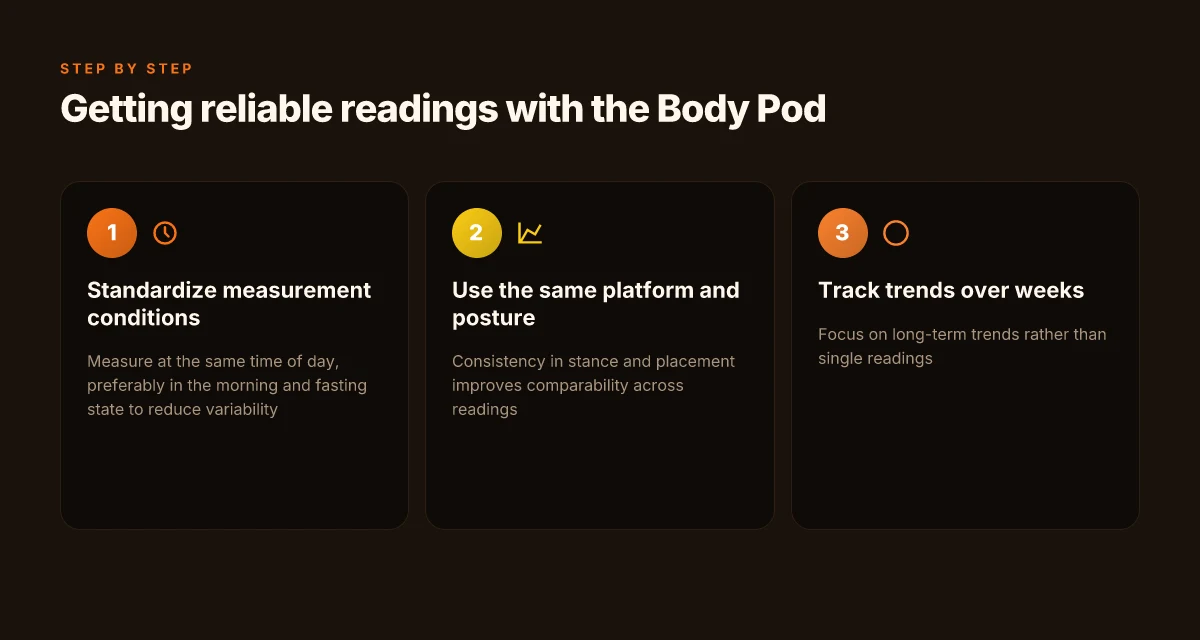
Start measurements in the same window each day, ideally in the morning after waking. A fasting state helps reduce variability from recent meals or hydration. If you occasionally deviate, note the exception and compare only within your normal routine. Over weeks, the small differences fade and the trend line becomes clearer. Make a habit of measuring on days when you’re well rested and your routine is steady. This consistency is what makes the readings meaningful.
Use the same platform and posture for each reading
Place the Hume Health Pod on the same level surface and stand with the same posture each time. Subtle shifts in stance or foot placement can skew readings enough to obscure real fat loss or muscle gain. If you use a fresh pair of socks or switch footwear, you may see a small drift in results. Keep apparel and stance constant, and you’ll improve reliability. A little routine goes a long way in home tracking.
Track trends over weeks rather than chasing single readings
Treat each reading as a data point in a longer story. Short-term changes are often noise from hydration, meals, or sleep quality. Look at a multi-week window to identify whether you’re gaining muscle, losing fat, or maintaining. The value of the Hume Health approach comes from seeing how metrics move together over time, not from any single day’s snapshot. Consider pairing your scale readings with a simple weekly note on workouts and meals to contextualize the trend. What is LivFresh's regulatory status in 2026 and why it matters for buyers
The practical payoff is a smoother trend line when you measure the same way every time. Consistency beats intensity in home tracking. Standards you set today shape what your data says next month.
From a reliability perspective, sticking to a routine reduces the confounding effects that some users report in casual use. If you notice drift after a rare deviation, reset the next reading to your established baseline conditions and continue. This approach helps you separate real changes from measurement noise.
I cross-referenced discussions about the Hume Pod and found that many users appreciate the idea of weekly checks rather than daily swings. When you maintain a steady protocol, the platform’s multi-metric readouts become a more trustworthy reflection of body composition changes. This is how you translate numbers into meaningful progress. For those weighing the decision, note that rivals like DEXA scans offer gold-standard validation, but at-home tracking with Hume Health provides frequent, comfortable updates you can fit into a daily routine.
Consistency is the core habit that unlocks useful insights. Track trends over weeks to see real fat loss and muscle gain. Use the same posture and timing to minimize drift.
Where this is going next for your home body tracking
The Hume Health Body Pod scale stakes a claim by aligning precision with daily life. I’ve looked at how it blends bioimpedance data with user-friendly dashboards, and the takeaway is clarity over clutter. The Body Pod translates complex metrics into a routine you can actually keep, which matters when you’re building long-term habits. You’ll notice the emphasis on consistent measurements rather than peak accuracy alone, making it easier to spot trends without chasing perfect data. What livfresh reviews reveal about the brand, the products, and real user outcomes
That balance matters because rivals like Withings, Omron, and Fitbit often push more features than practice, yet you still want something that fits your morning routine. Hume Health keeps the focus on what you’ll actually use, reducing friction by auto-syncing with popular health apps and offering a clean, inviting interface. If you’re comparing options, expect a calmer, more homelike experience rather than a data fortress.
If you’re ready to act, set a weekly check-in with the Body Pod and track a single habit change, hydration, sleep, or protein intake, and watch for gradual shifts in body composition. What one change will you test first this month? Try hydration consistency for 7 days and review the trend.